Disclosure: This post may contain affiliate links. If you purchase through one of our links, we may earn a commission at no additional cost to you.
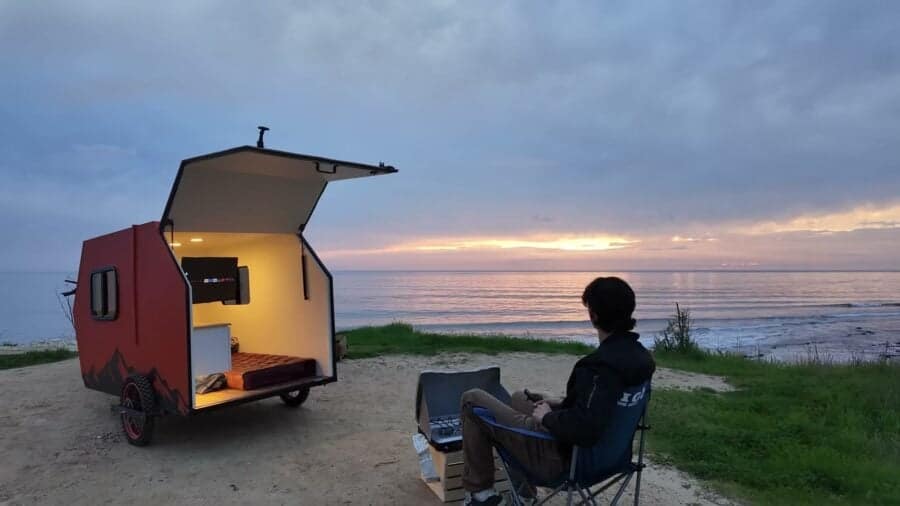
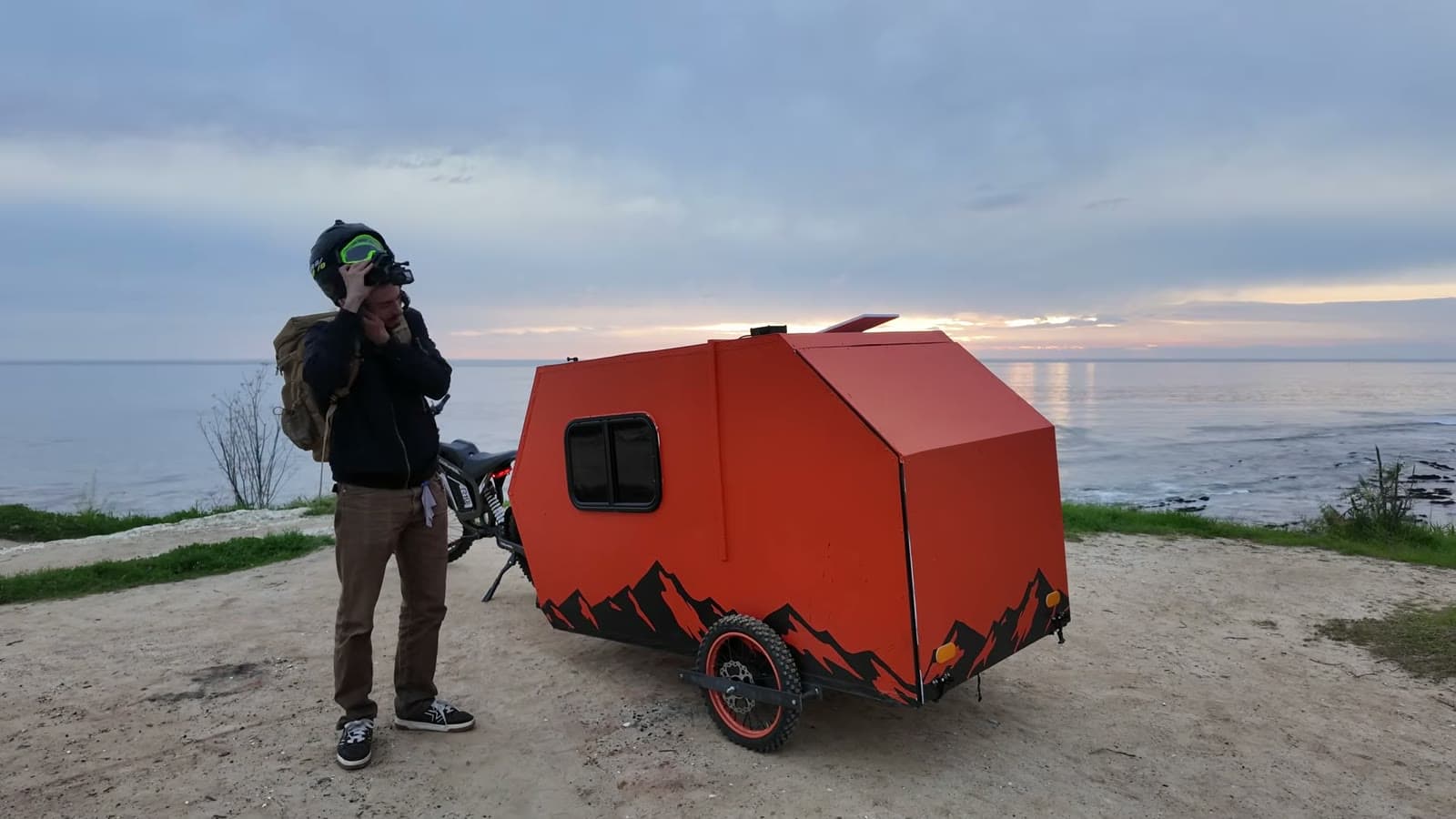
A 19-year-old YouTuber who goes by ENDOPRYSM set out to build what they call the ultimate e-bike camper: a tiny hard-sided trailer light enough to pull behind an electric dirt bike, but kitted out with a real bed, a floating cabinet, a swiveling TV, LED lighting, a portable power station, a 160-watt solar panel, and Starlink internet. They built it over a few weeks with a brother and a welder friend named Sheldon, then towed it out to a coastal bluff to spend a cold night watching the sunset.
It’s a fun, scrappy build, and that’s exactly why it’s worth a closer look. Plenty went wrong along the way, from an overweight door to a wheel that started bowing on its first real ride, and every fix along the way teaches something useful to anyone dreaming of a micro camper of their own.
A Steel Frame Sized for One (or Two) Sleepers
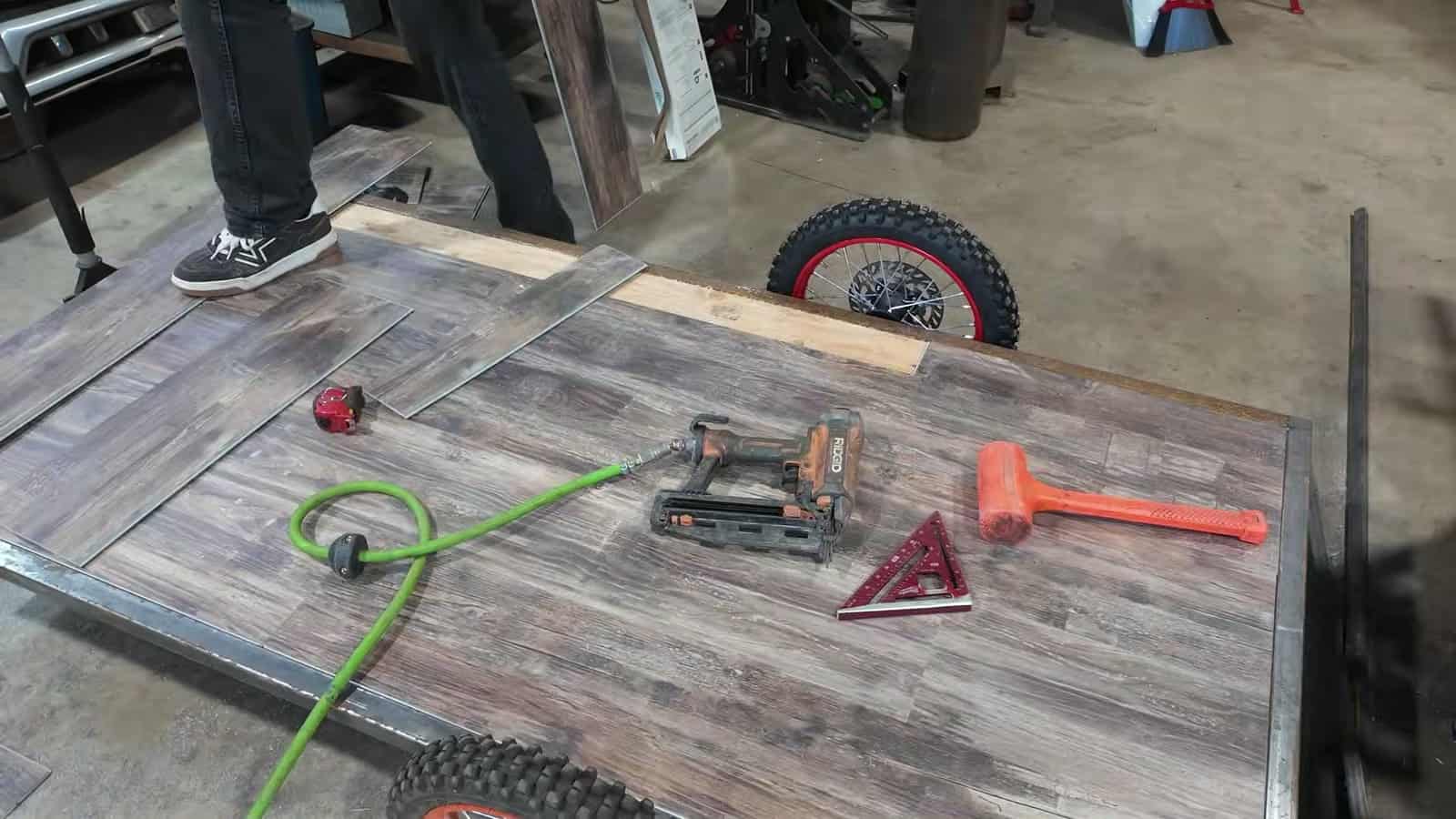
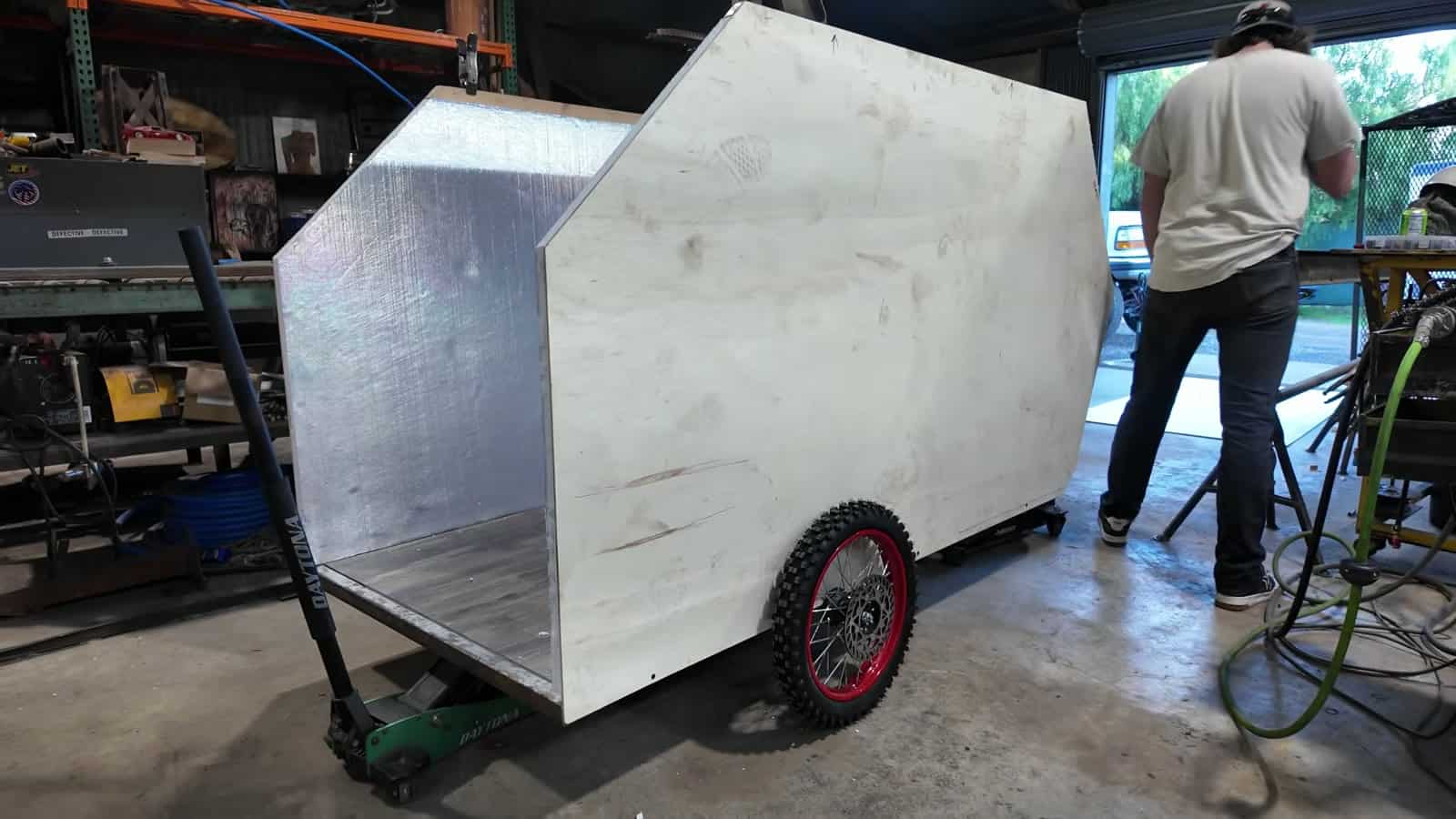
The plan started on a whiteboard: a box roughly 6’5″ long and 3½ feet wide, enough room to stretch out with a partner. The crew welded four lengths of square steel tube into a rectangle, added a simple axle, then welded in crossbeams for lateral support so the frame wouldn’t rack apart on the road. The wheels came off old e-bikes, which keeps the whole rig visually matched to the bike that pulls it.
A plywood deck was screwed straight to the frame with metal screws. Then, on a whim, they added real plank flooring laid with a natural stagger, the way you would in a house. It’s a small touch, but it makes the inside feel like a room instead of a cargo box.
Foam-and-Wood Walls Keep the Weight Down
Weight is everything when your tow vehicle is a bicycle, so the walls are a sandwich: sheets of wood glued to rigid foam panels with construction adhesive, picked up as 4×8 sheets from Home Depot. The side walls were cut to a simple geometric, hexagon-like profile so the inside stays as roomy as possible, and the second wall was traced from the first so the two matched.
Ribs went in along the roof for support, and foam insulation was cut and glued piece by piece between them. Before the interior was covered, channels were carved into the foam to bury the wiring for one outlet, a light switch placed right above the head of the bed, two recessed can lights, and a spot to plug in a power bank. A set of metal trim pieces was added around the outside like an exoskeleton to stiffen the shell.
A Full-Width Rear Hatch on Gas Struts
Instead of a side door, the whole back of the camper folds up like a giant hatch. Sheldon welded a frame with a second inner frame, hung it from a hinge at the top, and added a gas piston for a slow, smooth open. Once the door was skinned with wood, sealant and another layer of wood, it got too heavy for one strut, so a second piston went on the other side. Two struts held it fine.
The seams got Bondo, the trim got caulk, and the outside got a coat of bed liner as a water barrier. The builder’s honest takeaway: next time they’d skip ordinary caulk on the exterior because paint didn’t like drying over it. The 14 by 20-inch camper windows from Amazon were also designed for thinner walls, so they needed extra trim to look right.
A Mountain Paint Job with a Projector and a Razor Blade
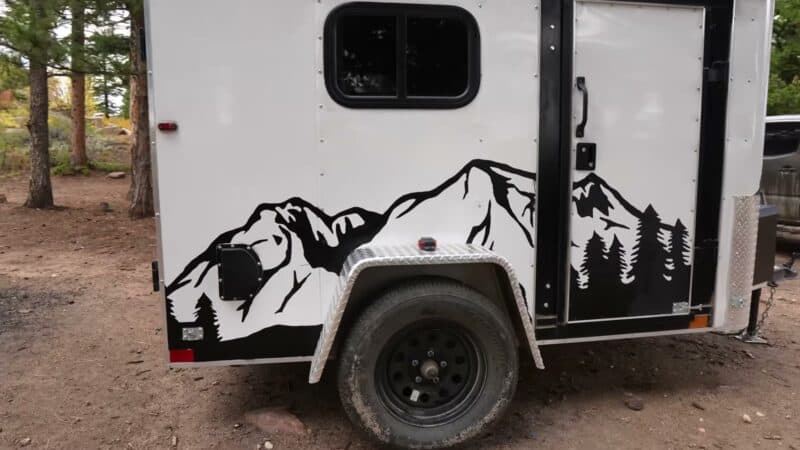
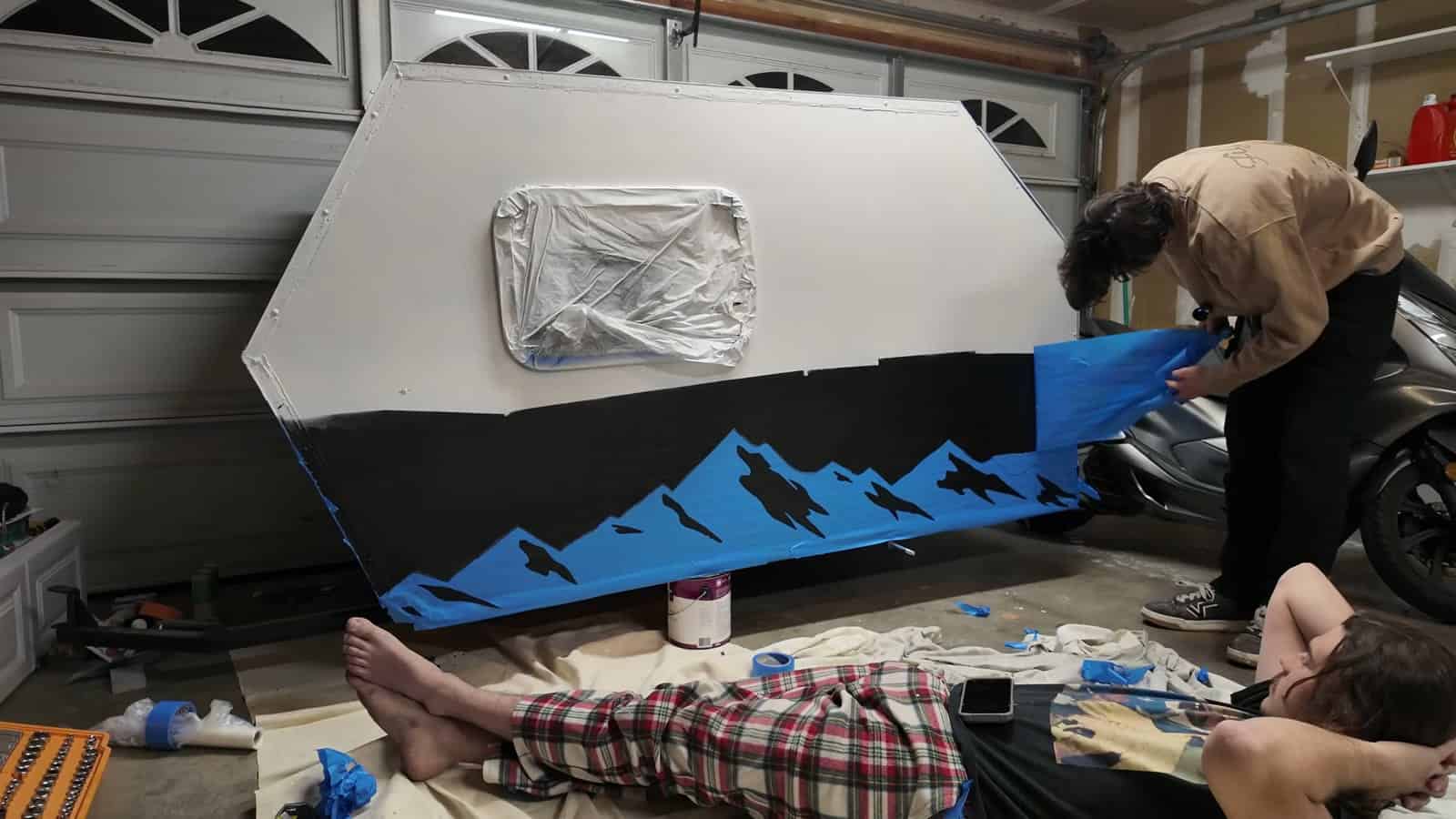
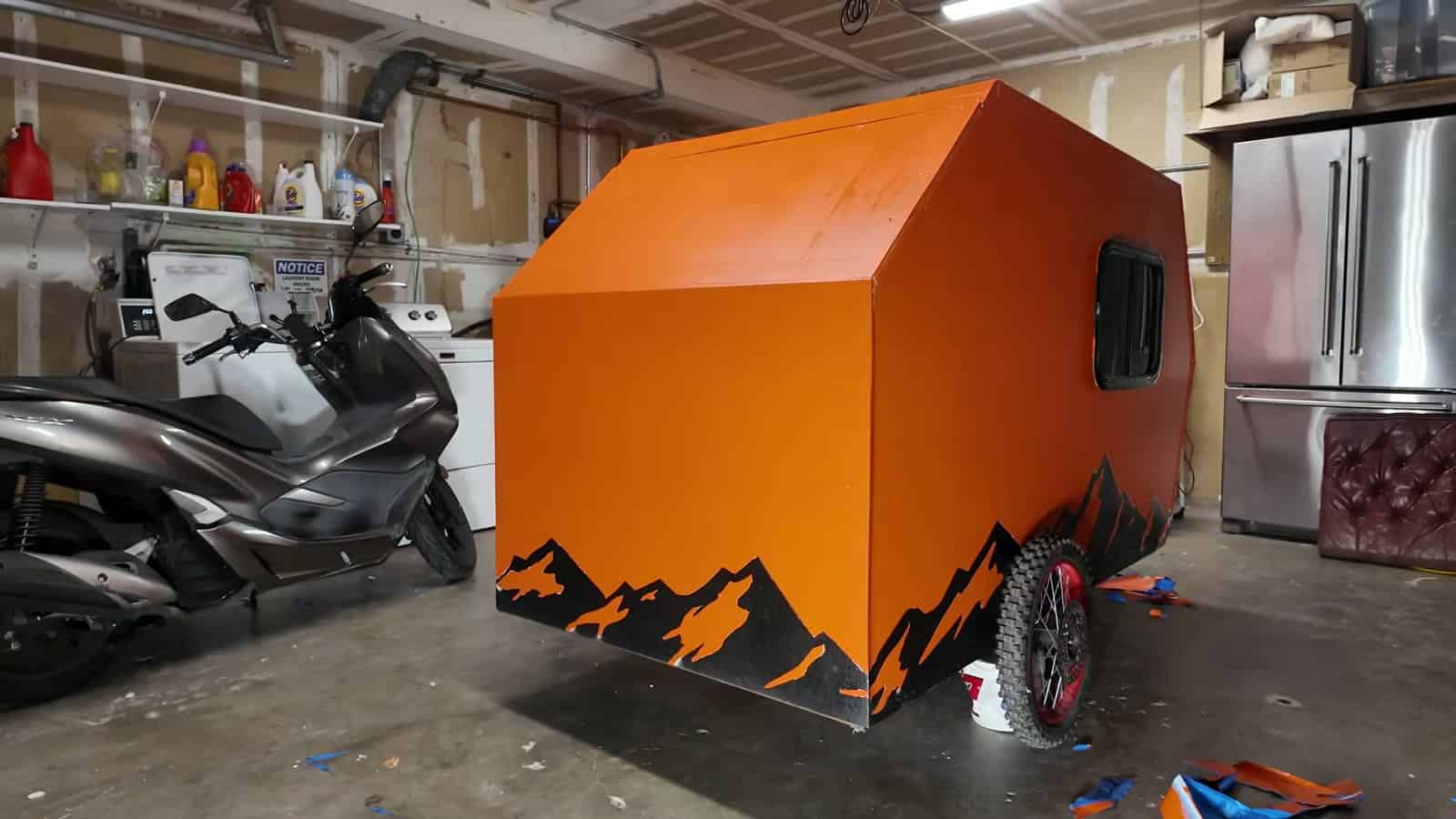
The paint is the part everyone notices. After an interior coat (and a second one after re-sanding), the bottom of the camper was sprayed, then the whole lower half was covered with masking tape. A mountain silhouette was projected onto the tape and cut out with a razor blade, leaving a stencil. White primer went on next so the orange wouldn’t let the dark base bleed through, then the top was rolled bright orange. When the tape came off, the black mountain range was left running around the bottom edge.
A Cozy Interior with a Floating Cabinet and Underglow
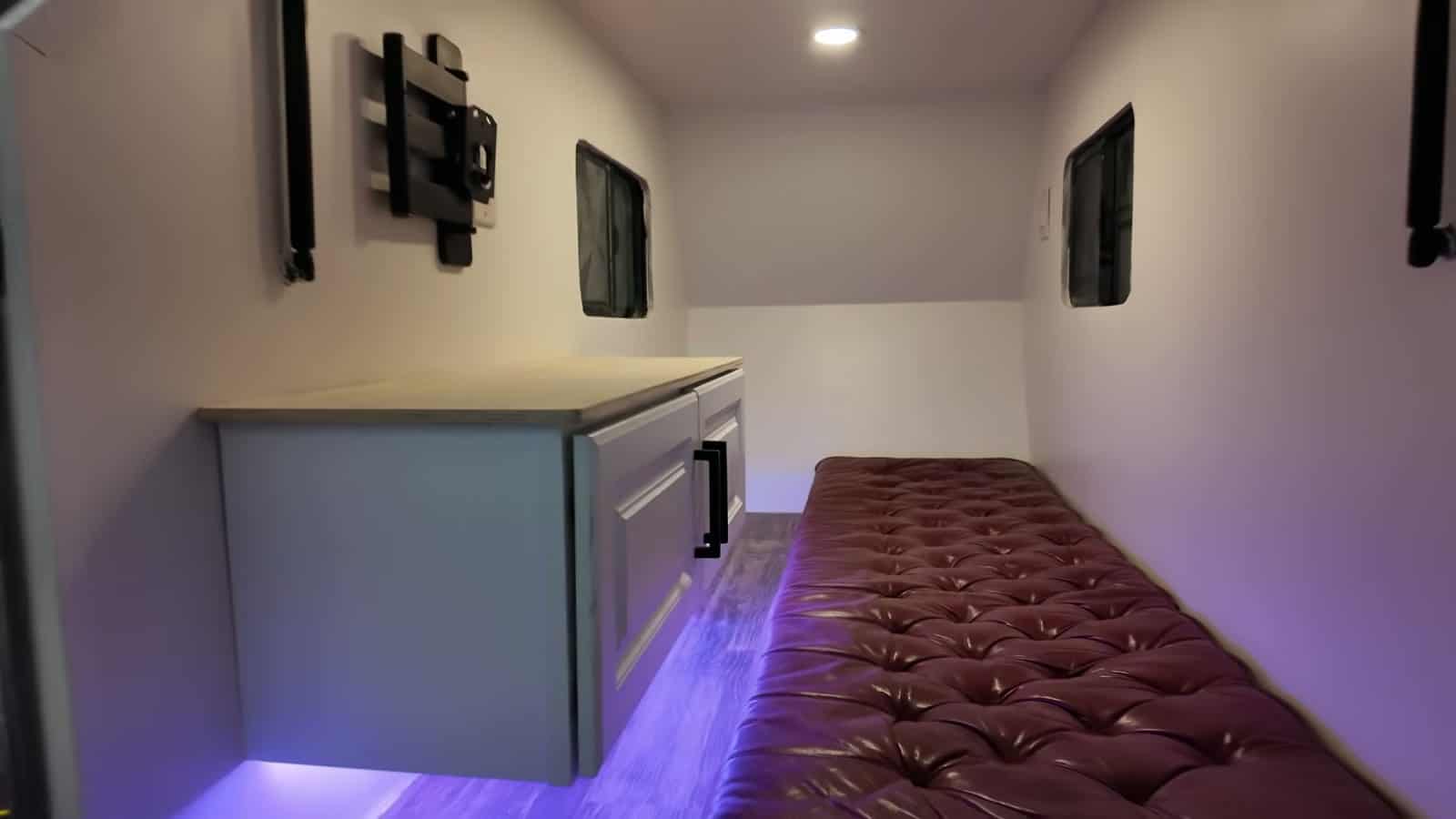
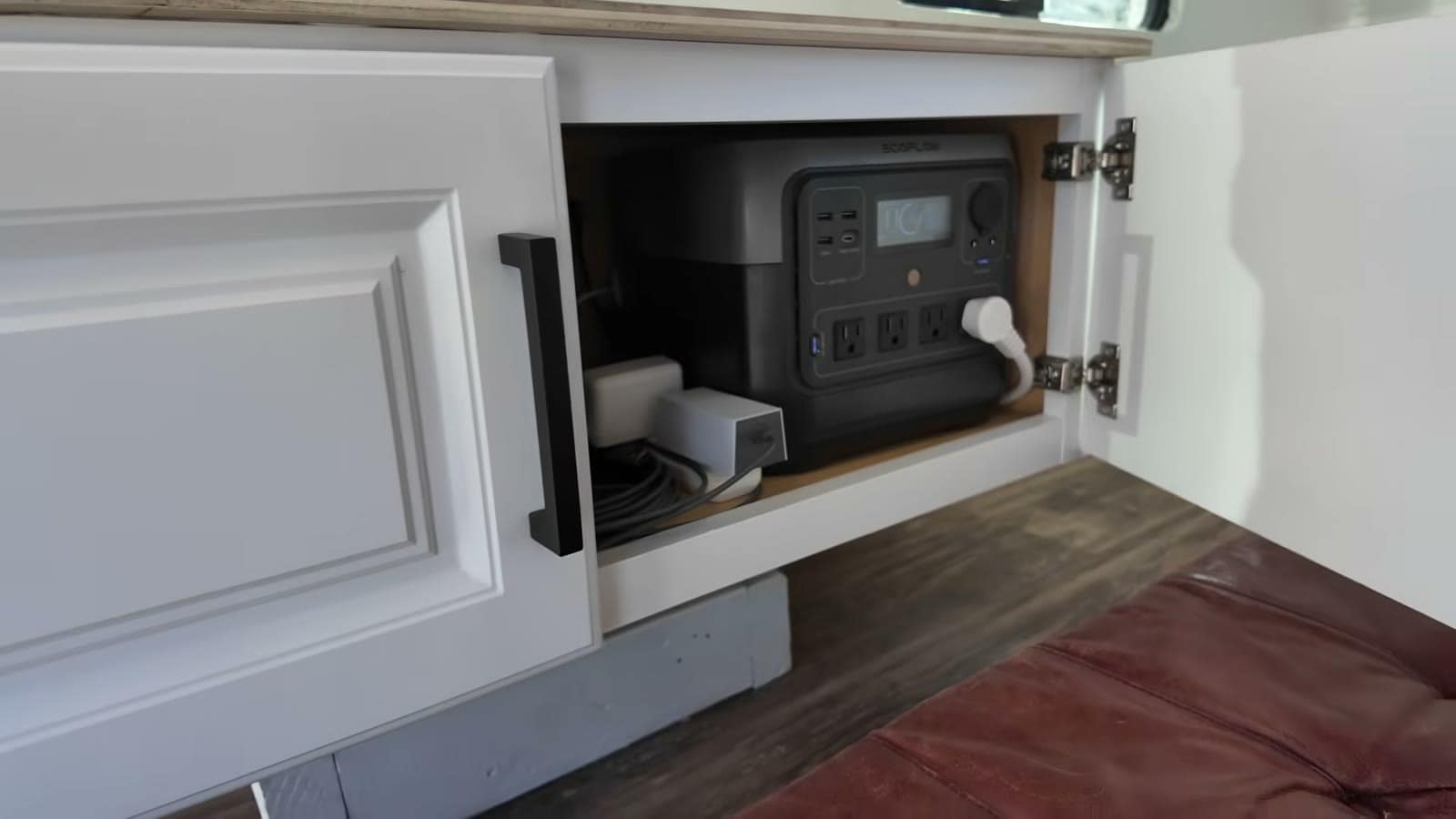
Inside, the walls were lined with wood and painted white, and a swiveling TV mount went on one wall so the screen can be angled toward the bed or the open hatch. A white cabinet from Goodwill was mounted on a frame of white-painted 2x4s so it looks like it’s floating above the floor, then topped with a wood countertop. A tufted burgundy cushion fills the rest of the floor as the bed, held in place with Velcro so it doesn’t slide on the road.
For about $30 they added LED underglow beneath the cabinet, and the ceiling lights can be controlled from a phone. The TV was a roughly $40 bargain from Big 5. It’s not fancy, but with the lights on, it does feel like a tiny hotel room.
Power Station, Solar Panel and Starlink
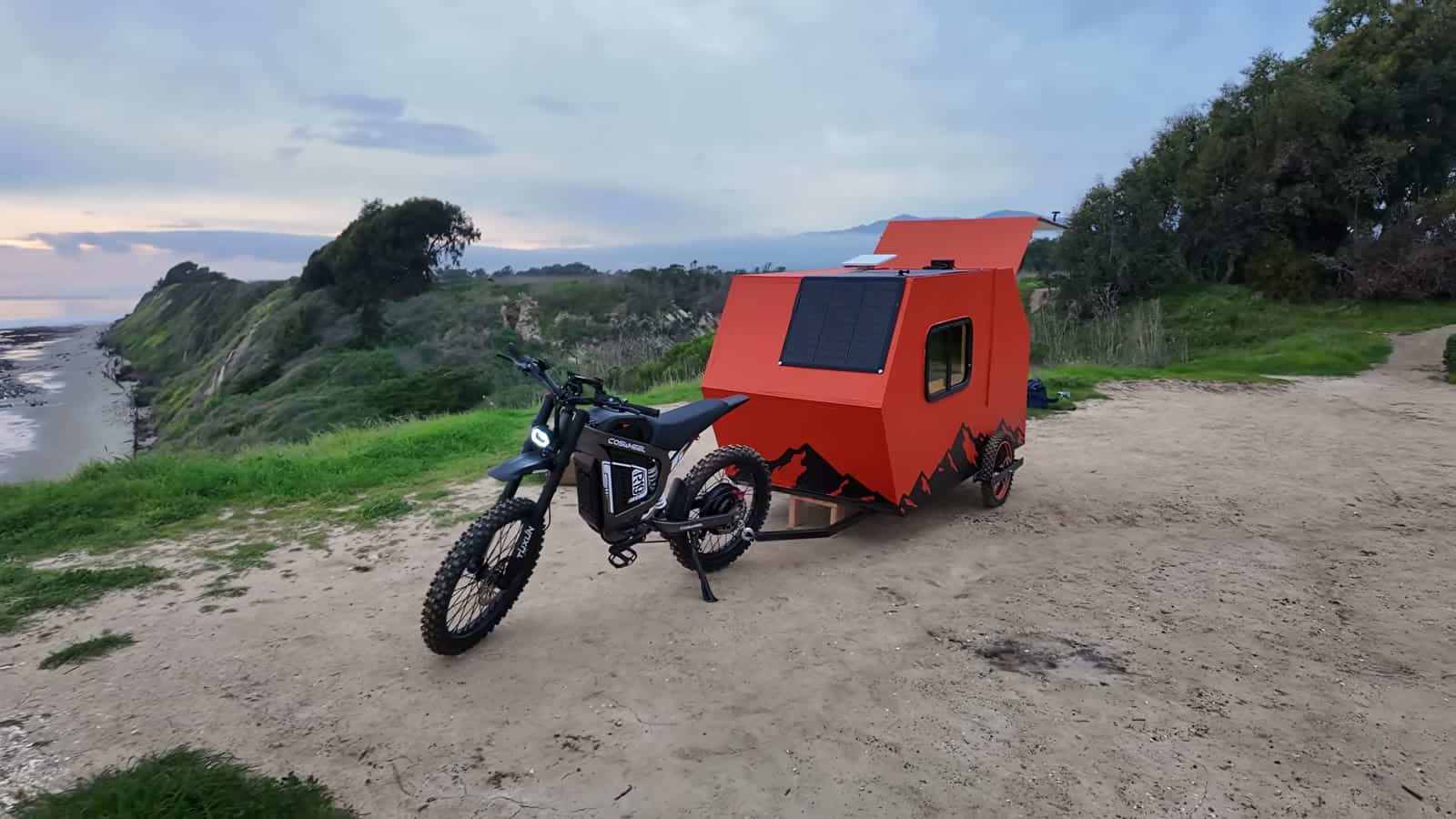
Everything runs off an EcoFlow portable power station that slides into the cabinet. A 160-watt solar panel was mounted to the roof, and a compact Starlink unit rides up top too, so there’s internet anywhere with a view of the sky. The wires come in through a junction box and a set of couplings painted orange to blend into the body.
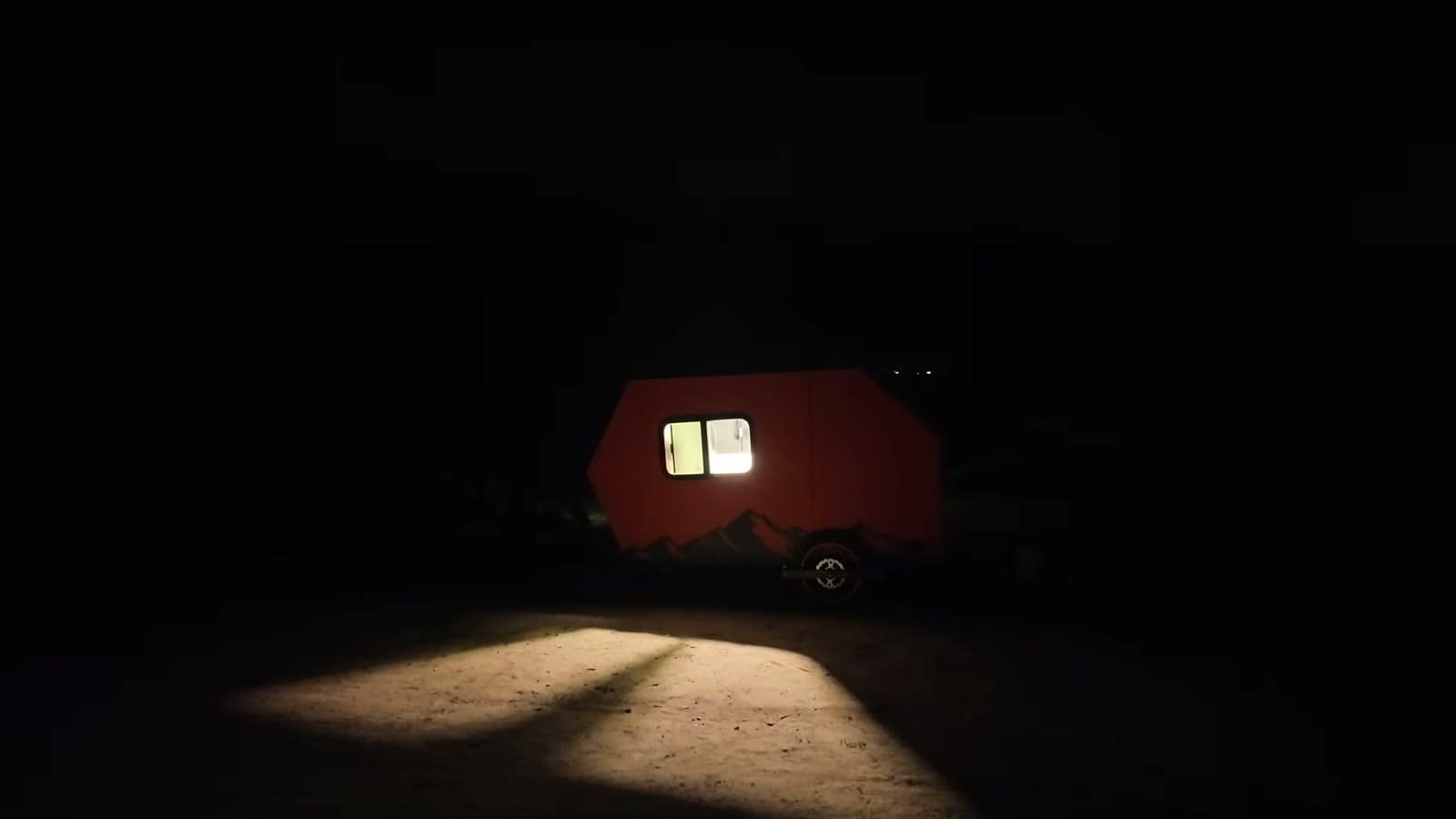
Real-world numbers are always more useful than spec sheets. In their first sun test the panel was putting out around 64 watts, well short of its 160-watt rating, which is typical when a flat panel isn’t angled toward the sun. On the overnight trip, after about five hours of running the TV, lights and accessories, the power station still showed roughly 60% charge.
Towing It with a Coswheel R19 E-Bike
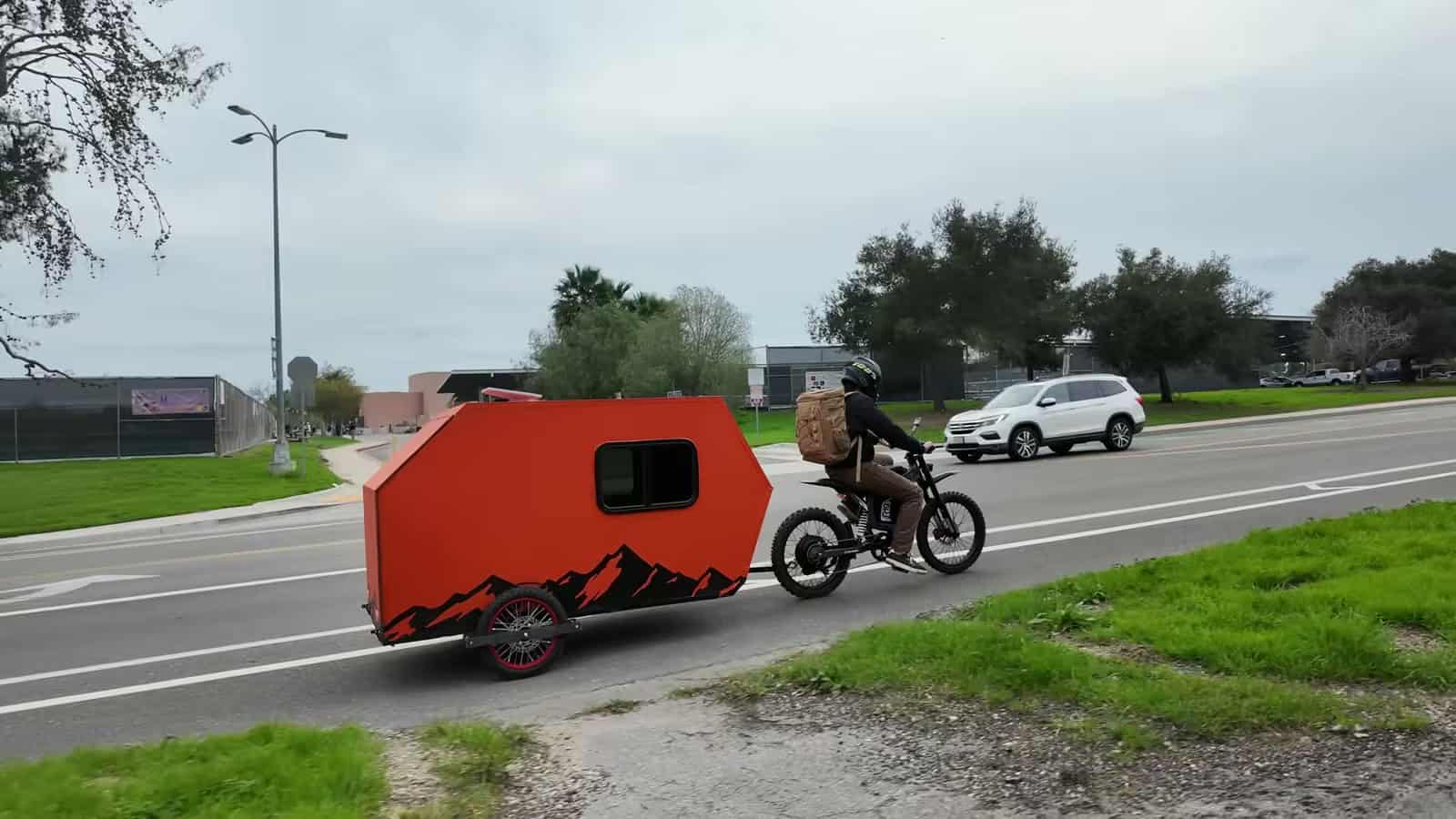
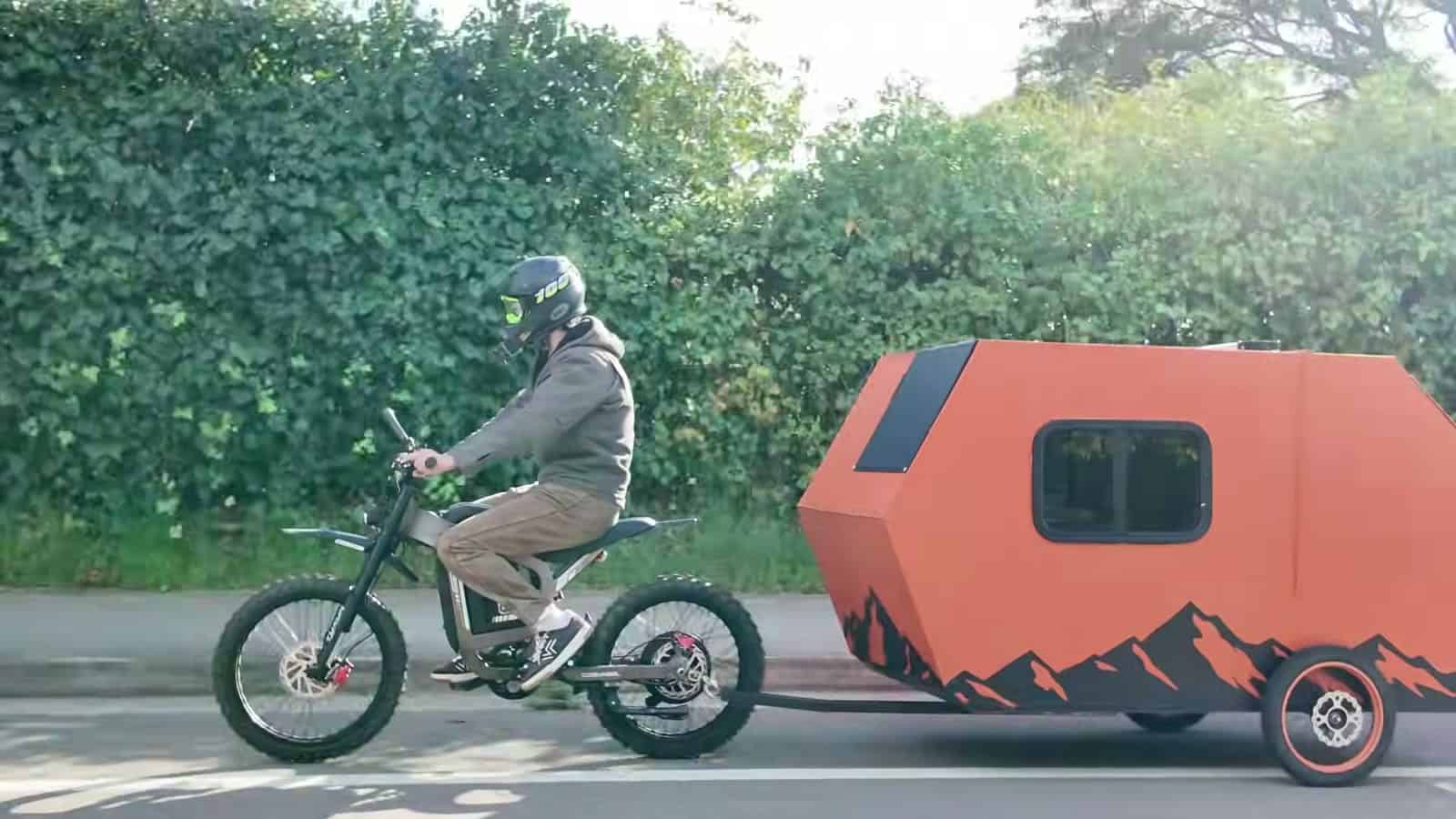
The tow vehicle is a Coswheel R19 electric dirt bike. The first hitch was a simple bolt coupling, and the builder worried it would fight the bike’s lean because it only pivots side to side. It turned out to be manageable after a few laps, and the camper followed smoothly through a parking lot. One unplanned test: a fast food drive-thru turned them away because it was a bike pulling a trailer.
The Wheel That Bowed, and the Axle That Fixed It
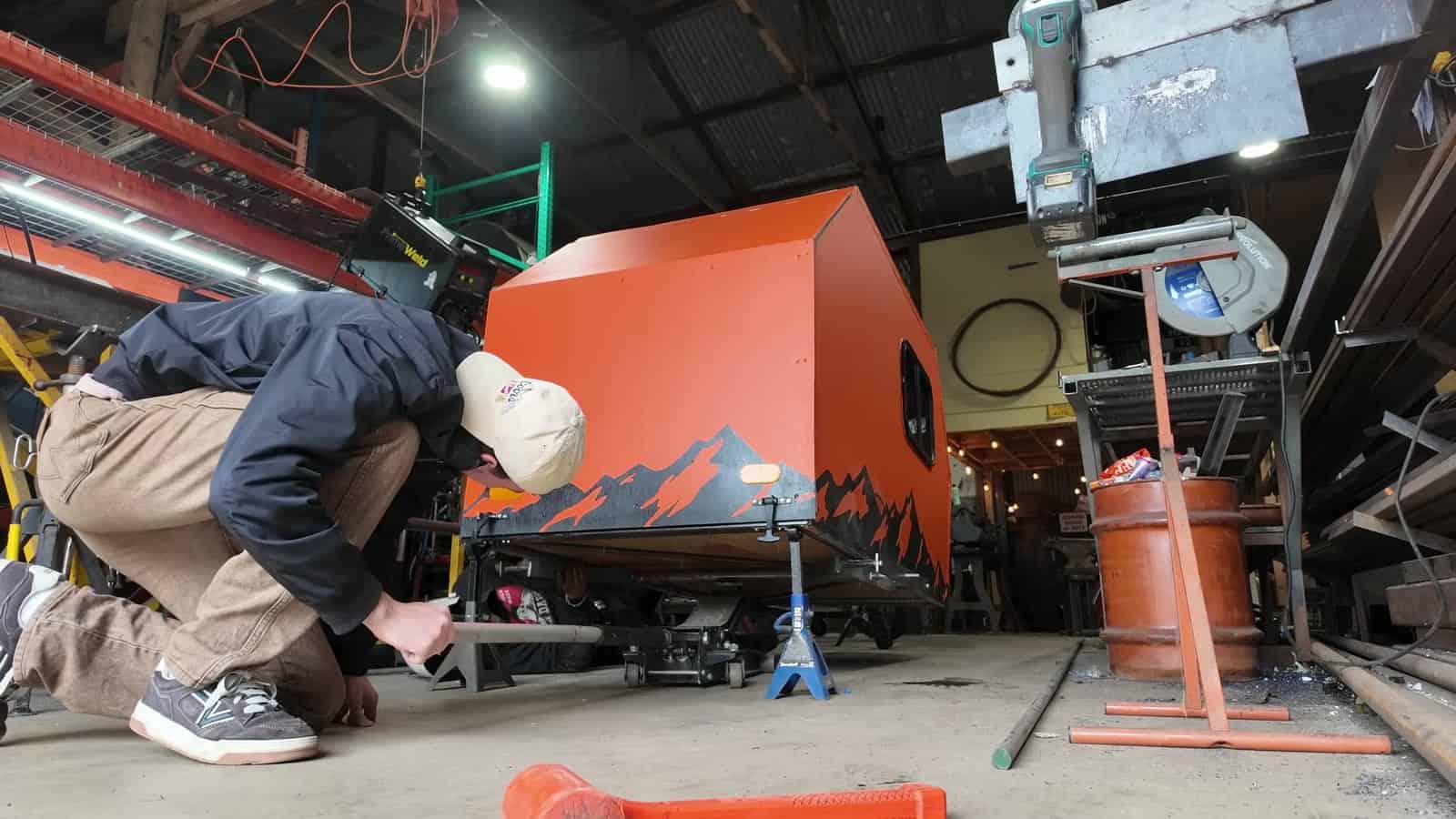
On the first real ride, one rear wheel began bowing inward and rubbing the body. Back at the shop, Sheldon built wheel wells that support each wheel on both sides and welded in a much heavier axle. On the second trip the camper felt solid even through a few deliberate swerves. Lesson learned: a quick test spin around a parking lot isn’t the same as miles of loaded towing, and the axle is the place not to cut corners. The trailer also turned out to be too wide for a park footbridge, so width is worth checking against the paths you plan to ride.
A Night on the Bluff
With the new axle in, they rode out to a coastal bluff just before sunset with the bike battery around half charged. The hatch swings up to frame the ocean, there’s room to sit cross-legged inside, and the camp stove refused to light (so dinner came from a brother delivering McDonald’s). After a few minutes of the TV, the builder admits it felt silly to watch a screen in front of that sunset, which is maybe the most honest review a camper can get.
Design Details
- Builder: ENDOPRYSM (YouTube), with help from a brother and welder Sheldon
- Interior footprint: about 6’5″ long by 3½ feet wide
- Frame: welded square steel tube with crossbeams; rebuilt heavy-duty axle and wheel wells
- Wheels: recycled e-bike wheels
- Walls: wood laminated to rigid foam, interior lined with wood and painted white
- Door: full-width rear hatch on two gas struts with a latch for riding
- Windows: 14 x 20-inch camper windows
- Weatherproofing: Bondo on door seams, caulk, bed liner, paint
- Interior: Goodwill cabinet on a floating 2×4 mount, wood countertop, cushion bed, swivel TV mount
- Electrical: EcoFlow power station, one outlet, two can lights, LED underglow
- Solar: 160-watt rooftop panel (about 64 watts measured in testing)
- Internet: Starlink
- Tow vehicle: Coswheel R19 electric dirt bike
What Makes This Build Special
- Foam-core walls are the key to bike towing. Laminating thin wood to rigid foam gives a stiff, insulated wall at a fraction of the weight of framed plywood.
- A full rear hatch turns a tiny box into a room with a view. Opening the whole back makes a 3½-foot-wide cabin feel connected to the outdoors.
- Plan for door weight early. Every layer you add to a hatch adds load on the struts; size them for the finished door, not the bare frame.
- Don’t skimp on the axle. A light axle that survives a test spin may not survive a loaded ride. Supporting wheels on both sides solved the bowing.
- Expect solar to underperform its rating. A flat roof panel delivered roughly 40% of its rated output here, so size your battery with some cushion.
- Thrift and bargain parts add up to a finished look. A Goodwill cabinet, a budget TV and $30 of LED strip lighting make it feel far more expensive than it is.
Video Tour
Watch the whole build, including the axle failure and the night on the bluff, below.
Learn More
- Video: I Built a Secret Luxury Camper
- Channel: ENDOPRYSM on YouTube
Highlights
- Tiny hard-sided camper built to be towed by an electric dirt bike
- About 6’5″ x 3½’ inside with a cushion bed
- Lightweight wood-and-foam walls on a welded steel frame
- Full-width rear hatch on twin gas struts
- Floating thrifted cabinet, swivel TV and LED underglow
- EcoFlow power station, 160W solar panel and Starlink
- Hand-stenciled black mountains on a bright orange body
Explore More
- Man Builds $400 Camper Bike in Beijing
- Urbanoid Booba: A 530-lb Micro Camper That Expands Into a Two-Person Bedroom
- Happier Camper HC1: A Retro Fiberglass Trailer Light Enough for Most Cars
- High Camp Teardrop: A Portland-Built Aluminum Camper with a Slide-Out Kitchen
- Teardrop Trailers
Would you spend a night in a camper you towed with an e-bike? Would you keep the TV, or just watch the sunset?
If you enjoyed this you’ll LOVE our Free Daily Tiny House Newsletter with even more!
You can also join our Small House Newsletter!
Also, try our Tiny Houses For Sale Newsletter! Thank you!
More Like This: teardrop trailers | Travel Trailers | DIY | Tours & Features
Disclosure: This post may contain affiliate links. If you purchase through one of our links, we may earn a commission at no additional cost to you.


Alex
Latest posts by Alex (see all)
- This DIY E-Bike Camper Has Solar, Starlink and a TV - October 17, 2026
- The Rock ‘n’ Roll House at Tiny Digs: A 1950s Tiny House with a Record Player - October 17, 2026
- 2025 Villa Max: A Move-In-Ready 10-Ft-Wide Farmhouse Park Model by Tru Form Tiny - October 17, 2026