
Disclosure: This post may contain affiliate links. If you purchase through one of our links, we may earn a commission at no additional cost to you.
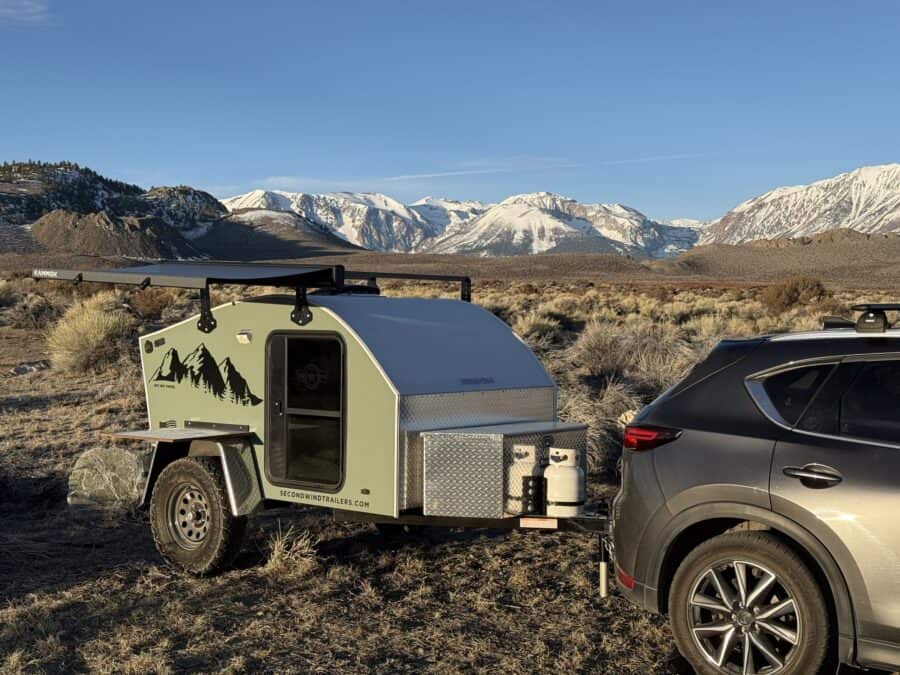
Nearly every off-road teardrop follows the same script: rounded shell, big hinged hatch at the back, galley kitchen underneath. Second Wind Trailers in Auburn, California leaves the hatch off on purpose — and the reasoning is the most interesting thing about the company.
Nathan Pizzo started the shop in 2014 and now builds alongside his sons James and Matthew. The flagship FREEDOM FLIGHT XL is a 5′ x 7′ off-road teardrop that sleeps two on a queen-size tri-fold mattress, weighs about 1,000 lbs in a typical build, and starts at $10,500 (checked October 24, 2026). Construction generally takes two to three weeks once a build begins, rather than the multi-season waits common in the overland world. We last featured Second Wind in 2021; five years on, the design has been rethought from the frame up.
Images courtesy of Second Wind Trailers
From a Sold Porsche to a Shop in Auburn
The company name is autobiographical, not marketing copy. Nathan started the business after the 2008 crash, looking for “a second wind, a new breath of fresh air, and a Whisper of hope” — and funded it by selling a ground-up 1974 Porsche 911 RS project car. The first trailer, the Whisper, was an egg-shaped mirror-finish homage to an Airstream on a bolt-together frame. He’s candid that it looked fabulous and didn’t work the way he wanted.
A decade of iteration followed: a 3D-modeled Whisper II, a harder-edged FREEDOM around 2016, then a US Coast Guard-themed custom for a Michigan customer that forced several innovations. Four Whisper 2s and five FREEDOMs later, the shop landed on today’s platform. Every generation moved further from bolt-together assembly toward a fully welded steel frame.
The craft is inherited. Nathan credits his father, who taught him woodworking in the mid-1970s between the demands of raising five kids and died at 62 before the business existed. “Every trailer I build is, in some way, a quiet tribute to him,” he writes. It’s now three generations deep.
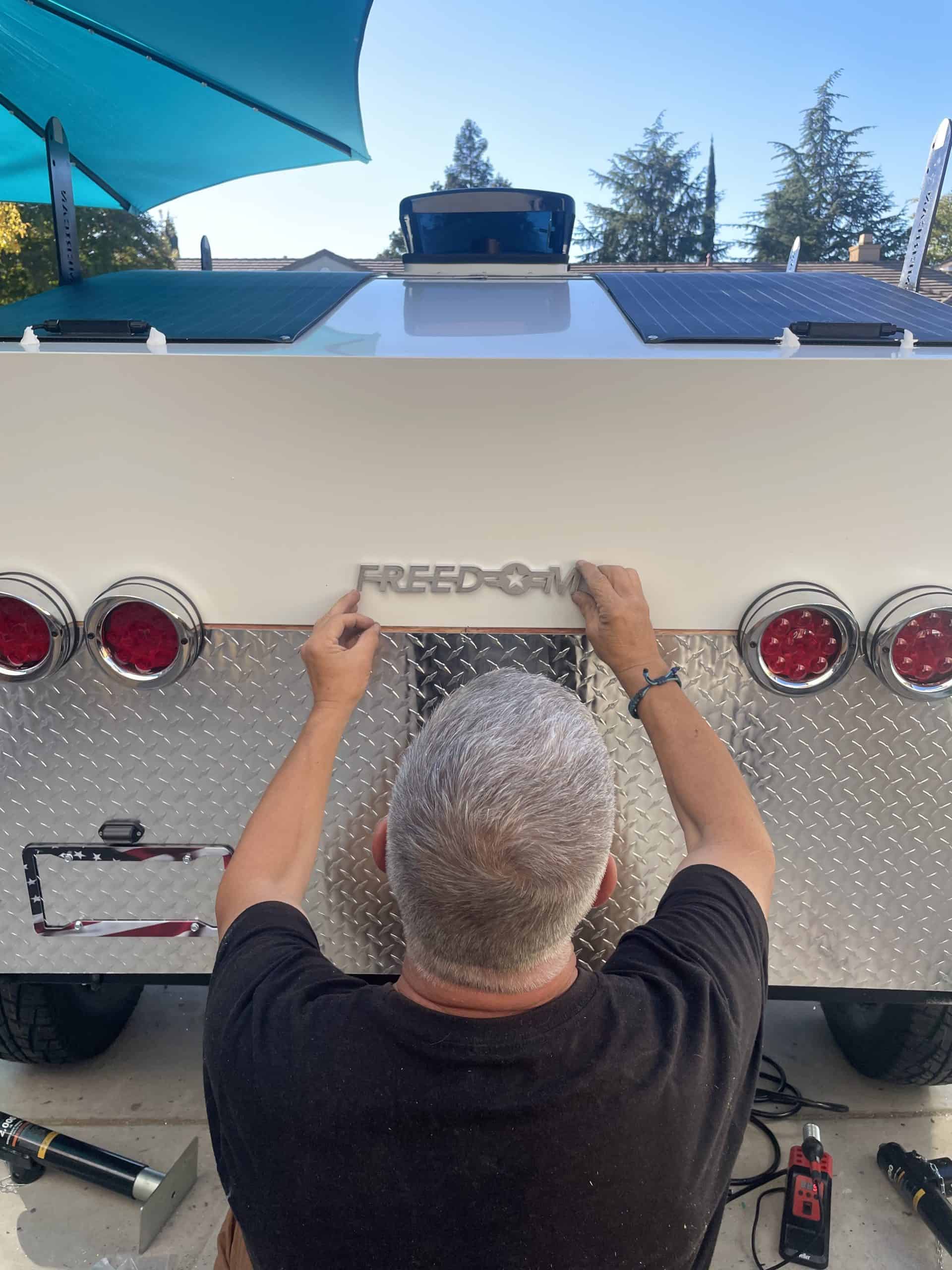
Image courtesy of Second Wind Trailers
The Freedom Flight XL at a Glance
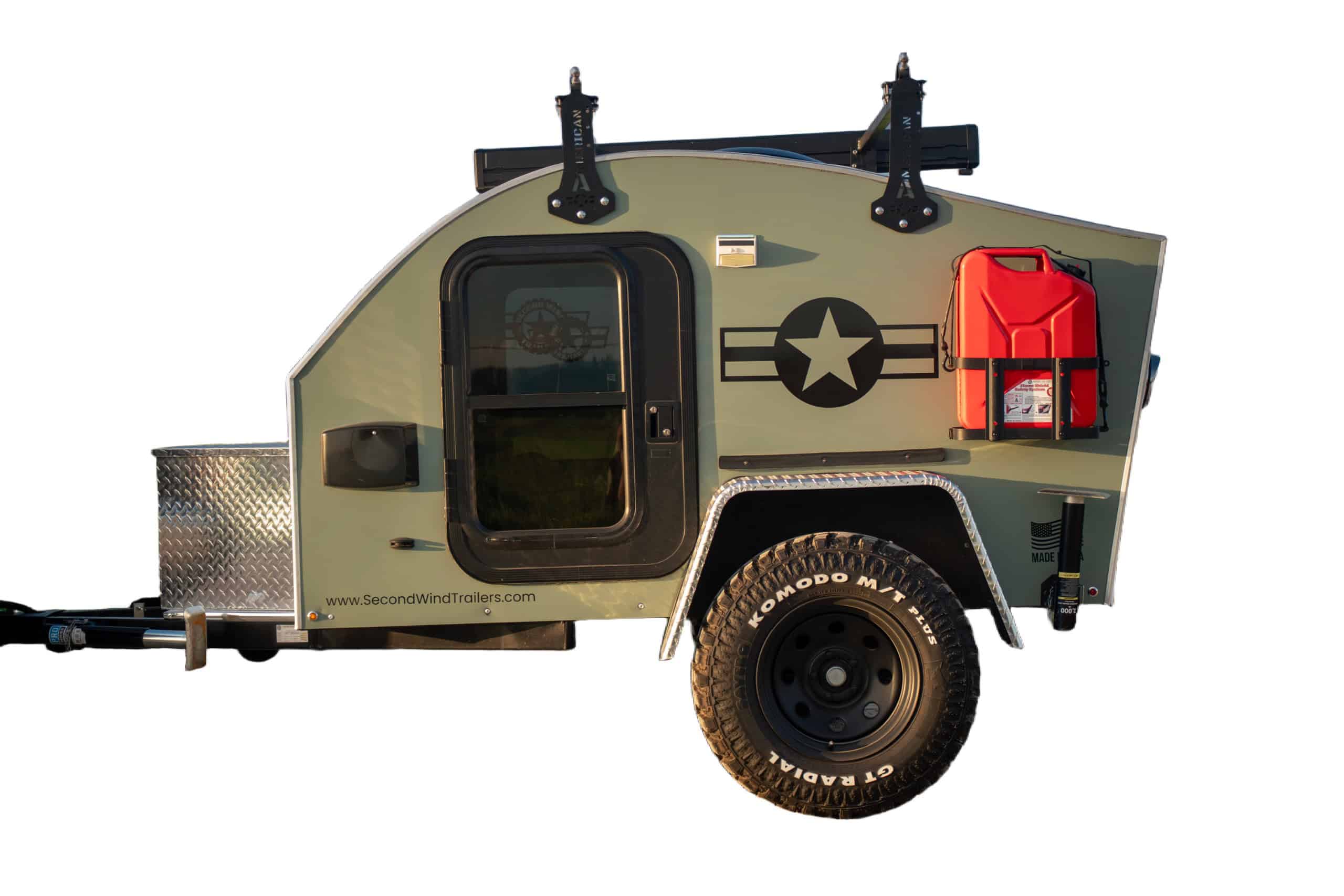
The XL is a 5′ x 7′ cabin on a 10’6″ chassis — small enough for a standard garage, big enough for a folding queen mattress and roughly 13.5 cubic feet of cabinet storage. The signature detail is the roofline: a classic teardrop curve at the nose transitioning into a squared-off, angled rear instead of tapering to a point. That single change buys back the headroom and storage volume a traditional teardrop gives away at the back.
Second Wind’s own diagram lays out the logic better than a spec table can:
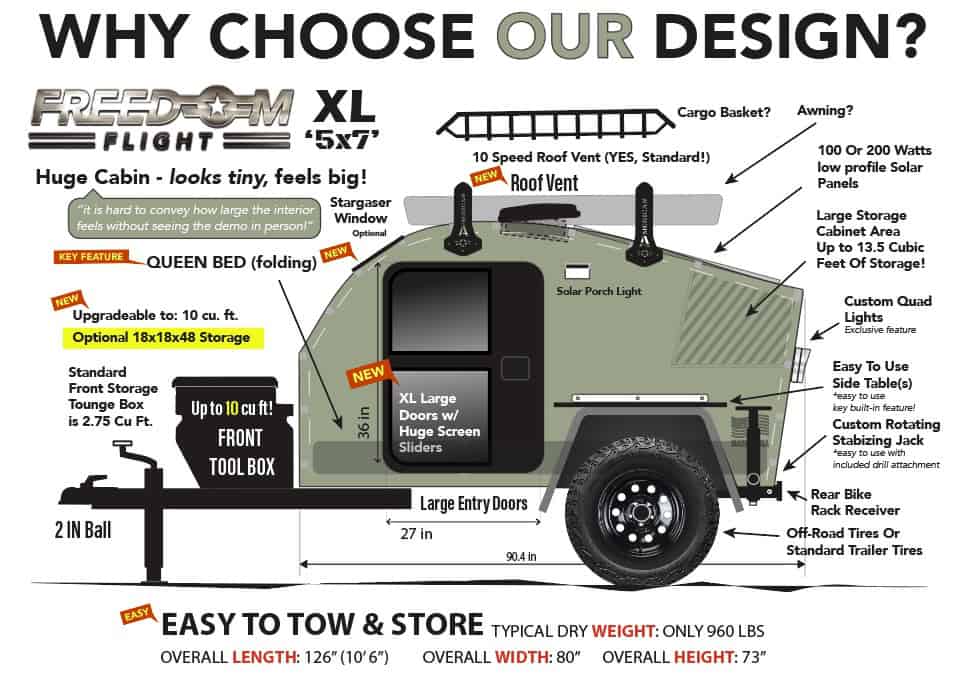
Image courtesy of Second Wind Trailers
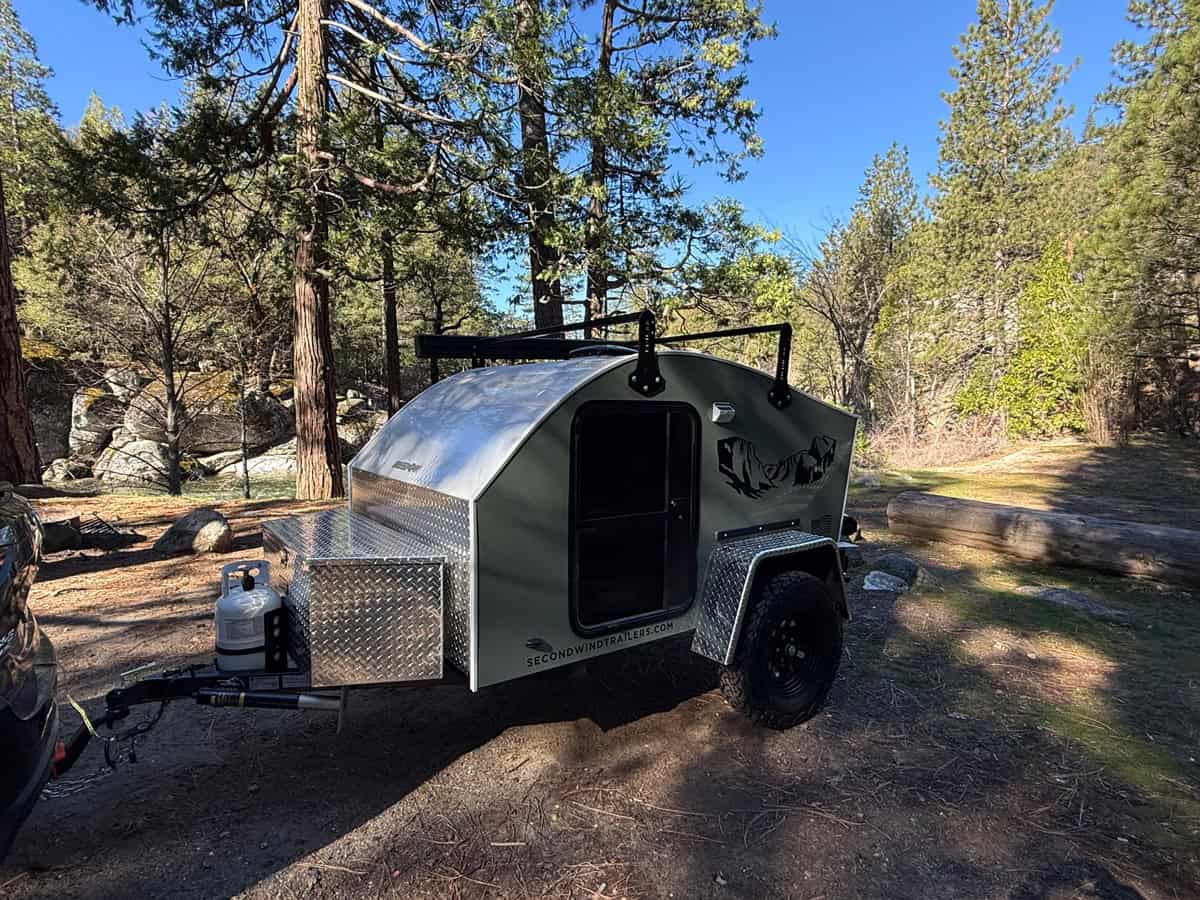
Image courtesy of Second Wind Trailers
Why There’s No Rear Galley Hatch
This is the decision that defines the trailer. A traditional teardrop puts a full-width hinged hatch across the back with a kitchen underneath — the iconic teardrop feature, and by Second Wind’s account the part most likely to cause problems over a trailer’s life.
That hatch creates a long horizontal seam at the highest-stress point of the shell, exposed to rain and UV, sealed by a gasket that degrades and eventually leaks. It requires hinges, gas struts, latches and slides, every one a moving part that can fail. It cuts a large opening in the rear wall, weakening the structure exactly where off-road vibration flexes it hardest. And it adds an estimated 150–300+ lbs hanging behind the axle, where it does the most damage to towing balance.
Delete it and you get a solid rear wall, far fewer seams, no large seal to maintain, better weight distribution, and a shape that sheds water rather than collecting it. The trade-off is real: you give up the fixed outdoor kitchen. Second Wind’s counter-argument is that a modular setup — chuck box, fridge slide, table under an awning — actually cooks better, since you’re no longer required to park level with your back end pointed somewhere pleasant.
If the galley is why you want a teardrop, this isn’t your trailer. If you’ve read enough forum threads about hatch seal replacement to be wary, the logic lands.
Inside the 5′ x 7′ Cabin
The interior is finished rather than raw — upholstered walls and ceiling, cedar accents, birch cabinet faces, and a tri-fold mattress measuring 78″ long by 57.5″ wide by 6″ thick on a cabin floor of 79.5″ by 58.5″. Cabin height is about 44 inches, floor to ceiling, so this is a sit-up space, not a stand-up one.
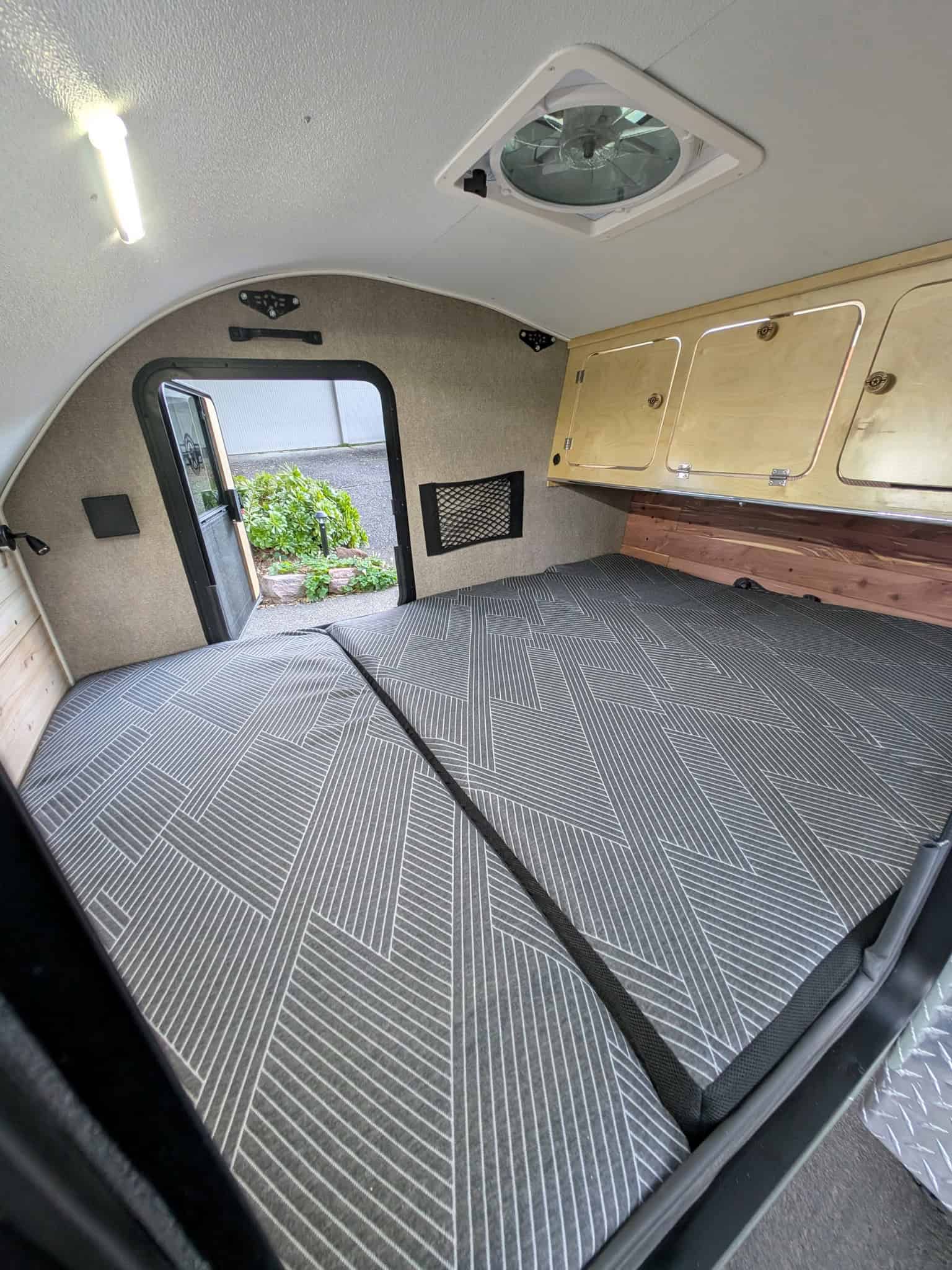
Image courtesy of Second Wind Trailers
Storage is all overhead and along the headboard wall, which is where the squared rear profile pays for itself. A bank of birch-faced cabinets runs the width of the cabin, and one door folds down into a drop table — useful for a laptop or breakfast in bed when the weather isn’t cooperating. Cargo nets on the side walls catch small items that otherwise migrate under the mattress.
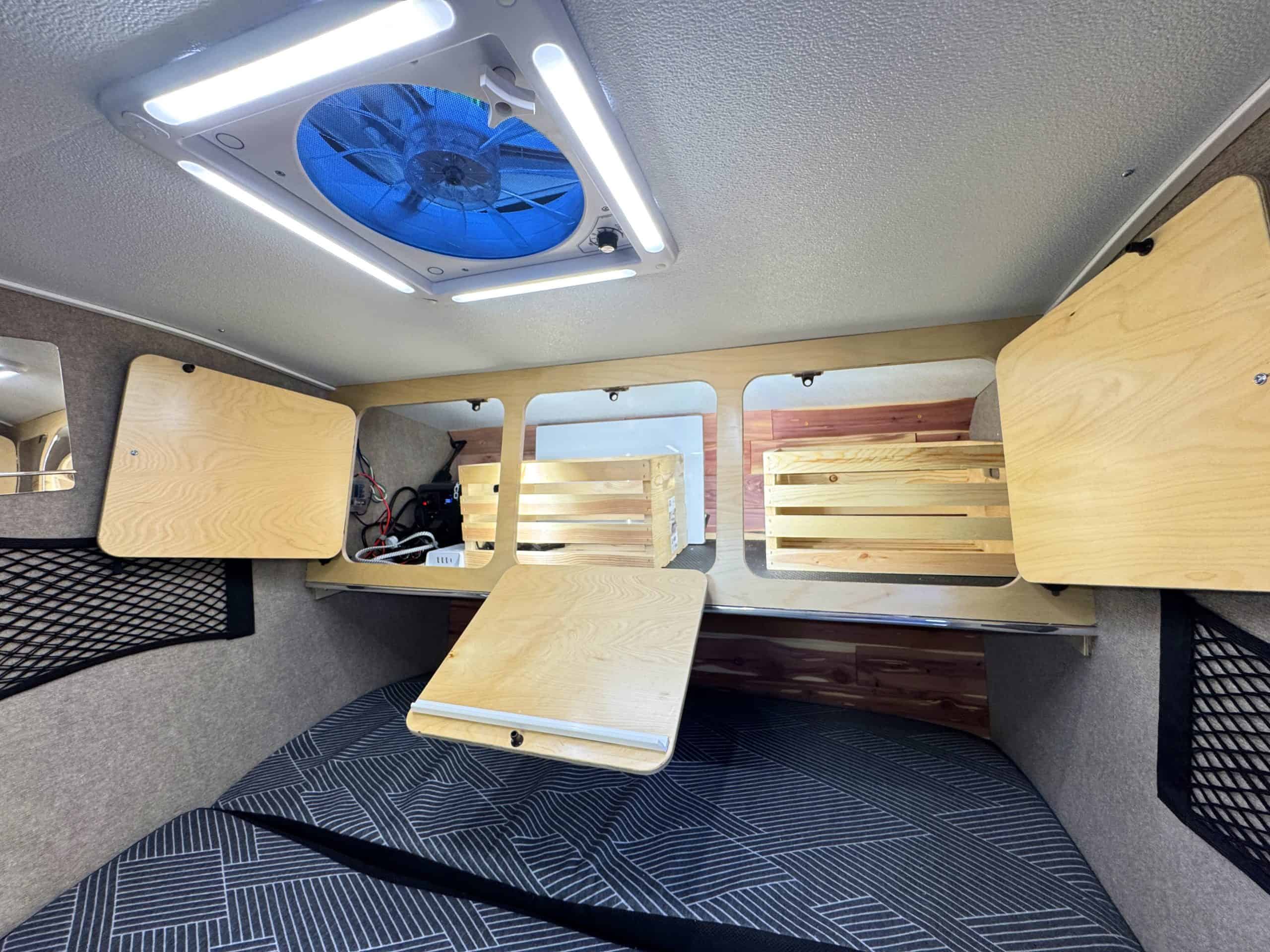
Image courtesy of Second Wind Trailers
Both doors are custom, with built-in screened slider windows — which matters more than it sounds. On Juliet Haas’s cross-country trip (more below), nights through Texas and the Gulf states were too hot to sleep until she ran the roof fan with both screen doors open for cross-draft. With no air conditioning as standard, the screens are the cooling system.
How It’s Built
Second Wind publishes a wall and floor cross-section — unusual, and worth crediting.
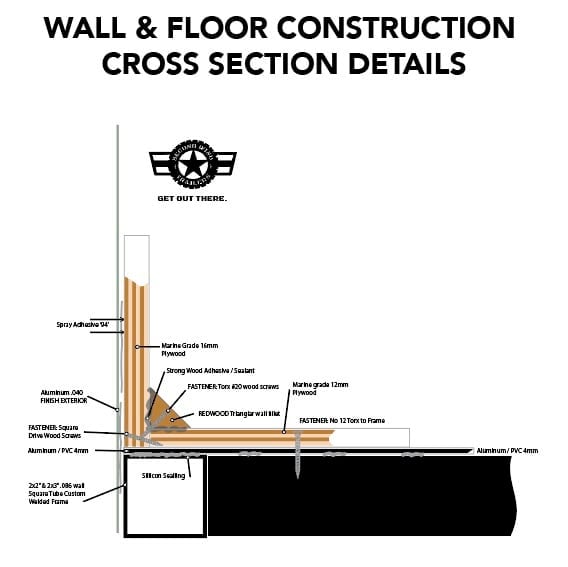
Image courtesy of Second Wind Trailers
From the outside in: a .040 aluminum skin bonded with spray adhesive to 16mm marine-grade plywood walls meeting a 12mm marine-grade plywood floor. The corner joint is reinforced with a redwood triangular fillet, bedded in adhesive and sealant, fastened with Torx #20 screws. The cabin sits on a welded frame of 2″x2″ and 2″x3″ square tube with .086 wall, silicone-sealed at the mating surface, with a 4mm aluminum/PVC layer capping the underside.
The practical translation: a wood-and-aluminum cabin built to marine standards on a welded steel chassis, with plywood edges protected from standing water at every joint. Ceiling plus front and rear walls are insulated, the subfloor is covered and waterproofed, and the trailer rides on a torsion axle with 15″ wheels on 235/75R15 all-terrains.
Power, Light, and Air
The base build is genuinely usable off-grid rather than solar-ready in name only. As of October 24, 2026, standard equipment is two 100-watt solar panels (200 watts total), a BLUETTI Elite 30 V2 portable power station (288Wh, 600W), a shore power plug, two USB charging stations, two flexible reading lights with USB chargers at the headboard, all-LED cabin lighting, two switch-controlled LED solar porch lights, a 10-speed high-flow roof fan with built-in LEDs, and Second Wind’s custom quad tail lights.
The upgrade path is straightforward: a BLUETTI Elite 100 V2 with a 1024Wh pack and four 1800W outlets is +$450, an extra 100Ah battery +$780, and 400 watts of external suitcase solar +$650. Second Wind specifically flags the Elite 100 V2 as the setup that will run a CPAP through the night — a small detail, but a telling one about who’s actually buying these.
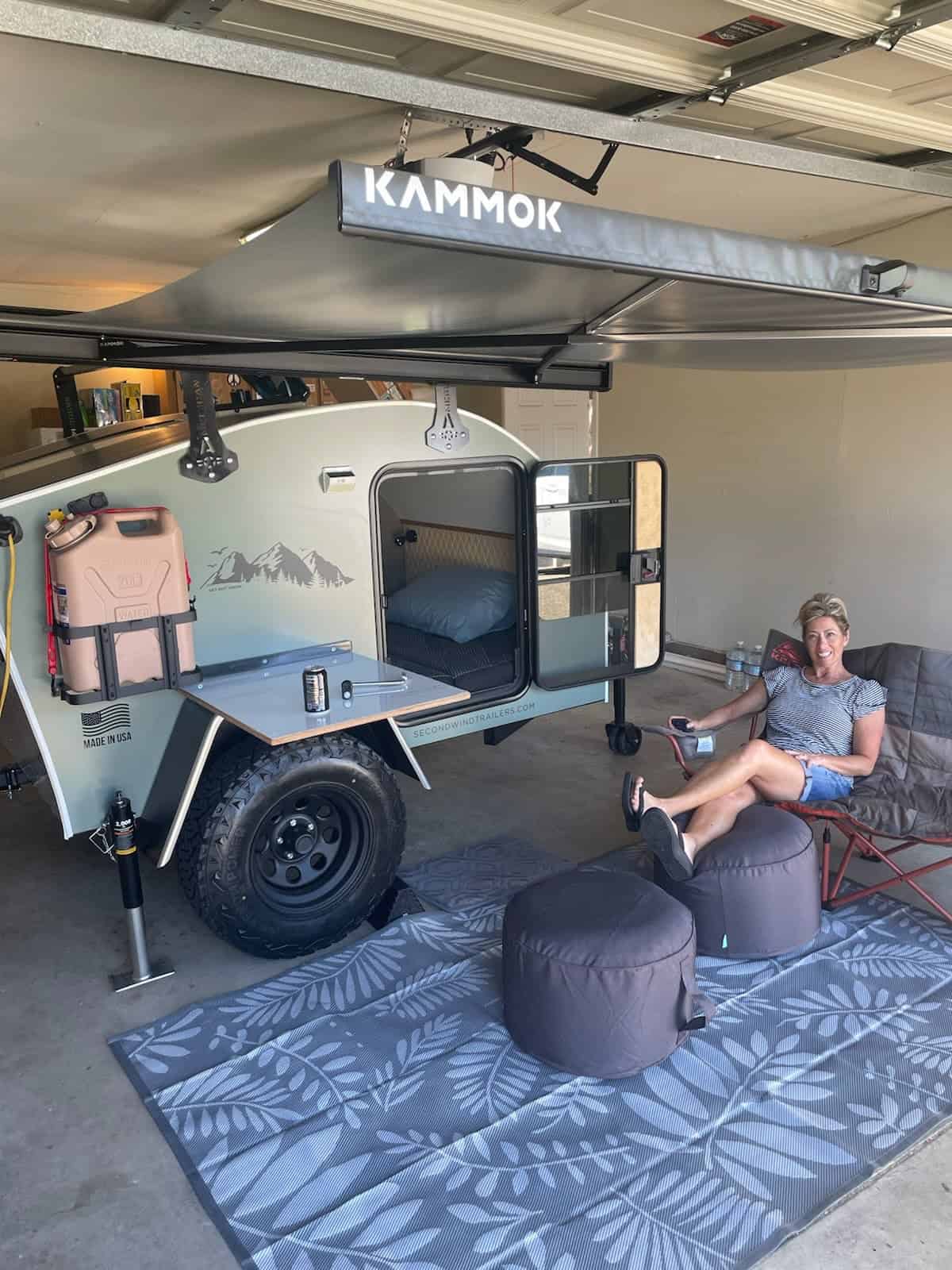
Image courtesy of Second Wind Trailers
The fold-out side tables are the other quiet win. With no galley pinning the kitchen to the back, the tables plus an awning turn the entire long side into an outdoor room — pointed wherever the view is.
The Options List and What It Actually Costs
The Freedom Flight XL starts at $10,500, with a $6,500 deposit holding your build slot (both checked October 24, 2026). Upgrades, taxes, licensing and a documentation fee are extra, and higher-priced builds may have an interim payment. Everything below is priced à la carte, so it’s easy to see where the money goes. Trailer brakes are not standard; a brake-equipped axle is a special-order option.
- American rack with crossbeams — +$480
- 4′ x 6′ awning — +$350
- 6′ x 8′ awning — +$425
- Front storage tongue box upgraded to 10 cu ft — +$750
- Rear welded 2″ receiver — +$250
- 12V fridge upgrade (requires custom tongue box) — +$850
- BLUETTI Elite 100 V2 portable power station, 1024Wh — +$450
- Extra 100Ah LiFePO4 boondocking battery — +$780
- Custom vinyl wrapped sides, single color — +$600
- Custom full-color printed vinyl sides — +$1,600
- Passenger-side keyless entry door lock — +$260
- Two jerry cans and two mounts — +$290
- 11 lb or 20 lb propane bottle mount — +$150
- 5 ft Kammok Crosswing awning — +$1,100
- 7 ft Kammok Crosswing, slate grey or tan — +$1,300
- Kammok Outpost with one XL hammock, grey or tan — +$550
- 7-gallon pressurized tank for washing and showering, installed — +$480
- 400W suitcase solar panels with exterior connection — +$650
- Spare wheel and tire — +$180
Standard side colors are Sage, White, and Brushed Silver with a white roof. A realistically equipped trailer — rack, awning, upgraded tongue box, rear receiver, bigger power station — lands in the $13,000 to $15,000 range. As one owner put it, “most name-brand trailers cost twice as much and the quality is not nearly as good.”
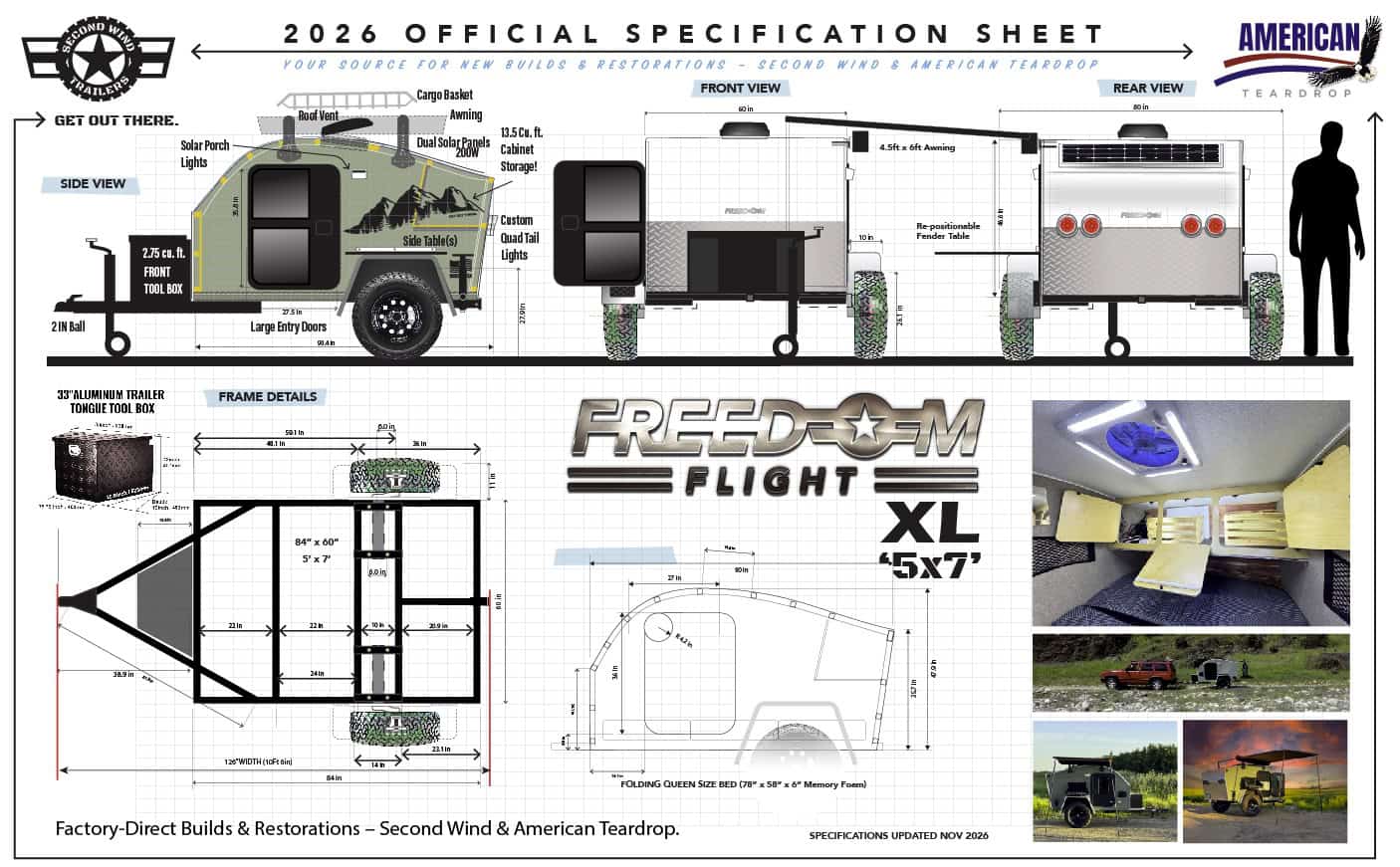
Image courtesy of Second Wind Trailers
Towing It With What You Already Own
This is the practical argument for a sub-1,000 lb trailer, and the reason most people find Second Wind in the first place. You don’t need to buy a truck.
Their own guidance is refreshingly conservative. A standard 2025 Subaru Crosstrek is rated at 1,500 lbs; they recommend staying at 70–80% of any vehicle’s maximum, putting the practical ceiling at 1,000–1,200 lbs. A typical XL at about 1,000 lbs sits at the edge of that window, and a heavily optioned one will go past it, which is why keeping heavy gear in the tow vehicle matters. Tongue weight runs about 160–210 lbs, often closer to 160. The standard coupler takes a 2″ ball with a basic 4-pin lighting connector; a 7-pin connection is a custom option.
Real-world reports back this up. Owners tow with a Toyota RAV4, a 2009 Subaru Forester, a Hyundai Santa Cruz, a Honda Passport, a Mazda CX-5 and a Lincoln Corsair. Jay Henderson pulled one up I-80 from Roseville to Auburn with a 2023 CX-5 and reported no push under braking, no sway, and brakes that got hot on the descent but never faded. Another owner’s husband went from “I don’t want to tow anything ever!” to “That was easy!” over one two-night trip, the Subaru still returning good mileage while gaining 5,000 feet in an hour.
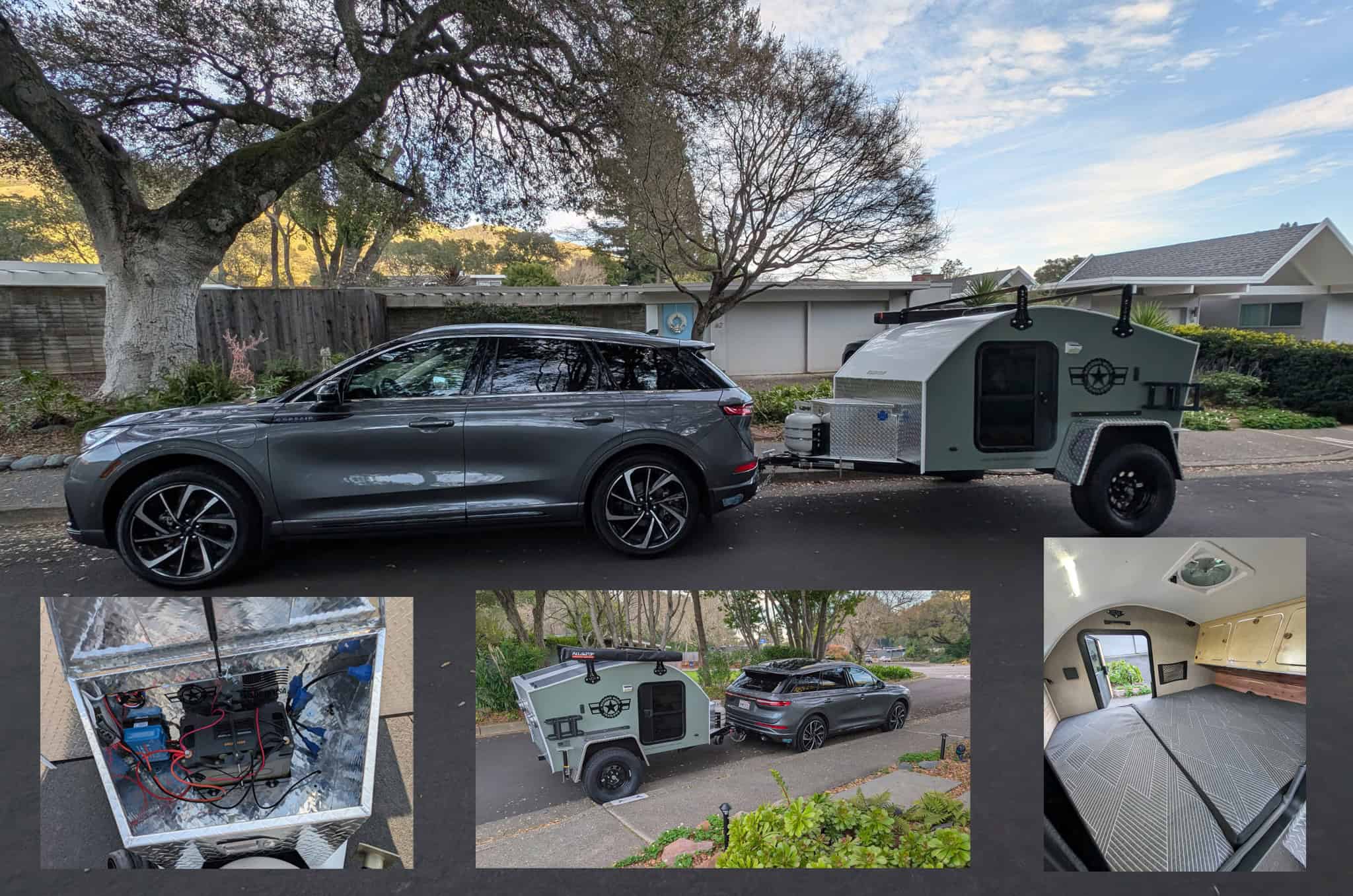
Image courtesy of Second Wind Trailers
None of this makes towing invisible. Second Wind is straight about it: acceleration is slower, hills need more throttle, and you will feel the trailer back there. It just isn’t a white-knuckle experience.
3,640 Miles as a Proving Ground
The most convincing durability data point isn’t a spec — it’s a move. When Juliet Haas relocated from South Lake Tahoe to southwest Florida with less than a month’s notice, Nathan completed a custom build inside a two-week window from her deposit, including a platform roof rack strong enough to stand on to make photographs.
Then she drove it across the country with her dog Oden riding shotgun: out of Auburn through Nevada’s high winds, past Lake Powell, into pounding rain across New Mexico, through flooded Texas highways during a deadly weather event, then Louisiana, Mississippi and Alabama to Bonifay, Florida — more than 3,640 miles.
“When I thought the 10 Fwy was literally going to pop the tires right off,” she said, “Pearl just kept going — with zero issues.” Her full account is more measured than a marketing quote: total damage was one broken bowl, from cabinet doors opening over rough construction zones. Second Wind also supplied a one-way transport permit as part of the package. A sample size of one — but a harder test than most trailers in this price bracket ever face.
The New Freedom Flight RTT Platform
The newest model drops the cabin entirely. The Freedom Flight RTT is a low-profile storage and rooftop tent platform on the same 10’6″ chassis as the XL — the logic being that if you already own a rooftop tent, you shouldn’t pay for a camper shell you won’t sleep in.
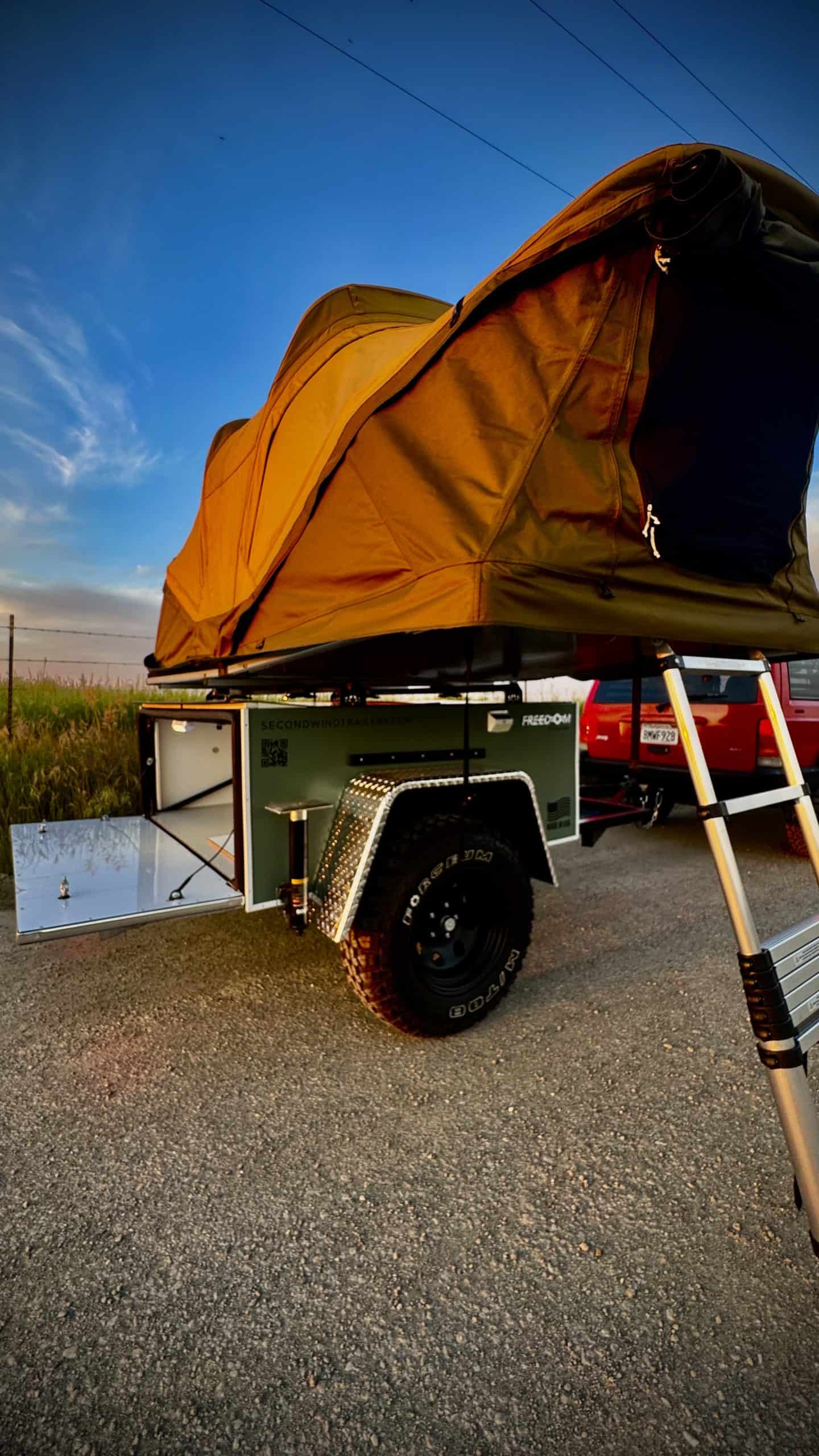
Image courtesy of Second Wind Trailers
Underneath the tent sits a 5′ x 5′ x 24″ enclosed storage box with a front lift lid and a rear tailgate-style opening, so gear is reachable from both ends. It rides on the standard XL suspension with 235/75R15 all-terrains on a 5×4.5 bolt pattern, with an independent torsion axle optional. Lighting is deliberately simple: four rechargeable magnetic LED strips inside (USB-C, motion sensing) plus a solar motion-activated porch light outside. With a three-person tent installed, it comes in around 800 lbs dry.
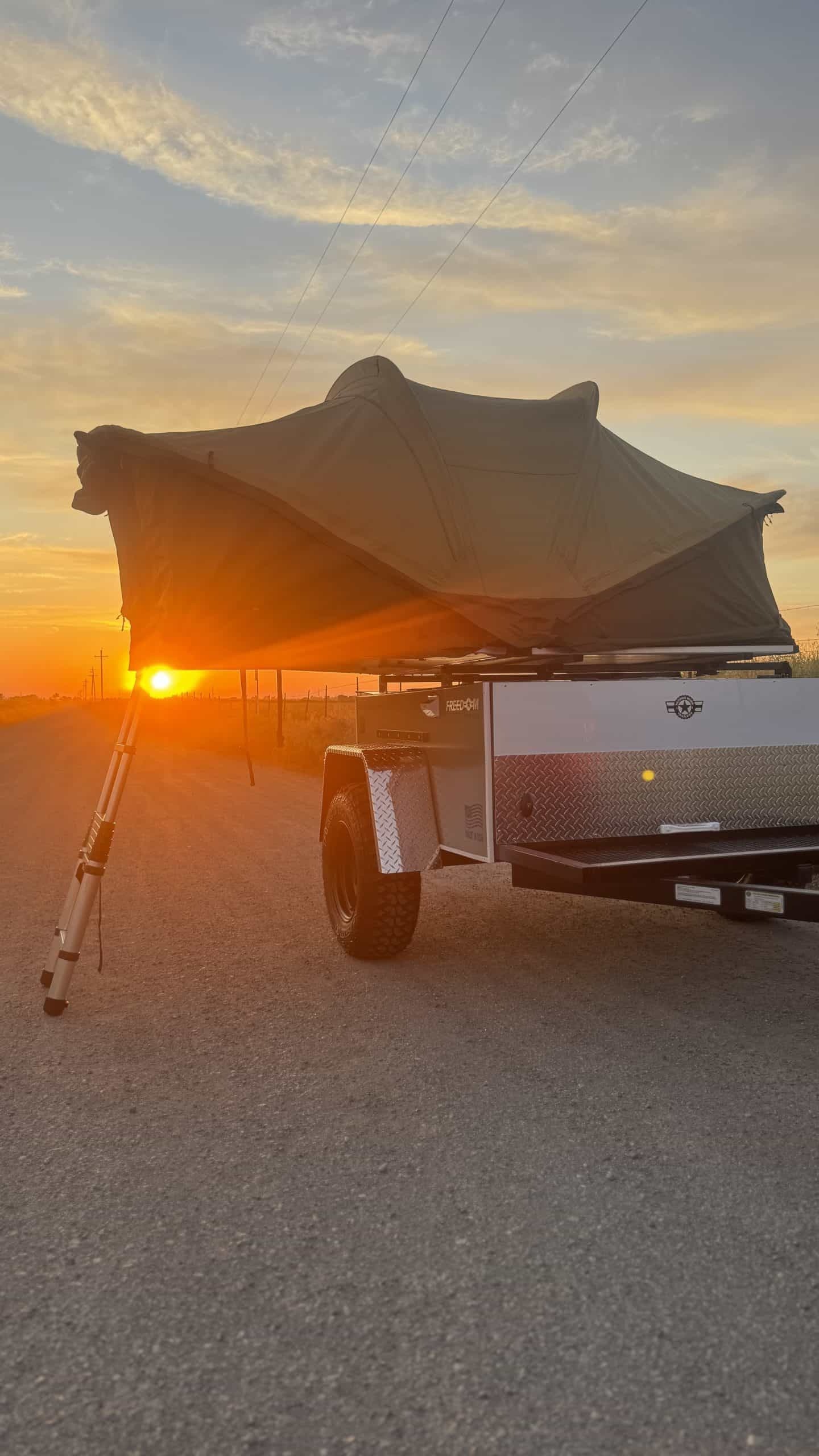
Image courtesy of Second Wind Trailers
Introductory pricing is $5,800 without a tent, or $7,850 with a two-to-three person tent included (checked October 24, 2026) — roughly half the XL’s entry point, and the cheapest way into a hand-built, made-in-USA off-road trailer the shop offers.
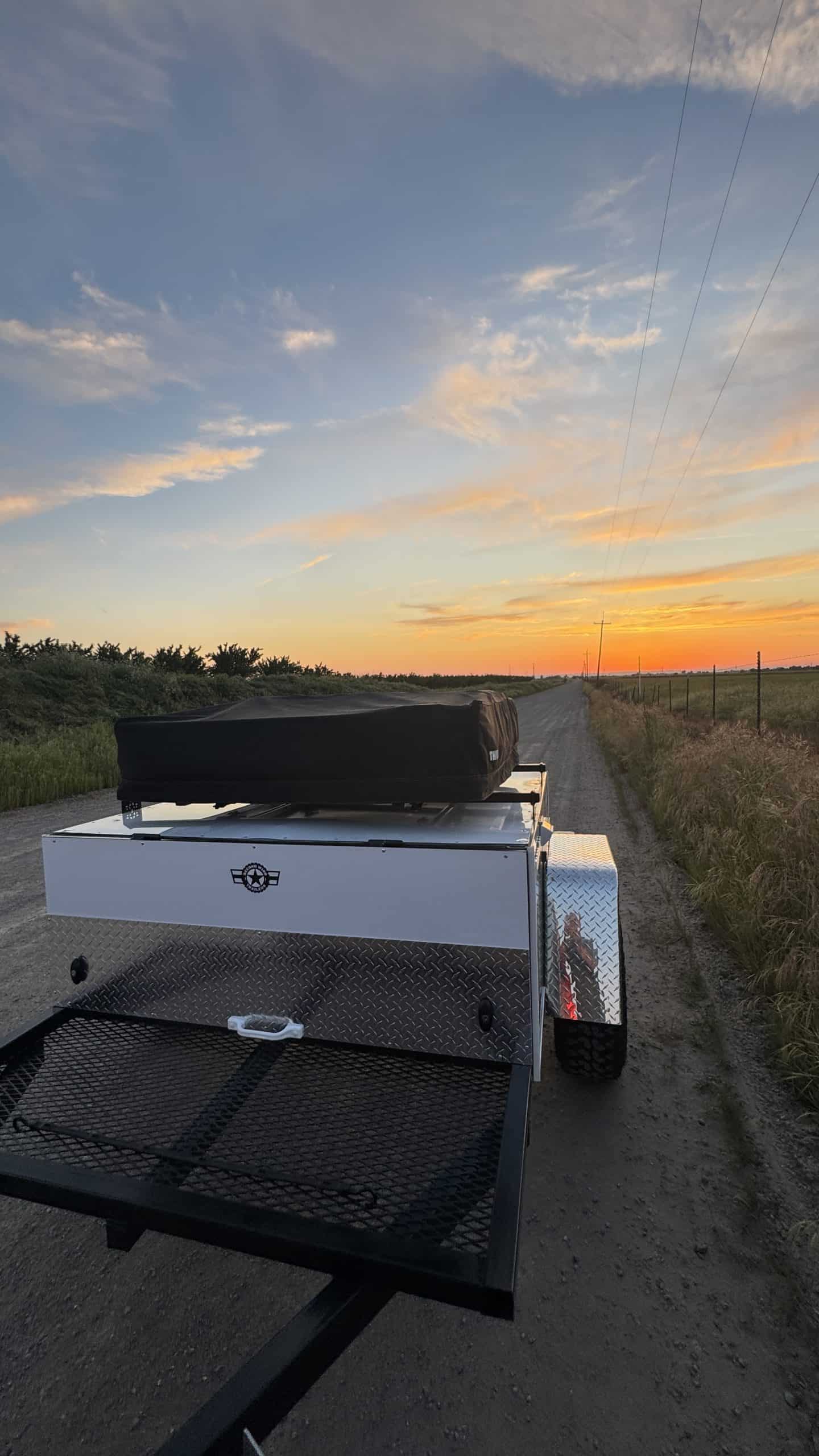
Image courtesy of Second Wind Trailers
One caveat worth stating plainly: Second Wind describes the RTT as brand new, with final details still being dialed in as the first prototype is built.
What Owners Actually Say
Second Wind holds a strong Google rating across 19 reviews, and the pattern is consistent enough to be meaningful. Almost nobody leads with the trailer. They lead with Nathan.
Larry, a retired scout leader towing with a RAV4, described the trailer in one word as “Easier.” Dan, a lifelong Northern California fly fisher, chose Second Wind because he wanted a California builder and named the solar and lighting system his favorite feature — the trailer is now “a main piece in our retirement plan.” Grace, towing with a 2009 Forester, picked “JOY.” Julian, one of the earliest customers, valued setup speed most: arrive late, climb in, sleep.
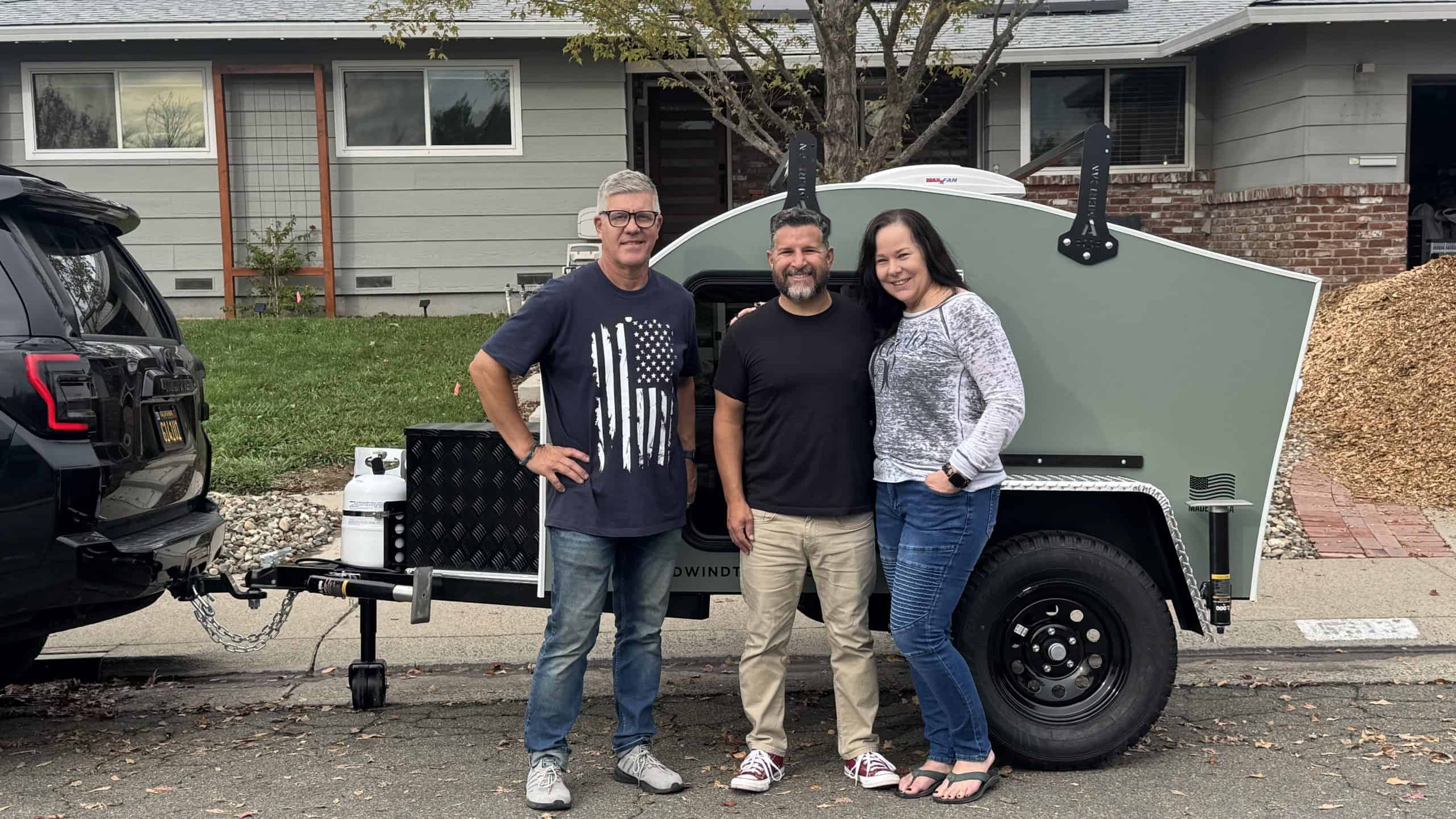
Image courtesy of Second Wind Trailers
Two reviews stand out because they aren’t from customers at all. Anne Harris bought her trailer elsewhere and describes Nathan repairing work done incorrectly and installing a better air conditioner before a Baja trip. William Bradshaw was passing through Auburn with a problem trailer and got it fixed on short notice. And Drew Hansen of the YouTube channel Playing with Sticks made the observation that best summarizes the design: “Most offroad trailers that are lightweight are not truly offroad capable. This trailer is light, capable, and unique.”
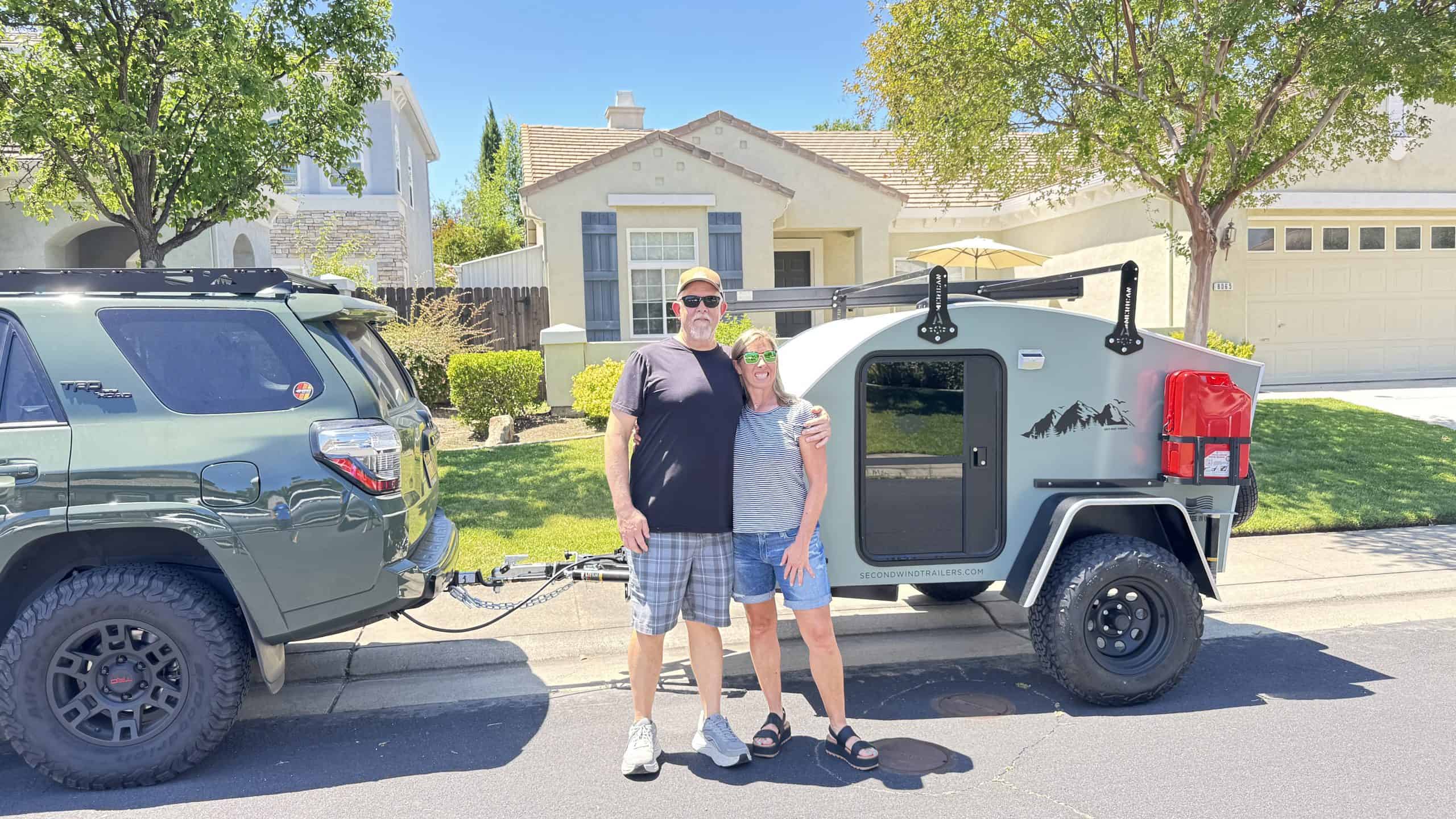
Image courtesy of Second Wind Trailers
Design Details
- Builder: Second Wind Trailers LLC, Auburn, California (D.O.T. Manufacturer ID #21933)
- Founded: 2014 by Nathan Pizzo; now building with sons James and Matthew
- Model: FREEDOM FLIGHT XL — 5′ x 7′ off-road teardrop
- Overall dimensions: 10’6″ long x 80″ wide x about 74″ high (current specifications page)
- Weight: about 1,000 lbs for a typical build; options add weight (older materials quote 960 lbs)
- Tongue weight: approximately 160–210 lbs
- Bed: tri-fold mattress, 78″L x 57.5″W x 6″ thick; cabin height about 44″
- Interior storage: up to 13.5 cu ft of cabinet space; 2.75 cu ft standard front tongue box (upgradeable to 10 cu ft)
- Frame: custom welded, weather-sealed 2″x2″ and 2″x3″ square tube; torsion suspension and axle
- Wheels and tires: 15″ wheels, 235/75R15 all-terrain
- Shell: .040 aluminum over 16mm marine-grade plywood walls, 12mm marine-grade plywood floor, redwood corner fillets, insulated ceiling plus front and rear walls
- Power: 200W solar (two 100W panels), BLUETTI Elite 30 V2 power station (288Wh), shore power plug, 2 USB stations, all-LED lighting, 10-speed high-flow roof fan
- Standard colors: Sage, White, Brushed Silver (white roof standard)
- Base price: $10,500 plus options (checked October 24, 2026); $6,500 deposit reserves a build slot
- Build time: generally 2–3 weeks once construction starts; start date depends on the queue
- Also offered: FREEDOM FLIGHT RTT rooftop tent platform, ~800 lbs with a tent installed, from $5,800 (or $7,850 with tent)
What Makes This Build Special
- The no-hatch decision is engineering, not cost-cutting. Deleting the rear galley removes the most leak-prone seam on a traditional teardrop, eliminates hinges and struts, strengthens the rear wall, and moves 150–300 lbs off the back of the axle. You lose the fixed kitchen; you gain durability and towing manners.
- The squared rear profile buys back interior volume. Where a classic teardrop tapers to a point and wastes the last two feet, the XL’s angled rear preserves headroom and makes room for the full-width cabinet bank that yields 13.5 cu ft of storage.
- Light weight is a tow-vehicle strategy. Staying around 1,000 lbs means crossovers already in the driveway can pull it at 70–80% of rated capacity — removing the truck purchase that usually comes with an off-road trailer.
- Published construction details are rare. Few builders in this segment will show a wall cross-section with plywood thicknesses, adhesives and fastener specs. It invites scrutiny, which usually means a builder expects to survive it.
- Weeks, not seasons. Two-to-three-week build times in a market where custom overland trailers run a year out is a genuine differentiator — and Juliet’s two-week build shows the shop can compress it further when it has to.
- The service reputation extends past customers. Two of the strongest reviews come from people who bought elsewhere and got fixed up in Auburn anyway — a useful signal about ownership after the sale.
Learn More
- Website: secondwindtrailers.com
- Freedom Flight XL model page: secondwindtrailers.com/freedom-flight-xl
- Freedom Flight RTT platform: secondwindtrailers.com/freedom-flight-rtt
- Full specifications: secondwindtrailers.com/specifications
- Owner reviews: secondwindtrailers.com/reviews
- Shop: 164-C Teamtrack Road, Auburn, CA 95603 — (916) 792-6915
- Social: Facebook and Instagram
Highlights
- Hand-built off-road teardrop trailers from a family shop in Auburn, California, building since 2014
- FREEDOM FLIGHT XL: 5′ x 7′ cabin, queen-size tri-fold mattress, about 1,000 lbs, from $10,500
- No rear galley hatch by design — fewer seams, less weight behind the axle, lower leak risk
- Welded steel frame, marine-grade plywood cabin, aluminum skin, insulated ceiling and end walls
- 200W solar and a 288Wh power station standard, with 400W solar and 1024Wh station upgrades available
- Towable by crossovers and small SUVs — RAV4, Forester, CX-5, Crosstrek, Santa Cruz and Corsair all reported
- New FREEDOM FLIGHT RTT rooftop tent platform from $5,800 (prototype stage)
- Construction generally takes 2–3 weeks once a build starts
Explore More
- Classic Teardrop Campers by Second Wind Trailers
- A Freedom Teardrop Trailer with an Off-Road Package by Second Wind
- Escapod’s TOPO2 Nomad: A 1,650-lb Off-Road Teardrop
- Bean Stock 2.0: A One-Piece Fiberglass Utah Teardrop
- Happier Camper HC1: A Retro Trailer Light Enough for Most Cars
- More Teardrop Trailers
- More Tiny House & Trailer Builders
Would you trade a rear galley for a sealed, lighter teardrop? Tell us in the comments.
If you enjoyed this you’ll LOVE our Free Daily Tiny House Newsletter with even more!
You can also join our Small House Newsletter!
Also, try our Tiny Houses For Sale Newsletter! Thank you!
More Like This: Teardrop Trailers | Builders | Travel Trailers
Disclosure: This post may contain affiliate links. If you purchase through one of our links, we may earn a commission at no additional cost to you.


Alex
Latest posts by Alex (see all)
- Xiaomi’s SkyNomad N90 Max Studio: An SUV With a Pop-Up Second Floor - November 6, 2026
- Sundown Station: Brayden Griffith’s DIY Truck Camper - November 6, 2026
- Second Wind Trailers: Hand-Built California Teardrops That Skip the Galley Hatch on Purpose - November 6, 2026






Join the Conversation
No comments yet. Be the first to join the conversation.