Disclosure: This post may contain affiliate links. If you purchase through one of our links, we may earn a commission at no additional cost to you.
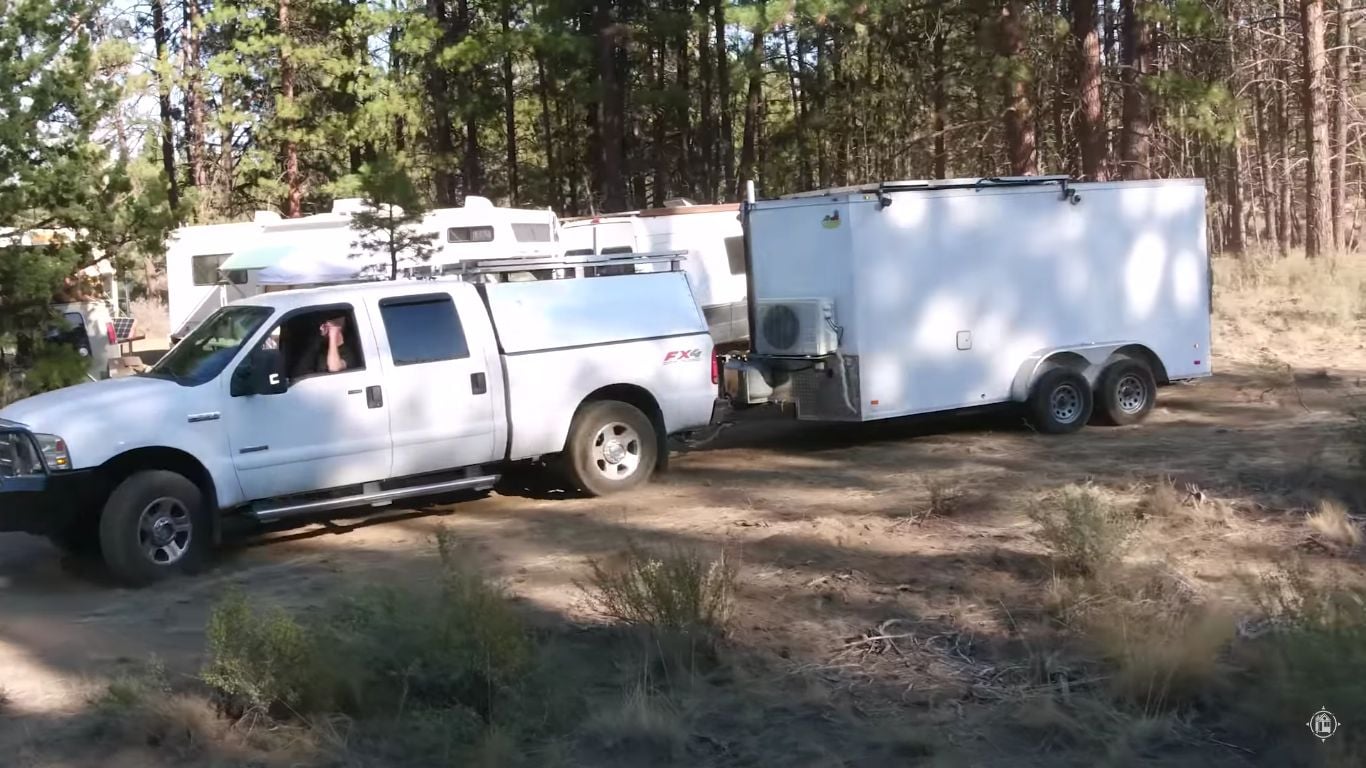
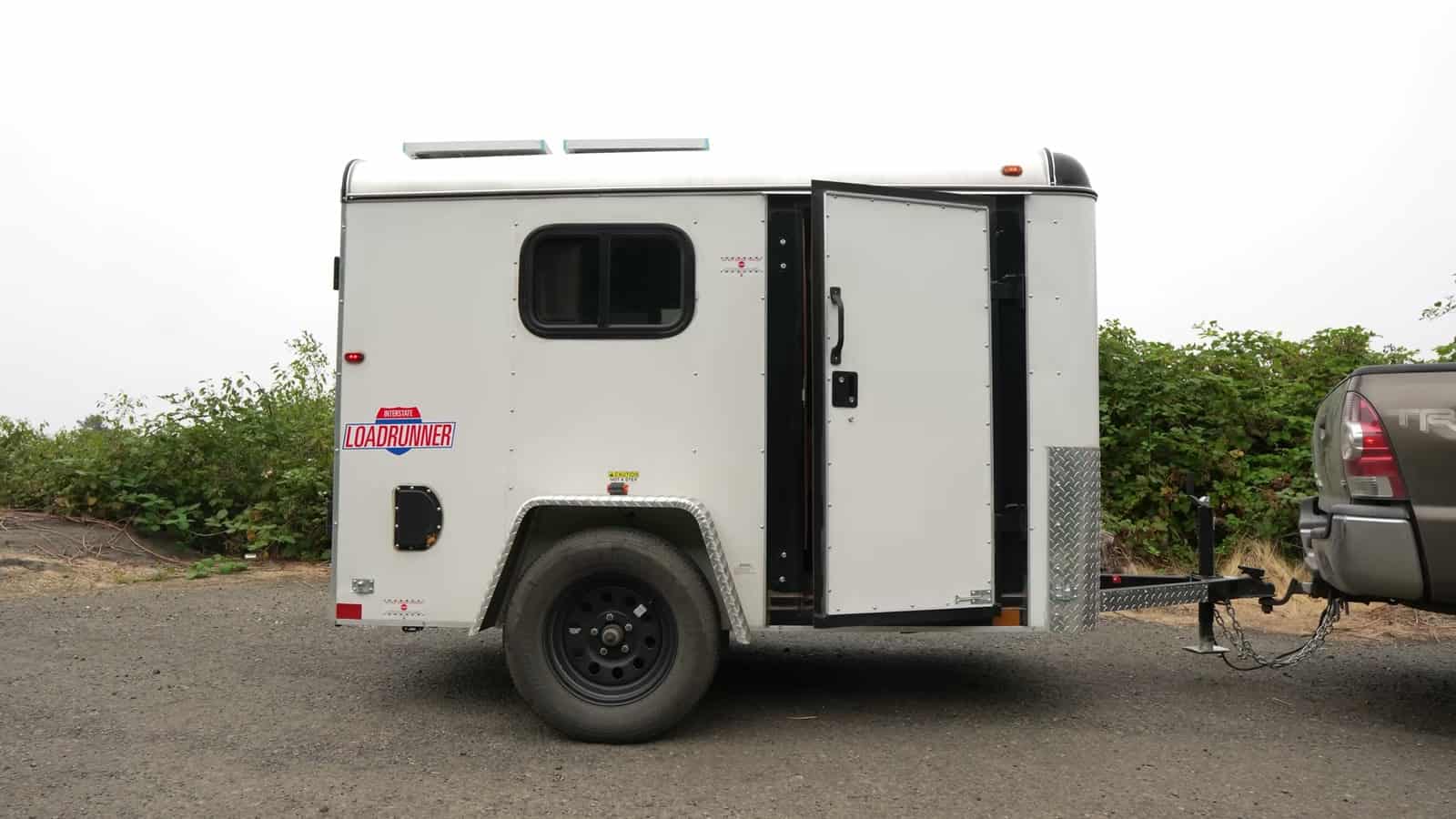
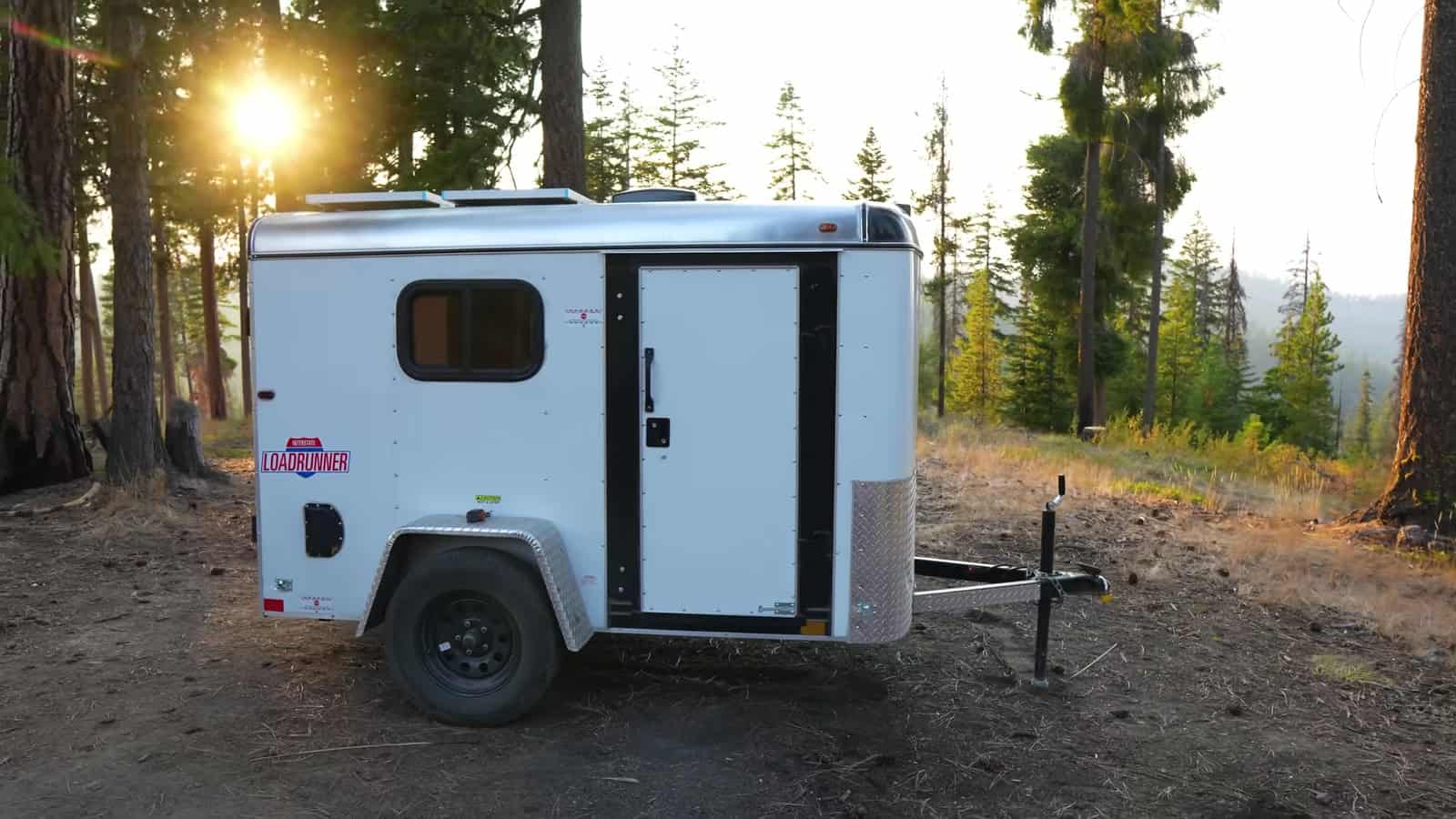
David Rule bought a brand-new 5×8 cargo trailer, an empty white metal box he couldn’t even stand up in, and turned it into a cozy little camper with solar power, a diesel heater, a fold-down desk, and a bed that converts to a queen. The twist is that he didn’t build it in a shop. He built it on the road, towing it with his Toyota Tacoma through eight western states and adding one new feature in every state he passed through.
You might remember David from his 22 sq. ft. micro home, his DIY truck bed camper, and his $15K tiny house built with no experience. This one is his most ambitious video yet. The build started in Wyoming and wound through Idaho, Oregon, Washington, Montana, South Dakota, and Nebraska before finishing in Colorado. By the end, the trailer cost about $6,500 all in. That’s well under half of what a comparable teardrop trailer usually costs.
Starting With an Empty 5×8 Cargo Trailer in Wyoming
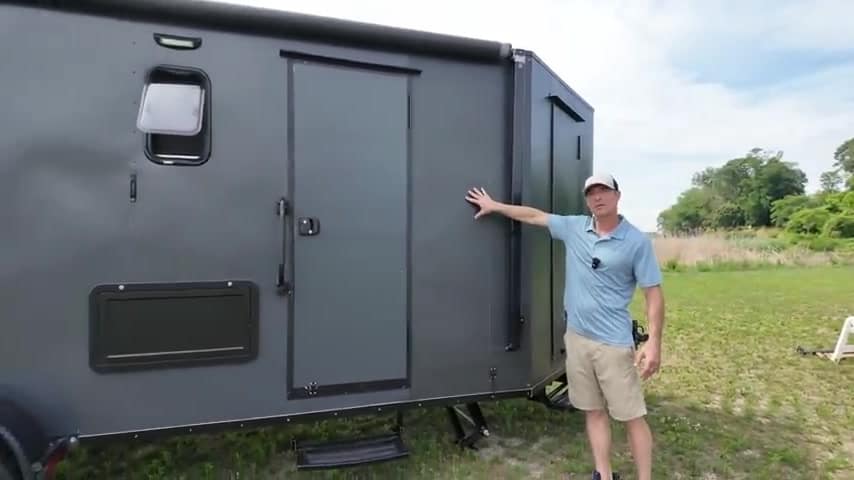
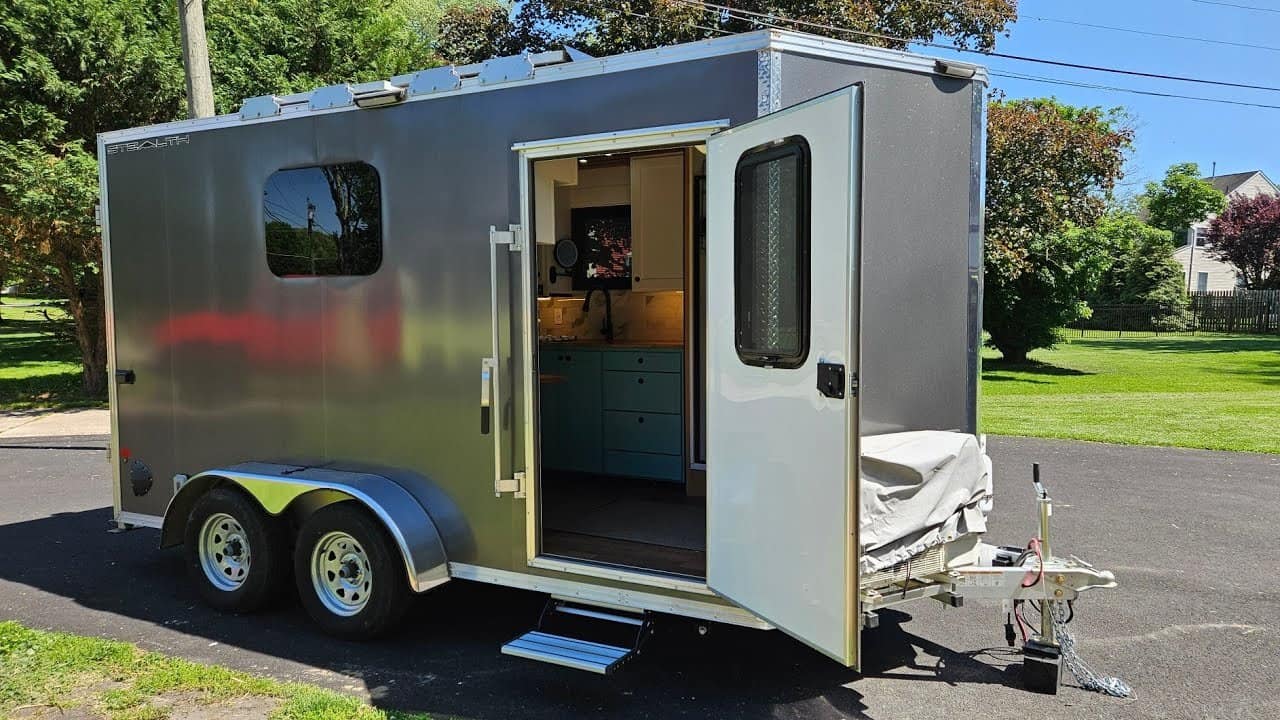
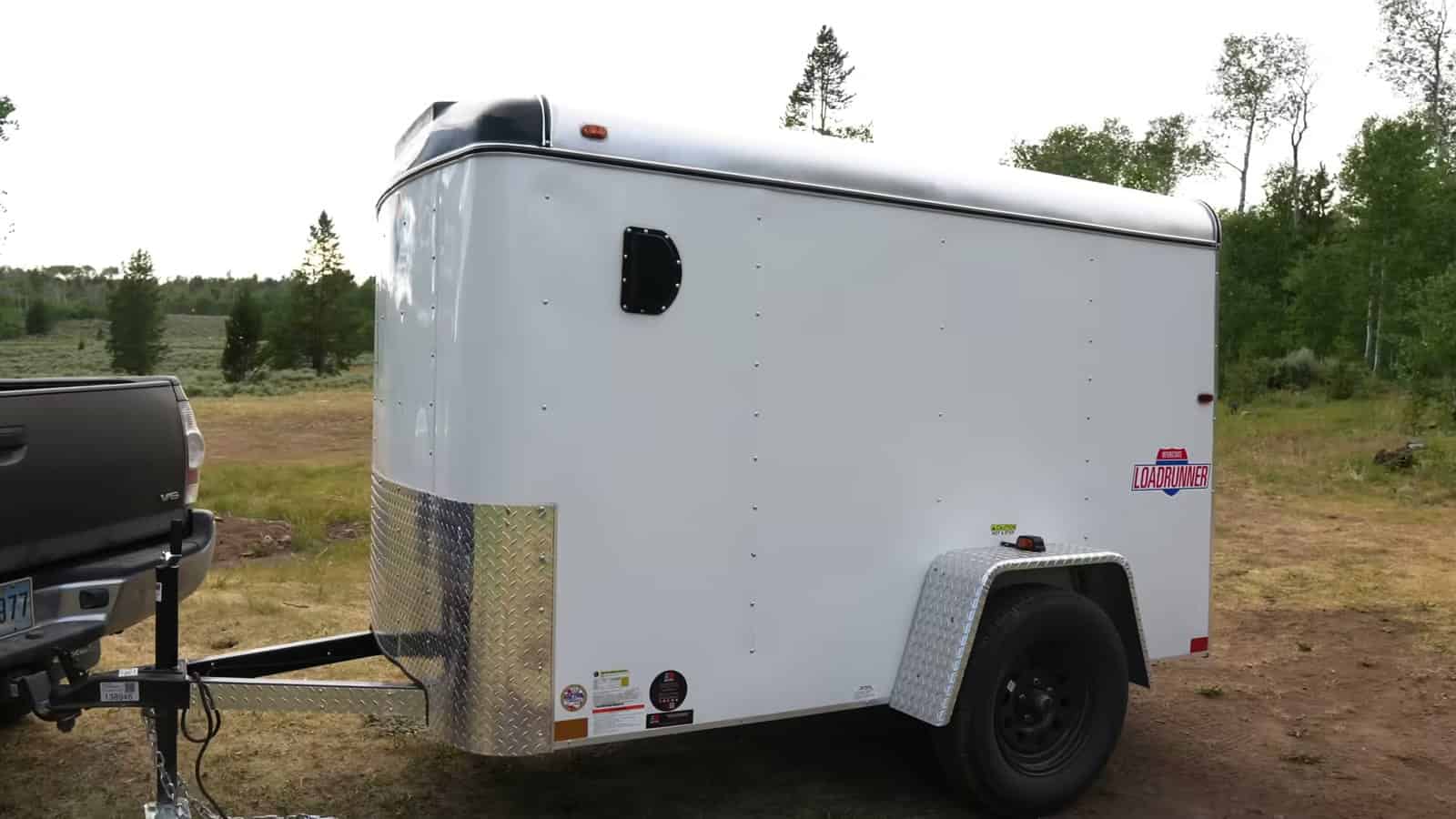
The trailer came as a blank canvas: white metal skin, a side door up front, wide barn-style doors in back, and plywood walls bolted over a steel frame. At 8 feet long, there’s room to lie flat, and at 6’3″, David accepted from the start that he’d be sitting, not standing, inside. Those first nights in the empty box, he joked, were like sleeping in a sardine can. Every state after that would make it a little more livable.
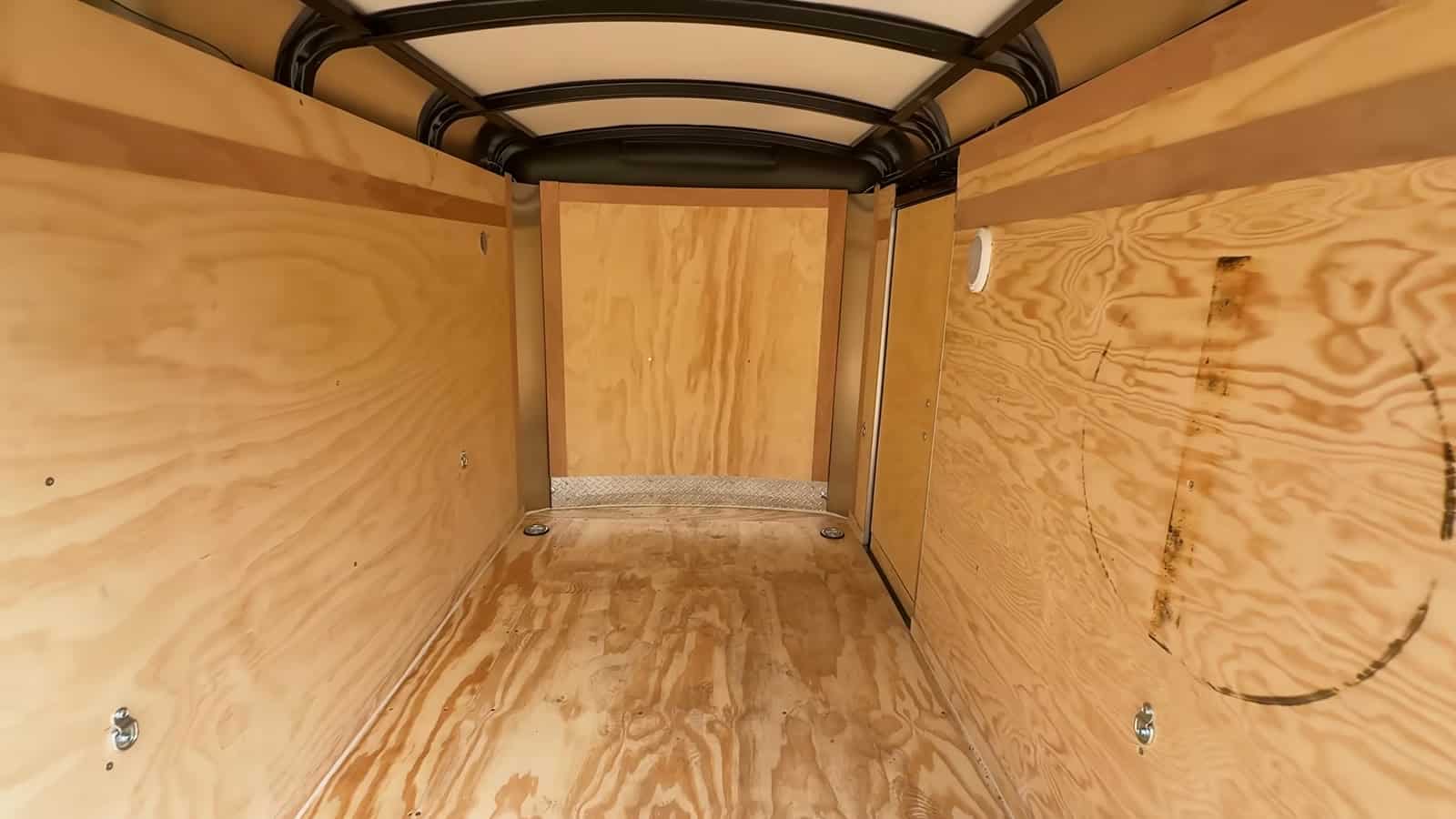
His Wyoming upgrades were the basics that make a cargo box feel like a camper. He pulled out the factory wood walls and sealed the seams around the framing so the shell stays watertight. He cut openings for two recycled RV windows, one on each side of the sleeping area, and backed each with 1-inch boards because the sheet metal alone is too thin to hold them. He skipped a window in the side door because it would add complexity and very little light. He also swapped the cargo latch for a lockable RV door handle that opens from inside and out. That’s a small change, but an important one: a door that can’t be opened from the inside is fine for hauling ATVs and not fine for sleeping.
Insulation, Laminate Floors, and Bright White Walls in Idaho
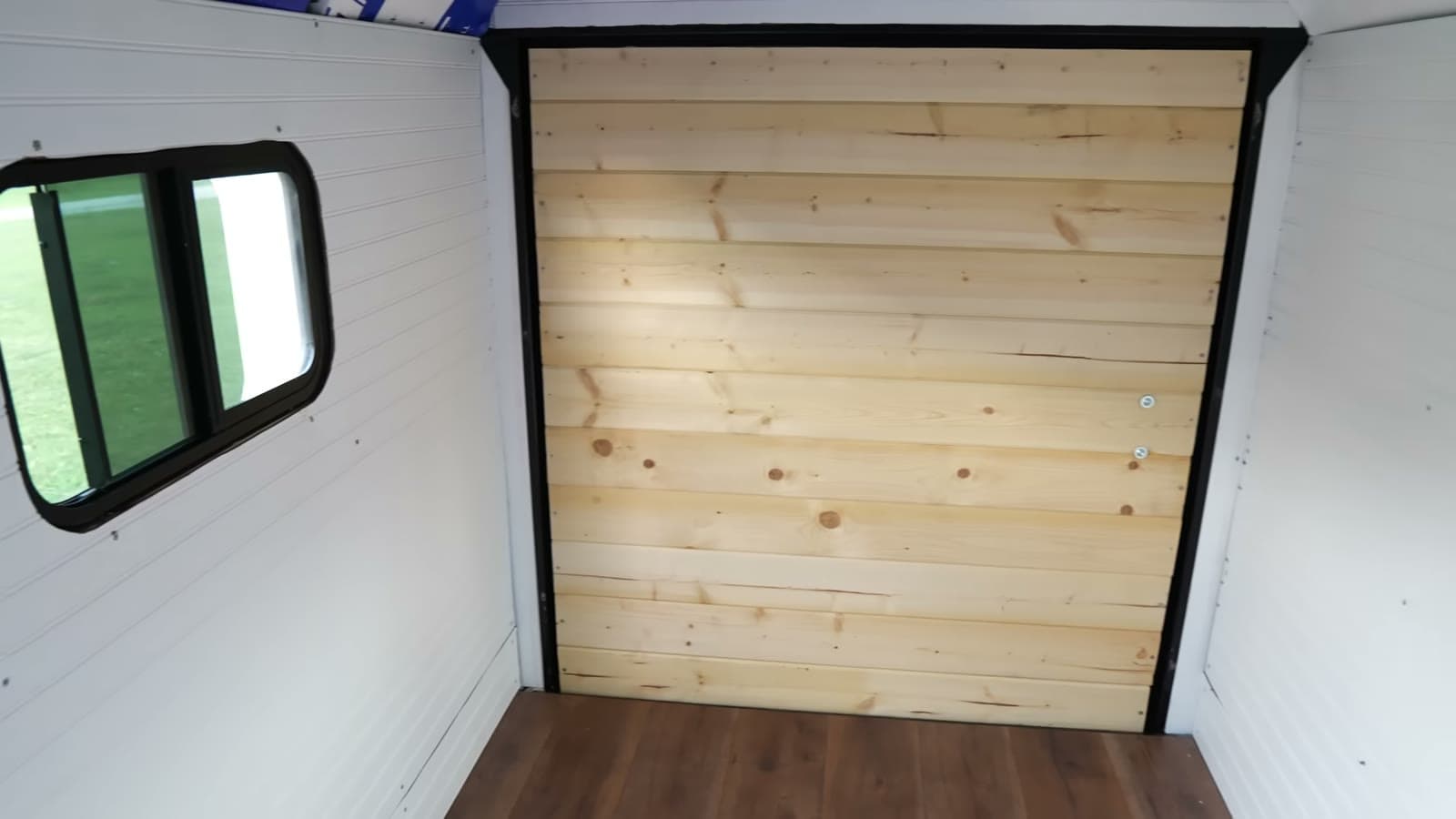
In Idaho, the trailer started to feel like a room. The steel framing is exactly an inch deep, so David lined every wall cavity with 1-inch rigid foam board glued in place with construction adhesive, and he insulated the door too. The floor got thicker 1.5-inch foam, screwed up from underneath with washers, and a final pass of spray foam sealed the gaps. Wood-look laminate went down on top. It’s an inexpensive, durable floor that looks warm and handles muddy boots.
For the walls, he broke from the tongue-and-groove cedar he’s known for and used white paneling fastened to the steel frame with sheet metal screws. The windows went back in for good with silicone around the edges. He still saved some cedar for the doors, and he points out that a little wood goes a long way: the warm doors against bright white walls make the space feel bigger and cleaner than wall-to-wall wood would.
A Roof Fan, Solar Panels, and an Arched Cedar Ceiling in Oregon
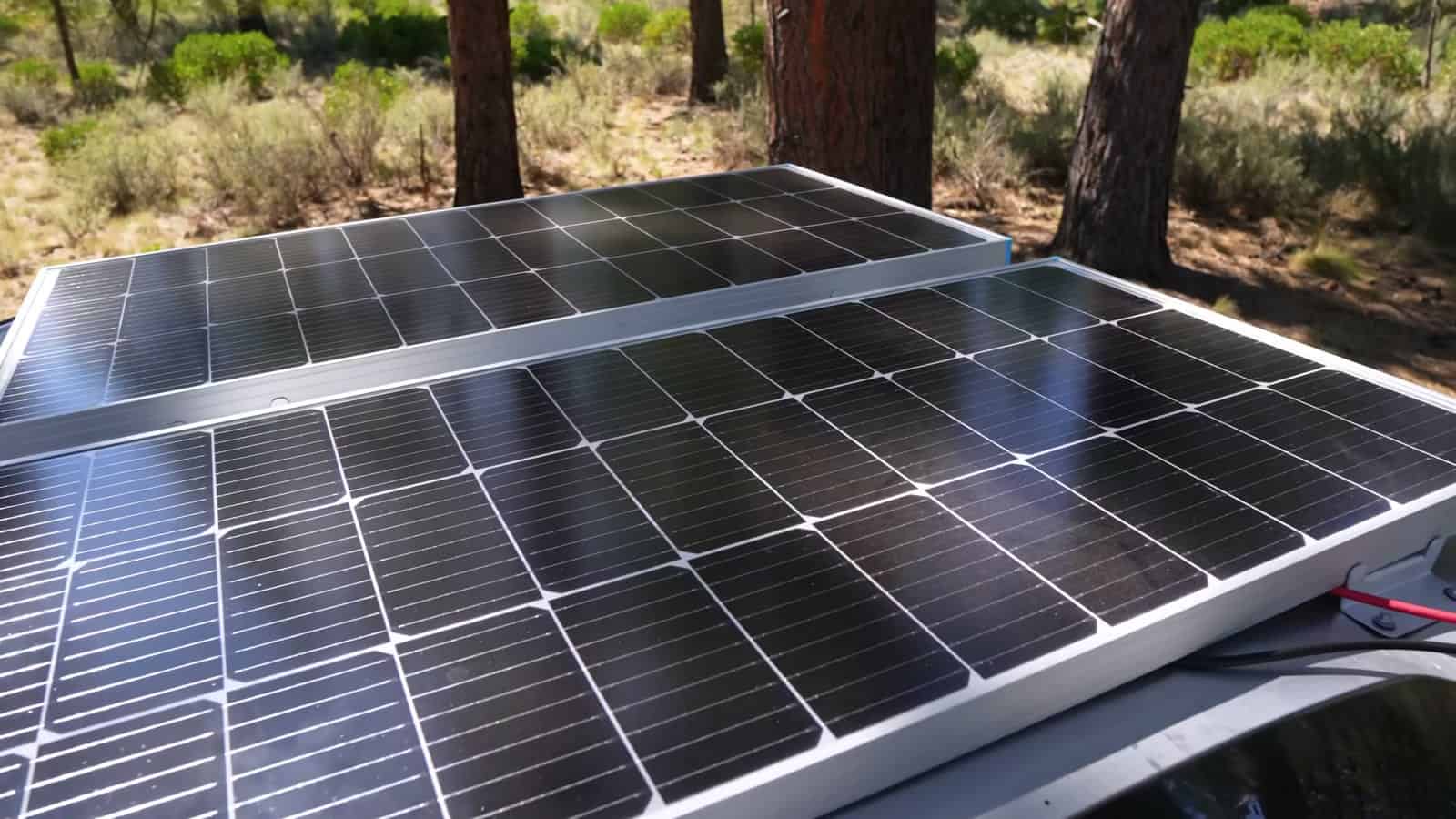
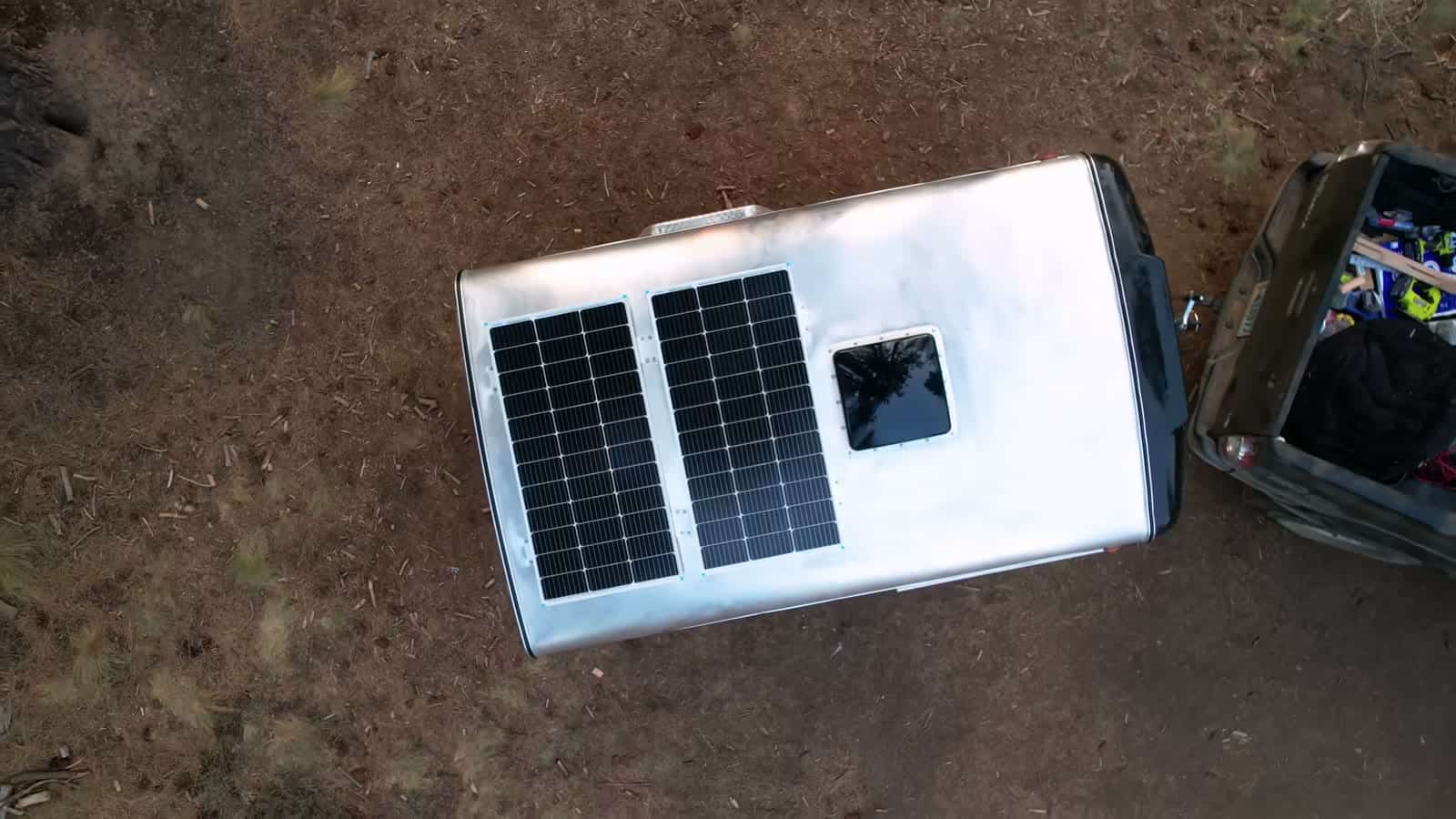
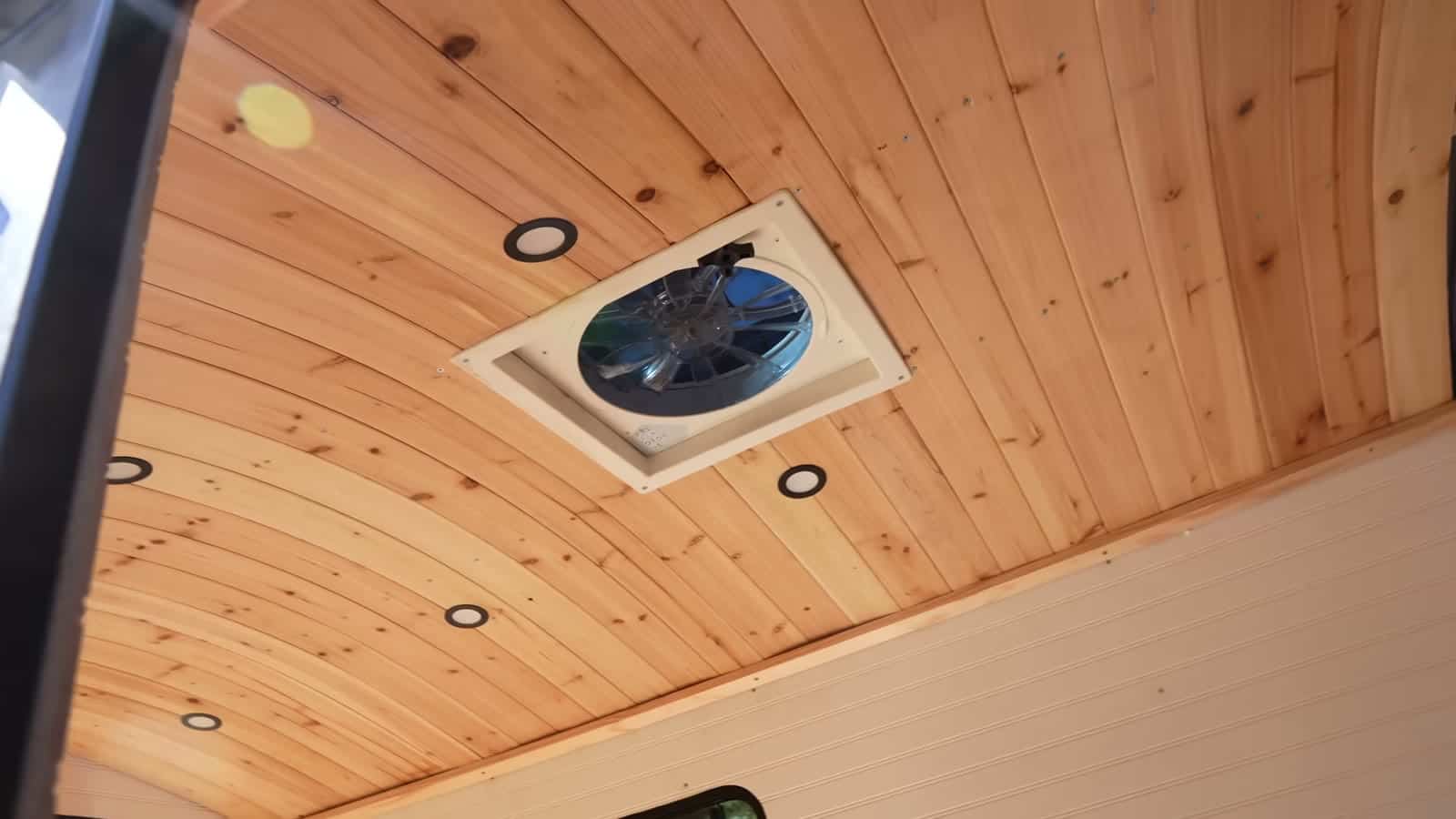
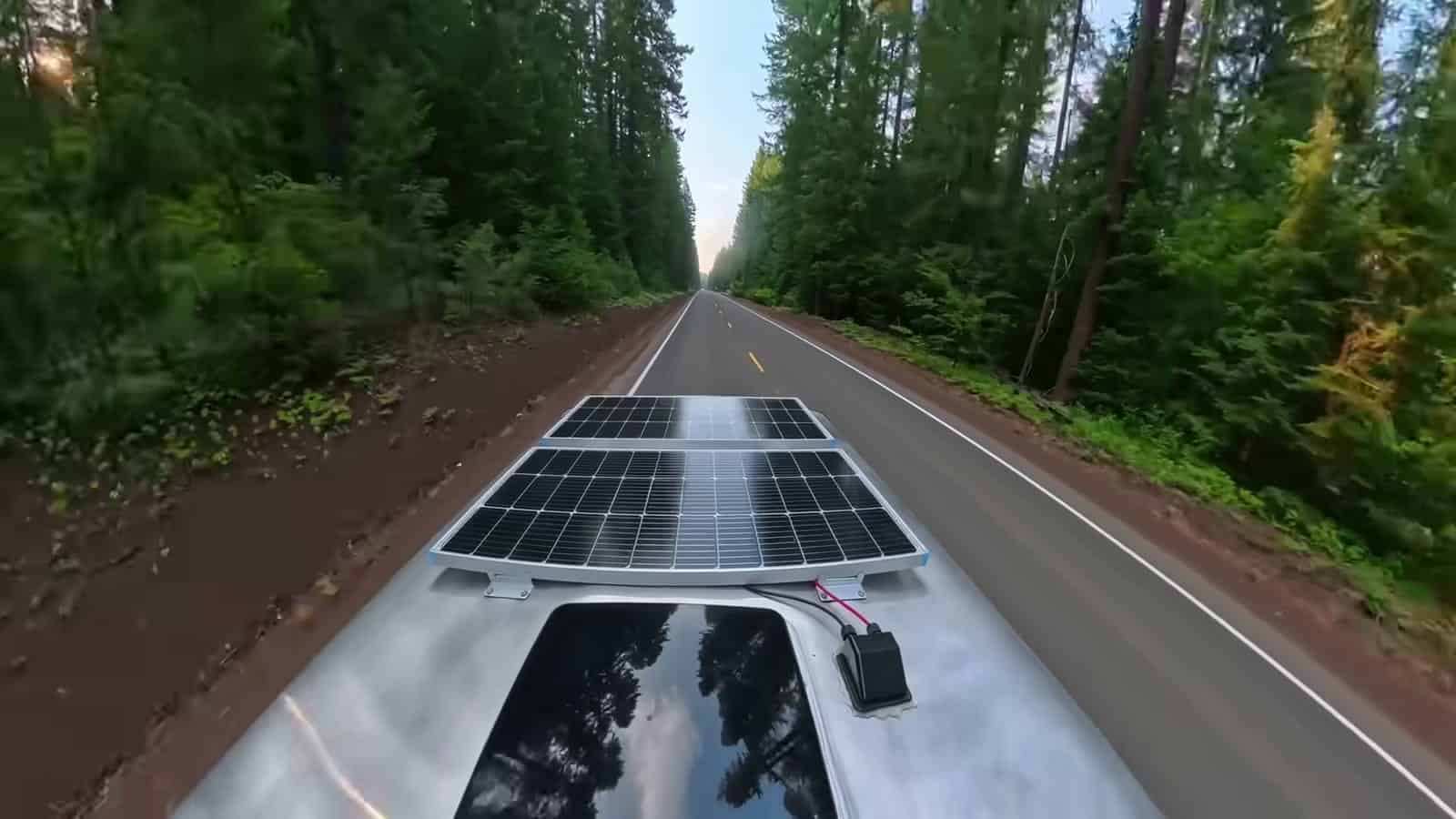
Oregon was all about the roof. Near Bend, David cut a square opening in the center of the roof for a 12-volt RV vent fan with a motorized rain cover, the same model he used in his first tiny home. He framed the opening with a square of 1-by boards so the fan has something solid to screw into, then sealed it with tape and roofing adhesive. Behind it he mounted two 100-watt solar panels on Z-brackets. Since the thin roof skin can’t hold screws on its own, he slid strips of 2×3 underneath and used rubber washers under every screw, the same method he’s used for years with no leaks.
Inside, cedar planking follows the gentle arc of the trailer roof. It looks complicated, but it’s simply narrow boards screwed to 1×2 furring strips. Before closing up the ceiling, he drilled and wired the recessed puck lights, because that’s far easier than fishing wires later. A rainy night on the Oregon coast doubled as a leak test, and the roof passed.
A Cedar Electrical Cabinet and Off-Grid Power in Washington
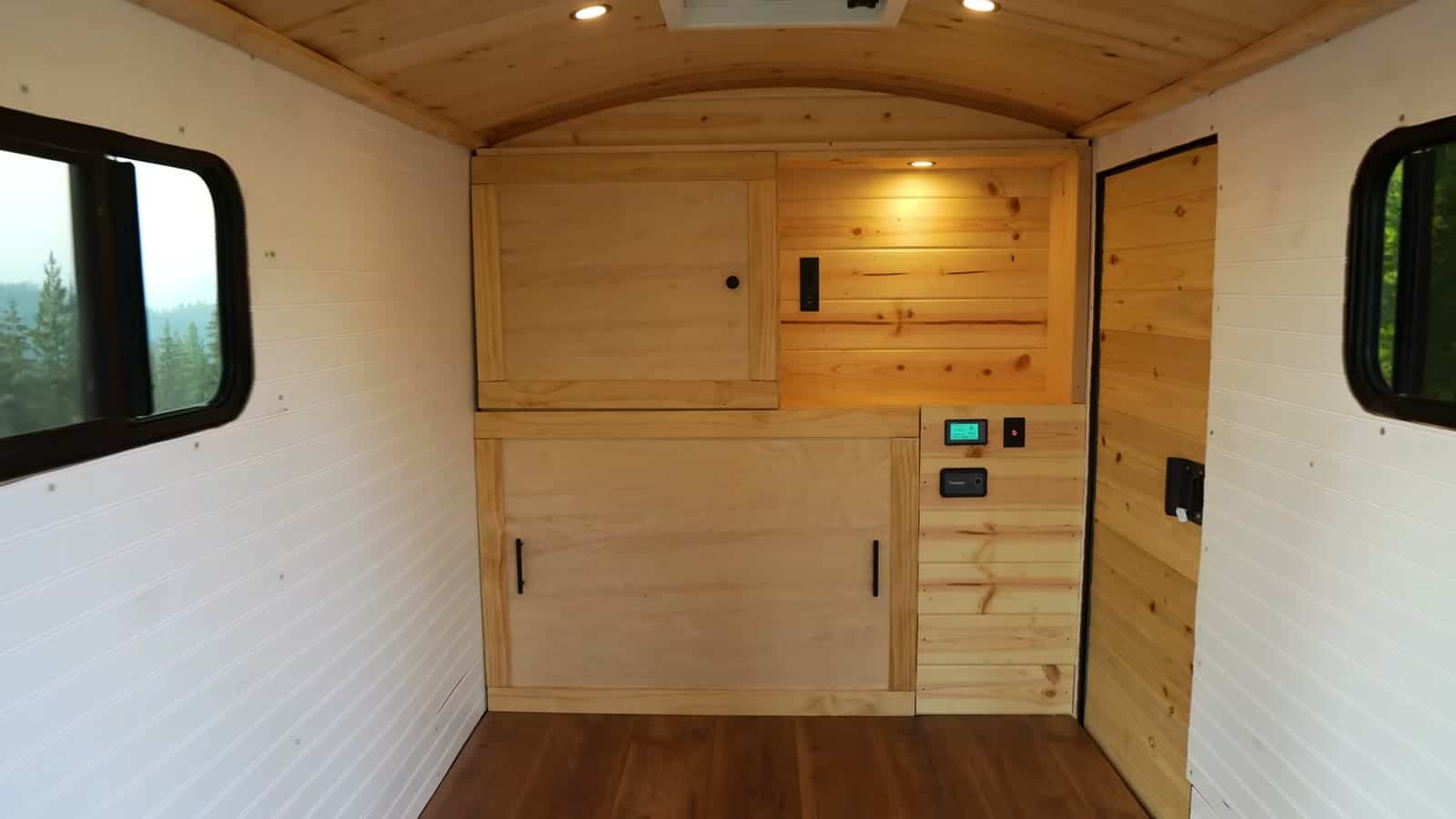
Outside Leavenworth, Washington, David built the piece that holds the whole camper together: a shallow cabinet across the front wall. He kept it just 10 inches deep, enough to fit the components and no more, and built it from 1×10 pine with four sections. The bottom left holds the electrical system, the bottom right holds the heater, the upper left is closed storage, and the upper right is an open shelf with its own light and a 110-volt outlet for charging devices. The cabinet doors have plywood panels set into grooved frames, cut on a table saw he borrowed from a barista at a local coffee stand. The lower door snaps on and off with clips for quick access to the wiring. The upper door uses soft-close hinges.
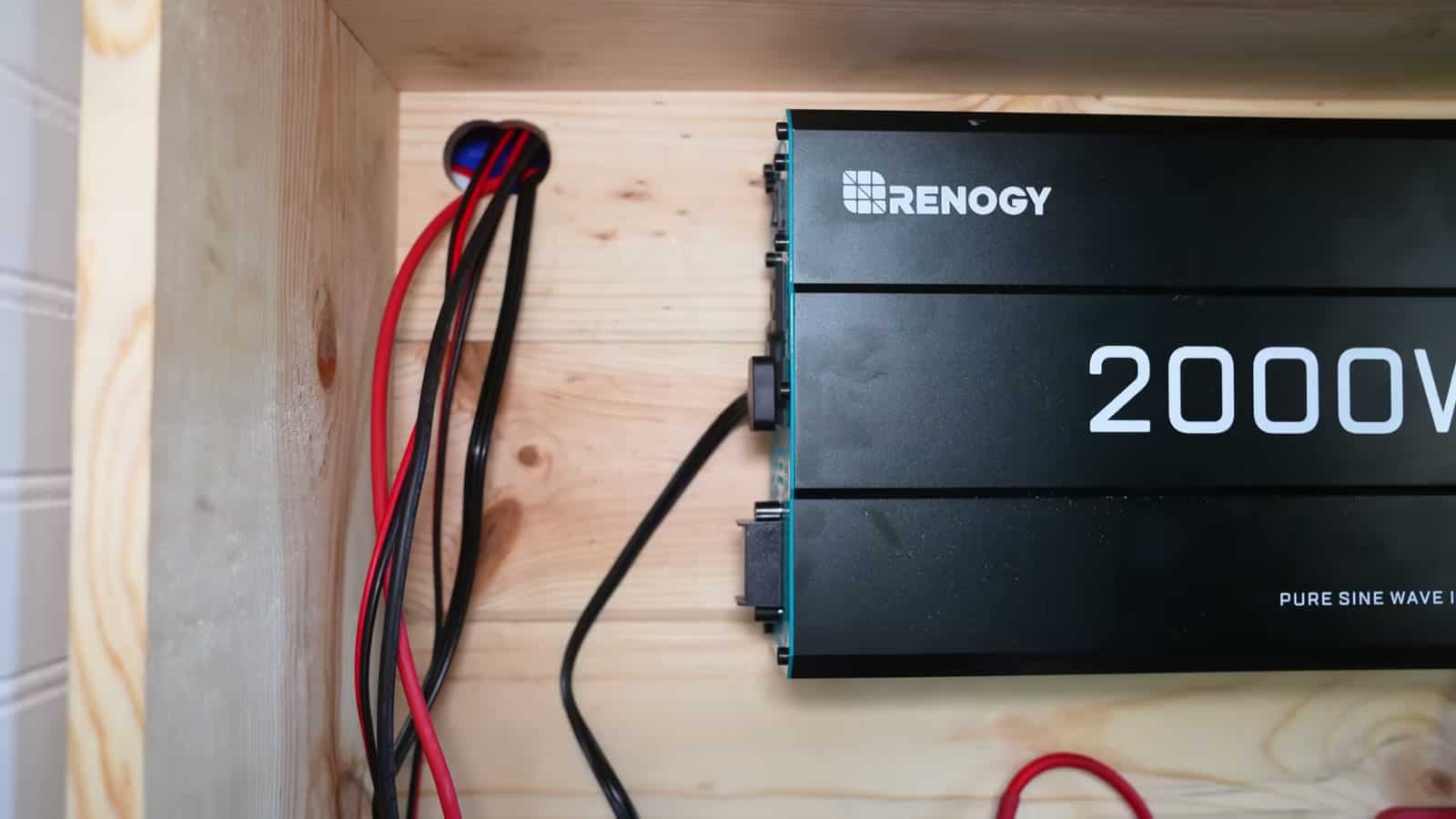
The power system is simple and solid. It runs on a 200Ah AGM battery (about 130 pounds) with a disconnect switch and fuse, plus bus bars and a solar charge controller. A 2,000-watt inverter turns 12-volt DC into regular household current. A small 12-volt fuse box runs the fan and lights through a dimmer, and a battery monitor shows the state of charge at a glance. He crimped all his own connectors, and he says wiring that felt overwhelming on his first tiny house is now very learnable for anyone willing to try.
A Storage Bed and a Desk That Turns Into a Queen Bed in Montana
In Whitefish, Montana, David tackled the challenge he jokes his whole channel is about: making a comfortable bed for a 6’3″ guy in a tiny space. He built a 2×4 bed box sized for a 75-by-30-inch mattress and 20 inches tall, a comfortable sitting height. He skinned the sides in pine shiplap and topped it with a hinged 3/4-inch plywood lid. The box is also the camper’s main storage. You can reach it from inside by lifting the lid, or from outside through a removable panel at the back doors, and the spare tire fits inside.
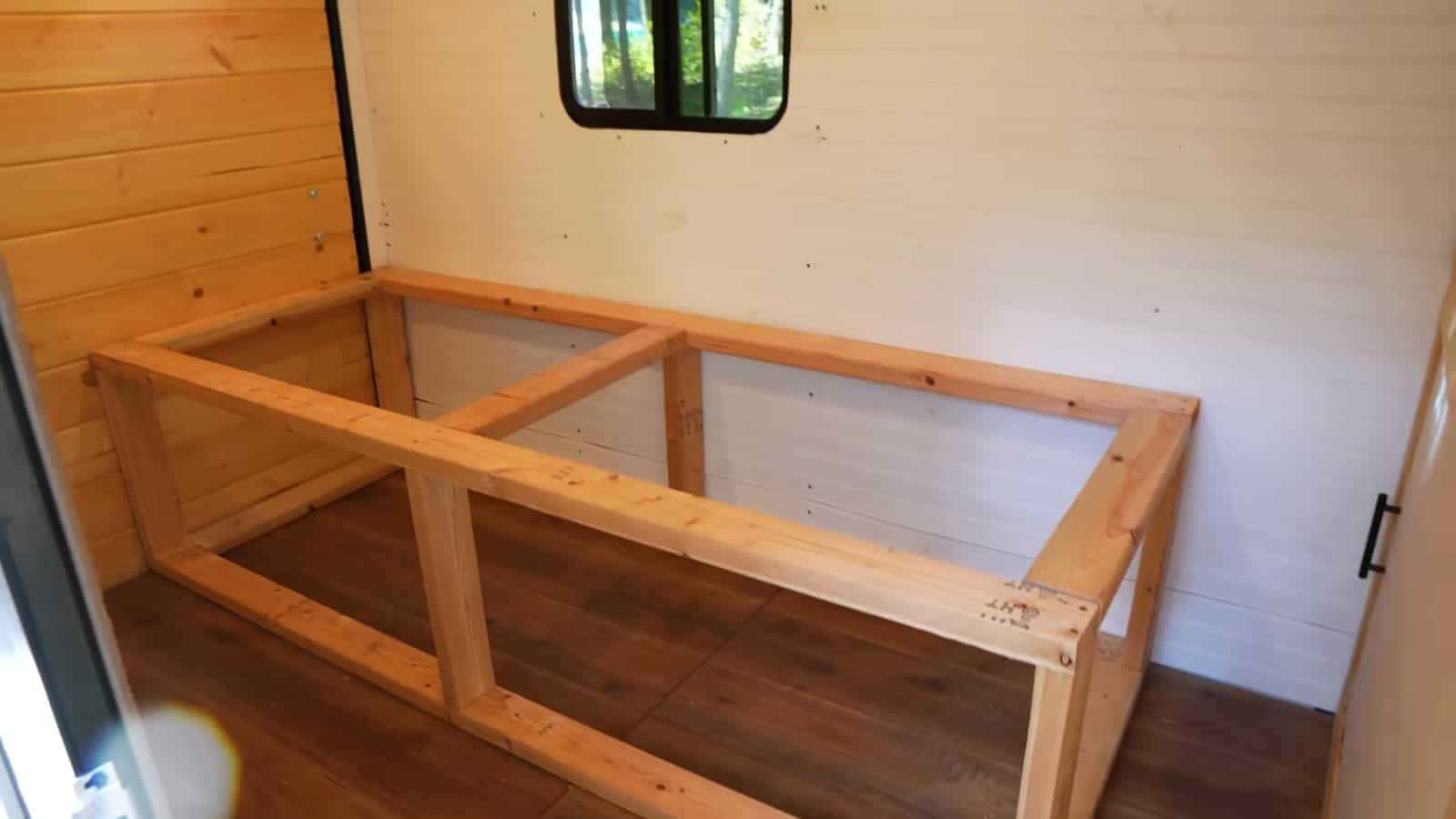
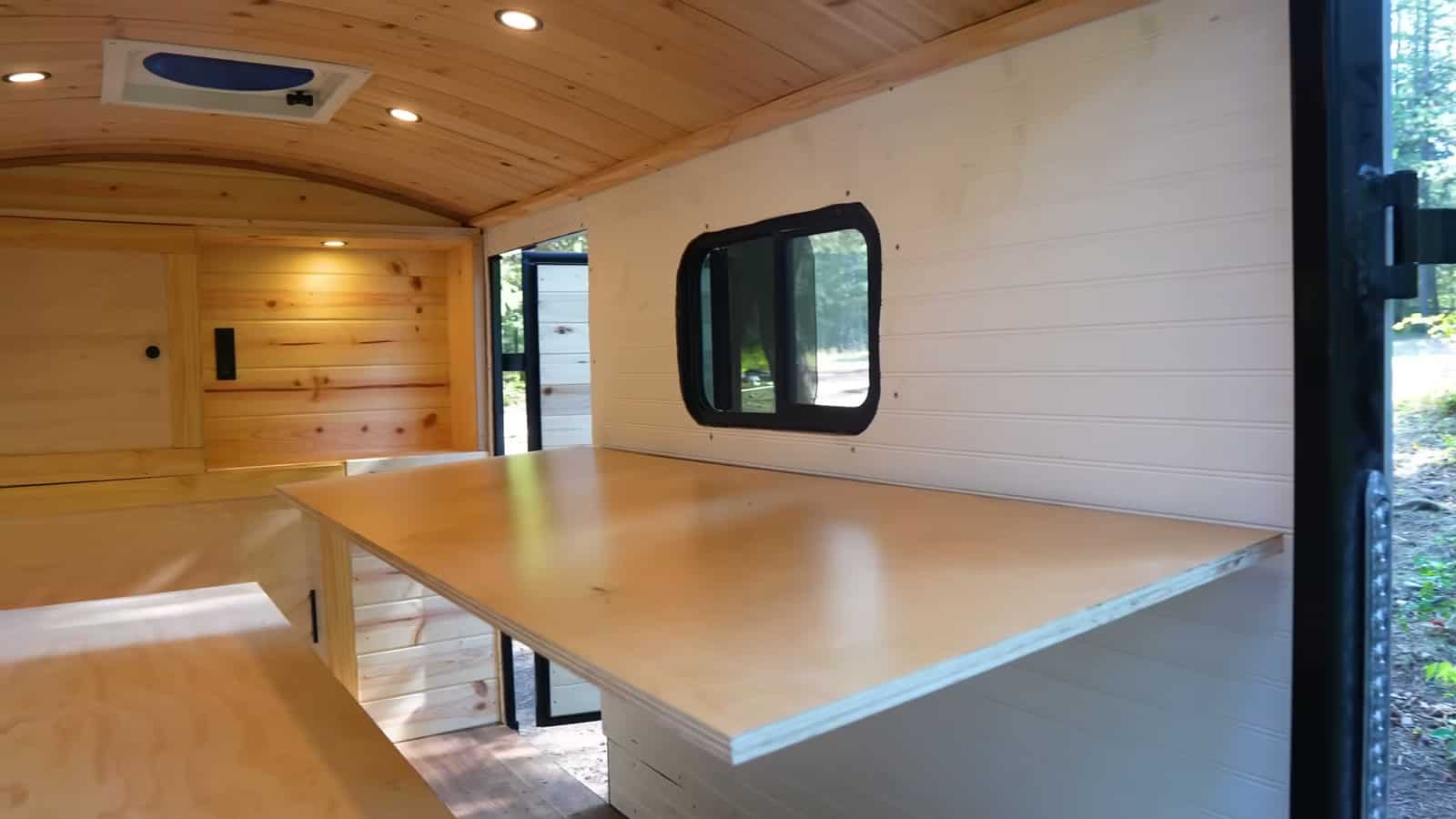
The desk is the cleverest part of the build. A slab of prefinished oak plywood sits on right-angle brackets that clip into E-track on the wall, with chains to the corners for extra support. Clipped into the upper track, it’s a desk under the window, and the bed is your seat. Clipped into a second, lower track, it sits flush with the bed. Add a filler board and a second mattress, and the skinny single becomes a queen-size bed that’s wide enough for David to finally sleep diagonally.
Diesel Heat and an Outdoor Movie Screen in South Dakota
Just outside Badlands National Park, David added heat with an inexpensive diesel air heater, the same type he used in his first tiny home. It sits on a small 2×4 platform in the cabinet’s empty bottom-right bay, with intake and exhaust running out through the floor. To keep fumes out of the cabin, the fuel tank lives outside, mounted to the back of a steel tongue box from Harbor Freight. That gives the trailer an exterior toolbox and makes refueling at the gas station easy.
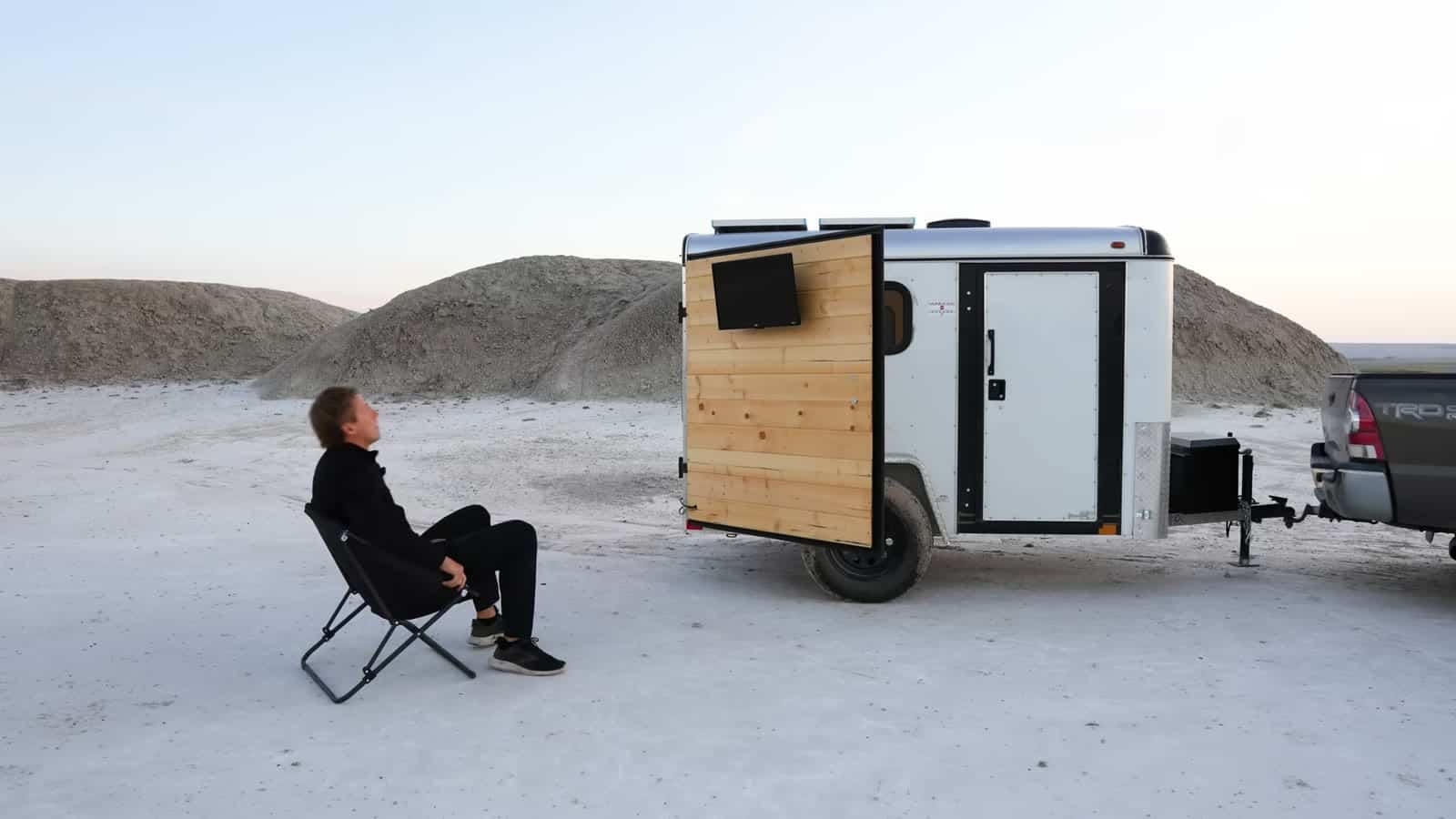
The last interior touch was a 24-inch TV mounted on the inside of the back door, with power and HDMI routed down the door and under the trailer to the cabinet. From bed it’s a TV. With the door swung open, it’s an outdoor movie screen, and David used it for a desert movie night.
Mountain Artwork Painted On With a Projector Stencil in Colorado
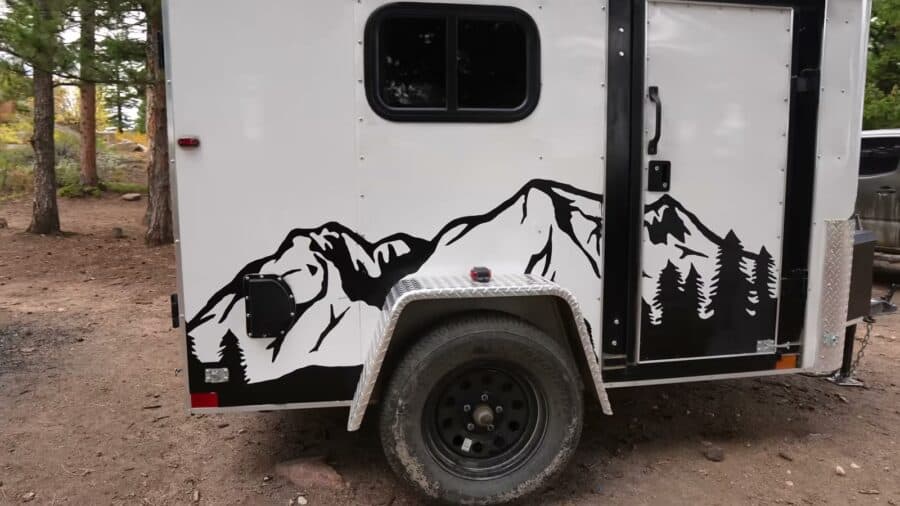
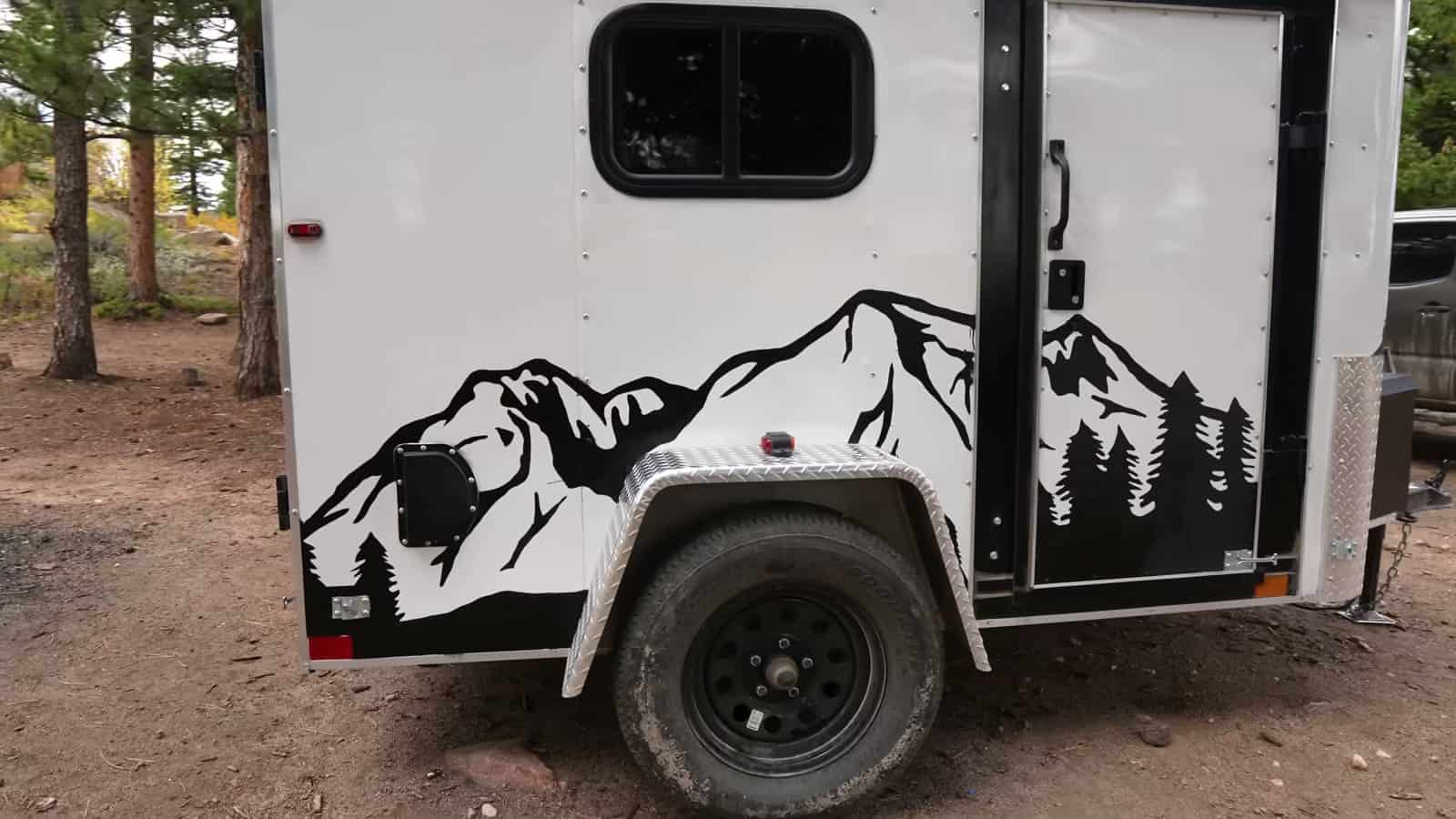
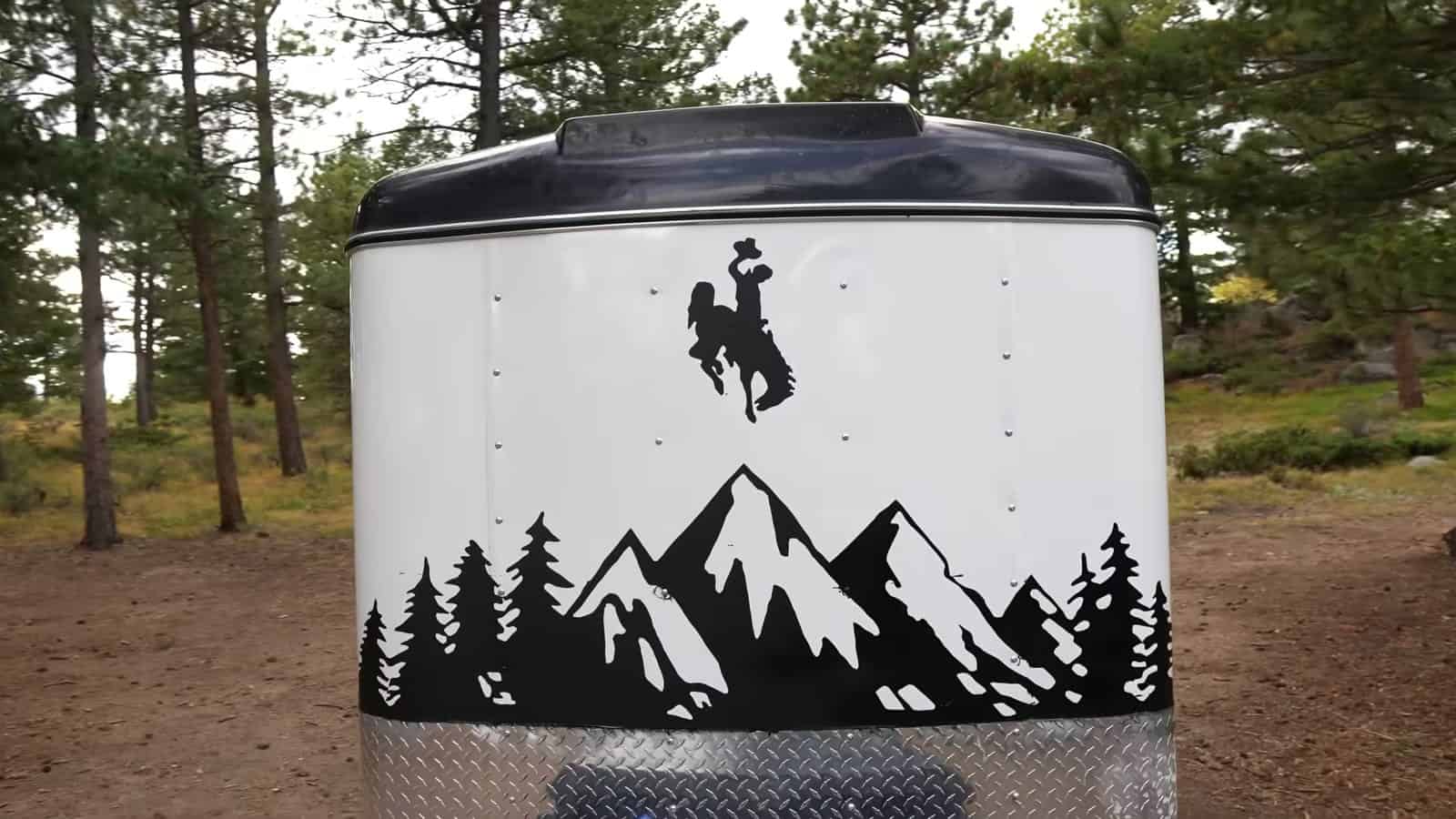
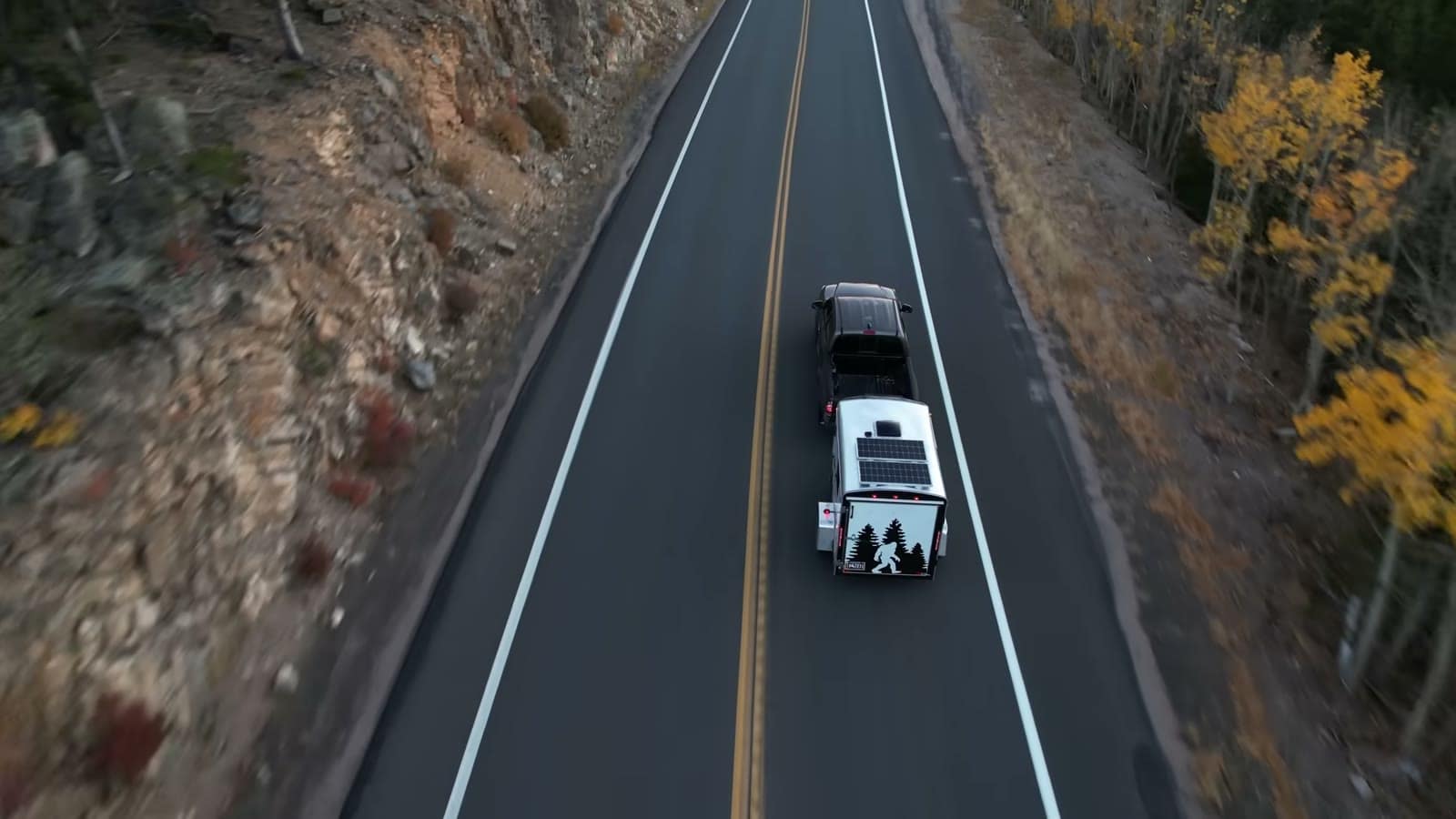
The final stop near Boulder was all about the exterior. David decided a full vinyl wrap was too easy to get wrong, so he painted on designs with a homemade stencil. He covered the design areas in masking tape, projected his artwork onto the trailer at night, traced it with a fine-tip Sharpie, and spent about three and a half hours cutting it out with a razor. Two coats of automotive acrylic enamel later, he peeled off the tape to reveal mountain ranges on both sides, a Bigfoot walking through the pines on the back, and peaks with the Wyoming bucking horse on the front.
What It Cost, and Why There’s No Kitchen or Bathroom
David’s final tally came to around $6,500:
- Trailer: about $3,500
- Building materials: about $1,200
- Electrical system: about $1,300
- Other expenses: about $500
He leaves out a kitchen and bathroom on purpose, and his reasons apply to plenty of road-trippers. Public restrooms are everywhere, he showers at the gym, and he mostly eats grocery-store food that doesn’t need cooking. Without plumbing, a cooktop, and propane, the trailer stays light, simple, and cheap. The finished camper weighs about 2,500 pounds, and in his test it dropped his truck’s fuel economy from about 19 to about 14 miles per gallon. He thinks the comfort is worth it.
Design Details
- Base: New 5×8 enclosed cargo trailer with a side door and rear barn doors
- Builder: David Rule (DIY), built over a road trip through eight western states
- Insulation: 1-inch rigid foam in walls and door, 1.5-inch foam under the floor, spray foam in the gaps
- Finishes: Laminate floor, white wall paneling, arched cedar plank ceiling, cedar on the doors
- Windows and ventilation: Two recycled RV windows and a 12V roof fan with a rain cover
- Power: Two 100W solar panels, a 200Ah AGM battery, a charge controller, a 2,000W inverter, a 12V fuse box, and a battery monitor
- Heat: Diesel air heater with an exterior tank on a tongue-mounted toolbox
- Sleeping: Storage bed box with a 75×30-inch mattress that converts to a queen with the drop-down desk
- Extras: Oak desk on E-track, 24-inch TV on the back door, 110V outlet, dimmable lights
- Weight: About 2,500 lb finished
- Total cost: About $6,500
Lessons From This Cargo Trailer Camper Build
- A cargo trailer is a great budget shell. You get a weather-tight box on a road-ready axle, ready for insulation and finishes, for a fraction of what a teardrop costs.
- Back up thin skins. Windows, roof fans, and solar panels all need solid wood behind the sheet metal to anchor screws and seal properly.
- Plan your wiring before the walls go up. David had to route the TV cables under the trailer because he didn’t run them earlier. Pre-wiring lights in the ceiling saved him the same trouble.
- Make furniture do two jobs. The bed is a couch, a seat, and the main storage, and the desk becomes half of a queen bed.
- A trailer can stay behind. Unlike a truck camper, you can leave it at camp and explore in the truck alone.
- Skip what you won’t use. Leaving out the kitchen and bathroom kept the build affordable, light, and finished in one trip.

Watch the Full Build and Road Trip
The video is about 45 minutes long and worth watching just for the scenery. It includes the Tetons, an Idaho hot spring, Cannon Beach, a 1912 fire lookout above a sea of clouds, a river float near Glacier, and the Badlands.
Learn More
- Full video: I Turned a $3000 Trailer into a Luxury Camper on YouTube
- David Rule on YouTube and Instagram
Highlights
- Empty 5×8 cargo trailer turned into a cozy mini camper for about $6,500
- Built on the road across eight western states, one new feature in each
- Solar power, roof fan, diesel heat, and dimmable lights
- Storage bed plus a desk that drops down to make a queen bed
- Back-door TV that doubles as an outdoor movie screen
- Hand-painted mountain artwork using a projector-traced stencil
Explore More
- His $3300 DIY Truck Bed Camper
- He Built a 22 sq. Ft. Micro Home for $1,470
- He Built a $15K Tiny House with No Experience
- Building His Dream Tiny House for Under $8,000
Would you skip the kitchen and bathroom to keep a camper this simple? Tell us in the comments.
If you enjoyed this you’ll LOVE our Free Daily Tiny House Newsletter with even more!
You can also join our Small House Newsletter!
Also, try our Tiny Houses For Sale Newsletter! Thank you!
More Like This: Cargo Trailers | DIY | Video Tours
Disclosure: This post may contain affiliate links. If you purchase through one of our links, we may earn a commission at no additional cost to you.


Alex
Latest posts by Alex (see all)
- Activan Jackson 144: A Short AWD Sprinter Camper Van with a Queen Bed and Tiled Shower - October 16, 2026
- He Built a $6,500 Mini Camper From a Cargo Trailer While Road-Tripping 8 States - October 16, 2026
- Alaskan HS 640: A Lighter Hard-Sided Pop-Up Truck Camper That Fits Many Half-Ton Pickups - October 16, 2026