Disclosure: This post may contain affiliate links. If you purchase through one of our links, we may earn a commission at no additional cost to you.
About a mile from the luxury apartments and new hotel rising in downtown Spartanburg, South Carolina, a very different kind of housing is taking shape. BridgeWay Village is a community of 18 tiny homes on the city’s Northside, built to help single women and small families move out of homelessness and into a stable future.
According to The Post and Courier, construction was nearing completion in September and the first residents were expected this fall. Later reporting put the target move-in date at November 1, and the nonprofit running the program is still looking for volunteers to help welcome them.
Filling a Gap for Women and Families
Most transitional housing programs in Spartanburg County serve specific groups, such as people returning from incarceration or recovering from substance use. That leaves a gap for women and small families who don’t fit those programs but still need help. A Place to Call Home, the nonprofit running BridgeWay, notes that 81% of single mothers in the county live below the ALICE threshold, meaning they’re working but still can’t afford basics like housing, childcare, and transportation.
“We’re serving single women and small families because we see that’s a big gap in what’s currently provided,” director Hannah Jarrett told The Post and Courier.
How the Plan Grew from 2020 to Today
BridgeWay has been six years in the making, and the plan changed along the way. When First Baptist Spartanburg announced it in 2020, the idea was a village of about 20 small one-bedroom houses for single women without children, a group the church saw falling through the cracks because women with kids often get priority for help. In April 2022, the design passed the city’s Design Review Board with 18 homes and room for 27 residents, according to the Spartanburg Herald-Journal.
By the time construction neared completion, the mission had widened to include small families, and the mix had become nine studios and nine two-bedroom homes. That change matters. A two-bedroom unit lets a mother keep her children with her instead of choosing between housing and family, which is one of the hardest trade-offs in the shelter system.
Small Homes, Fully Furnished
The village has 18 tiny homes on a single campus: nine studios and nine two-bedroom units, with three of each designed to be accessible for residents with disabilities. Even the largest is under 400 square feet, small enough to fit inside a standard garage. Every home has a full bathroom and comes fully furnished, with kitchen appliances including a small fridge, a microwave, and an oven. The nonprofit also supplies hygiene products and kitchen equipment.
What the Village Will Look Like
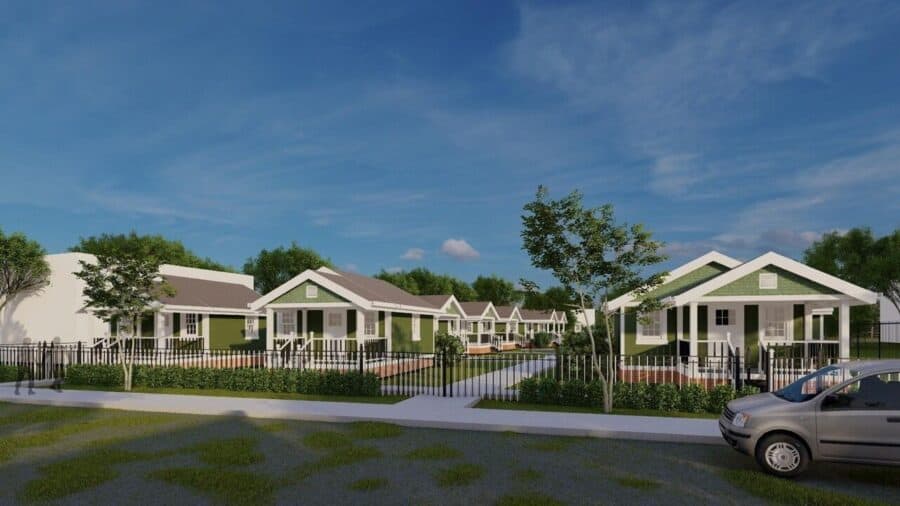
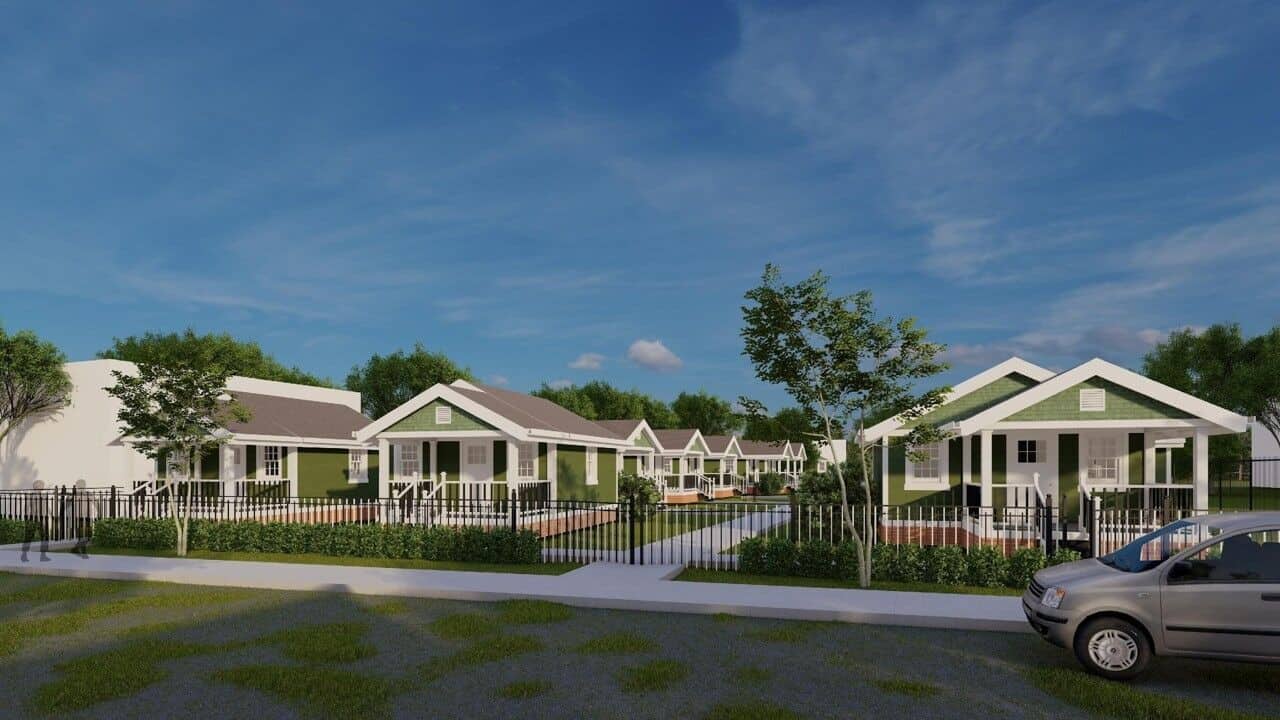
The rendering below shows the plan for the campus: small cottage-style homes lined up along a shared walkway. Each home has its own front door and porch, and the shared paths and green space are meant to make neighbors out of residents instead of strangers sharing a hallway.
Why Tiny Homes Work for Transitional Housing
A shelter bed and a tiny home feel very different to the person living there. A tiny home has a door that locks, a private bathroom, and a kitchen, so a resident can sleep through the night, store her belongings safely, cook for her kids, and keep a normal work schedule. Those basics are often what make it possible to hold down a job, which is the whole point of a two-year program.
A village layout also keeps case managers close by, so support is a short walk away rather than a bus ride across town. BridgeWay goes a step further than many tiny home villages: every unit has its own full bathroom and kitchen appliances, while many villages for people experiencing homelessness use shared bathhouses and kitchens. Making six of the 18 homes accessible means a disability doesn’t rule anyone out.
Tiny homes are not a cure for a housing shortage on their own. Researchers who studied tiny house communities in Texas warn that, for some people, ending up in a tiny house is a symptom of a housing market that has stopped working. BridgeWay is built with that risk in mind: the homes are a bridge with a two-year limit, and the goal is a lease or mortgage of the resident’s own on the other side.
A Stepping Stone, Not a Final Stop
Residents can stay up to two years, which gives them more time than a typical shelter stay of about six months to work through “complex barriers” like past evictions, gaps in employment, or bad credit. Instead of just handing over the keys, the program wraps residents in support, including case management, housing navigation, life skills, job training, financial education, and help with transportation.
Residents pay a small program fee that covers rent, electricity, internet, and more. It’s capped at 30% of their income and no more than $650 a month, so they can practice paying bills in a supportive setting. In return, they commit to working, saving, and checking in regularly with a case manager.
A Community Effort
First Baptist Spartanburg launched BridgeWay in 2020 and invested $1.6 million in the site, which sits next to its outreach mission, The Bridge at Green Street. In 2025, the church gave the property to Homes of Hope, which now owns and manages it. The City of Spartanburg helped fund the final construction, and A Place to Call Home is leasing the property to run day-to-day operations, intake, and services. Jarrett called it a “model of what cross-sector collaboration can build.”
How You Can Help
A Place to Call Home is looking for volunteers to help the first residents move in, including building furniture, providing temporary child care on moving day, and cooking welcome-home meals. There’s also an Amazon wishlist to help furnish the homes. You’ll find the volunteer survey, wishlist, and donation link at aptchspartanburg.org/volunteer.
Village Details
- Location: Northside, Spartanburg, South Carolina, next to The Bridge at Green Street
- Homes: 18 tiny homes (9 studios, 9 two-bedroom), all under 400 sq ft; 6 accessible units
- Features: full bathroom, furnished, kitchen appliances in every home
- Who it serves: women (18+) and small families experiencing homelessness
- Stay: up to 2 years, with case management and wraparound services
- Program fee: no more than 30% of income, capped at $650 a month (covers rent, electricity, internet, and more)
- Owner: Homes of Hope; operator: A Place to Call Home; founded by First Baptist Spartanburg with support from the City of Spartanburg
- First move-ins: fall 2026 (target of November 1 in later reporting)
- Project history: announced 2020; design approved April 2022; $1.6 million invested by First Baptist Spartanburg
Tiny home villages are helping communities across the country. See Providence Park tiny housing for the homeless in Arkansas, Albuquerque’s tiny house village, the New Vision Village for former foster kids, and Seattle’s Belmont Tiny House Village.
Learn More
BridgeWay Village, Spartanburg
Program: aptchspartanburg.org/bridgeway
Volunteer or donate: aptchspartanburg.org/volunteer
A Place to Call Home: info@aptchspartanburg.org · 864-580-5022 · Partnerships: Deandra Comer, dcomer@aptchspartanburg.org
Homes of Hope: homesofhope.org · (864) 269-4663 · Instagram @homesofhopesc
Sources: The Post and Courier, Christian Smith, September 10, 2026; Spartanburg Herald-Journal, April 12, 2022
Rendering: A Place to Call Home/Provided.
Highlights
- 18 tiny homes for women and small families leaving homelessness
- Studios and two-bedroom homes, all under 400 sq ft
- Fully furnished, with full bathrooms and kitchen appliances
- Up to two years of housing with wraparound support
- Program fee capped at 30% of income or $650 a month
- Two-bedroom homes let mothers keep their children with them
- Six accessible homes
- Volunteers needed for the first move-ins
Explore More
- Providence Park Tiny Housing for the Homeless in Arkansas
- The New Vision Village For Former Foster Kids
- Belmont Tiny House Village: 32 Volunteer-Built Homes on Seattle’s Capitol Hill
- Van Nuys Opens a 50-Home Tiny House Village
- Bellingham’s Third Tiny Home Village
- Are Tiny Houses a Solution or a Symptom? A Year of Research in Texas
- Tiny House Villages for Seattle’s Homeless
- Communities
Does your town have a tiny home village like BridgeWay? Tell us in the comments.
If you enjoyed this you’ll LOVE our Free Daily Tiny House Newsletter with even more!
You can also join our Small House Newsletter!
Also, try our Tiny Houses For Sale Newsletter! Thank you!
More Like This: Communities | Tours & Features | Tiny Houses
Disclosure: This post may contain affiliate links. If you purchase through one of our links, we may earn a commission at no additional cost to you.


Alex
Latest posts by Alex (see all)
- Shipping Container Cabins on Fish Creek: A Tiny Hotel Near Saratoga, New York - October 21, 2026
- Belle Tout Keeper’s Loft: Sleep in the Tower of an 1832 Clifftop Lighthouse - October 21, 2026
- Attrap’Rêves: Stargazing from Bed in a Clear Bubble Near Marseille - October 21, 2026