
Disclosure: This post may contain affiliate links. If you purchase through one of our links, we may earn a commission at no additional cost to you.
There’s no question that communities everywhere are struggling to create affordable, walkable, and sustainable housing — but the team at the MicroLife Institute decided to turn that challenge into a real solution. In partnership with the city of Clarkston, Georgia, they developed Cottages on Vaughn, a half-acre micro pocket neighborhood featuring eight beautifully designed cottages ranging from 250 to 550 square feet.
What started as a small urban infill idea quickly became one of Georgia’s most talked-about tiny housing projects. Before ground was even broken in 2019, more than 1,500 people had joined the interest list — a clear sign of how badly communities want attainable small homes.
Each cottage was sold between $119,000 and $201,000, and the development includes shared green spaces, edible landscaping, solar power, and other smart, eco-friendly features. While you can’t move in today, the MicroLife Institute now offers plans for these cottages, making it possible to recreate this model in other towns facing similar housing shortages.
Don’t miss other interesting tiny homes like this one – join our FREE Tiny House Newsletter!
Eight Tiny Homes in New Atlanta Micro Community
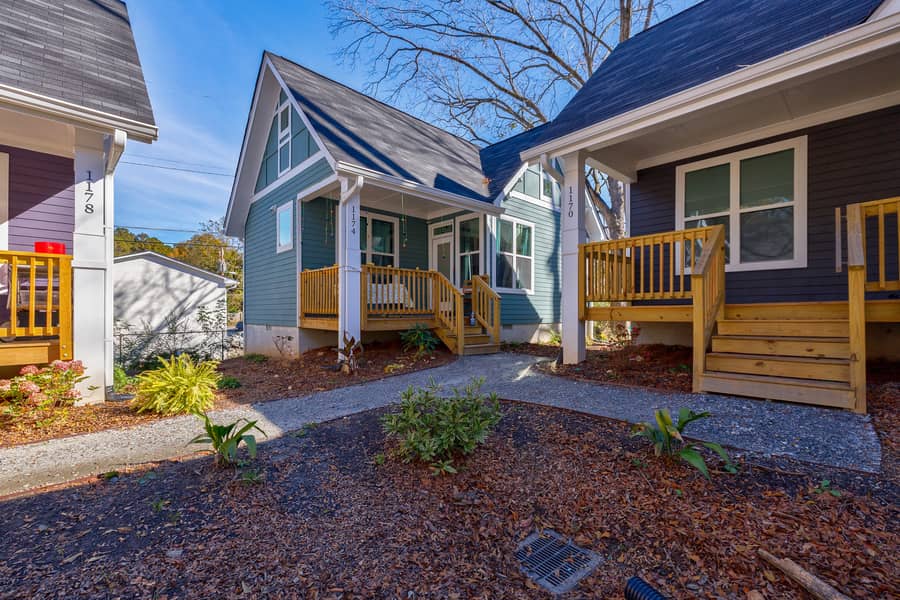
Blue Cottage with Full Solar Roof for Energy Savings.
This cottage is one of the standout designs in the community thanks to its full solar array. Homeowners benefit from lower long-term utility costs while reducing their environmental footprint — a major advantage of living in a micro pocket neighborhood like this.

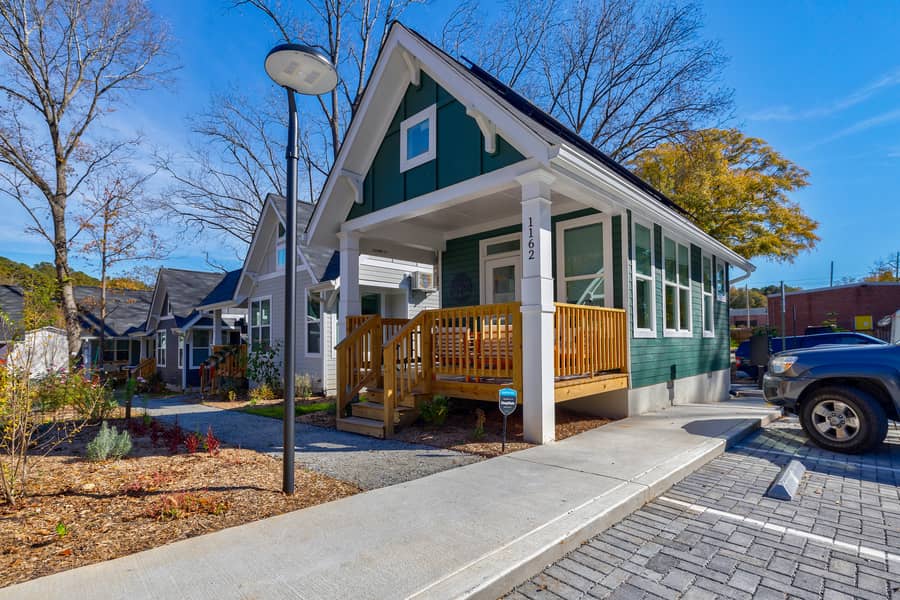
Dedicated Parking for Every Cottage.
Despite the compact footprint of the development, each homeowner still enjoys their own designated parking space. It’s a thoughtful detail that blends the convenience of suburban living with the charm of a walkable, small-scale neighborhood.

One of the 250 Sq. Ft. Micro Cottages
This smaller floor plan shows how livable a truly compact space can be. Efficient layouts, covered porches, and beautiful exterior colors help these cottages feel bright, inviting, and spacious despite their minimal footprint.
Edible Landscaping Throughout the Community
Fruit trees, herbs, and regenerative plantings create a mini food-forest environment. Beyond adding visual beauty, these shared edible spaces encourage residents to connect, garden, and enjoy fresh food right outside their doors.

A Look Inside One of the Cottages
Natural light, clever storage solutions, and warm finishes make these interiors feel much larger than their square footage suggests. Each cottage is designed to maximize vertical space and create a calm, cozy atmosphere.
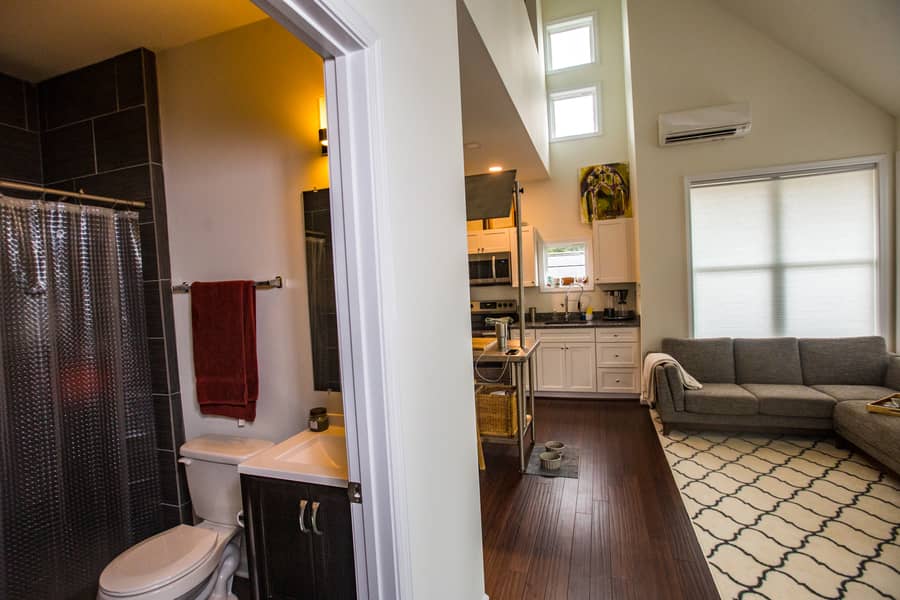
Bright, Functional Kitchen Space
The kitchens in these cottages offer full-sized appliances, generous counter space, and room to cook comfortably. Even in a micro home setting, the layouts feel practical for everyday living.
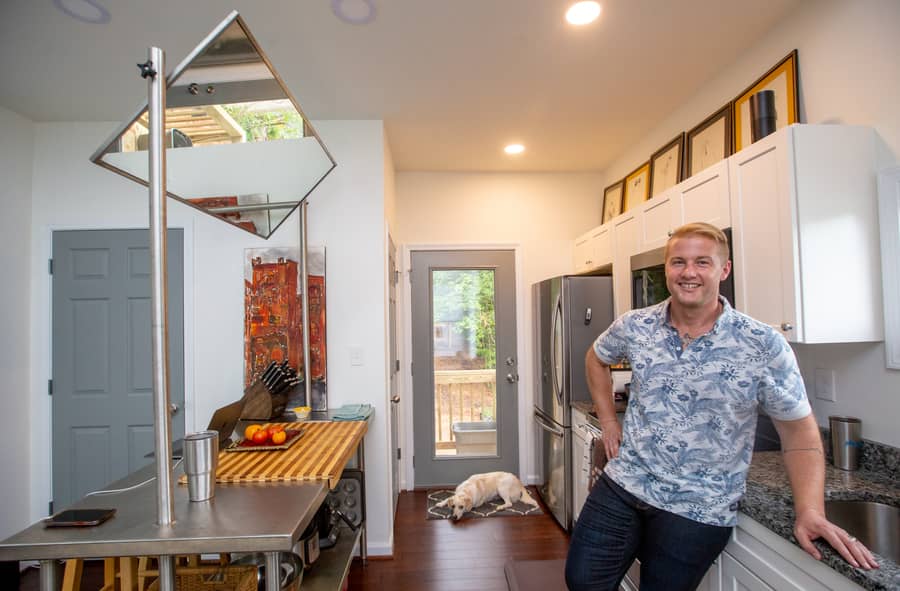
Comfortable Tiny House Living Area
Open-concept designs help the living area flow naturally into the kitchen and entryway. These layouts allow tiny home residents to entertain, relax, and work from home without feeling cramped.
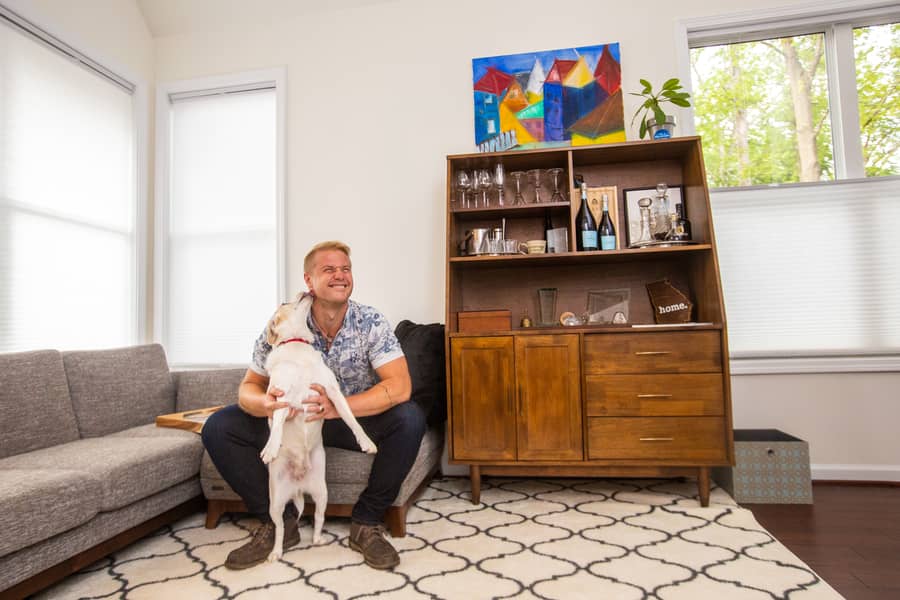
Additional View of the Cottage Kitchen
This angle highlights the thoughtful cabinetry, woodwork, and natural tones used throughout the interiors. Every inch has been optimized for beauty and function, proving tiny homes can feel both modern and timeless.

Village Site Plan and Cottage Layouts
The site plan shows how all eight cottages are arranged around a shared green space, creating a friendly, communal environment. Walkways, gardens, and open spaces make the entire neighborhood feel inviting and human-scaled.

Project Details and Cottage Plan Options
The new pocket neighborhood, situated on a half-acre lot a block away from downtown Clarkston, includes eight micro-cottage homes, a common green space for gathering, and climate-conscious development features such as solar panels and edible, regenerative landscaping. You can now purchase our 250 square foot floor plan as well as our 492 cottage home plan.
Highlights
- MicroLife Institute collaborated with Clarkston, Georgia, to create a “micro pocket neighborhood” with eight tiny homes.
- The homes range from 250 to 550 square feet and were sold for $119,000 to $201,000.
- The development incorporates environmentally friendly features like solar panels and edible landscaping.
- An initial interest list had 1,500 people, highlighting significant demand for such housing solutions.
- MicroLife Institute offers plans for these homes, facilitating replication in other areas.
- The neighborhood includes common green spaces and aims to address affordable housing needs.
- Interested individuals can access resources and purchase house plans through the MicroLife Institute’s website.
Learn more:
Related stories:
- Sno: Modern Scandinavian Cabin Plans for Sale!
- HTH 2-Bedroom Tiny House Plans
- 753 Sq. Ft. Mønhuset Longhouse Small Home Design
Our big thanks to Patrick for sharing!
You can share this using the e-mail and social media re-share buttons below. Thanks!
Frequently Asked Questions
What is a micro cottage neighborhood?
A micro cottage neighborhood is a small-scale residential community designed around compact homes—usually 250 to 600 square feet—with shared green space, walkable layouts, and sustainable features. Cottages on Vaughn is one of the best examples in Georgia.
How big are the cottages at Cottages on Vaughn?
The cottages range from 250 to 550 square feet. Despite their small size, they feature full kitchens, living areas, bathrooms, storage, and beautiful outdoor porches.
How much did the homes cost?
The original cottages sold between $119,000 and $201,000, depending on the size and layout. Prices may vary for anyone building similar designs today.
Are the cottage floor plans available to purchase?
Yes. The MicroLife Institute now offers official architectural plans for both the 250 sq. ft. and 492 sq. ft. cottages. These plans make it possible to recreate similar neighborhoods elsewhere.
Where is Cottages on Vaughn located?
The community is located in Clarkston, Georgia, on a half-acre lot just one block from downtown. It is considered Georgia’s first micro cottage neighborhood.
Can I visit or tour the community?
The original eight homes are privately owned, but public case studies, photos, and project documentation are available through the MicroLife Institute.
Are tiny home communities allowed in other cities?
Zoning varies widely by city. Many towns are now exploring pocket neighborhoods, cottage clusters, and tiny home villages as affordable housing solutions. Always check with your local zoning office before planning a build.
Love tiny homes like these?
Get our Free Daily Tiny House Newsletter for the best new tours, small house plans, DIY builds, and tiny living inspiration — delivered fresh every morning.
More Like This: Tiny Houses | Small Houses | Communities | Tiny House Plans
See The Latest: Go Back Home to See Our Latest Tiny Houses
Disclosure: This post may contain affiliate links. If you purchase through one of our links, we may earn a commission at no additional cost to you.


Alex
Latest posts by Alex (see all)
- An In-Stock Starlink-Ready Scamp 13 Deluxe Layout A - October 16, 2026
- An In-Stock Scamp 13 Deluxe Layout A With Heat-Strip A/C and Lithium - October 16, 2026
- The Most Affordable Scamp on the Lot: An In-Stock Scamp 13 Layout 1 - October 16, 2026





These are nice. This is a nice community. I don’t know that I would want to be that close to the next house, though.
Very well done! I adore this kind of thing! How lovely it would be to have blocks of small/tiny house “villages” scattered through a town rather than several floor multi-apartment “ghetto blocks” (as my late Mother called them) as is happening in my beautiful home town of Fayetteville, Arkansas. My town is the home of the mother campus of the University of Arkansas with 30,000 or so (it rises each year) out of area students, each of whom needs local housing. The developers here have for years (and continue to) build large blocks of apartments, which are approved by the city authorities. A dear friend of mine (Harvard PhD… a kind scholarly gentleman) recently spend 4 months in my town and his verdict: “This lovely town is being ruined by new blocks of privately-owned high rise apartments that are spreading like a terrible disease.” How much better it would be for these small/tiny house villages to be approved and built instead. No doubt it is more expensive to build clusters of small/tiny house villages than 3 to 5 story high-rise apartment complexes, and of course developers go for the bottom line: PROFIT. Anyhow…. highest praises to the city government of Clarkston, Georgia, and the developers that created this lovely in-town village. These comments are respectfully submitted. Stephan of Arkansas
Exactly what is happening in New Zealand… ironically introduced by a Labour Government, rather than a National Government. We’ve got to house immigrants… why? We’ve got a population of just over 5 million now. I don’t want hordes of immigrants flooding the country. But no, the Labour Government says we have to. I suspect a vast majority of people here think the same way. But “Jacinda” has decided and made it a “right” to build 6 stories. One look at what has transpired in Wellington fair gives me the sh*ts.
I’ll bet you’ll really enjoy lugging everything you buy from the parking lot to your house in the humidity and rain. UGH….can’t fathom spending 150k+ and can’t park next to my side door. They may be pretty but NOT practical.
Hi Paula. It seems to me that yours is a fair comment. Small or tiny house living — especially without adjacent parking — is not for everybody. No doubt there will be such housing with a parking place right in front of or beside it, so that would be for folks like U. I am almost 75 years old, with rheumatoid arthritis, and walk slowly with a cane. As it is now, I walk approx 65 ft from my parking place to my apartment door… and I am glad to do it. It forces me to stay active. But hey, to U what U like; to me what I like. Hopefully U would agree that to each her/his/its own.
Proximity to parking isn’t always an issue, as some people just don’t travel and it has become popular to have just about everything covered by a delivery service. Especially, after the lock down made such services more wide spread.
While some people don’t get enough exercise and may find short walks actually beneficial.
So, whether practical or not will vary on the individual and their situation. Along with level of willingness or resistance to adapting…
They are cute but way out of my price range. I have a 3 bedroom 2 bath house that I only paid 120,000.00 for. I have a nice big back yard and a nice size front yard. I would like to go tiny,but the prices out there are too high for me. I’m retired and only have an income of 564.00 per month. Thank god my house is paid for.
Location is always a factor on the pricing of any real estate property. Generally, the more rural the lower the costs and the more urban then the higher the costs, along with other variables like supply and demand, tract home vs high end custom, what is and isn’t included, and old vs new as most of the cost would be in new construction but that doesn’t get passed on to subsequent owners… So they won’t all be in this price range, just these in this location and time…
While there could be ways to leverage your existing property to live a more efficient life without needing to actually switch to a tiny house… There’s usually multiple ways to do just about anything. Just also always trade offs and what works best will vary upon situation…
Can I just buy the home plans & blue print? If so,how? & how much?
Thx
@Licha, https://www.microlifeinstitute.org/shop.
@Stephan of Arkansas, we really like Fayetteville! I’d love to live in one of the loft apartments on the square, or at least somewhere within walking distance to Hugo’s (for those who don’t know, a basement cafe off of Fayetteville’s town square that serves great food). Our problem is affordability.
Greetings Dick @Licha,
My hometown of Fayetteville, Ark., is delightful in every way EXCEPT THAT it is growing much too rapidly and now has approx 90,000 residents. Old town Fayetteville is beautifully green with mature trees dotting the landscape. But the new outer areas of Fayetteville are, in my view, suffocating. Developers are building multiple dozens of houses at a time, whole blocks in fact, that are crammed closely together, with mature trees bulldozed and later tiny 5 ft tall stick saplings are planted in place of them, and far too often the developers do not take the time/money to water and groom such saplings and so many of them die. Old town is the place to be, but prices have sky-rocketed and are beyond budget of my middle class friends. A condo on The Square is I understand is more than $1.5 million. As U say, Hugo’s restaurant just off The Square is a delight. These comments are respectfully submitted. Stephan of Arkansas
Four years later: The above link is dead. The new link is https://www.microlifeinstitute.org/cottage-plans/cottages-on-vaughan-plans.
Thank you, Dick! You were absolutely right about the old link being dead. I’ve updated the post with the new link you shared. Appreciate you helping keep things accurate for everyone!
Pocket neighborhoods were very popular around the turn of the last century and were beautiful. This neighborhood is great! I love the cottagey feel to all of the homes and even though some will say they are too close together, I see neighborhoods with McMansions that don’t have much space between houses, either. Many people with busy lives or who no longer want the work of a big yard will appreciate these smaller than normal lots…I would, for sure! I have been suggesting something similar to my own City for years but so far there is no movement in that direction. These are so much better than apartments and thankfully smaller than the monster houses we see being built. Smaller houses on smaller lots are an excellent way to make single family homes affordable either as a starter home or a retirement community. Hope there aren’t any HOA’s…I’d like to do the gardening myself and don’t want the added monthly expense. If I could change one thing it would be to have my parking space right by my house. I’m sure creative planning could make that possible so it didn’t feel like apartment living.
If we are to have any wild areas left in the years to come, we all better get used to the idea of high density housing. Our city has some very attractive condo/apartment complexes and they may not be for everyone, but they utilize land really well. These small-house pocket neighborhoods are a great alternative for those who really don’t want to share walls…though if apartment buildings were insulated properly, we wouldn’t hear each other which is one of the biggest complaints…and want a little land to putter around in and have a BBQ grill, etc.. Location, as mentioned in several comments, is key to pricing but the smaller lot sizes should help to make homes more affordable. In all of history, homes that are closer to downtown are generally more expensive and I can’t see that being different but what if these small communities went a bit further and had businesses that would provide jobs, too, to reduce commute times and use less fuel. Clusters of small neighborhoods could share a common shopping area with a grocery store, dry cleaner, small shops and other places that would provide both jobs and services. How great it would be to have these small communities be near railways for those who still work a distance away? We all need to start thinking differently to make our growing population fit into smaller spaces than in the past when land seemed to go on and on without end. I don’t know all the answers but I do know our mindset has to shift if we are to have a good quality of life for everyone. Water will become scarce in some areas, electricity is expensive everywhere and getting worse, McMansions are unwelcoming and poorly designed multifamily buildings can become a blight quickly. Those who live in dense housing need to take some responsibility for keeping it nice looking as do the landlords if they are rentals. Yes, some families need a large house so we need to come up with combination neighborhoods. We all better try to think in ways that benefit the community while still providing good choices.
Cool. I like them.
I wish someone would build a community like this in the Charlottesville area. I love it!