Disclosure: This post may contain affiliate links. If you purchase through one of our links, we may earn a commission at no additional cost to you.
Around 1980, a New Mexico geologist named Bruce Black decided the perfect office would be inside a cliff. So he hired two out-of-work miners he met at a café in Durango, handed them dynamite, and had them blast a 1,700-square-foot room straight into a wall of 60-million-year-old sandstone above Farmington. The whole excavation reportedly cost about $20,000.
There was just one problem: clients weren’t eager to hike 70 feet down a cliff face for a meeting. The office sat empty for years, until the family finished it out as a home and, in 1997, opened it to guests. Today it’s Kokopelli’s Cave, one of the most unusual places to spend a night in the American Southwest, with a full kitchen, a waterfall shower, a rock-walled Jacuzzi and a view across four states.
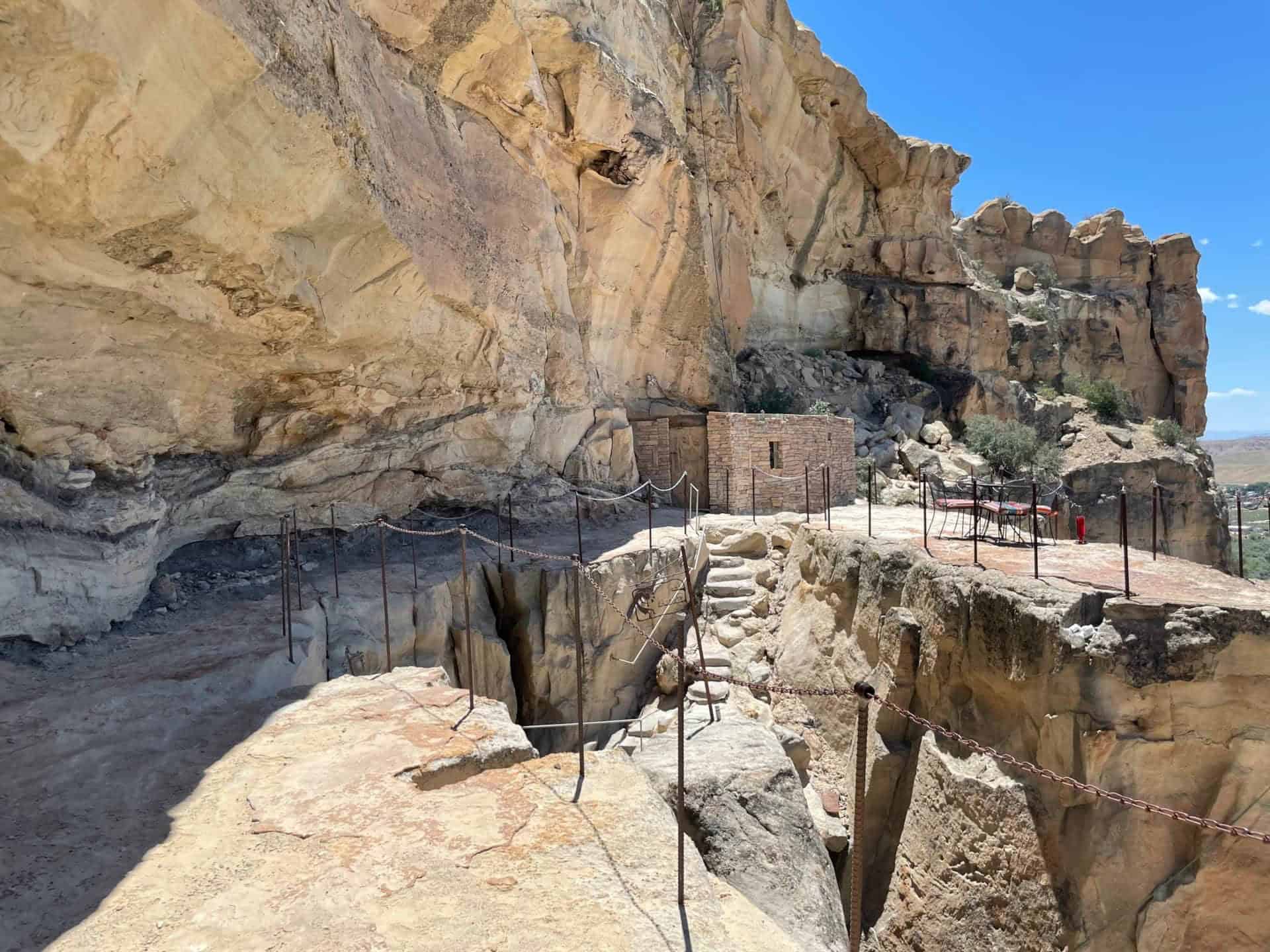
A Cliff Entrance You Have to Earn
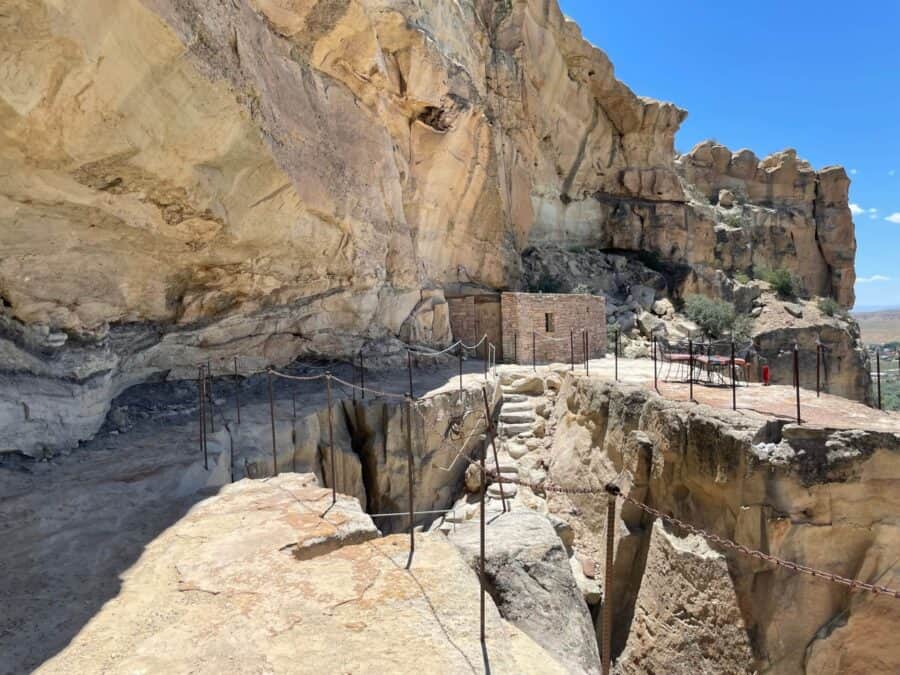
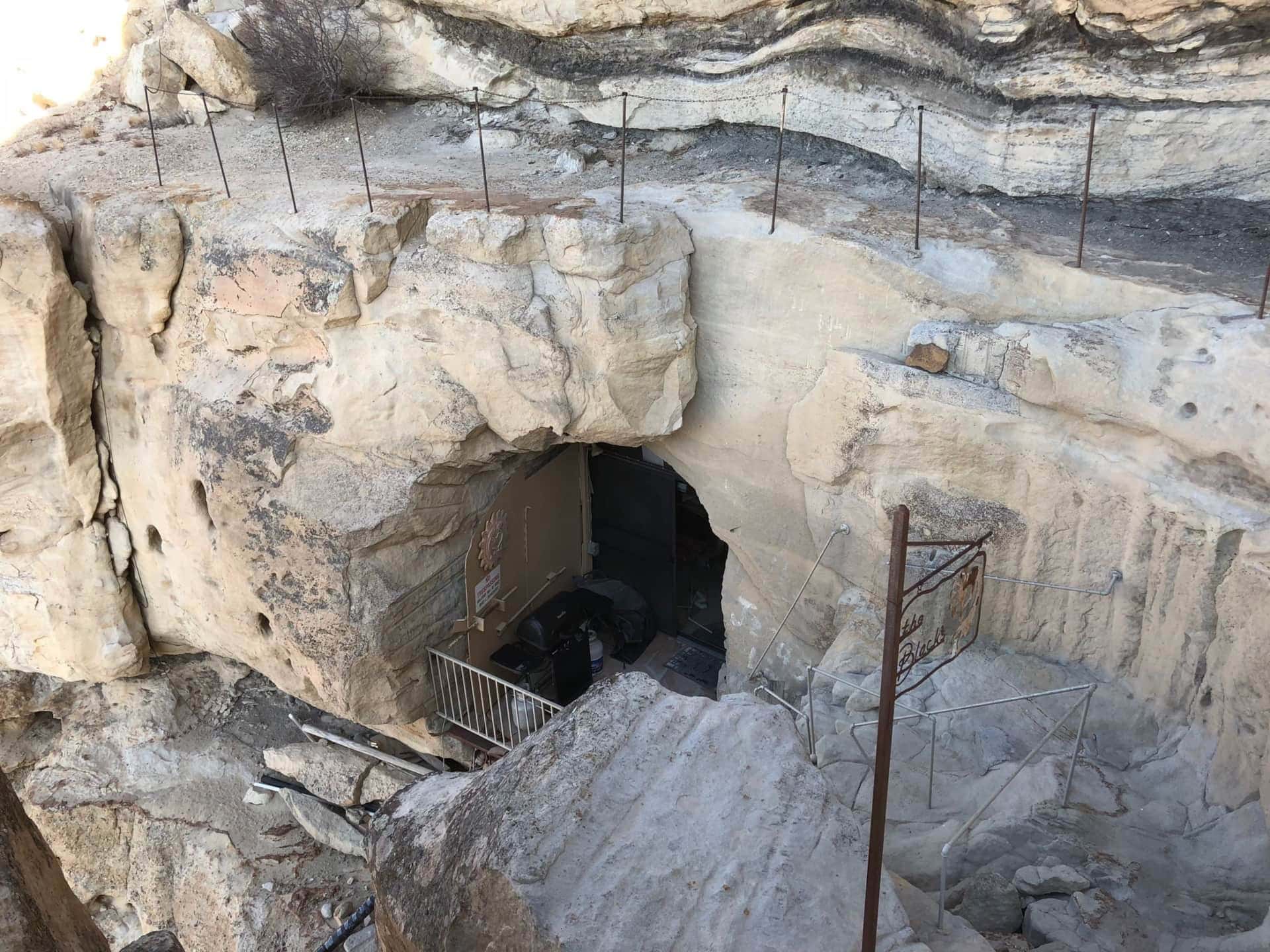
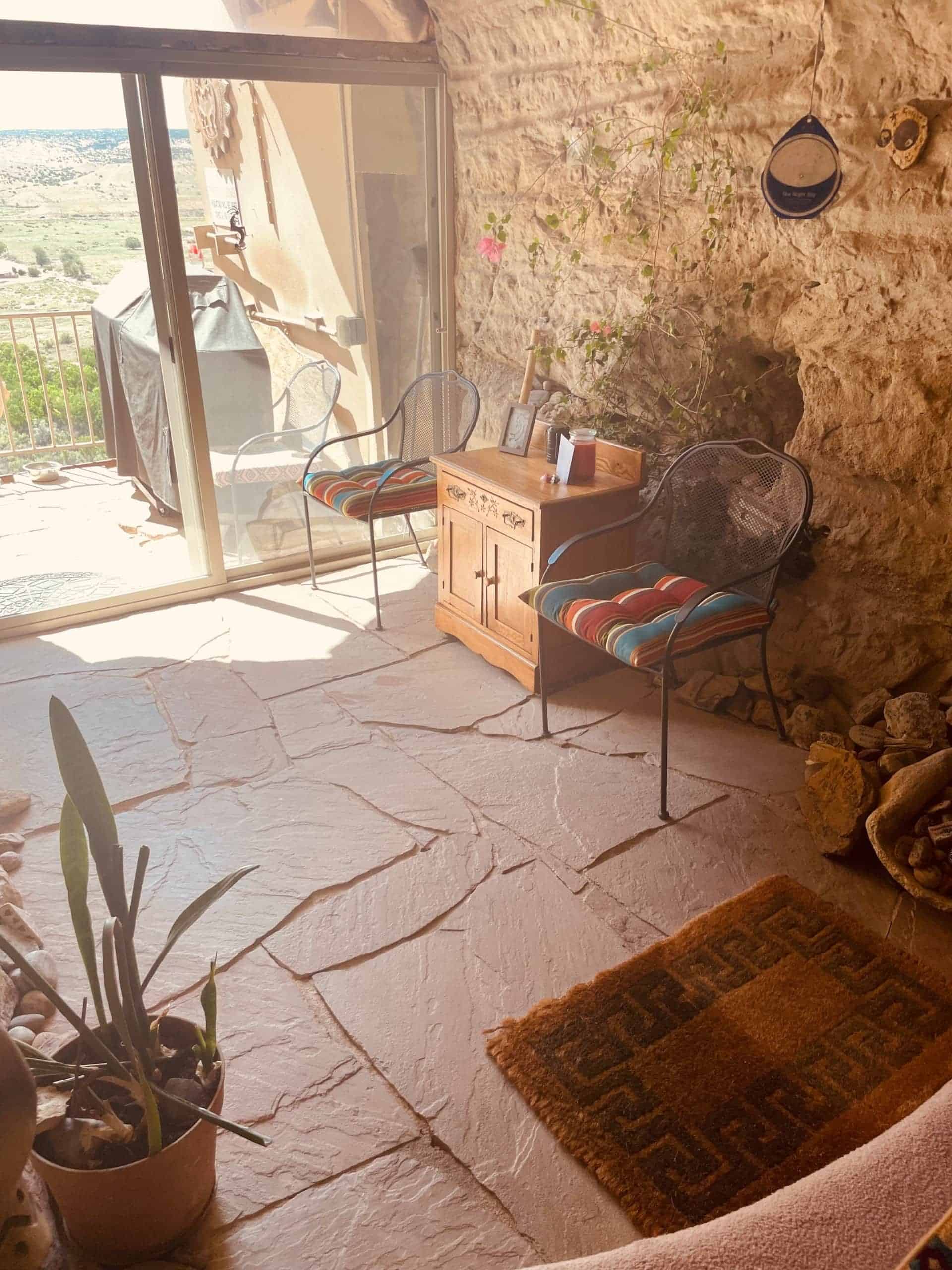
There’s no driveway at the front door, because the front door is in the middle of a cliff. You park (or lock your car in the single-car garage) on the mesa top, then walk down a sloping path and steps cut directly into the sandstone. The entrance opens onto a small porch hanging over the La Plata River valley, about 300 feet below.
That walk is the whole point, and also the whole caveat. There’s no elevator, the site is wheelchair-inaccessible, and the operator’s own advice is to pack light, ideally in a backpack. Think of it as the reverse of a mountain cabin: the hike comes at the end of the day instead of the start, and the reward is a room the outside world can’t reach.
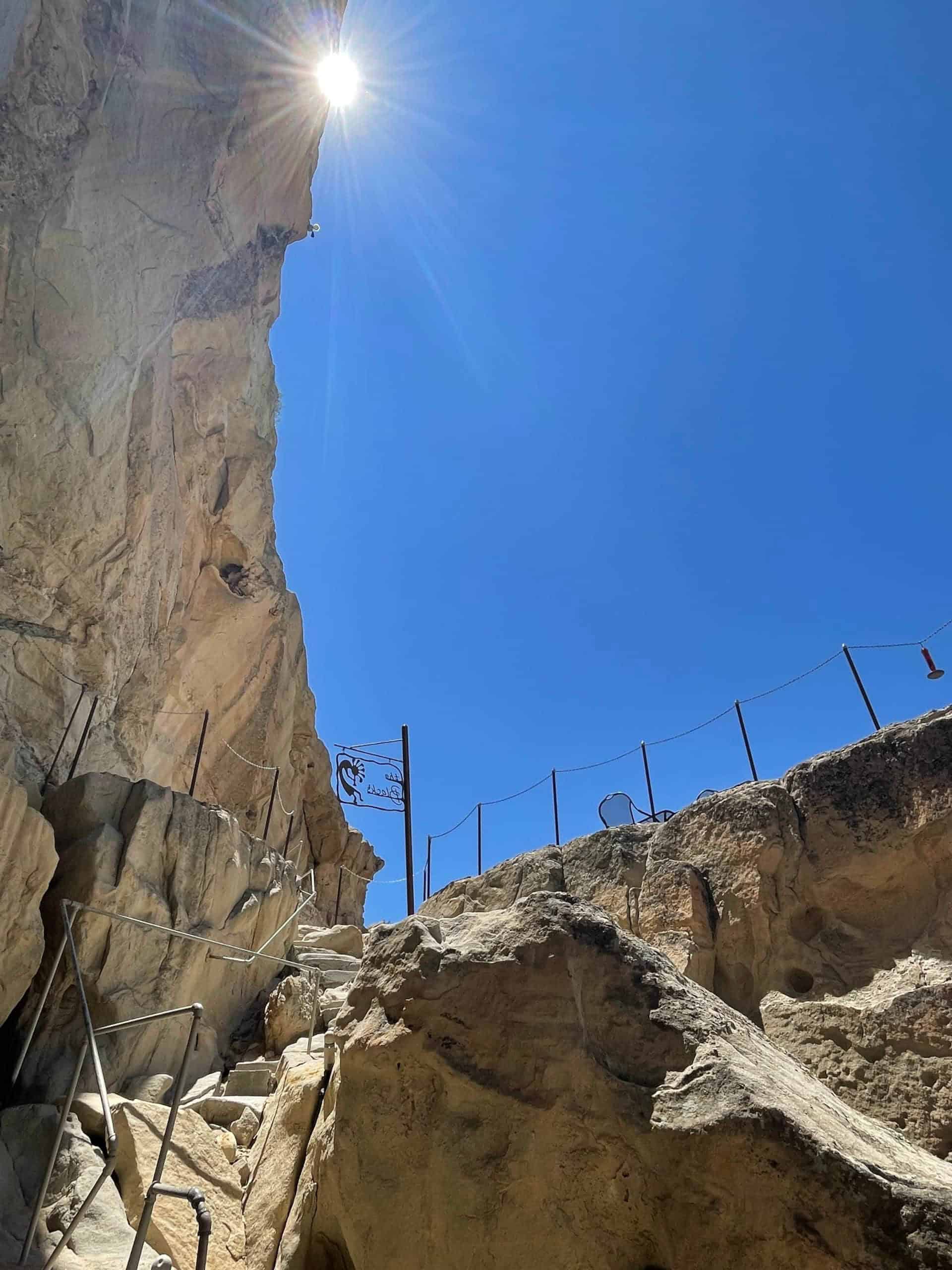
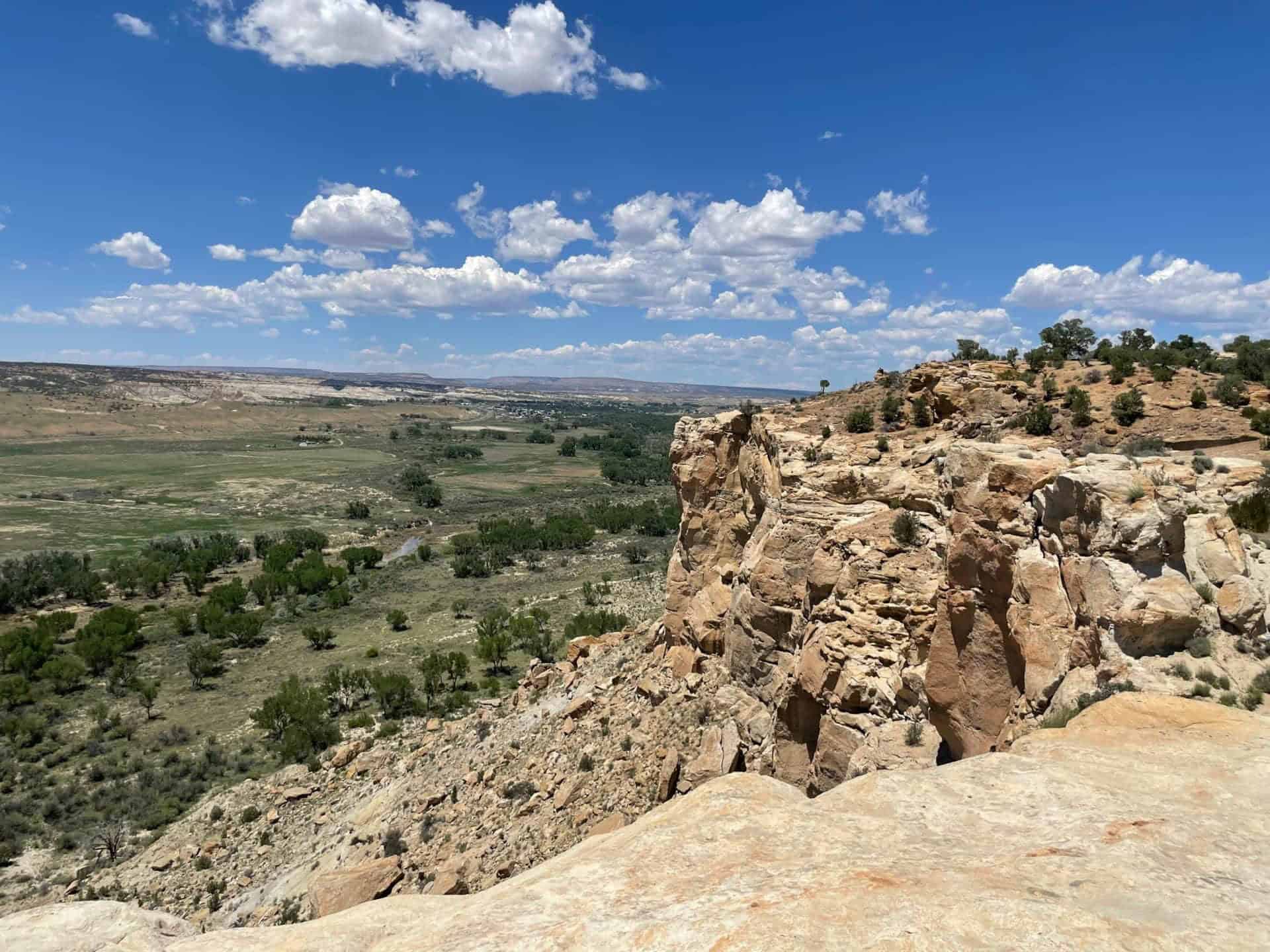
Views Across the Four Corners
The cave was cut into the vertical cliffs of the Ojo Alamo sandstone, a formation geologists know well in the San Juan Basin. From the cliff top and the cave’s two porches, you look out over the river valley toward the meeting point of New Mexico, Arizona, Utah and Colorado. Sunsets here are the main event. With no neighbors in sight and no light pollution to speak of, the evenings are as much of a draw as the cave itself.
Stepping Inside the Sandstone
The first room past the door is a carved entryway with a sliding glass door to the porch, which is how daylight gets into a space that’s otherwise fully enclosed in rock. This is a smart bit of design worth noticing. Rather than burrowing straight back into the cliff, the cave runs along the cliff face, so both the entry and the bedroom get a glass wall and a porch. The result feels far less like a tunnel than you’d expect.
A Living Room Built Around a Stone Pillar
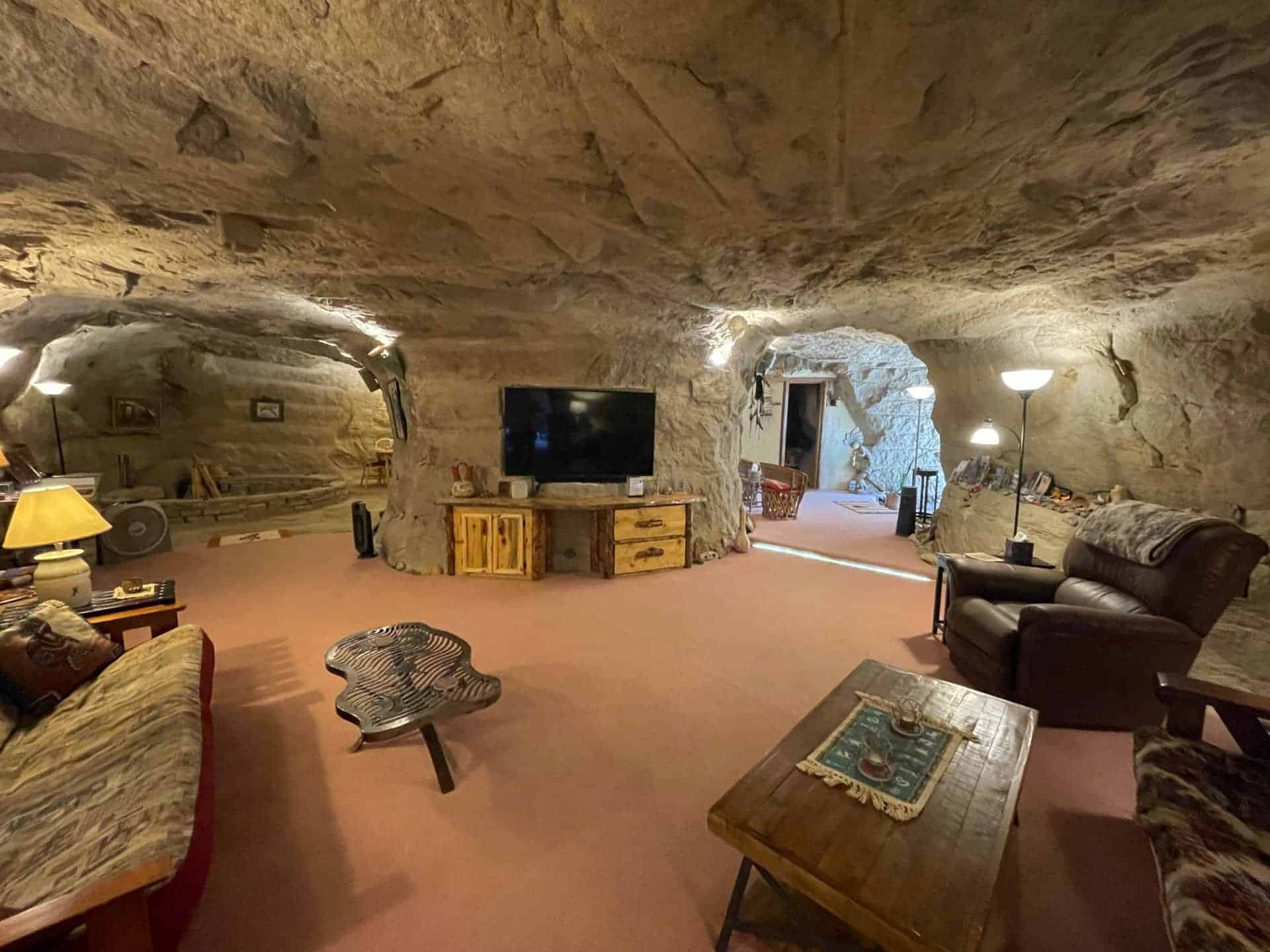
The miners left a huge column of sandstone standing in the middle of the cave, and it’s still holding up the ceiling. Every room except the bedroom and bath wraps around that central pillar, so it doubles as structure and room divider. Carpet softens the floor, the walls are left raw, and modern comforts are tucked in where you’d least expect them: Wi-Fi, a smart TV, a washer and dryer, and even lighting you can control by voice.
Best of all, there’s no thermostat battle. Like most underground spaces, the cave holds a steady 68 to 73 degrees year-round, which makes it cool in a New Mexico July and snug in January.
A Replica Kiva at the Dining Table
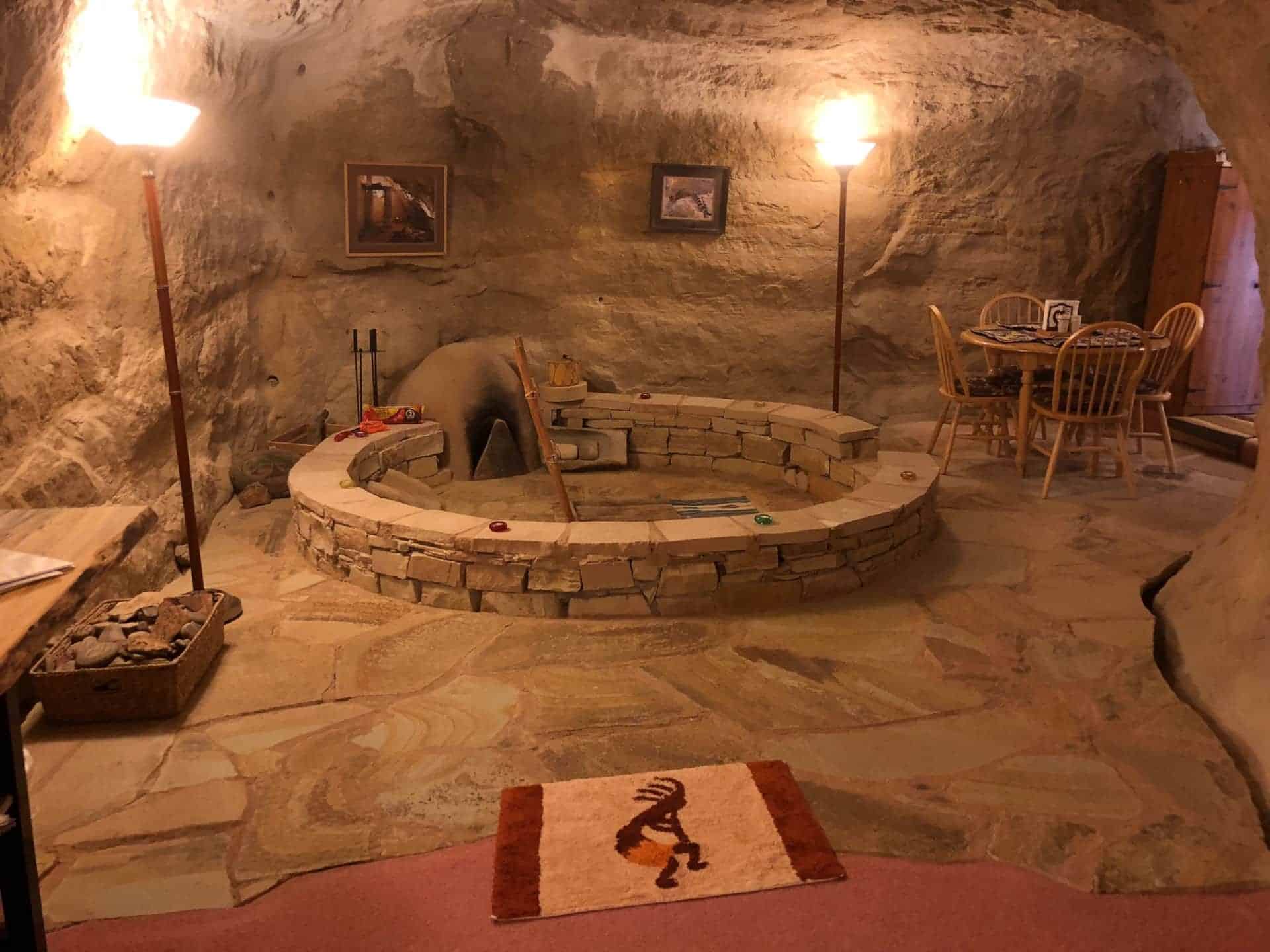
One of the cave’s most memorable touches is a replica of a Native American kiva, the round ceremonial room found at Ancestral Puebloan sites throughout the region. Here it’s a circle of stacked stone beside the dining area. It’s a nod to local history: Aztec Ruins National Monument, which has a reconstructed great kiva of its own, is a short drive away.
The full kitchen is stocked for real cooking, with an oven, stove, microwave, refrigerator, toaster and coffee maker. There’s also a gas grill. Continental breakfast items are included with your stay, along with a welcome bottle of wine. Water flows down from a tank above the cave, so the kitchen and bathroom have working plumbing.
Sitting Room and Bedroom Behind a Rock Arch
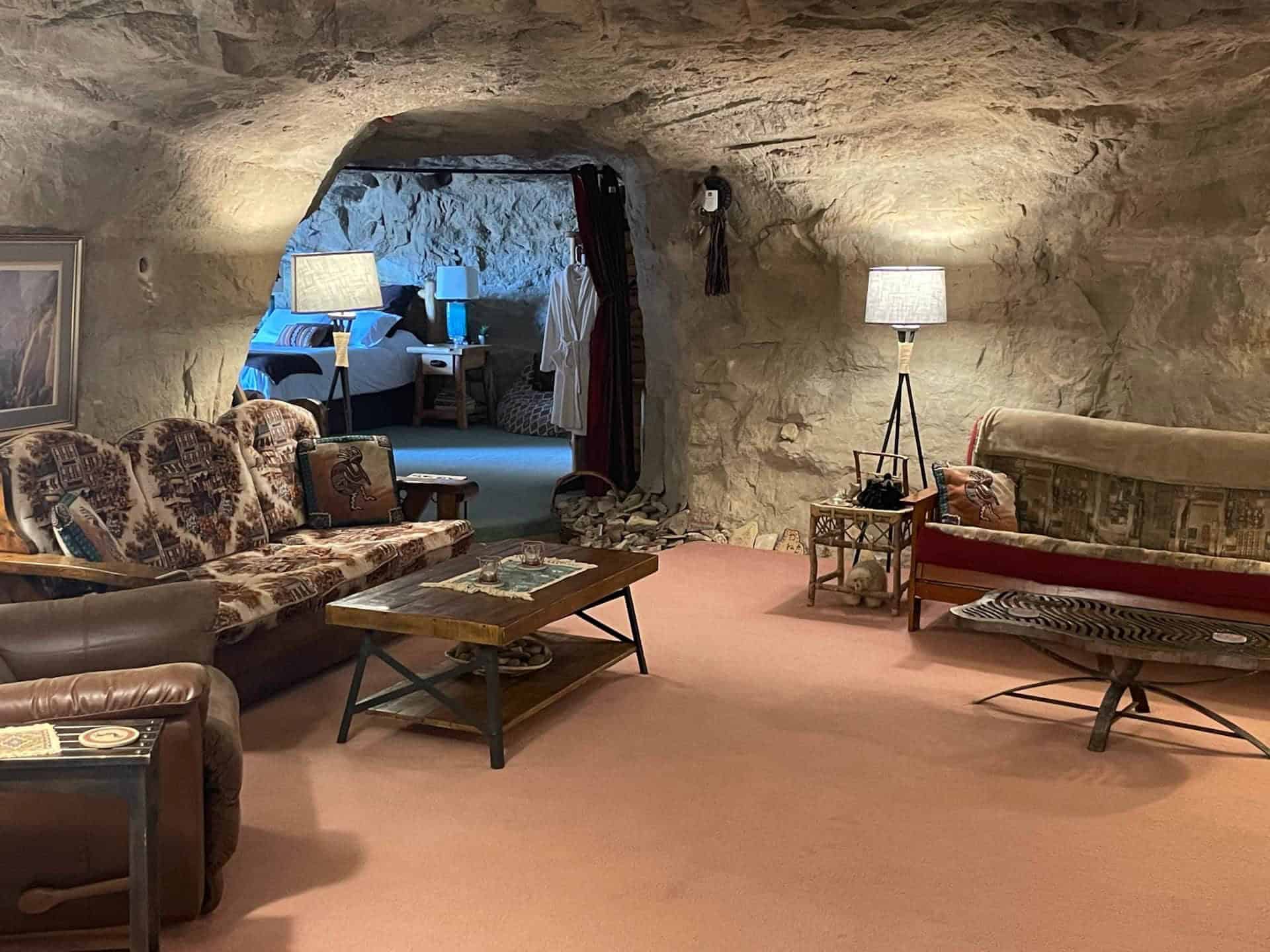
Past the sitting area, a natural-looking rock arch leads to the master bedroom with its queen bed and its own porch and sliding glass door. The listing sleeps up to eight guests using a queen bed, a sofa bed and a fold-away bed. In practice, the cave is happiest with a couple or a small family, since there’s one bedroom and one bathroom to share.
A Waterfall Shower and a Stacked-Stone Jacuzzi
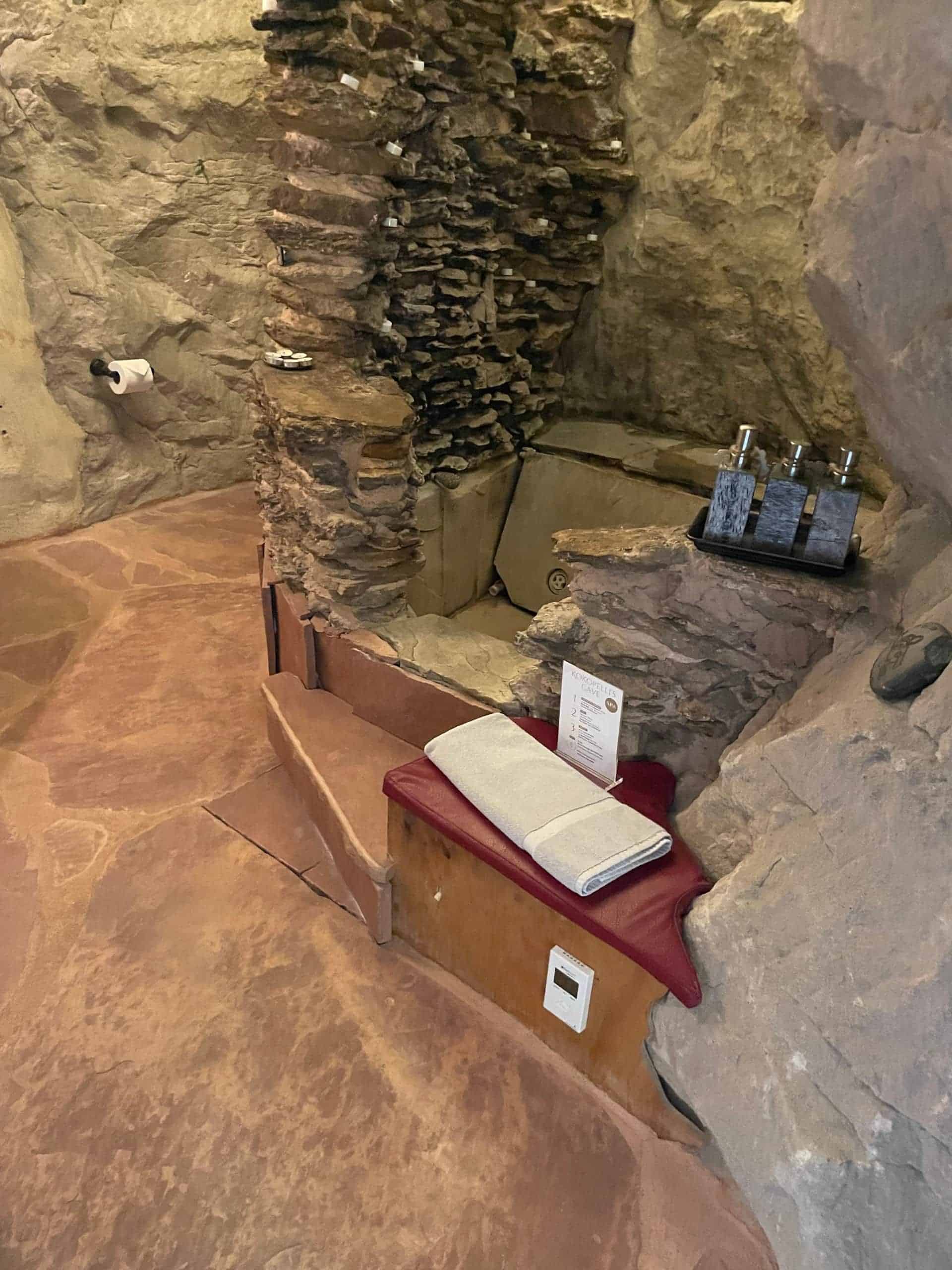
The bathroom is the room people tend to talk about afterward. The rock walls were left in place and turned into a grotto, with a waterfall shower and a Jacuzzi tub set into stacked stone and flagstone. Candles tucked into the rock finish the effect. It’s an eye-opening example of how far a cave space can go beyond “rustic” when the builders lean into the stone instead of covering it up.
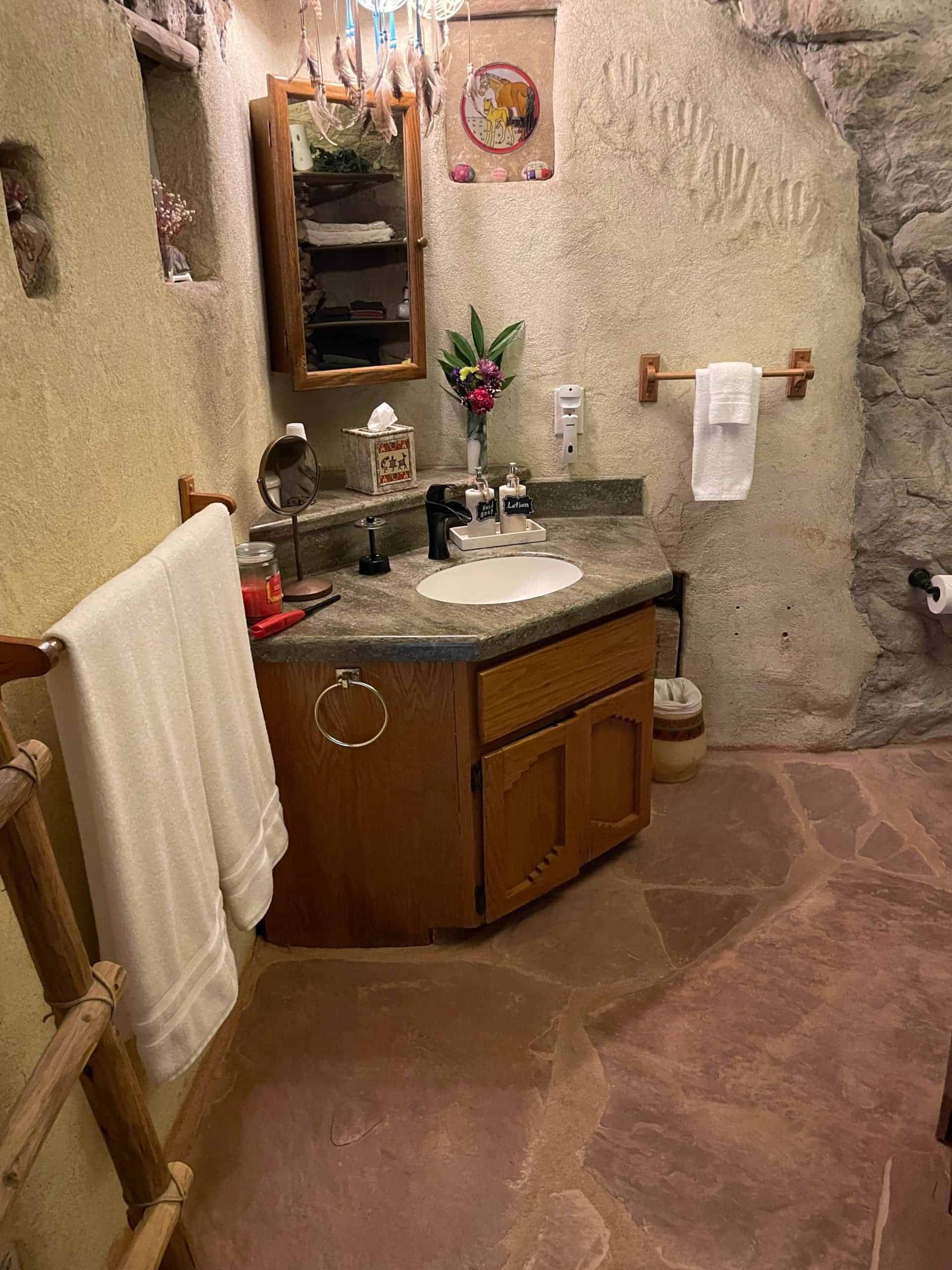
The vanity continues the theme with a carved wooden cabinet, flagstone floor and a patchwork of rock walls.
Design Details
- Location: Cliffs above the La Plata River valley, Farmington, New Mexico (Four Corners region)
- Size: About 1,700 square feet
- Depth: Roughly 70 feet below the cliff top, about 300 feet above the valley floor
- Rock: Ojo Alamo sandstone, around 60 million years old
- Built: Blasted out around 1980 as a geologist’s office; opened to guests in 1997
- Layout: Entryway, living room around a central sandstone pillar, replica kiva and dining area, full kitchen, master bedroom, bathroom, two porches
- Sleeps: Up to 8 (queen bed, sofa bed, fold-away bed); 1 bedroom, 1 bathroom
- Climate: 68–73°F year-round
- Amenities: Waterfall shower, Jacuzzi tub, full kitchen, gas grill, washer/dryer, Wi-Fi, smart TV, garage parking at the top
Stay Details
- Rate: The operator lists a default rate of $380 a night for two guests, plus $50 per additional guest per night (check the booking calendar for current pricing)
- Included: Continental breakfast items and a welcome bottle of wine
- Check-in / out: 4:00 PM / 11:00 AM
- Policies: Children welcome; no pets; no smoking; not wheelchair accessible
- Cancellation: Full refund if canceled 14 or more days before arrival
- Season: The cave has closed during winter weather in past years, so check availability before planning a cold-season trip
What Makes This Cave Special
- It was never meant to be a home. A geologist’s office idea, a couple of miners and some dynamite produced one of the country’s most famous cave stays almost by accident.
- It runs along the cliff, not into it. Two glass-walled porches bring in daylight and views, solving the biggest drawback of living underground.
- The rock does the work. The central pillar is both the structure and the floor plan, and thermal mass keeps the temperature steady without heavy heating or cooling.
- It embraces the stone. The bathroom shows how leaving rock exposed can feel luxurious rather than primitive.
- The access is part of the experience. The cliffside walk filters out casual visitors and makes the cave feel genuinely remote, even though Farmington is minutes away.
More Cave and Underground Stays We’ve Featured
If Kokopelli’s Cave has you hooked on living inside the earth, here are more caves, cliff dwellings and underground homes from the Tiny House Talk archive:
- Historic Cave Home in Spain: a restored traditional cave house in Guadix, Andalucía, one of the world’s great cave-dwelling regions
- Dugout Dick: Idaho’s Cave Dwelling Community on the Salmon River: the man who hand-dug an entire village of caves over 60 years
- Epic Cave Vacation with Hot Tub Sleeps 7: a Washington home built between two boulders with a hot tub in a real cave
- Cozy Underground Cottage at Purposely Lost Retreat: a luxurious earth-sheltered stay in the Maine woods
- Cliffside Dwelling in Campton, Kentucky: a two-part cabin bolted to a cliff line in Red River Gorge country
- Tiny Stone Cellar Cottage in France: a cozy studio carved out of the cellar beneath an old stone house
- Casa Aljibe: Home Built In & Over an Old Cistern: a house that makes its home inside an old underground water tank
- Man Living in an Underground Home on $5k/Year: a moss-roofed underground home built for frugal living
- They Built a Tiny Earth Home in New Mexico… And It’s Round!: another New Mexico stay that puts you right inside the land
- Top Quirky Tiny House Rentals: our roundup of the strangest and most delightful places to spend the night
Learn More
- Kokopelli’s Cave overview and booking
- Full photo gallery
- Nightly rates and contact the property manager
- KOB 4: Farmington bed and breakfast built inside a man-made cave
So, would you make the cliffside walk to sleep 70 feet inside the rock? Or is the waterfall shower enough to talk you into it? Tell us in the comments!
If you enjoyed this you’ll LOVE our Free Daily Tiny House Newsletter with even more!
You can also join our Small House Newsletter!
Also, try our Tiny Houses For Sale Newsletter! Thank you!
More Like This: Vacations | Tiny Houses For Rent | Tours & Features
Disclosure: This post may contain affiliate links. If you purchase through one of our links, we may earn a commission at no additional cost to you.


Alex
Latest posts by Alex (see all)
- From Shipping Container to Family Home: An Expandable 775-Sq-Ft Prefab in Rural Cyprus - October 18, 2026
- Kokopelli’s Cave: A Geologist’s Dynamite-Blasted Cliff Office Turned Cave B&B in New Mexico - October 18, 2026
- BuildX Whitman ADU: A One-Level Two-Bedroom Backyard Home with Cathedral Ceilings - October 18, 2026