Disclosure: This post may contain affiliate links. If you purchase through one of our links, we may earn a commission at no additional cost to you.
The Going Tiny Series, Part 13 of 45 · Guide 2 of 5: Where Can I Put It?
A free chapter goes up every day. See every part. Rather have it all at once, with printable worksheets? Get the Going Tiny Toolkit.
Set aside about three hours. Grab Worksheet 1 (Jurisdiction Finder) and Worksheet 2 (Zoning Code Search Log), a cup of coffee, and a computer. You don’t need to call anyone yet. By the end, you’ll either know the answer or know exactly what question to ask.
Step 1: Find out who’s in charge (20 minutes)
The first job is finding your jurisdiction, the government whose rules apply to a specific piece of land. This trips people up because a mailing address isn’t always a reliable guide. Your mail might say “Springfield” when the land is actually outside city limits.
- Inside city or town limits: the city’s zoning and building rules usually apply.
- Outside city limits (“unincorporated”): the county usually controls zoning, though some counties have little or no zoning in rural areas.
- Townships: in some states (parts of the Midwest and Northeast), townships do their own zoning.
- Extra layers: some cities control zoning a short distance beyond their limits; some areas are inside special overlay districts (historic, coastal, airport, floodplain).
How to find out: Search for “[county name] parcel viewer” or “[county name] GIS map.” Most U.S. counties have a free online map where you can click a parcel and see who owns it, its size, and often its zoning district and whether it’s inside city limits. If you’re looking at a general area rather than a specific lot, click around a few parcels in the neighborhood you like.
Write down on Worksheet 1: the jurisdiction, the zoning district name or code (for example, “R-1,” “AG,” “RR-5”), and the website of the planning department.
Step 2: Find the zoning code online (20 minutes)
Almost every U.S. city and county now publishes its codes online. Many use one of a few code-hosting services, so try these searches:
- “[city or county name] zoning ordinance” or “[city or county name] unified development code”
- “[city or county name] Municode” (Municode hosts thousands of local codes)
- “[city or county name] eCode360” (General Code’s library)
- “[city or county name] American Legal” (American Legal Publishing’s code library)
Some smaller counties post their zoning ordinance as a PDF on the planning department’s page instead. If you can’t find it online at all, that’s your first email question (Part 14).
Also find the zoning map, which shows which district each area is in. It’s usually on the planning department’s page or in the county GIS viewer.
Want to do this on paper?
The printable PDF of Where Can I Put It? has fill-in worksheets for this step, including:
- Jurisdiction Finder
- Zoning Code Search Log
- Call and Email Script Builder
They come with all five guides in the Going Tiny Toolkit.
Step 3: Search the code with the right keywords (60 to 90 minutes)
Don’t try to read the whole code. Use the search box (or Ctrl+F / Cmd+F in a PDF) and look up these terms one at a time. Log each one on Worksheet 2: the keyword, the section number, and a plain-English note on what it says.
| Search for | What you’re looking for |
|---|---|
| minimum dwelling size, minimum floor area, square feet, gross floor area | Any minimum house size, overall or by district |
| tiny house, tiny home, movable tiny house | Specific tiny house rules (newer codes) |
| accessory dwelling, ADU, guest house, secondary dwelling, cottage | Whether a second small home is allowed on a lot, and its size limits |
| recreational vehicle, RV, travel trailer, camper | Whether RVs can be lived in, for how long, and where |
| temporary occupancy, temporary dwelling, temporary use | Living in an RV while building a permanent home; medical hardship provisions |
| camping, campground, RV park | How long camping on private land is allowed; where parks are allowed |
| manufactured home, mobile home, park model, factory-built, modular | Where manufactured homes and park models are allowed |
| hardship, caregiver, family care, elder cottage | Special permits that allow a second unit for caring for a relative (common in some rural counties) |
| definitions (then “dwelling,” “dwelling unit,” “structure”) | How the code defines a home. This decides which rules apply to yours. |
| setback, lot coverage, minimum lot size | How far from property lines you must build; whether a lot is big enough to build on |
Read the definitions section first
Near the beginning of most zoning codes is a “Definitions” section. Look up “dwelling,” “recreational vehicle,” and “accessory dwelling unit.” If the code says a dwelling must be “on a permanent foundation,” that tells you instantly how it treats a house on wheels.
Step 4: Read the district table (30 minutes)
Most zoning codes have a use table (sometimes called a “table of permitted uses” or “land use matrix”). It lists uses down the side and zoning districts across the top. Each box has a letter. The letters vary, but commonly:
- P = permitted by right
- C, CU, or S = conditional or special use (application and usually a hearing)
- A = accessory use (allowed only alongside a main use, like an ADU next to a house)
- blank or – = not permitted
Find your district’s column. Run down it to the rows for single-family dwelling, accessory dwelling unit, manufactured home, and recreational vehicle or campground. Write what you find on Worksheet 2.
Then find the dimensional standards table for your district (often a separate table). It lists minimum lot size, setbacks, maximum height, and sometimes minimum dwelling size.
Step 5: Check the private and health layers (20 minutes)
- If it’s a specific lot: is it in a subdivision? Search the county recorder’s site for recorded covenants, or ask the seller or listing agent for them.
- Search “[county name] environmental health septic” to find septic rules and the application process.
- Look up the flood zone at FEMA’s Flood Map Service Center (msc.fema.gov), which lets you search by address.
Step 6: Write your questions (15 minutes)
At the end of your session, you’ll have one of three results:
- A clear yes: great. Confirm it in writing (Part 14) before spending money.
- A clear no: also useful. Look at the next category (can a 600-square-foot cottage work instead?) or the next town over.
- “It’s unclear”: by far the most common. Write the specific question on Worksheet 3, citing the section number. Officials answer specific, cited questions much faster than general ones.
Research a whole region, not just one town
Rules can change dramatically across a county line. If your target town says no, repeat this session for the neighboring county, the next town over, and a smaller town within 30 minutes of the people and services you need. It’s common to find that a neighboring county has a lower minimum house size, or none at all.
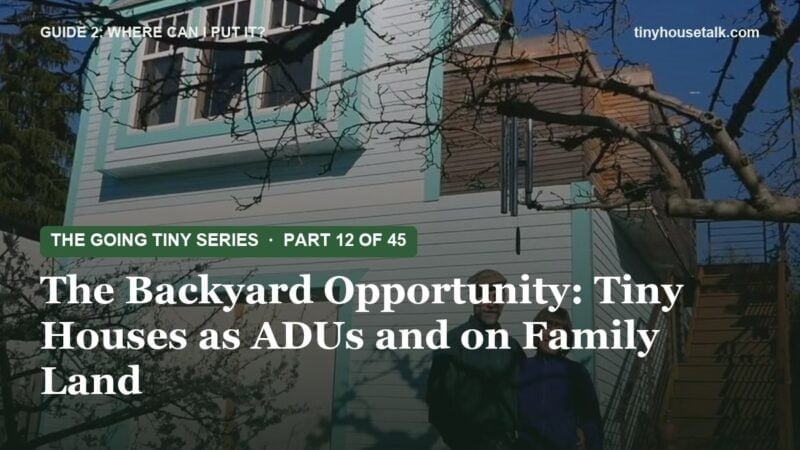
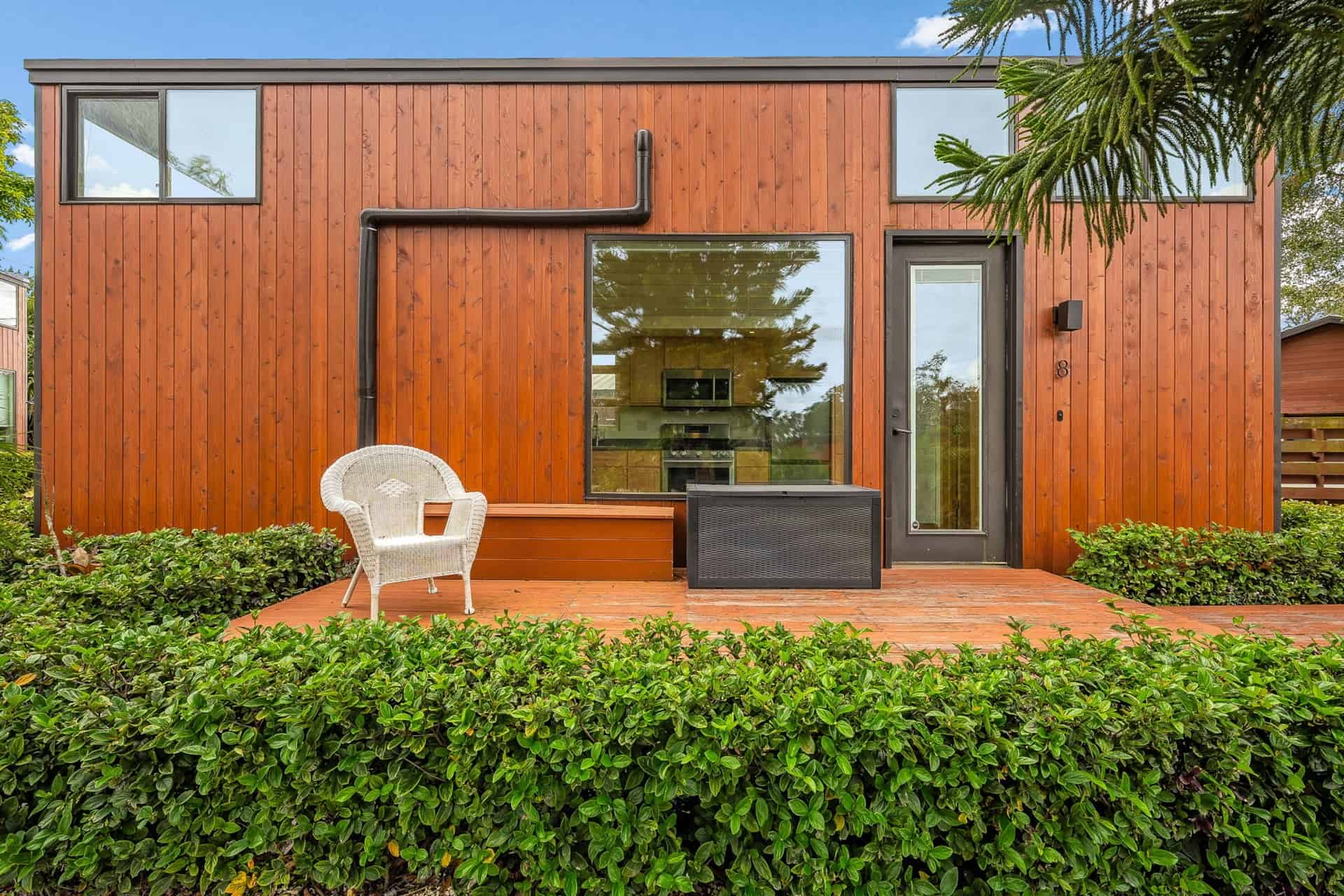
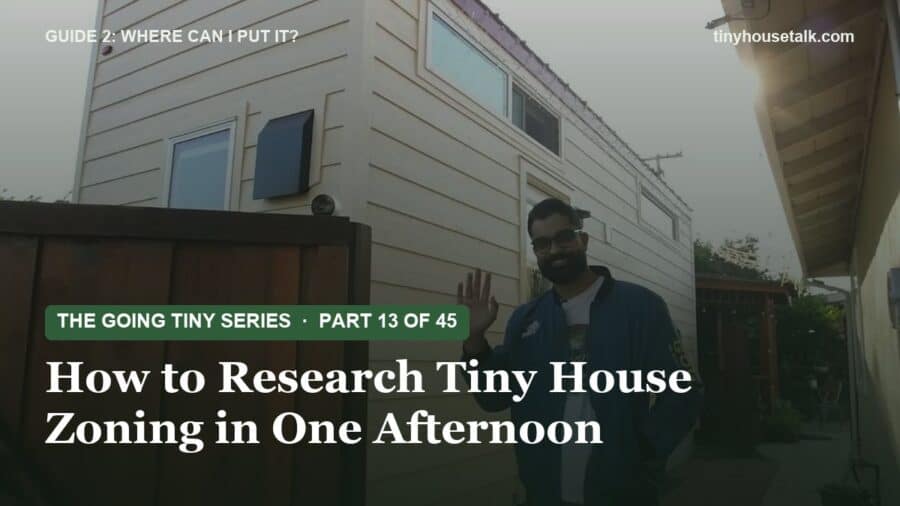
Top photo: Teja's Legal Tiny House in His Parents' San Jose Backyard. Photo via Tiny House Giant Journey/YouTube. See their story.
Your turn
Where are you hoping to put your tiny or small home? Share your state or country in the comments.
Want the whole series in one place?
This series is free to read here, and it always will be. If you’d rather have it as five clean, printable PDFs, that’s the Going Tiny Toolkit:
- Where Can I Put It? (the guide this chapter comes from): zoning research in an afternoon, call scripts and email templates, and a land checklist
- The Tiny House Money Plan
- Tiny Without the Ladder
- Bringing Them On Board
- Your First Tiny Steps
Every guide adds printable worksheets and a 30-day action plan, and Tiny Without the Ladder comes with the bonus One-Level Floor Plan Idea Book (18 to-scale floor plans). All five are $47, with a 30-day refund.
← Previous: Part 12: The Backyard Opportunity: Tiny Houses as ADUs and on Family Land
Next (tomorrow): Part 14: Asking the Zoning Office: Call Scripts and Email Templates
Not sure which part matters most for you? The free 10-minute What’s Really Holding You Back? quiz tells you where to start. And to get a new part (and a new home) in your inbox each day, join the free Tiny House Newsletter.
Disclosure: This post may contain affiliate links. If you purchase through one of our links, we may earn a commission at no additional cost to you.


Alex
Latest posts by Alex (see all)
- She Skipped a $150K Tiny House for an $80K Destination Trailer - October 31, 2026
- A Team Canada Speed Skater’s Off-Grid Tiny House on a Calgary Ranch - October 31, 2026
- How to Research Tiny House Zoning in One Afternoon - October 31, 2026