
Disclosure: This post may contain affiliate links. If you purchase through one of our links, we may earn a commission at no additional cost to you.
Texas occupies a singular place in the American tiny house story. Counties here have very limited zoning power, which means cities set most of the rules, and the results span the full spectrum: Houston has no traditional zoning but its building codes, subdivision rules, and deed restrictions make a permanent tiny home inside the city hard to pull off, while the small town of Spur proclaimed itself the nation’s first “tiny house-friendly town” in 2014 and wrote an ordinance to back it up. Austin’s HOME code changes now allow up to three housing units, including tiny homes, on most single-family lots. Lake Dallas Tiny Home Village bills itself as the first tiny home village of its kind built from the ground up inside city limits under the IRC’s Appendix Q. And in East Austin, a community built around a working organic farm on land with a 120-year-old farmhouse calls itself an “agrihood” and has drawn national coverage. This is a state that does not do anything at small scale, even when the subject is small homes.
This guide covers established tiny house communities across Texas, organized from mission-driven nonprofit villages to purpose-built residential communities to resort-style ownership developments. For each community, we explain what it is, how the land and ownership model works, what distinguishes it from alternatives, and where to find current pricing and availability. Prices marked “checked October 24, 2026” were confirmed on the community’s own website that day; everything else should be confirmed directly before you make plans. The regulatory section explains the patchwork of city-by-city rules that shapes where tiny homes can legally be placed. Projects that are changing, still in development, or that we could not fully verify are grouped in an “On the Horizon” section with appropriate caveats.
Community First! Village: Austin’s Widely Studied Model for Permanently Housing the Formerly Homeless
Developer / operator: Mobile Loaves & Fishes (nonprofit)
Land model: Nonprofit-held community land; residents pay an affordable monthly rent
Home types: Micro-homes, ICON 3D-printed homes, RVs, and canvas cottages
Community size: About 440 formerly homeless neighbors (per Mobile Loaves & Fishes, October 2026); planned capacity of about 1,900 homes when the expansion is complete
Status: Original village fully operational; expansion underway
Community First! Village is the most widely covered tiny home project in Texas and one of the most closely studied communities for formerly homeless residents in the United States. Founded by Mobile Loaves & Fishes, a faith-based nonprofit that has served Austinites experiencing homelessness since 1998, the village on Hog Eye Road in northeast Austin opened its first homes in the mid-2010s and has grown into a master-planned neighborhood that the nonprofit says is now home to about 440 formerly homeless neighbors. The scale of the project, the intentionality of its design, and the depth of its support services have made it a reference point for groups around the country looking to build similar communities; Mobile Loaves & Fishes runs a formal replication program for them.
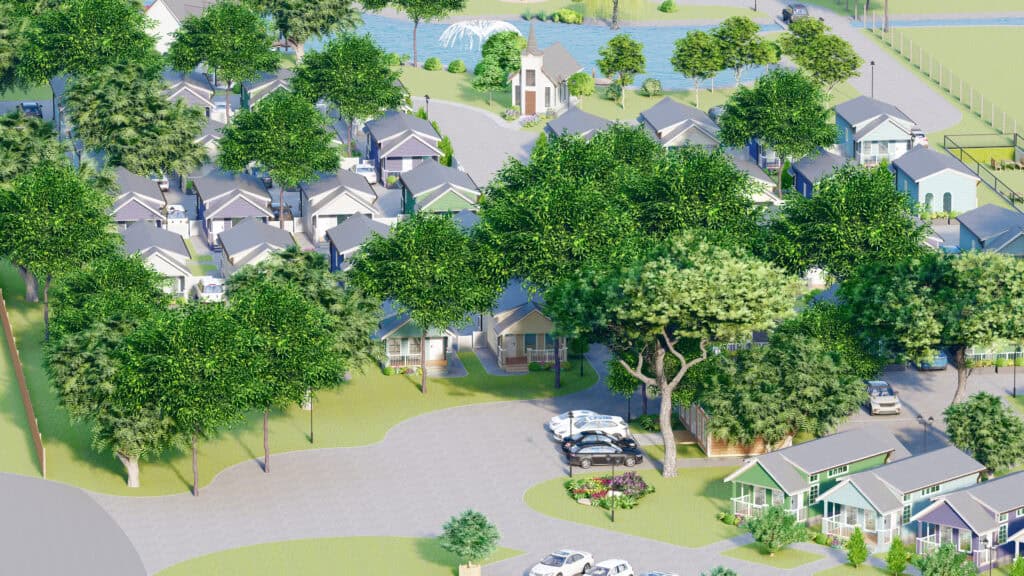
The physical design of Community First! Village is built around a concept the organization calls “Neighborhoods of Knowingness.” Homes are clustered in pockets of 40 to 50, each grouped around shared outdoor kitchens, laundry, restroom and shower buildings, and common green space. Front porches encourage the casual, daily contact between neighbors that the whole model depends on. Home types are intentionally varied: traditional stick-built micro-homes sit alongside ICON-constructed 3D-printed units, converted recreational vehicles, and canvas cottages, creating a neighborhood that looks and feels diverse rather than institutional. On-site features include a health clinic, community market, cinema and amphitheater, organic gardens, chapel, and a Community Works program through which residents earned about $1 million in “dignified income” in 2025 doing jobs like woodworking, art sales, and farming.
The current expansion is large in scope. Mobile Loaves & Fishes is developing two additional tracts — a 51-acre parcel on Hog Eye Road and a 76-acre parcel on Burleson Road in Southeast Austin — that together are planned to add roughly 1,400 homes, bringing the village toward about 1,900 homes in total. In December 2024, ICON, the Austin-based 3D printing construction company, announced it had begun building 100 more 3D-printed homes at the village with Mobile Loaves & Fishes and the Lennar Foundation, adding to the 17 homes and facilities ICON had already printed there. New homes come online in phases as funding allows. For TinyHouseTalk readers, Community First! Village is not a market-rate housing option — residents are people coming out of chronic homelessness — but as a demonstration of what thoughtfully designed tiny home communities can accomplish at scale, it has no peer in the state.
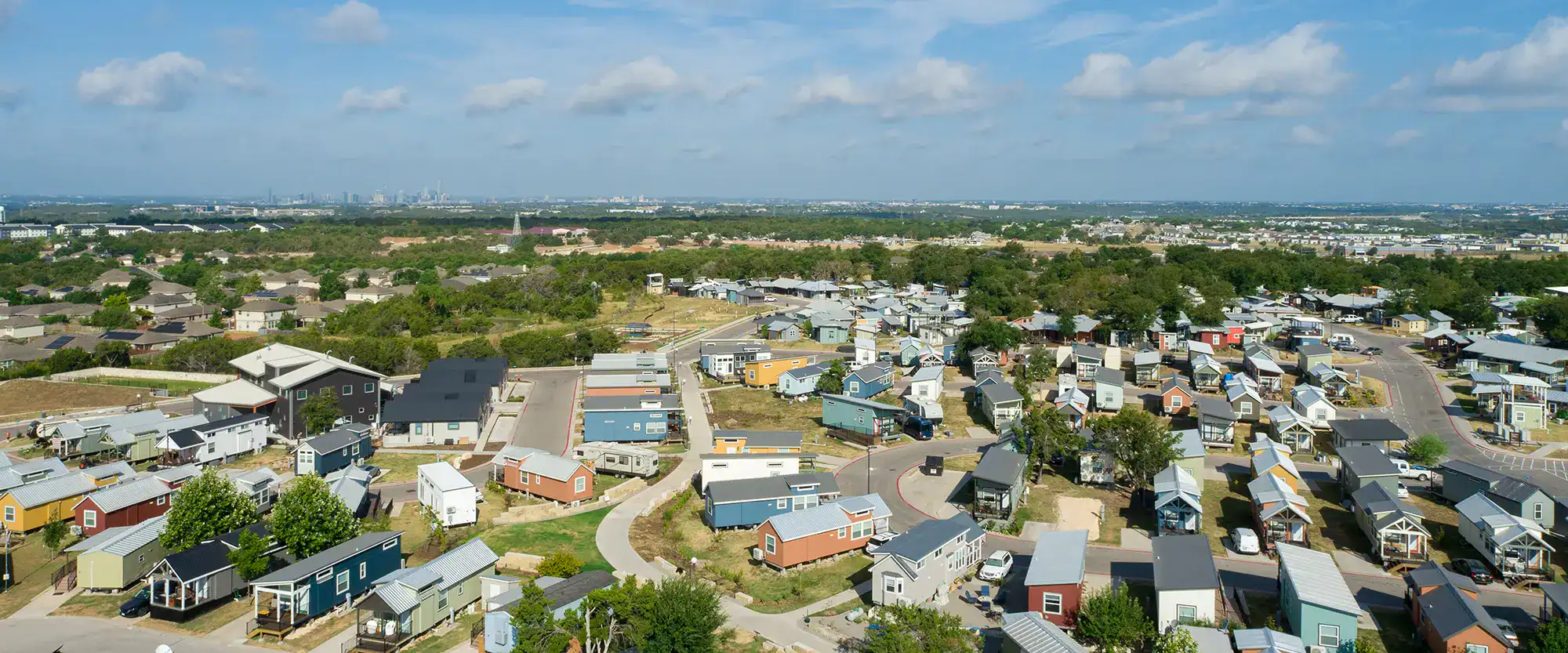
Image courtesy of Mobile Loaves & Fishes / Community First! Village
Learn more: mlf.org/community-first/ | Related on TinyHouseTalk: ICON’s first permitted 3D-printed tiny house in Austin
Village Farm Austin: A Tiny Home Agrihood Built Around a Working Organic Farm
Developer / operator: Roberts Communities (developer); Green Gate Farms (working organic farm partner)
Land model: Residents buy their home and lease the lot; homes are park model RVs
Home sizes: About 395 to 399 sq ft; one bedroom, one bath; seven models listed (Tumbleweed, Sedona, Wedge, Barton Creek, Bungalow, Waterloo, King Casa)
Home prices: From $89,995 (Tumbleweed) to $129,995 (King Casa) (checked October 24, 2026)
Monthly lot fee: Not published on the community’s site; earlier reports put it between about $600 and $785 a month, so ask for the current figure
Community size: About 150 home sites (Builder magazine reported 154 across two phases)
Status: Active; homes for sale with “limited availability”; two-night “try before you buy” stays offered at $150 per night (checked October 24, 2026)
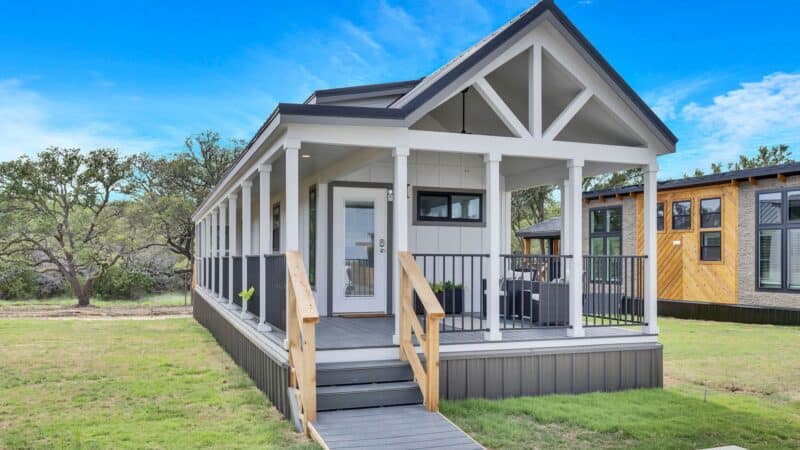
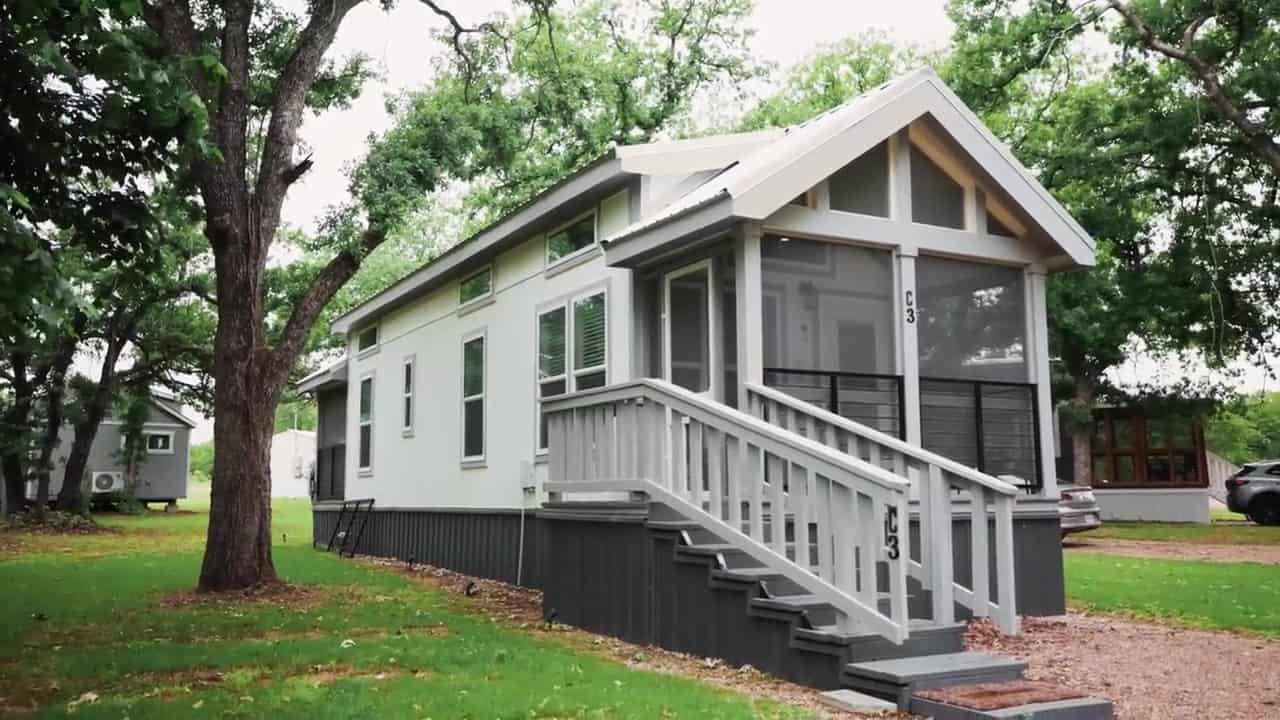
Village Farm calls itself an agrihood — a residential community built around and in relationship with a working farm — and Tiny House Blog called it the country’s first tiny home agrihood. The development is centered on Green Gate Farms, a USDA-certified organic operation established in 2006, on land the community says was acquired from the historic Bergstrom family. Roberts Communities built park model homes in the 399-square-foot range around the farm’s fields, outbuildings, and walking trails. The result is a community where residents can buy into the farm’s CSA program, shop a seasonal Saturday farmers market, and live next to the kind of working agricultural landscape that is increasingly rare inside a major city’s limits.
The financial structure at Village Farm is worth understanding carefully before visiting. Homes are park model RVs — they sit on chassis and are classified as recreational vehicles, not real property — so they are not taxed or financed like a site-built house. Buyers purchase the home itself, with seven models listed from $89,995 to $129,995 (checked October 24, 2026), and then pay a monthly lot fee that covers the home site, common-area upkeep, and use of the amenities. The community does not publish that fee online; reported figures over the years have ranged from about $600 to $785 a month, so get the current number in writing and budget for it alongside any home financing. If you want to test the lifestyle first, Village Farm offers up to two nights in a furnished tiny home for $150 a night.
Residents have two pools and a hot tub, two dog parks with a dog-wash station, picnic and grill areas, community gardens, and events like a fall Thursday-night concert series at the bandstand and pop-up dinners at the 120-year-old farmhouse. For buyers who want a finished, amenitized tiny home community inside Austin with a working farm as a neighbor, Village Farm is the most developed option in the city.
Learn more: villagefarmaustin.com | Read our full features: Village Farm Austin: A Modern Sustainable Tiny House Agrihood and Braden’s 400 sq ft park model at Village Farm
Lake Dallas Tiny Home Village: A Purpose-Built Tiny Home Village Inside City Limits
Developer / operator: Privately operated
Land model: Leased lots only (bring your own home); one-year leases, renewable; owner-occupied only (no rental homes)
Home requirements: Tiny homes on wheels 7.5 to 8.5 feet wide and up to 40 feet long; NOAH or Bildsworth International certified, or inspected by a Texas-certified inspector; no park models, RVs, mobile homes, or shipping containers
Lot rent: $700 to $750 per month (includes water, sewer, trash, mowing, and the on-site washateria; electric metered separately); $1,000 security deposit (checked October 24, 2026)
Community size: 13 lots (eight 20×40 lots and five larger lots)
Community center: Renovated 1910 farmhouse with great room, game room, small gym, library, and back porch
Status: Full; wait list and $1,000 reservation-list deposit (checked October 24, 2026)
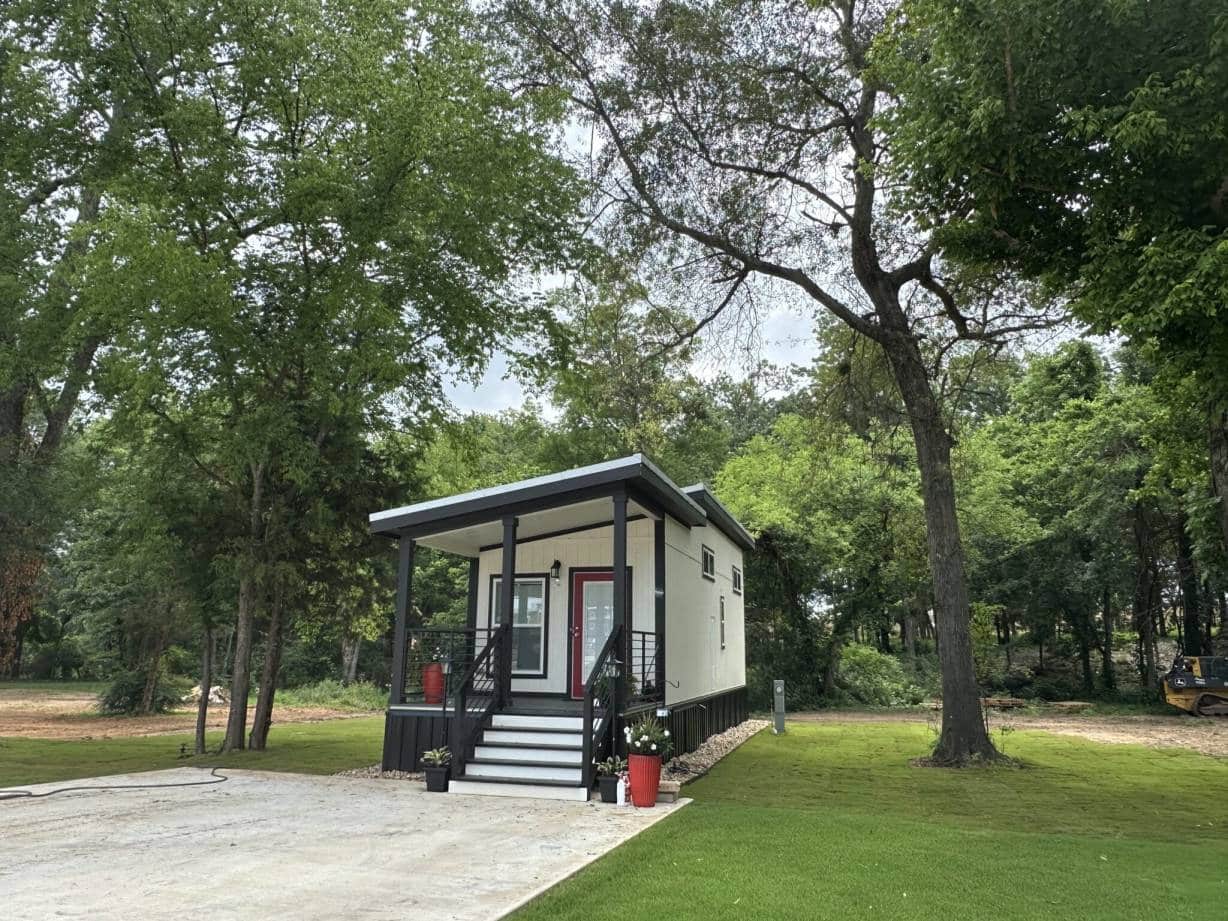
Lake Dallas Tiny Home Village describes itself as the first tiny home village of its kind built inside a city’s limits from the ground up for homes on wheels under the International Residential Code’s Appendix Q. Many early tiny house parks were repurposed RV parks or rural sites operating under looser county rules. Lake Dallas worked through the city’s permitting process to create a residential setting for tiny homes, with city utility connections, landscaped lots, and dedicated common space.
The 13 lots sit in Lake Dallas’s Downtown District, which gives residents access to the town’s walkable core: a library, children’s parks, tennis courts, ball fields, restaurants, an old-time hardware store, and schools. Lewisville Lake is a short walk from the village. The community’s shared amenity is the Gotcher Street Farmhouse, a renovated and expanded 1910 farmhouse with a great room and full kitchen, game room, small gym, library, and back porch — a gathering space that gives the small community a social anchor most RV parks lack. Leases run one year and can be renewed, and the village requires a minimum one-year stay. A strict owner-occupancy rule means investors cannot park homes here for rental income.
The practical limitation worth knowing before getting excited: homes must be 7.5 to 8.5 feet wide, which rules out standard 399-square-foot park model homes. The community is built for purpose-built THOWs. As of October 24, 2026, all 13 lots were full. Applicants can join the wait list, and those ready to move can put down a $1,000 deposit to join the reservation list, which gets first chance at openings. Lot rent runs $700 to $750 a month (checked October 24, 2026). The village also posts a scam warning: it does not collect deposits through Facebook listings, so use the contact form on its official site.
Learn more: lakedallastinyhomevillage.com
Majestic Hills Tiny Home Community: A Park Model Community Near Lake Conroe and Houston
Developer / operator: Majestic Hills Tiny Homes (sales contact email is a Roberts Communities address, the same company behind Village Farm Austin)
Land model: Residents buy a home through Majestic Hills and lease the site
Home types: One-bedroom, one-bath park model homes
Home prices: Ten homes listed from $85,000 (The Wedge) to $129,000 (The Berry) (checked October 24, 2026)
Status: Active; homes for sale; contact for site lease terms
Contact: 936-249-1403 | info@majestichillstinyhomes.com
Majestic Hills fills a gap in the Houston market. Houston has no traditional zoning, but its building codes, subdivision rules, and widespread deed restrictions make it hard to place a tiny home as a permanent residence inside the city. Majestic Hills sits in Montgomery County, north of Houston, close enough to The Woodlands — one of the metro’s largest planned communities and employment centers — to serve buyers who work in the region but want to live small. Lake Conroe, one of the most popular recreational lakes in Texas, is minutes away.
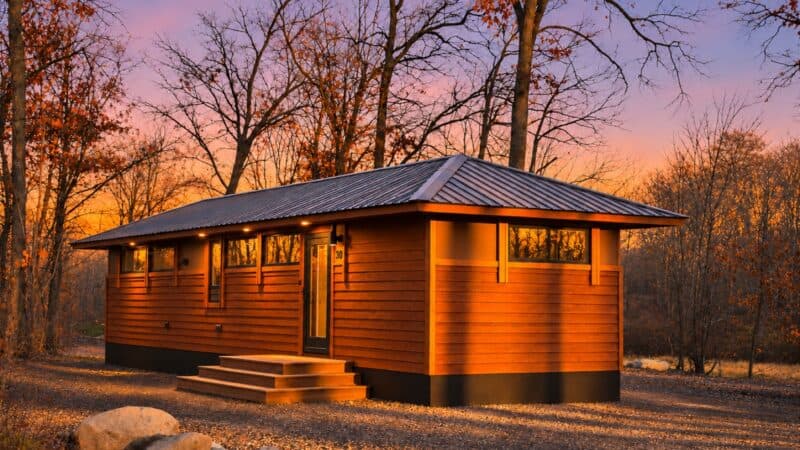
The community model has buyers purchase their home from Majestic Hills rather than bringing their own, which is standard for park model communities but worth noting for anyone hoping to place an existing house. When we checked on October 24, 2026, the sales page listed ten one-bedroom, one-bath models, including The Wedge at $85,000, The Farmhouse at $100,000, The Robin at $106,000, The Cardinal at $108,000 (after a $21,000 price cut), The Tumbleweed and The Robin with Loft at $112,000, The Sedona at $125,000, and The Berry at $129,000. Residents then lease their sites; ask for the current lot rent and what it includes, since it is not posted online. The amenity package is generous for a community of this size: a heated pool and hot tub, a one-acre fenced dog park, a three-quarter-acre community garden, a community center, workout facility, recreation room, indoor movie theater, outdoor kitchen and grill area, and lawn games. Cable TV and internet access are available.
For buyers drawn to the Houston area who want a purpose-built tiny home community rather than a lot at an RV park, Majestic Hills is the most developed option we found in the metro’s orbit. The Montgomery County location requires a car for most errands, but Lake Conroe and The Woodlands give residents substantial employment, retail, and recreation without driving into downtown Houston.
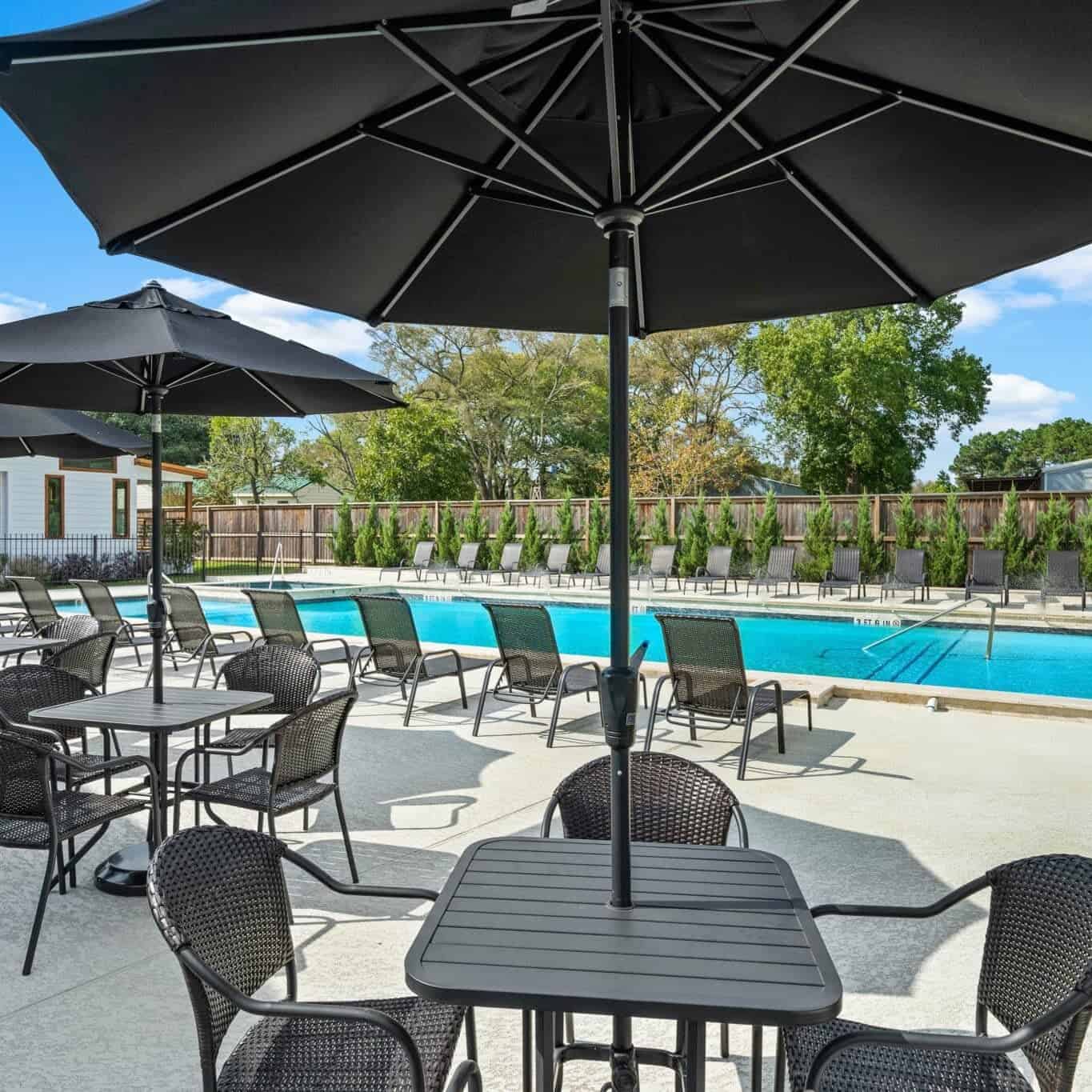
Image courtesy of Majestic Hills Tiny Homes
Learn more: majestichillstinyhomes.com | Phone: 936-249-1403
Mustard Seed Village: A 28-Home Affordable Rental Community Built in Six Months North of Austin
Developer / operator: Joseph and Stephanie Claypool (private owners); financed by Amplify Credit Union
Land model: Rental community (not ownership)
Home sizes: Two-bedroom, one-bath homes reported at about 822 sq ft (these are small homes, not sub-400 sq ft tiny homes)
Rent: Capped at $1,375 per month when the community opened in 2023 (not re-verified for 2026)
Community size: 28 homes plus a girls’ group home in the center
Status: Opened in 2023 and fully leased at the time; current availability not published
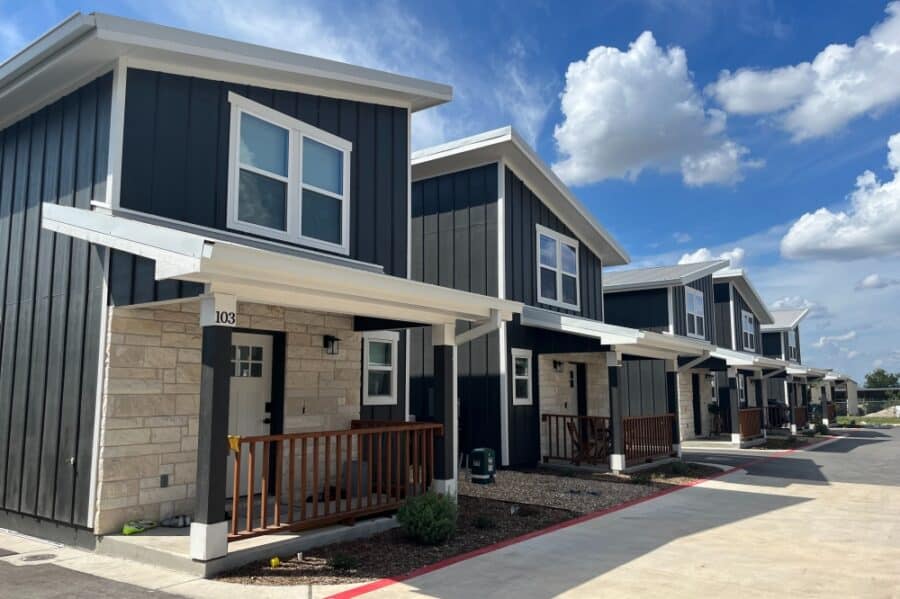
Mustard Seed Village in Round Rock is a different model from the park model communities and THOW villages in this guide — its homes are reported at about 822 square feet, well above the 400-square-foot threshold for tiny homes — but it belongs here because it shows what is possible when a small-scale developer, a community-oriented credit union, and a city with a housing shortage work together on affordable housing. Joseph Claypool, a lieutenant with the Round Rock Police Department, and his wife Stephanie, a local teacher, founded the community. They built 28 two-bedroom, one-bathroom homes on Tate Lane in about six months: the project broke ground in January 2023, and all of the homes were leased by June 15, 2023, two weeks after construction wrapped, according to Community Impact.
Amplify Credit Union, an Austin-based credit union, funded the project and announced its completion in September 2023. Residents at opening included single parents, first responders, teachers, service workers, and students. The rent was capped at $1,375 a month at opening. Shared amenities include a laundry space, an outdoor fire pit, and a dog park, and a girls’ group home in the center of the community, started by the Claypools with a one-year Teen Challenge program, is integrated with the rest of the neighborhood.
We could not find 2025 or 2026 updates on occupancy, current rent, or a wait list, so contact the owners for current availability. For renters who need affordable housing within commuting distance of Austin and who don’t need a sub-400-square-foot home, Mustard Seed Village is a model worth knowing about.
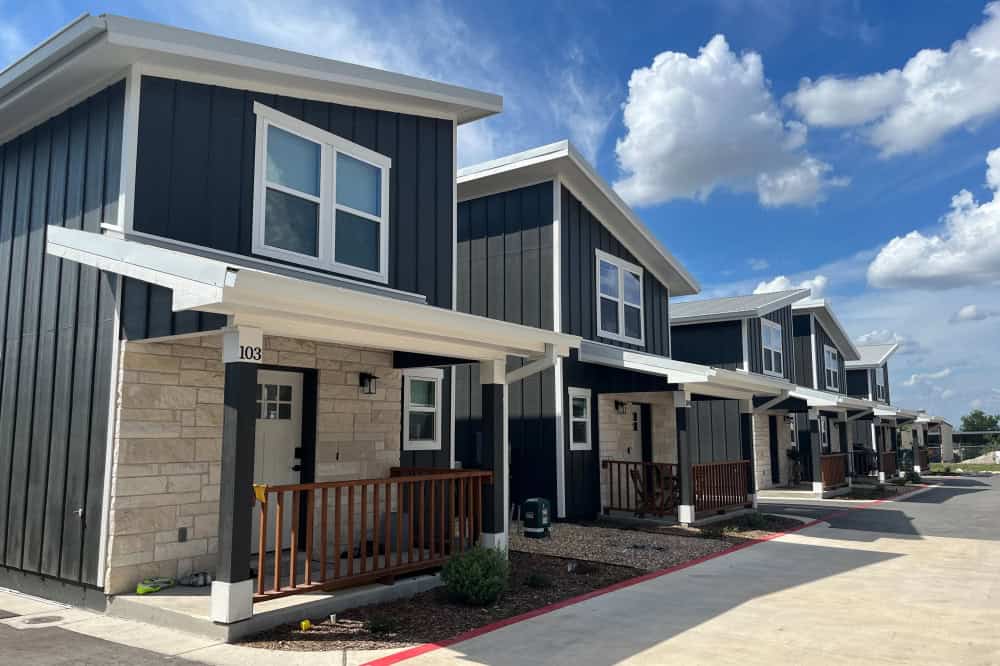
Image courtesy of Brittany Anderson / Community Impact
Learn more: Coverage via Community Impact | Address: 20 Tate Lane, Round Rock, TX 78665
Monarch Springs Ranch: A Gated Lakeside Tiny Home Community in North Texas
Developer / operator: Monarch Springs Ranch (privately operated)
Land model: Leased homesites (bring your own park model or tiny home on wheels under 400 sq ft); two lakefront tiny homes for monthly rent
Lot lease: $700 per month (includes utilities and mowing; electric billed separately) (checked October 24, 2026)
Rental homes: $1,400 and $1,450 per month (includes utilities and mowing; electric billed separately) (checked October 24, 2026)
Community size: 12 home sites on 20 acres
Status: Active; homesites and two rentals listed; the ranch is also preparing three boutique cabin stays it says will open in fall 2026
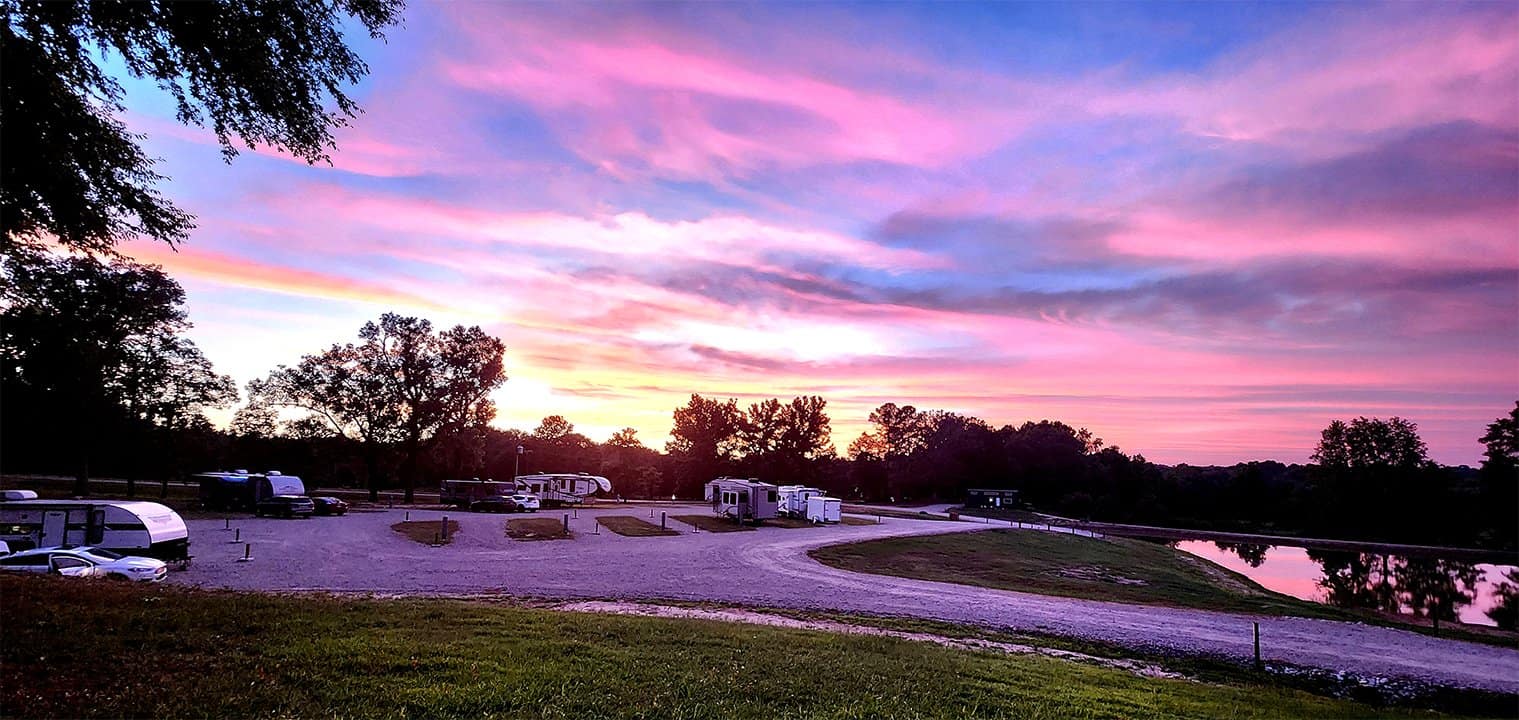
Monarch Springs Ranch is a deliberate counterpoint to the density of the Dallas-Fort Worth metroplex: 12 home sites on 20 acres in Celeste, a small Hunt County town about an hour northeast of Dallas, arranged around a private lake with fishing docks. The community is small by intention and prioritizes privacy and quiet over resort-style amenities. Visits are by appointment only, since it is a private gated community.
The lot lease model is straightforward: residents bring their own park model or tiny home on wheels (under 400 square feet, subject to the community’s design guidelines) and pay $700 per month for the site, which includes utilities and mowing; electric is billed separately (checked October 24, 2026). For owners who already have a tiny home or THOW and want a semi-rural North Texas base with a strong outdoor character, this is one of the few options of its kind in the region. Two lakefront tiny homes are also available for monthly rent at $1,400 and $1,450, which gives prospective residents a way to experience the community before committing to bringing their own home.
The ranch says it is best suited to individuals and couples looking for a calm, low-maintenance, nature-oriented lifestyle, and it is not designed as a high-density or transient community. It is also changing: the homepage now promotes three boutique cabin stays (Prairie Cottage, Blackland Ranch, and The Lake Loft) opening in fall 2026, along with native prairie and pollinator-garden restoration around the lake. If you are looking for a long-term homesite, confirm availability and how the new cabin stays will share the property.
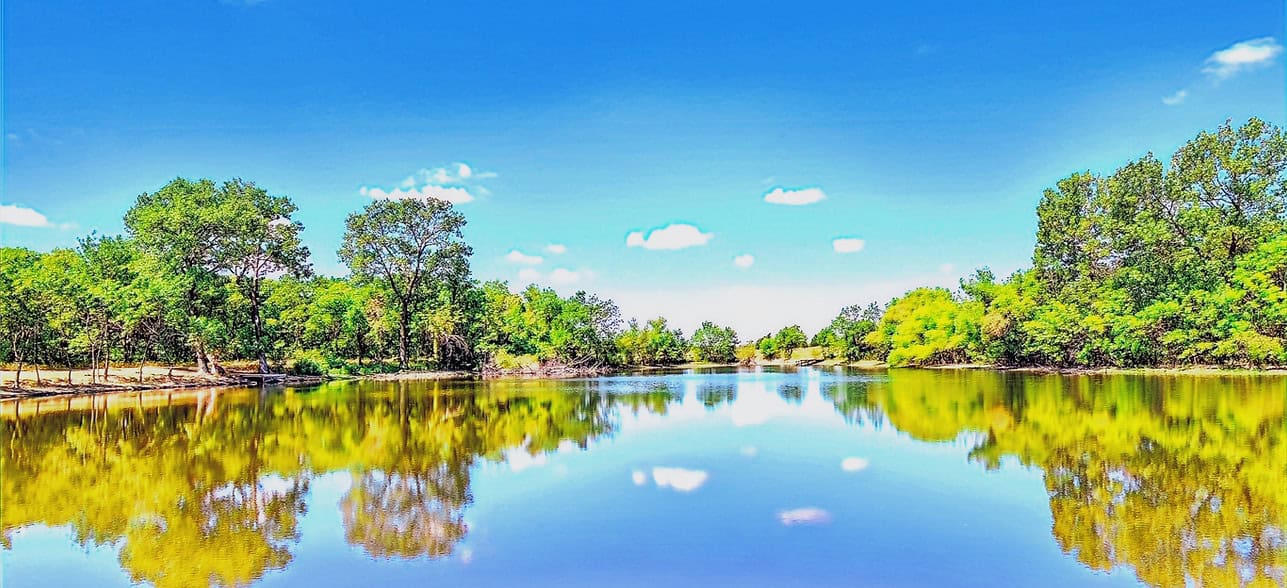
Image courtesy of Monarch Springs Ranch
Learn more: monarchspringsranch.com | Read our full feature: Monarch Springs Ranch: Twelve Homes on Twenty Acres in Celeste, Texas
Liberty Tiny Village: A 55-Plus Resort Community Near the Dallas North Tollway in Aubrey
Founder: Melissa Hayes
Land model: Leased lots; residents buy a home through the on-site dealership and lease the site
Lots: Most about 25×67 feet, with parking for two cars and 100-amp service
Monthly lot rent: $950 for Phases 2 and 3 (includes water, sewer, trash, basic internet, and full landscaping service) (checked October 24, 2026)
Status: Phase 1 full; Phases 2 and 3 under construction, and their wait list is also full (checked October 24, 2026)
Contact: 940-440-7800 | info@libertytinyvillage.com; models open Wednesday to Saturday, 12 to 4 p.m.
Liberty Tiny Village in Aubrey occupies a specific spot in the fast-growing North Dallas corridor: a 55-plus community on a few wooded acres between the master-planned subdivisions of Denton County’s growth edge and the farms that still define its rural interior. It is aimed at buyers who want resort-style amenities and a tight-knit community without the prices that come with Frisco, McKinney, or Plano. Founder Melissa Hayes has described the village, which opened in 2022, as a way to fill a gap for adults who want smaller homes, less maintenance, and more community.
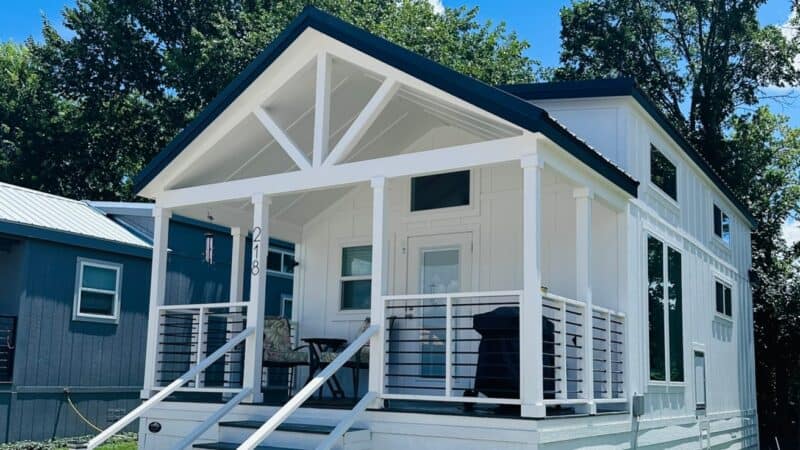
The lot rent of $950 per month for the new phases covers water, sewer, trash, basic internet, and a full landscaping package (checked October 24, 2026). An on-site dealership and design center let buyers order a home and pick a lot in one place. The community is laid out as a pocket neighborhood: homes face shared green space and walking paths, and cars park in an alley behind or beside each house. Amenities listed on the community’s site include a community center with a full kitchen that doubles as a storm shelter, a 24/7 fitness area, a half-acre stocked pond with a fishing dock and paddle boat, a dog park, a resort-style heated pool and hot tub, a chapel, and a community garden. Several of these are marked as planned or coming, so ask which are finished before you buy.
Phase 1 is full. Phases 2 and 3 are under construction, but when we checked on October 24, 2026, the homepage said their wait list was full too, so contact the community before planning around a spot. A “Try It Tiny” vacation rental program lets curious buyers stay overnight. Business Insider is among the outlets that have toured the village, and coverage keeps coming back to the same point: the draw is the community as much as the homes.
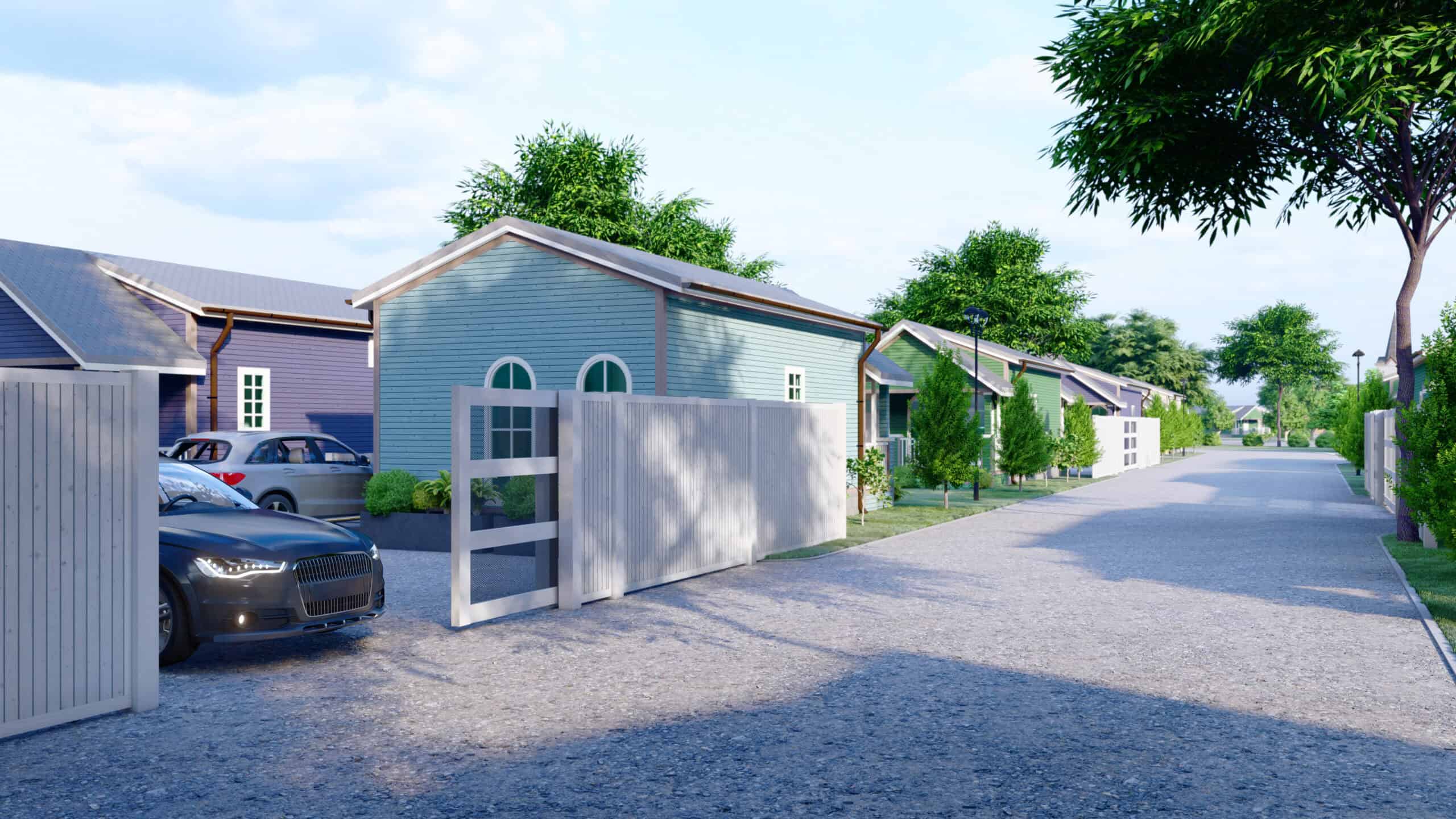
Image courtesy of Liberty Tiny Village
Learn more: libertytinyvillage.com | Phone: 940-440-7800 | Read our full feature: Liberty Tiny Village: A 55+ Resort Community in Aubrey, TX
The Oaks on 37: An Adult-Only Tiny Home Neighborhood in Mount Vernon
Developer / operator: The Oaks on 37 Tiny Homes & RV Resort
Land model: Buy a home through the community or bring your own; monthly lot rent includes water, sewer, trash, Wi-Fi, and resort amenities
Lots: Concrete pads with two dedicated parking spaces; approved carports, sheds, fencing, and patio extensions allowed
Status: Active; adult-only tiny home section within a 122-site RV resort (checked October 24, 2026)
Contact: (469) 825-7240
The Oaks on 37 pairs an RV resort with an adult-only tiny home neighborhood aimed at long-term residents, retirees, and extended stays. Each tiny home sits on a concrete pad with two parking spaces, and residents can personalize their sites with approved carports, sheds, fencing, and patio extensions. Residents can buy a home through the community or bring their own, and the monthly lot rent includes water, sewer, trash, Wi-Fi, and use of the resort’s pool, fitness center, and 24/7 clubhouse. The lot rent is not posted online, so call for current pricing. We’ve featured the community twice, including a retired couple who moved into a no-loft park model here to live debt-free.
Learn more: theoakson37.com | Read our full features: The Oaks on 37: An Adult-Only Tiny-Home Neighborhood and Pam and Jeff’s Debt-Free Retirement at The Oaks on 37
Firefly Resort Coastal Bend: A Waterfront Tiny Home and RV Lot Community on the Laguna Madre
Developer / operator: Firefly Resort
Land model: Individually owned waterfront lots for RVs or tiny homes; Firefly manages short-term rentals for owners who want them
Community size: 66 units
Lot prices: Resale listings seen in 2026 ranged from about $180,000 to $299,000 (broker listings, not Firefly’s site; not re-checked)
Owner fees: One 2026 listing reported HOA dues of about $505 per month, paid quarterly, covering utilities, Wi-Fi, and grounds maintenance (unverified)
Status: Open; RV sites, tiny home rentals, and extended stays bookable (checked October 24, 2026)
Firefly Resort Coastal Bend is a 66-unit waterfront community on the Laguna Madre — a large, shallow, hypersaline lagoon between Padre Island and the Texas mainland known for redfish, flounder, and speckled trout. Firefly markets it as a luxury tiny home and RV resort with direct water access, RV sites with full hookups, tiny home rentals, and extended stays. Broker listings describe a boat ramp and slips, a fishing pier, a bayside tiki pavilion, a pool, and kayak and paddleboard rentals.
The ownership model sets it apart from the leased-lot communities elsewhere in this guide. Lots and units are sold individually, often with a tiny home or RV already in place, and many are run as short-term rentals through Firefly’s management program while the owner is away. When we looked in 2026, resale listings on broker and MLS sites ranged from roughly $180,000 to $299,000 depending on location and whether a dock or boat slip was included, and one listing reported owner dues of about $505 per month. Treat those as ballpark figures and confirm current prices and fees with a licensed agent or the resort. This is an investment product as much as a residence: the appeal is owning a waterfront lot with resort services built in, not a community built around full-time tiny home living.
For TinyHouseTalk readers interested in coastal Texas, Firefly Coastal Bend offers a way into waterfront property at well below what a conventional bayfront home costs. Padre Island National Seashore, one of the longest undeveloped stretches of barrier island in the world, is a short drive south, and Corpus Christi International Airport makes the site workable as a second home for owners elsewhere in Texas.

Image courtesy of Firefly Resort
Learn more: firefly-resorts.com/corpus-christi | Phone: 980-249-3240
More Texas Tiny Home Communities We’ve Covered
- Cozy Acre Tiny Home Community (Poolville): A small, family-owned lot-lease community west of Fort Worth for bring-your-own tiny homes and RVs, with shade trees, a fenced dog park and free indoor laundry. Read Cozy Acre Tiny Home Community: Shaded Lots, a Dog Park and Free Laundry in Poolville, Texas.
- The Village in Fredericksburg (Hill Country): A gated, tiny-home-only community on Wine Road 290 where you buy a condominium homesite instead of paying lot rent, with a pool, pickleball and a wine hall. Read The Village in Fredericksburg: A Gated Tiny Home Community Where You Own Your Homesite.
Texas’s Regulatory Landscape: What You Need to Know Before You Move
Texas counties have very limited zoning authority, so most land-use rules for tiny homes are set city by city, with county rules covering things like subdivisions, septic, and floodplains in unincorporated areas. The result is one of the most varied regulatory environments in the country, spanning everything from Houston, which has no traditional zoning but plenty of building-code, subdivision, and deed-restriction hurdles, to Austin’s code changes that allow tiny homes as one of up to three units on most single-family lots. Understanding the local rules is essential before settling on a location.
On the building code side, Texas law makes the International Residential Code the baseline residential code for cities, but appendices such as the tiny house appendix (Appendix Q in the 2018 IRC, renumbered Appendix AQ in later editions) apply only where a city adopts them. That appendix sets construction standards for homes of 400 square feet or less, relaxing requirements around loft ceiling heights, stairs, and ladders that would otherwise make small homes hard to permit. Because adoption is local, the same design may be permittable in one city and rejected in the next.
The most significant recent local change is Austin’s HOME (Home Options for Middle-Income Empowerment) initiative. HOME Phase 1, adopted by the Austin City Council on December 7, 2023, allows up to three housing units — including tiny homes — on properties zoned SF-1, SF-2, and SF-3, with applications accepted starting February 5, 2024. HOME Phase 2, adopted May 16, 2024, created a small-lot single-family use that allows one home on lots as small as 1,800 square feet; citywide Phase 2 applications were accepted starting November 16, 2024. The city defines a tiny home as a dwelling unit of 400 square feet or less in floor area, excluding loft space. For anyone hoping to place a tiny home on an existing Austin property, HOME is one of the most significant policy shifts in the state’s recent history.
Outside Austin, the picture is mixed. Each community in this guide reached its legal footing differently: Lake Dallas Tiny Home Village worked through its city’s permitting process, Village Farm, Majestic Hills, and other park model communities operate as RV-style communities, and Mustard Seed Village’s 822-square-foot homes were built as conventional rental housing. Inside Houston, buyers face the hurdles described above; communities like Majestic Hills sit outside the city in Montgomery County instead.
For tiny houses on wheels specifically, most Texas jurisdictions treat THOWs as recreational vehicles. That means THOW owners usually need a community or site set up for RVs — which is how most of the communities in this guide operate — rather than placing their homes on standard residentially zoned land. Spur, the small town in Dickens County that declared itself the nation’s first tiny house-friendly town in 2014, is notable because it adopted a tiny house ordinance (Ordinance 677, amended since) for homes on permanent foundations inside city limits. The ordinance requires a cement footing at least six inches deep, connection to city utilities, a flush toilet (composting toilets are not allowed), and a permit with approved plans; homes on wheels are not permitted unless the wheels come off and the home is tied to a foundation.
At the state level, the 2025 legislative session took up a statewide ADU bill, SB 673, which would have barred cities from banning accessory dwelling units on single-family lots. It passed the Senate 31-0 but died in the House. Lawmakers did pass SB 15, a narrower bill that requires large cities to allow smaller lots in new subdivisions of at least five acres; it does not address tiny homes directly. Rules for placing a tiny home therefore remain largely local. The United Tiny House Association tracks advocacy and regulatory developments nationally: unitedtinyhouse.com. The Tiny Home Industry Association also maintains regulatory resources: tinyhomeindustryassociation.org. For the most current rules in your target area, contact the local planning department directly.
On the Horizon: Developments Worth Watching
Firefly Resort Fredericksburg (Texas Hill Country): Firefly’s Hill Country location in Fredericksburg is a larger RV and tiny home resort a short drive from the town’s Main Street, wineries, and tasting rooms. Its website says all RV lots and tiny homes there are individually owned, and the resort rents them to guests; amenities include two clubhouses, a luxury pool with cabanas, a hot tub, pickleball courts, mini golf, and an outdoor kitchen. The resort says USA Today readers voted it the best luxury RV and tiny home resort in Texas in 2024. It is primarily a vacation destination rather than a full-time residential community, but it is worth watching for buyers interested in vacation-oriented tiny home ownership in the Hill Country. Contact: fireflyhillcountry.com
Liberty Tiny Village Phases 2 and 3 (Aubrey): With Phase 1 full, Liberty Tiny Village’s next two phases are under construction, with lot rent set at $950 a month. As of October 24, 2026, the community’s homepage said the Phase 2 and 3 wait list was also full. Contact the community at 940-440-7800 or info@libertytinyvillage.com to ask whether more openings are expected.
Spur, Texas (Dickens County): Spur remains on the map as the town that started the national conversation about tiny house-friendly municipalities in 2014. Its ordinance allows tiny homes on permanent foundations within city limits, defined as homes under 900 square feet with no minimum size. Land in Spur has historically sold for very little by Texas standards, but the town is small and shrinking (863 residents in the 2020 census, down from 1,318 in 2010) and sits about 70 miles east of Lubbock. Local jobs are limited, so Spur is most practical for remote workers, retirees, and homesteaders. It is not an organized community like the others in this guide — it is a town that welcomes people who want to buy land and build their own small home. Confirm the current ordinance with the city before buying.
Indigo River Tiny Homes (North Texas): Indigo River Tiny Homes, a veteran-owned North Texas builder of tiny homes on wheels, lists creating a tiny home village and supporting the North Texas tiny home community among its long-term goals. No community has opened yet. Contact: indigorivertinyhomes.com | Read our feature: Her Indigo River Tiny House in a Texas Community
What These Communities Have in Common
Across the communities profiled here, Texas’s size shows up in the variety of options. No single region dominates the way Asheville and Flat Rock dominate North Carolina’s tiny house landscape. Austin has two very different, well-known models — Community First! Village and Village Farm — while North Texas has its own cluster (Lake Dallas, Liberty Tiny Village, Monarch Springs Ranch, and The Oaks on 37), Houston has Majestic Hills to its north, Corpus Christi has a waterfront ownership option, and the Hill Country has Firefly Fredericksburg. The state’s internal diversity produces a community landscape that mirrors Texas itself: big, varied, and operating under different rules in different corners.
The leased-lot model appears across nearly every market-rate community in this guide, and for the same reasons it dominates elsewhere: it lets operators maintain consistent standards and shared amenities without the complications of individual lot sales and HOA governance. For buyers, the financial implication is the same here as elsewhere — the home may be affordable by conventional standards, but the lot rent is a permanent monthly cost, and the home’s value depends partly on the operator’s continued quality of management. Leases at communities like Lake Dallas run one year at a time, which is a meaningful difference from the longer leases some communities in other states offer. Read the lease, ask how much rent has risen in recent years, and find out what happens to your home if the community is sold.
The mission-driven community model is also prominent in Texas. Community First! Village has become a reference design for nonprofits around the country, and Mobile Loaves & Fishes runs a formal program to help others replicate it. Mustard Seed Village takes a different approach — private construction by a couple motivated by community service — but the underlying impulse is similar: using the small-home format to create housing that the conventional market will not supply at the needed price point. Texas’s housing affordability pressure, especially around Austin, is likely to keep generating demand for exactly these kinds of alternative models.
Highlights
- Community First! Village in Austin is home to about 440 formerly homeless neighbors and is expanding toward about 1,900 homes, including 100 more ICON 3D-printed homes
- Village Farm Austin is a park model agrihood built around Green Gate Farms; homes listed from $89,995 to $129,995 (checked October 24, 2026), plus a monthly lot fee
- Lake Dallas Tiny Home Village has 13 owner-occupied THOW lots inside city limits; lot rent $700 to $750; currently full with a wait list
- Majestic Hills near Lake Conroe lists park model homes from $85,000 to $129,000 (checked October 24, 2026), with a heated pool, dog park, and movie theater
- Monarch Springs Ranch in Celeste offers 12 homesites on 20 lakeside acres at $700 a month; Liberty Tiny Village in Aubrey is a 55-plus community with $950 lot rent and a full wait list
- Firefly Resort Coastal Bend in Corpus Christi sells individually owned waterfront lots, many run as managed short-term rentals
- Tiny home rules are set locally in Texas; Austin’s HOME changes allow tiny homes as one of up to three units on most single-family lots, and the statewide ADU bill SB 673 died in the House in 2025
Explore More
- Best Tiny House Communities in the US: 15 Real Places You Can Live Tiny Right Now
- Tiny House Communities in Georgia
- Village Farm Austin: A Modern Sustainable Tiny House Agrihood
- Liberty Tiny Village: A 55+ Resort Community in Aubrey, TX
- Monarch Springs Ranch in Celeste, Texas
- The Oaks on 37 in Mount Vernon, Texas
- Researchers Spent a Year Studying Tiny Houses in Texas
- More Tiny House Communities
Resources and Further Reading
- Community First! Village — Austin; nonprofit micro-home community for formerly homeless residents; about 440 neighbors now, planned for about 1,900 homes
- Village Farm Austin — East Austin agrihood; park model homes listed from $89,995 to $129,995 (checked October 24, 2026)
- Lake Dallas Tiny Home Village — Lake Dallas; 13 owner-occupied THOW lots inside city limits; full with wait list
- Majestic Hills Tiny Homes — Willis (Houston area); park model community near Lake Conroe; phone: 936-249-1403
- Monarch Springs Ranch — Celeste (North Texas); gated lakeside community; 12 homesites, $700/month lot lease
- Liberty Tiny Village — Aubrey (DFW area); 55+ resort community; Phase 1 full, Phase 2 and 3 wait list full; phone: 940-440-7800
- The Oaks on 37 — Mount Vernon (East Texas); adult-only tiny home neighborhood at an RV resort
- Firefly Resort Coastal Bend — Corpus Christi; 66-unit waterfront community on the Laguna Madre with individually owned lots
- Firefly Resort Fredericksburg — Fredericksburg; Hill Country RV and tiny home resort with individually owned lots and homes
- Austin HOME Amendments — the city’s code changes allowing tiny homes as one of up to three units on single-family lots
- Indigo River Tiny Homes — veteran-owned North Texas tiny home builder with a stated goal of creating a tiny home village
- United Tiny House Association — advocacy and regulatory guidance
- Tiny Home Industry Association — regulatory resources and builder listings
Which Texas community would you choose: a farm-side park model in Austin, a lakeside homesite in North Texas, or a waterfront lot on the coast? Tell us in the comments.
If you enjoyed this you’ll LOVE our Free Daily Tiny House Newsletter with even more!
You can also join our Small House Newsletter!
Also, try our Tiny Houses For Sale Newsletter! Thank you!
More Like This: Communities | Small Houses | Roundups & Lists
Disclosure: This post may contain affiliate links. If you purchase through one of our links, we may earn a commission at no additional cost to you.


Alex
Latest posts by Alex (see all)
- Tiny House Communities in Texas: A Complete Guide - November 29, 2026
- South Florida Tiny Homes: Where to Look In and Near Miami, Fort Lauderdale, and Palm Beach - November 29, 2026
- Touring Escape Tampa Bay’s Tiny House Village in Thonotosassa, Florida - November 29, 2026




Join the Conversation
No comments yet. Be the first to join the conversation.