
Disclosure: This post may contain affiliate links. If you purchase through one of our links, we may earn a commission at no additional cost to you.
The Going Tiny Series, Part 33 of 45 · Guide 4 of 5: Bringing Them On Board
A free chapter goes up every day. See every part. Rather have it all at once, with printable worksheets? Get the Going Tiny Toolkit.
Many readers told me the kids were the reason they were waiting. Some were waiting for graduation. Some had teens who were, in one reader’s words, appalled and mortified by the idea of an unconventional mom. Some had a family of four where only one person wanted to go small.
“We have children whom we promised we wouldn’t uproot from their school until they graduate. That would be 2.5 years from now. I guess that gives more time to plan for the future though.”
— Gretchen, Tiny House Talk reader
Gretchen’s approach is honest and generous: she made a promise, she’s keeping it, and she’s using the time to plan. That’s often the right call.
Principles that work at any age
- Involve them early. Kids who help design a space are far more likely to like living in it.
- Give them real ownership. A space that’s theirs to arrange, decorate, and keep (or not keep) tidy.
- Protect privacy. This matters more as kids get older. A door, a curtain, a place to change clothes, a place to be upset in private.
- Be honest about the timeline. “We’re thinking about it for after you graduate” is very different from “we’re moving in June.”
- Don’t make them the reason for an adult disagreement. Kids shouldn’t be recruited to one parent’s side.
Age-by-age notes
| Age | What often matters | What can help |
|---|---|---|
| Babies and toddlers | Nap-time quiet, safe floors, stairs and lofts, laundry volume. | A separate sleeping space with a door; no open lofts; plan for gear like strollers and high chairs. |
| Young children (4–10) | Play space, outdoor time, a bed of their own, routine. | Let them design their nook; plan outdoor play space as part of the home. |
| Tweens (10–13) | Growing need for privacy, friends visiting, starting to care what others think. | Involve them in decisions; give them a door or curtain; ask how they’d describe the home to a friend. |
| Teens (13–18) | Privacy, friends, school, identity, embarrassment, part-time jobs. | Consider waiting until graduation; a separate sleeping structure or room; a clear voice in the decision. |
A real home from Tiny House Talk

Photo: Lucas Muro
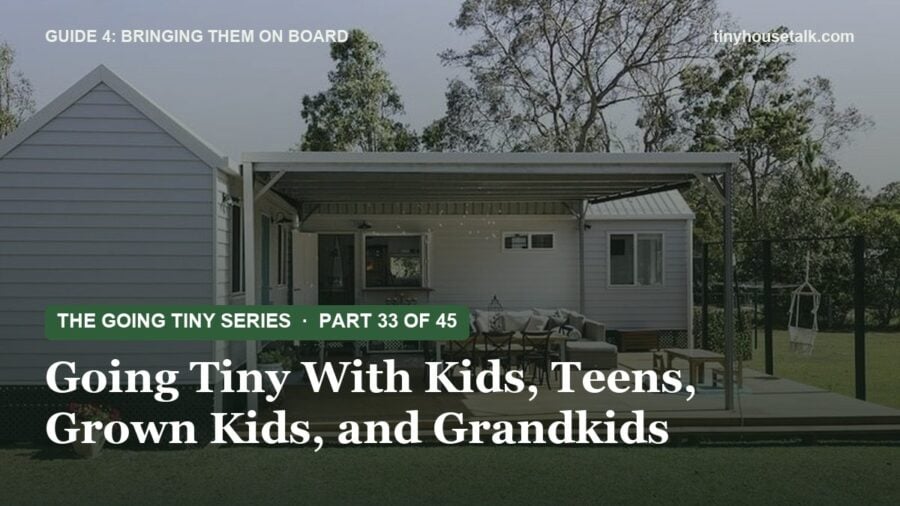
A single mom's two-tiny-house home with a bedroom for each girl
Young kids often need a bed and a routine of their own. Amanda, a single mom on Australia's Sunshine Coast, lives in two no-loft tiny houses joined by a covered porch. One holds the kitchen, living room, and her bedroom; the other is split so each daughter has a full-size bedroom and wardrobe, like the ones they had before.
Want to do this on paper?
The printable PDF of Bringing Them On Board has fill-in worksheets for this step, including:
- Our Values & Dreams
- The Objection Decoder
- Where Are We Each on the Spectrum?
They come with all five guides in the Going Tiny Toolkit.
When your teen is embarrassed
A teen’s embarrassment is real, even if it’s temporary. Arguing them out of it rarely works. Some things that can help:
- Acknowledge it: “I get it. This would be different from what your friends have.”
- Ask what would make it okay: their own space? Friends being able to stay over? Not moving schools?
- Let them see examples of well-designed small homes, not just the tiniest ones.
- Consider whether this is a plan for after they leave home. Many readers chose exactly that.
A real home from Tiny House Talk

Photo via Tiny House Expedition/YouTube
A mom and her teen daughter in a tiny house her friends love
After a divorce, this single mom downsized from more than 3,000 square feet into a Mint tiny house with two slide-outs, parked on her parents' property in Canada. She has a private downstairs bedroom, her teenage daughter has a fun, stylish space of her own, and the daughter's friends love coming over.
When only one person in a family of four wants it
A family decision this big needs more than one yes. If you’re the only one excited, step back down the Small-Living Spectrum to something the whole family can say yes to: decluttering together, a family getaway cabin, a summer in a rented camper, or simply a smaller house in the same school district. Plant the seed, then let it grow on its own schedule.
Adult children who move back
Several readers have grown kids who leave and return, sometimes more than once. That’s common and nothing to be ashamed of, but it’s a real design question.
- A flexible room that can be an office, hobby room, or bedroom as needed.
- A backyard cottage or ADU (where allowed) that gives a returning adult child independence, and gives you your home back.
- An honest family conversation about what “staying with us” will look like after you downsize: how long, what space, what contribution.
Grandkids and guests
For many readers, the biggest worry isn’t daily life. It’s the holidays. Where will the grandkids sleep? Where does everyone eat Thanksgiving dinner?
| Guest solution | Good for |
|---|---|
| Sleeper sofa, daybed, or wall bed | Occasional overnight guests in a small house. |
| A small guest cabin, bunkhouse, or sleeping cabin | Frequent visitors; doubles as an office or hobby room. |
| Camper or RV parked as a guest room | Seasonal visitors (check local rules on occupied campers). |
| Nearby rental or inn for big visits | Large families; often cheaper than heating extra rooms all year. |
| Outdoor dining space, porch, or covered patio | Big meals in good weather. |
| Hosting at a family member’s larger house | The big holidays, with you bringing the food. |
It can help to count: how many nights a year do you actually host overnight guests? Many people discover it’s a handful, and that paying for a nearby rental those nights costs less than keeping and heating guest rooms year-round. Others, like Deanne, decide that hosting is central to their life, and size their home to keep doing it. Both are good answers.
Your turn
Is someone in your life on the fence about living smaller? Share what's worked (or hasn't) in the comments.
Prefer the clean, printable version?
This series is free to read here, and it always will be. If you’d rather have it as five clean, printable PDFs, that’s the Going Tiny Toolkit:
- Bringing Them On Board (the guide this chapter comes from): conversation starters, low-risk trial ideas, and worksheets for couples and families
- The Tiny House Money Plan
- Where Can I Put It?
- Tiny Without the Ladder
- Your First Tiny Steps
Every guide adds printable worksheets and a 30-day action plan, and Tiny Without the Ladder comes with the bonus One-Level Floor Plan Idea Book (18 to-scale floor plans). All five are $47, with a 30-day refund.
← Previous: Part 32: Designing a Tiny or Small Home for Two (or More)
Next (tomorrow): Part 34: Small Homes for Extended Family, Friends, and Caregiving
Not sure which part matters most for you? The free 10-minute What’s Really Holding You Back? quiz tells you where to start. And to get a new part (and a new home) in your inbox each day, join the free Tiny House Newsletter.
Disclosure: This post may contain affiliate links. If you purchase through one of our links, we may earn a commission at no additional cost to you.


Alex
Latest posts by Alex (see all)
- Going Tiny With Kids, Teens, Grown Kids, and Grandkids - November 20, 2026
- She Restored an Abandoned Fire Lookout by Herself in 8 Days, Without Power Tools - November 19, 2026
- A Northwoods Cabin-Style Tiny House Shell with a Wood Stove in Michigan’s Upper Peninsula - November 19, 2026




Join the Conversation
No comments yet. Be the first to join the conversation.