
Disclosure: This post may contain affiliate links. If you purchase through one of our links, we may earn a commission at no additional cost to you.
Florida presents the tiny house movement with a paradox. On one hand, the state’s climate, tourism culture, and deep tradition of park model and RV living have created more infrastructure for alternative dwelling than almost anywhere in the country. On the other hand, a regulatory environment still largely designed around that snowbird RV tradition — where stays are counted in nights rather than years — has made it genuinely difficult to establish tiny home communities oriented around full-time permanent residents. The result is a landscape that is richer and more varied than most state guides acknowledge, but that requires a sharp eye to distinguish the vacation rental villages from the residential communities, the almost-open developments from the ones with actual residents, and the verified communities from the AI-generated listicle phantoms that populate so many roundup articles about Florida tiny homes.
This guide covers verified, established tiny house communities across Florida organized by region. For each, we explain the ownership or rental model, the home types permitted, current pricing and availability, and what makes each community worth knowing about.
Tiny Town Orlando: A Lakefront THOW Neighborhood on Lake Fairview
Developer / operator: Tiny Town Orlando (privately operated); also known as Orlando Lakefront
Land model: Leased lots for THOW owners; company-managed long-term rentals for residents who prefer furnished homes
Home types: Mostly tiny houses on wheels (THOWs); the community estimates 49 tiny homes, 3 small houses, and 1 RV
Lot lease: $650 to $850 per month as of 2026 per the community’s About page (checked October 24, 2026); includes water, sewer, internet, and lawn maintenance
Long-term rental homes: $1,400 to $2,300 per month on 6- to 12-month leases per the About page (checked October 24, 2026); the FAQ lists $1,500 to $2,200 with utilities and Wi-Fi included
Status: Lots full; waiting list of roughly 12 months, with a $200 non-refundable fee and a background check required
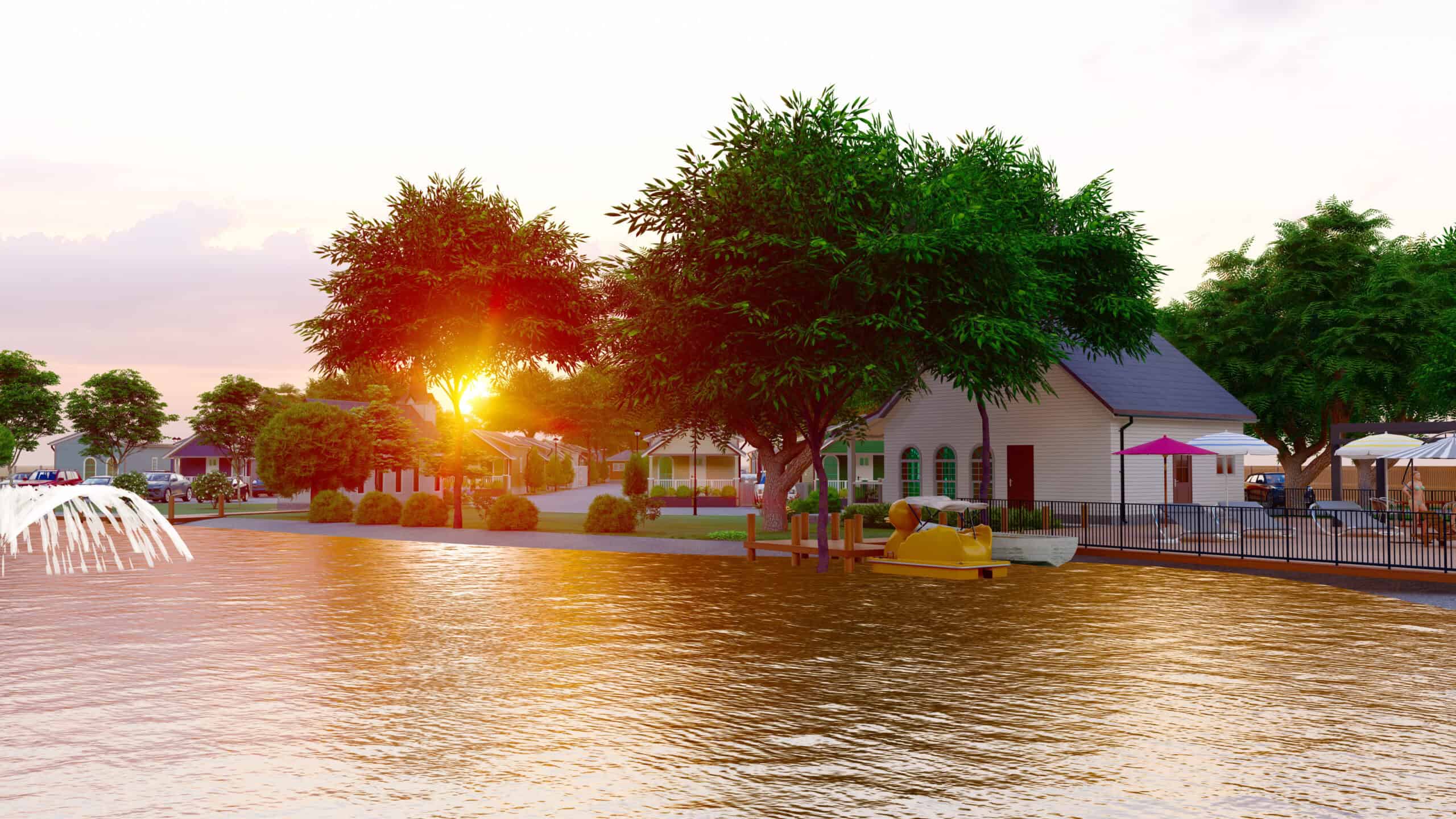
Orlando Lakefront — now operating publicly under the name Tiny Town Orlando — is the community that most people mean when they talk about living in a Florida tiny house community, and one of the most frequently cited examples of a residential THOW neighborhood in the state. It grew out of a revitalized 1950s-era RV park on the shores of Lake Fairview near Orlando’s College Park neighborhood, and over more than 14 years it has evolved from a modest cluster of early THOW adopters into a neighborhood of an estimated 49 tiny homes, 3 small houses, and 1 RV, organized around direct access to the 405-acre lake. The address — 3405 N. Orange Blossom Trail, just off I-4 — gives residents fast access to downtown Orlando and the broader metro while living in a lake-adjacent environment that feels nothing like the surrounding commercial corridor.
The financial structure here is a hybrid that reflects the community’s long history. THOW owners who lease lots pay a monthly fee that varies by location within the park — $650 to $850 per month as of 2026, according to the community’s About page — with that fee covering water, sewer, internet, and lawn maintenance. For residents who want to live in the community without bringing their own home, the management team operates 21 of its own tiny homes as furnished long-term rentals, available on six- to twelve-month leases ranging from $1,400 to $2,300 per month depending on the unit, with a $1,000 refundable deposit plus the first month’s rent. Short-term rentals of privately owned tiny houses are not allowed. That rental option makes Tiny Town Orlando accessible to people who want to try tiny house living before investing in a home, or who are relocating to Orlando and want community housing without the commitment of home ownership.
The amenities at Tiny Town Orlando are built around the lake: free use of kayaks and paddleboards, boat and fishing docks, a community fire pit and barbecue area, a community garden, and on-site coin laundry. The community is pet friendly, and every resident goes through a background check. The lot waiting list is estimated at about 12 months, and getting on it requires a phone call and a $200 non-refundable fee. Homes must also meet construction criteria for approval. Like most Florida THOW communities, Tiny Town Orlando grew within a framework built for RVs rather than permanent houses.
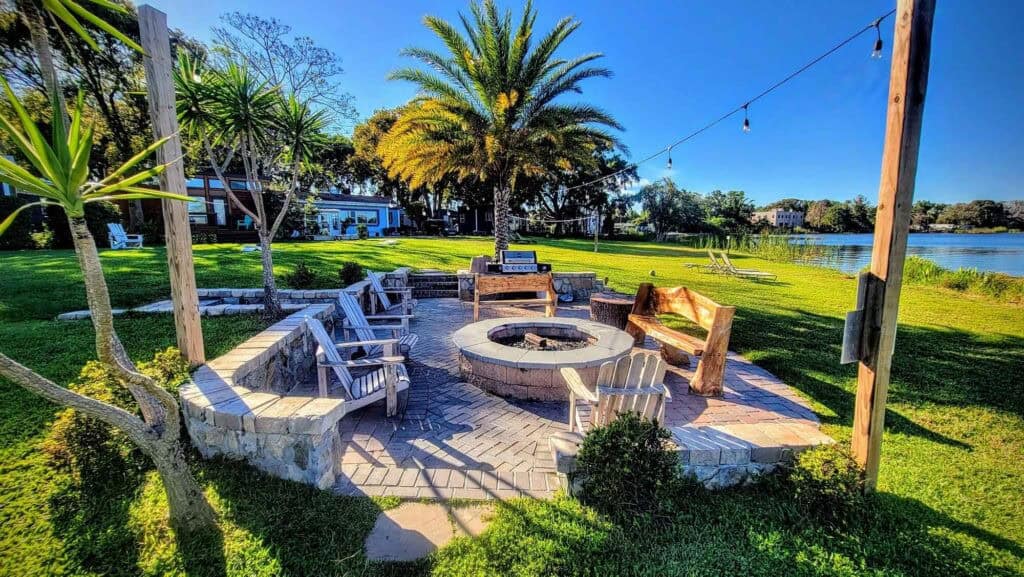
Image courtesy of Tiny Town Orlando
Learn more: tinytownorlando.com | Phone: 407-936-4094
Read our full feature: Tiny Town Orlando on Lake Fairview: Lot Lease and Long-Term Rentals
Peacewind at Braveheart Properties of Brevard: A Legally Zoned Tiny Home Community in Cocoa with Lots for Sale
Developer / operator: Braveheart Properties of Brevard (501(c)(3) nonprofit); founder and president Jinkie Echols
Land model: Mix of deeded lot ownership and long-term leased lots; both homeowners and renters
Home types: Tiny houses on wheels; small cottages and houses on foundations; custom panel homes
Community size: 84 sites; the nonprofit describes the property as 35 acres
Lot purchase price: $89,000 for each of the two lots currently listed (one marked pending sale) on Echols Rentals (checked October 24, 2026); earlier listings ran $72,000 to $82,000
Lot lease: $800 per month for the most recently listed rental lots, tenant pays all utilities; one-year lease, $40 background check, and one month’s security deposit (checked October 24, 2026). Both listed lots were marked rented as of September 1, 2026
Rental homes: Listed on echolsrentals.com when available
Status: Active; current lot and home listings are posted at echolsrentals.com; phone 321-522-1953
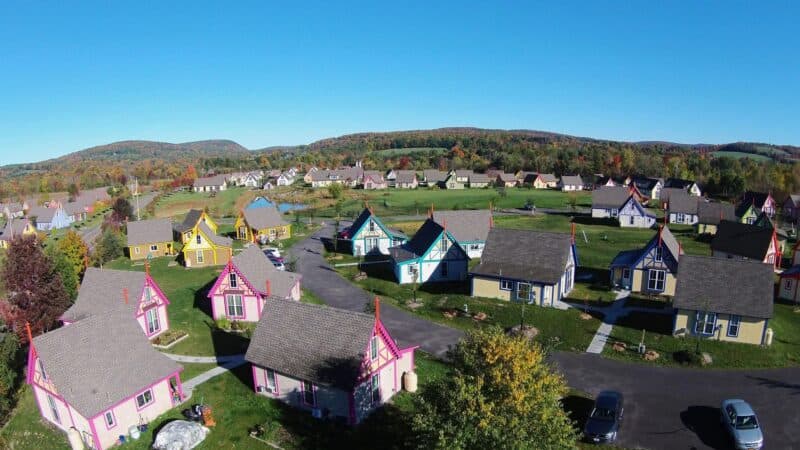
Peacewind is the community Florida tiny house advocates often point to when they need to show what is possible when a determined founder works through the local regulatory process. Jinkie Echols, the founder and president behind the nonprofit Braveheart Properties of Brevard, wrote the codes and zoning for Peacewind and got them passed by the county so the community could operate as a legally planned urban development for permanent long-term living — and the nonprofit says it was the first tiny home community in Brevard County. That effort produced something many Florida tiny house communities cannot offer: a legally zoned, code-compliant community where residents can purchase their lots as deeded property rather than leasing from a private owner. In a state where most THOW communities operate under RV park rules, that ownership option — with lots currently listed at $89,000 — meaningfully changes the financial math for buyers who want to build equity.
The property on Sandpiper Drive in Cocoa has 84 sites with a diverse mix of THOWs, small cottages built on foundations, and custom panel homes, with both renters and homeowners. Its mission framing centers on providing safe, affordable housing in an environment that is “educational, relational, sustainable, and fun” — an intentional community model rather than a resort model. Rental lots require a one-year lease and a background check, and renters pay their own utilities. Because Braveheart is a 501(c)(3), it also accepts donations, which it says go to specific projects and to building new homes.
The Space Coast location adds practical value: Brevard County is home to Kennedy Space Center and a growing aerospace and technology employment base, which makes the area attractive for remote workers and people employed in the space industry. The nonprofit’s stated vision emphasizes high-quality homes, landscaped gardens, and a pocket-community layout that encourages neighbors to know each other. For buyers who want the affordability of tiny home living combined with the equity of lot ownership and mission-driven management, Peacewind is one of the few options in Florida that offers that combination. Listings change quickly, so check echolsrentals.com for current availability.
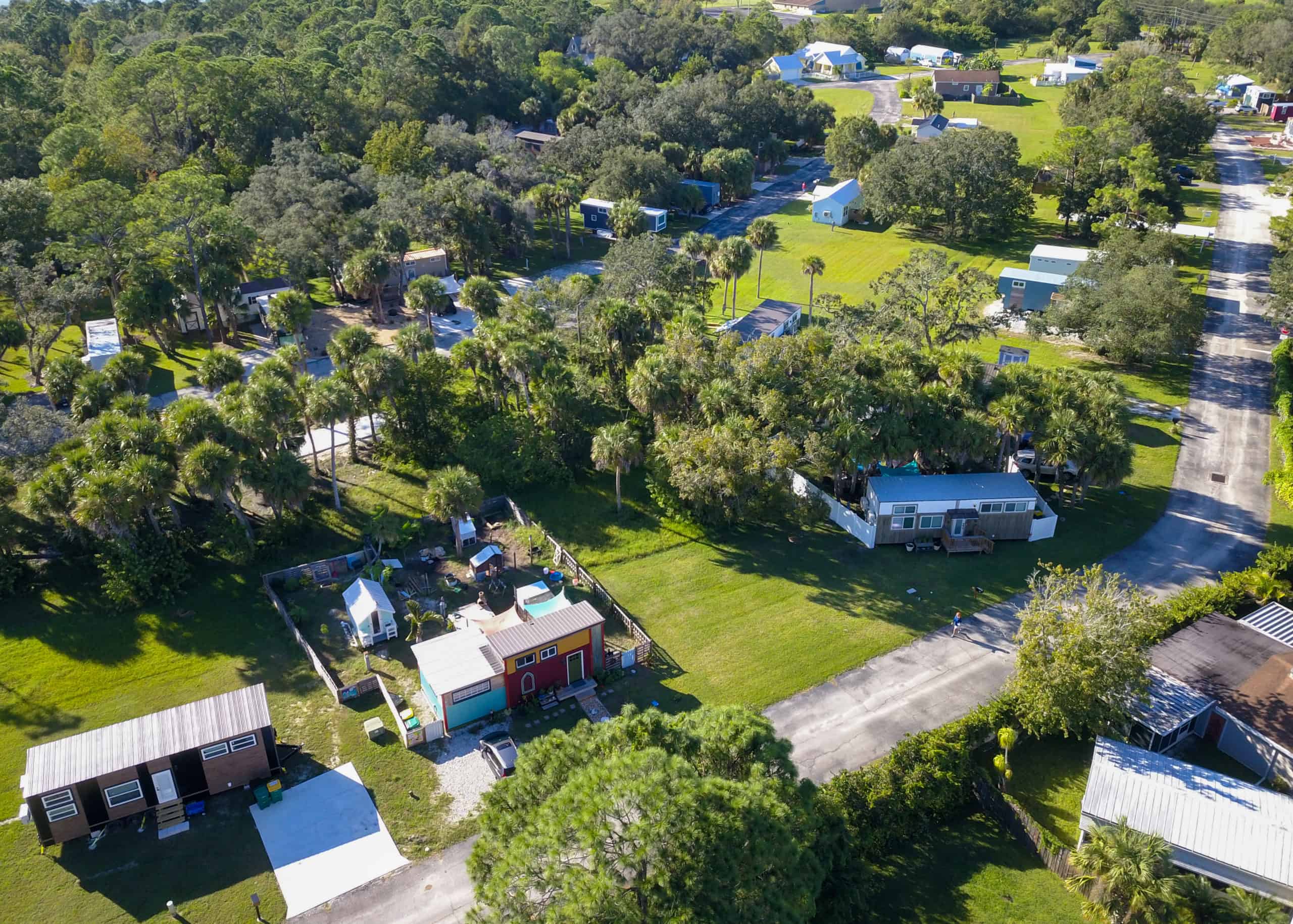
Image courtesy of Braveheart Properties of Brevard / Peacewind
Learn more: braveheartproperties.org | echolsrentals.com (current listings) | Phone: 321-522-1953
Read our full feature: Braveheart Properties Presents Peacewind Tiny House Village
ESCAPE Tampa Bay Village: A Tiny Home Ownership Community Outside Tampa, Now Sold Out
Developer / operator: ESCAPE Tampa Bay Village (privately operated); homes built by ESCAPE (escapetraveler.net)
Land model: Home ownership with monthly lot rent; owners may rent their homes for 9 months or longer (no short-term Airbnb)
Home types: ESCAPE tiny homes built specifically for lots in the village; units sleep 2 to 4 depending on model
Original home prices: Reported at $95,000 to $249,550 during the original sales phases
Lot rent: Varies by site per the community FAQ (earlier reported at $625 to $700 per month); covers water, sewer, garbage/recycling, private deck(s), landscaping, gated security, and parking; power, internet, and propane are extra
Community size: Three neighborhoods — The Village, The Oaks, and Palm Court
Status: Sold out; no units for sale (checked October 24, 2026) — resales are announced to the email list first; contact sales@escapetampabay.com
ESCAPE Tampa Bay Village was one of the Tampa area’s most watched tiny home developments when its first phase opened in the early 2020s, and the sellout of both the original Village phase and the later Oaks phase confirmed there was real demand in the Tampa Bay market for a professionally built, ownership-model tiny home community within commuting range of a major city. The community sits off Highway 301 in Thonotosassa, an unincorporated Hillsborough County community east of Tampa, with quick access to I-4 and I-75 that keeps residents connected to the broader metro without requiring them to live in it. Mature oaks shade much of the property, and a large central park ties the neighborhoods together.
The homes are ESCAPE models built specifically for lots at the village — the community does not accept outside RVs or mobile homes — and they accommodate two to four occupants depending on the unit. Buyers own their homes and pay monthly lot rent, which the community FAQ says varies by site and covers water, sewer, garbage and recycling, private deck(s), landscaping maintenance, gated security, and parking. A Dwell feature on the community reported all-in monthly costs (lot rent plus home financing) of roughly $1,000 to $1,100 for financed buyers, well below typical apartment rents in the Tampa Bay metro. That affordability math, combined with the ownership structure, drove the demand that sold both phases out.
Today the community is effectively a resale market. As of October 24, 2026, the Available Units page says there are no units for sale and that resales are announced to its email subscribers first. Owners may rent their homes for nine months or longer, and the community helps match owners with long-term renters. If you love the homes but not the location, ESCAPE also builds and delivers its models nationwide through escapetraveler.net.
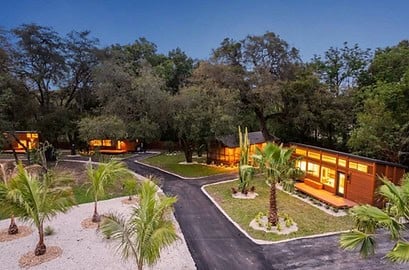
Image courtesy of ESCAPE Tampa Bay Village
Learn more: escapetampabay.com | Email: sales@escapetampabay.com
Read our full feature: Grove Classic King XL: All-Electric Tiny Home at Escape Tampa Bay Village
Circle Pond: A Garden-Focused Tiny Home Community on Nearly 5 Acres in South Hillsborough County
Developer / operator: Circle Pond Tiny Community (privately operated); owner Debbie Caneen
Land model: Monthly or yearly lot rental
Home types: Tiny homes on wheels and small homes (must be certified safe; instant hot water systems required)
Lot lease: Starting at $625 per month when available (checked October 24, 2026); includes water, sewer, garbage, lawn care, and electricity
Community size: 12 tiny home spaces on nearly five acres around Circle Pond
Status: Small waitlist; request to be added by email (circlepondcommunity@gmail.com); tours by appointment only, usually on weekends or after working hours
Circle Pond distinguishes itself from Florida’s other tiny home communities through its focus on growing food and living close to nature. The nearly five-acre property in Ruskin is arranged around Circle Pond, and residents share fruit from mango, avocado, olive, mulberry, banana, plum, and loquat trees on site. Every new resident receives a raised garden bed, residents are encouraged to plant and harvest, and raw local honey is produced on the property. Owner Debbie Caneen received a 2019 Sustainable Business Award for developing the community, and that sustainability focus shows up in daily life rather than in an amenity list.
The financial structure is among the most straightforward of any Florida community in this guide. Twelve spaces are available at a monthly lot rent starting at $625, with that fee covering water, sewer, garbage pickup, lawn care, and electricity — the full utility suite in a single payment rather than billed separately. That all-inclusive approach removes the variable utility costs that affect residents in communities where electric is billed separately, and it makes the monthly budget simple. The community requires homes to be certified as safe and to use an instant hot water system, a relatively minimal set of requirements that leaves room for a range of THOW designs and build styles. Pets are allowed with the usual leash and cleanup rules.
Circle Pond’s South Hillsborough County location gives it practical workplace access that distinguishes it from rural tiny home communities. The site is within walking or biking distance of Hillsborough Community College, the Firehouse Cultural Center, and an Amazon Fulfillment Center, with interstate access a few minutes away, which gives residents employment options without a long commute into Tampa. As of October 2026, the community’s website says there is “a bit of a waitlist,” and prospective residents can request to be added by email.
Image courtesy of Circle Pond Tiny Community
Learn more: circlepondtinycommunity.com
Read our full feature: Circle Pond Tiny Home Community in Ruskin, Florida
Gracious Tiny House Park: An Affordable Waterfront Community on the Rim Canal of Lake Okeechobee
Developer / operator: Gracious Tiny House Park (small, family-owned RV park); full-time adult residents
Land model: Monthly lot rental; rates based on a minimum six-month term, most commonly a year
Home types: Tiny houses on wheels up to 35 to 40 feet on select grassy full-hookup sites (30- and 50-amp service)
Lot lease: Home page lists rent starting at $450 per month on long-term leases (checked October 24, 2026); the FAQ, dated spring 2024, lists $425 standard and $500 waterfront plus electric, and $30 per month for a washer/dryer
Community size: 21 sites on over 1.5 acres; about 10 directly on the waterfront
Status: Often full, with slow turnover and a short waiting list
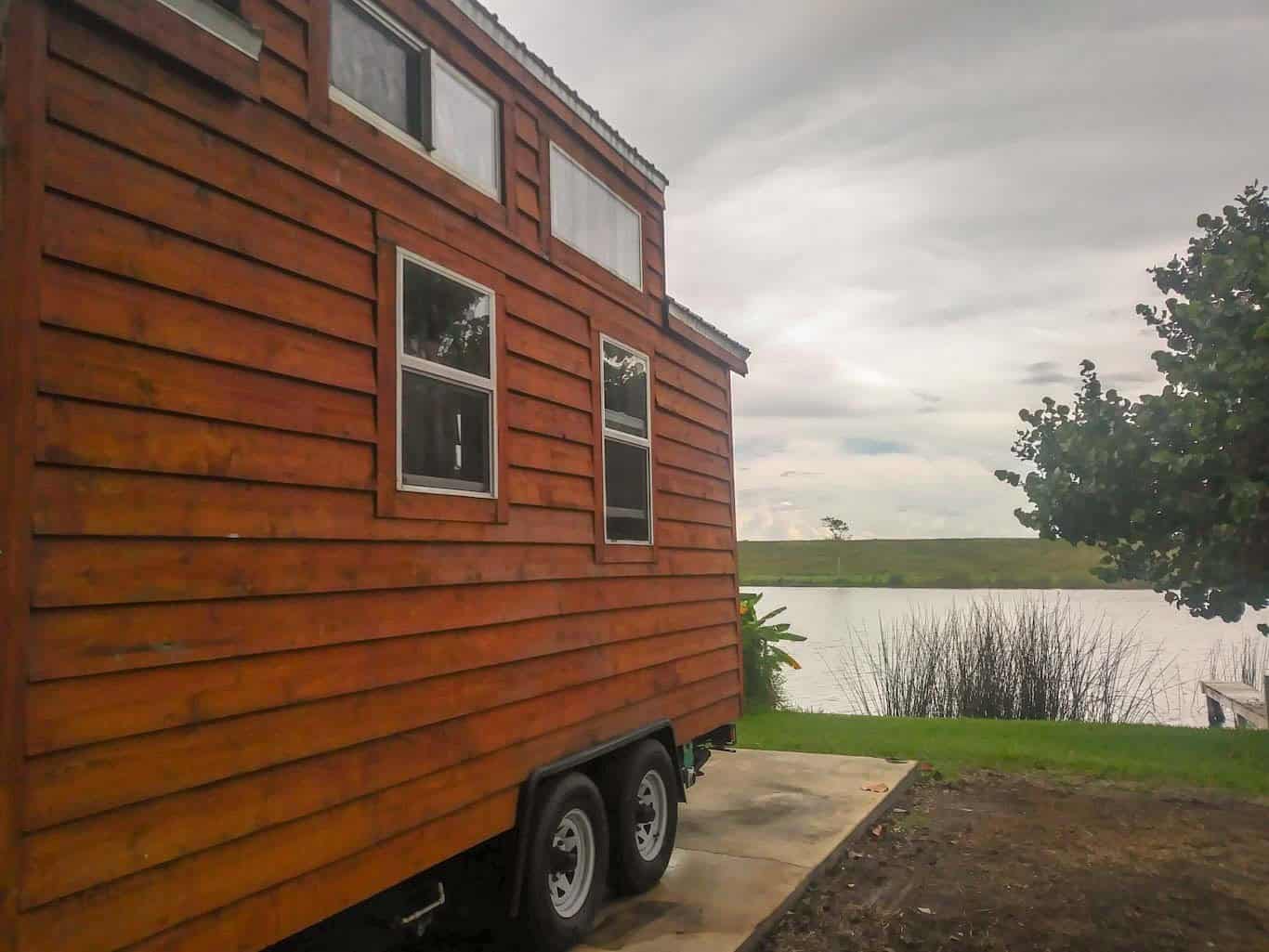
Gracious Tiny House Park is the kind of community that rarely makes it into listicles but that its residents clearly value. Situated along the Rim Canal at the northern tip of 750-square-mile Lake Okeechobee, the small, family-owned park offers 21 full-hookup sites on just over an acre and a half, with about 10 of them directly on the water. Pricing has stayed well below many Florida tiny home communities: the home page lists rent starting at $450 per month on long-term leases, and the FAQ (last dated spring 2024) lists $425 for standard sites and $500 for waterfront sites, plus electric, which is metered and billed by Florida Power & Light. Lawn service and trash collection are included. The philosophy is simple: provide good sites at fair prices and let the lake do the rest.
The lake does a lot. Lake Okeechobee is well known for bass fishing, and the park’s fish cleaning station, waterfront gazebos with picnic tables, and boat docks along roughly 300 feet of seawall give residents working access to the water rather than a decorative view of it, with access to the open lake through a nearby lock. The site accommodates tiny houses up to 35 to 40 feet on select sites, which fits a wide range of THOW configurations. A nature trail runs along the levee at the park’s border, and wading birds and other wildlife are part of daily life. The park is not designed for people who need restaurant delivery or walkable retail. It is designed for people who want to live inexpensively on the water in south-central Florida with boat access and good fishing.
The park describes availability as having slow turnover, with a short waiting list that can move quickly once an opening appears. As of spring 2024 the park counted seven full-time tiny housers among its residents. The location — about 40 minutes to Fort Pierce and Port St. Lucie, an hour to Palm Beach, and two hours to Orlando — puts it in the agricultural interior of the state, so local employment options are limited and a car is essential, though the city of Okeechobee has major groceries, banks, restaurants, and home improvement stores. For retirees, remote workers, or anyone who wants to live cheaply on the water, Gracious Tiny House Park is an important part of the state’s tiny home community map.
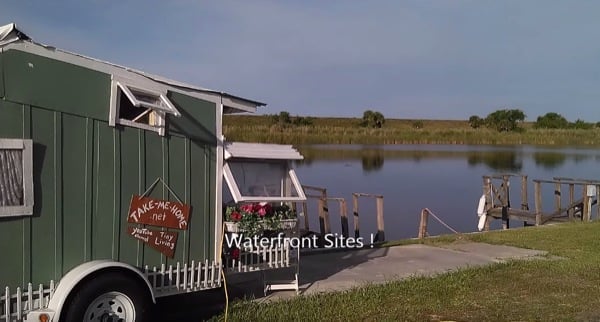
Image courtesy of Gracious Tiny House Park
Learn more: gracioustinyhousepark.com
Read more: Tiny House Friendly RV Park on Lake Okeechobee
Fresh Start Village: A Seven-Home Community in Pensacola Giving Former Foster Youth a Permanent Address
Developer / operator: AMR at Pensacola, Inc. (501(c)(3) nonprofit housing developer); project founded by Jim Reeves
Land model: Nonprofit-held property on about an acre of land donated by Baptist Health Care Foundation; housing for young adults aging out of foster care
Home types: Seven single-occupant tiny homes of about 400 square feet each, fully furnished
Community size: 7 homes plus a community center (funded in part by an IMPACT 100 grant)
Rent: Described by AMR in 2023 as break-even, covering debt service and upkeep; residents are young adults transitioning out of foster care
Status: Open and occupied; first residents welcomed in August 2024
Fresh Start Village shows what small, purpose-built homes can do for a population that conventional affordable housing often misses. The site at West Blount Street and North Pace Boulevard in Pensacola has seven 400-square-foot homes and a community center, and it welcomed its first residents in August 2024 — young adults who aged out of the Florida foster care system at 18 and faced independence without the family safety net most young adults take for granted. The project began when founder Jim Reeves approached the AMR at Pensacola board about building a tiny home community for youth aging out of foster care; Baptist Health Care Foundation donated the land, and local organizations and individual donors paid for the build. The homes are fully furnished, and the community center is staffed with people from healthcare, Social Security, financial services, and other support programs.
AMR at Pensacola, a nonprofit and state-certified community housing development organization, describes a larger goal through its Phoenix Project: a total of 14 tiny home communities of approximately 12 homes each across Escambia County. That neighborhood-scale model is deliberate — small clusters on land within established neighborhoods rather than one large development on the edge of town. Fresh Start Village is the working proof that the model can be built, permitted, and occupied, though the pace of any expansion depends on funding, land, and local zoning.
For TinyHouseTalk readers, Fresh Start Village is not a market-rate housing option — residency is specifically for young people transitioning out of foster care, and AMR worked with partner agencies such as Families First Network to identify residents. But as a demonstration of what 400-square-foot homes can accomplish when a nonprofit works within the existing regulatory framework rather than waiting for statewide reform, it is one of the more significant tiny home stories to come out of the Panhandle. The project has been covered by WEAR-TV and WSRE PBS.
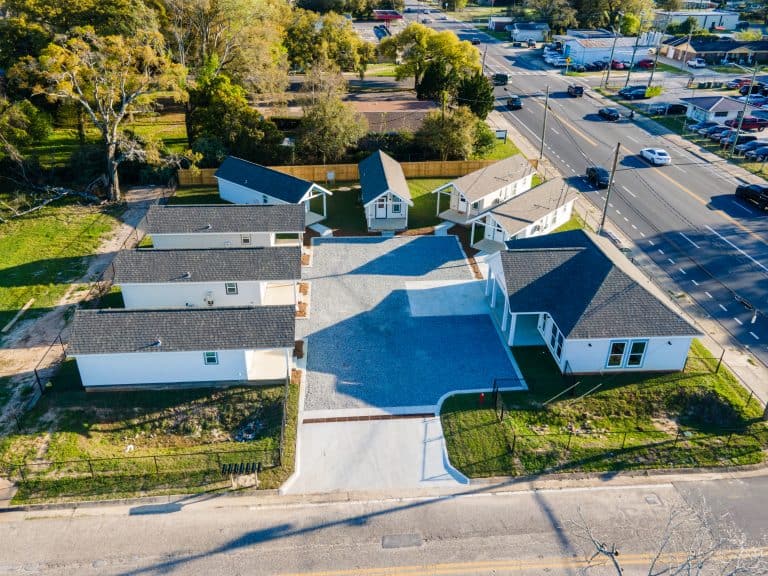
Image courtesy of AMR at Pensacola / Fresh Start Village
Learn more: amrpensacola.com
Trinity Village: A Nine-Home, Donation-Funded Senior Community in Downtown Pensacola at About $500 a Month
Developer / operator: Catholic Diocese of Pensacola-Tallahassee through its Trinity House nonprofit; executive director Deacon Ray Aguado
Land model: Diocese-owned property; affordable rental housing for low-income seniors at risk of homelessness
Home types: Roughly 300-square-foot homes, each with a kitchen, bathroom, sleeping area, and living space; one ADA-accessible unit; built to hurricane standards; laundry on site
Community size: 9 homes
Rent: About $500 per month including utilities, as reported by WUWF and Catholic news coverage in 2025–2026
Status: Opened May 2026; applications opened in early May 2026
Trinity Village represents a different model from everything else in this guide: a faith institution using land it already owns, funded by private donations, solving a housing problem for a specific underserved population — low-income seniors in Pensacola facing housing insecurity — at a price point (about $500 per month including utilities) the market cannot match. The Catholic Diocese of Pensacola-Tallahassee broke ground in September 2024 on a vacant lot directly behind its pastoral center, built through 2025, and opened the nine-home village in May 2026. The diocese says the project cost a little over $1 million and was paid for with donations, with no loans or government money, and avoiding land costs is a big part of what makes the rent possible.
Each of the nine single-occupant homes has its own kitchen, bathroom, sleeping area, and living space, and one unit is ADA accessible. Laundry is on site, and the homes were built to hurricane standards. The diocese plans case management, counseling, and mentoring for residents — support aimed at helping them maintain physical and financial health — which is what distinguishes a supportive tiny home community from a cluster of small rental units. The diocese has also said it has identified more land it already owns for future tiny homes.
Trinity Village is not open to the general public; residency runs through the diocese’s application and screening process for seniors on low or fixed incomes. Together with Fresh Start Village, it makes Pensacola one of the more interesting tiny home community stories in Florida right now — two different nonprofits, two different populations, and two different community models, both showing that purpose-built homes of 300 to 400 square feet can be built and occupied within the existing local permitting framework.
Image courtesy of the Catholic Diocese of Pensacola-Tallahassee / Trinity Village
Learn more: ptdiocese.org/trinity-house
Gators Tiny Home Community: A Self-Sufficiency-Minded Community Between Tampa and Orlando
Developer / operator: Gators Tiny Homes (privately operated; RV park with a growing tiny home community)
Land model: Monthly lot rental for long-term residents; work-trade projects available
Home types: Tiny homes on wheels, small homes, and RVs
Lot lease: Full hook-up sites $795/month + tax + electric; partial hook-up sites $695/month + electric + tax; $45/month discount for residents who contribute to the community in a significant way (checked October 24, 2026)
Status: Open; welcomes long-term residents; also offers nightly tiny house rentals and occasional tiny homes for sale
Gators Tiny Home Community occupies a category that appears often in the Florida tiny home landscape: a working RV park that is building a tiny home community identity alongside its RV sites. The property at 449 Lake Van Road in Auburndale — a Polk County community positioned between Tampa and Orlando — calls itself “a happy tiny home community” and “long term friendly.” That identity shows up in the community’s recruitment approach, which invites tradespeople, handymen, carpenters, artists, and anyone “good with a shovel” to take on work-trade projects in exchange for site rent, and offers a $45 monthly discount to residents who contribute to the community in a significant way — a model more common in intentional communities and co-ops than in conventional housing.
The self-sufficiency vision shows up in the free garden space in the community garden that comes with renting a tiny house site, and in the operators’ stated goal of becoming “the greenest, happiest, and most self-sustainable Tiny House Community in the USA” — ambitious framing for a community still growing. Lot rent sits toward the upper end of this guide at $795 per month for a full hook-up site plus tax and electric. Partial hook-up sites at $695 offer a meaningful savings for residents who can manage with water and electric only, and the contribution discount creates a third tier for residents whose skills help the community develop.
The Auburndale location places Gators in a useful position for residents who need access to both the Tampa and Orlando metro areas. Lakeland provides the closest full retail, medical, and employment options, and the surrounding Polk County landscape gives the site the open, low-density character many tiny home residents look for. Gators is best understood as a growing community with clear values rather than a fully established neighborhood with a long waitlist — people interested in helping shape a community will find it more interesting than those who want a proven, full-occupancy community. Visitors can also try it out first: the community lists nightly tiny house rentals.
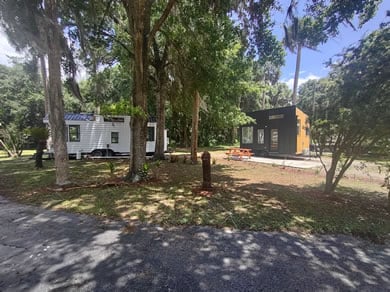
Image courtesy of Gators Tiny Home Community
Learn more: gatorstinyhomes.com
On the Horizon: Developments Worth Watching
AMR Escambia County Expansion (Pensacola area): AMR at Pensacola, the nonprofit that built Fresh Start Village for former foster youth, describes a goal through its Phoenix Project of developing 14 tiny home communities of approximately 12 homes each in Escambia County. Fresh Start Village is the working example; the pace of any expansion depends on funding, land, and the county’s approach to tiny home zoning, which had not changed as of our October 2026 check. Contact: amrpensacola.com
Neighborhood Center Tiny Homes (DeLand, Volusia County): After DeLand approved rules allowing tiny home communities within city limits in fall 2025, the Neighborhood Center of West Volusia broke ground in July 2026 on a transitional housing community next to its main facility: 10 units built from recycled shipping containers, two of them family units sleeping up to four, with completion expected in early 2027. It will serve people moving out of the center’s family and bridge shelters, so it is not open to the general public, but it is a useful model for other Florida cities weighing similar ordinances.
Movable Roots (Melbourne, Brevard County): Movable Roots is a Florida builder based in Melbourne that designs and builds modular homes, ADUs, park model RVs built to ANSI standards, and tiny homes on wheels, and delivers within Florida. It is not a community, but it can supply the home side of the equation for buyers who have secured a lot in one of the communities in this guide. Contact: movableroots.com | Phone: 321-600-4988
What These Communities Have in Common
Florida’s verified tiny home communities are more geographically dispersed and more organizationally diverse than the community landscapes in most states this guide series has covered. There is no Florida equivalent of North Carolina’s Asheville-Flat Rock cluster, where a single region dominates the state’s tiny home community identity. Instead, the communities that have actually opened and filled — Tiny Town Orlando, Peacewind in Cocoa, ESCAPE Tampa Bay, Circle Pond in Ruskin, Gracious Tiny House Park on Lake Okeechobee, and Gators in Auburndale — are spread across different counties and oriented around different values: lakefront lifestyle, affordable lot ownership, home ownership in a professionally managed village, food growing, and pure affordability. That dispersal reflects both the state’s size and the absence of a single regulatory environment that has made tiny home community development especially easy or especially difficult in one region.
The nonprofit community model has a notable presence in Florida, and it is concentrated in the Panhandle. Fresh Start Village and Trinity Village represent two applications of the same basic insight: that a mission-driven nonprofit or faith institution with land and donated funding can build tiny homes for underserved populations faster and more cheaply than the conventional affordable housing pipeline. Both are in Pensacola, opened less than two years apart (August 2024 and May 2026), and serve different populations — former foster youth and low-income seniors. Together they give local advocates real evidence that small homes can be built, permitted, and occupied in the area, which is useful as Escambia County continues to weigh whether to adopt Appendix Q.
The waitlist pattern at several of Florida’s market-rate communities — ESCAPE Tampa Bay Village sold out both of its original phases, Tiny Town Orlando estimates a roughly 12-month lot waitlist, Gracious and Circle Pond keep short waitlists — points to the same supply-demand imbalance seen in Texas, North Carolina, and Georgia. Florida’s population growth has driven housing costs up across the Tampa-Orlando corridor, which makes a lot rent in the $450 to $850 range, or a reported all-in cost around $1,000 to $1,100 for financed ESCAPE buyers, competitive with the region’s conventional rental market. The gap in the Florida market is not demand — it is the regulatory clarity and developer confidence needed to build more supply.
Highlights
- Tiny Town Orlando on Lake Fairview is one of Florida’s best-known THOW communities: an estimated 49 tiny homes, 3 small houses, and 1 RV; lot leases of $650 to $850/month as of 2026 and furnished long-term rentals of $1,400 to $2,300/month (checked October 24, 2026); roughly 12-month lot waitlist
- Peacewind in Cocoa is a legally zoned nonprofit community with 84 sites where you can buy a deeded lot — currently listed at $89,000 — or rent one at about $800/month plus utilities (checked October 24, 2026)
- ESCAPE Tampa Bay Village in Thonotosassa is a sold-out ownership community of ESCAPE-built homes across three neighborhoods; no resale units were listed as of October 24, 2026, but long-term rentals of 9+ months come up
- Circle Pond in Ruskin offers 12 spaces on nearly five acres from $625/month with electricity and other utilities included (checked October 24, 2026), plus fruit trees, garden beds, and on-site honey
- Gracious Tiny House Park on Lake Okeechobee is among the most affordable waterfront options, with rent starting at $450/month on long-term leases plus electric (checked October 24, 2026)
- Pensacola has two nonprofit tiny home communities: Fresh Start Village (7 homes for former foster youth, opened August 2024) and Trinity Village (9 homes for low-income seniors at about $500/month with utilities, opened May 2026)
- Florida’s Building Code has included Appendix Q for foundation-built tiny homes of 400 sq ft or less since the 2020 edition, but local zoning still decides where they can go; movable tiny home bills died in committee in 2023 (HB 321) and 2024 (HB 557)
Explore More
- Tiny Town Orlando on Lake Fairview: Lot Lease and Long-Term Rentals
- Braveheart Properties Presents Peacewind Tiny House Village
- Circle Pond Tiny Home Community in Ruskin, Florida
- Traveler XLS at Escape Oaks Village in Tampa Bay
- Can You Legally Live in a Tiny House in Florida?
- The Ultimate Guide to Tiny House Living in Florida
- Tiny House Resources in Florida: Builders, Communities, Airbnbs & Events
- Tiny House Communities in Georgia
- 31 Florida Cabins and Tiny House Airbnbs
- More Tiny House Communities
Resources and Further Reading
- Tiny Town Orlando — 3405 N. Orange Blossom Trail, Orlando; lakefront THOW community on Lake Fairview; lot leases $650-$850/month as of 2026; lot waitlist; long-term furnished rentals; phone: 407-936-4094
- Peacewind / Echols Rentals — 200 Sandpiper Drive, Cocoa; developed by the 501(c)(3) Braveheart Properties of Brevard; 84 sites; current lot and home listings; phone: 321-522-1953
- ESCAPE Tampa Bay Village — 11008 Highway 301, Thonotosassa; sold out; resale and rental inquiries to sales@escapetampabay.com
- Circle Pond Tiny Community — 302 24th Street SE, Ruskin; 12 spaces; lot rent from $625/month with utilities included; waitlist
- Gracious Tiny House Park — Rim Canal, Lake Okeechobee; 21 sites; rent from $450/month on long-term leases plus electric
- Gators Tiny Home Community — 449 Lake Van Road, Auburndale; RV park and growing tiny home community; lot leases $695-$795/month + electric + tax
- AMR at Pensacola / Fresh Start Village — Pensacola; 7-home nonprofit community for former foster youth
- Trinity Village — West Garden Street, downtown Pensacola; 9-home senior community at about $500/month including utilities; Catholic Diocese of Pensacola-Tallahassee
- Movable Roots — Melbourne; modular homes, ADUs, park model RVs, and THOWs; phone: 321-600-4988
- Tiny Home Industry Association — Florida — state-specific regulatory resources, builder listings, and legislative tracking
- THIA Florida Legislation Tracker — Florida tiny home bill history and county-level regulatory updates
- Appendix Q — 2020 Florida Building Code (Residential) — text of Florida’s Appendix Q tiny house construction standards
Want more Florida tiny home content? Browse our Tiny House Community archives and our Movable Roots tag for Florida-built homes featured on the blog.
What do you think? Would you rather lease a lakefront lot in Orlando, buy a deeded lot at Peacewind, or keep costs low on Lake Okeechobee? Tell us in the comments!
If you enjoyed this you’ll LOVE our Free Daily Tiny House Newsletter with even more!
You can also join our Small House Newsletter!
Also, try our Tiny Houses For Sale Newsletter! Thank you!
More Like This: Communities | Small Houses | Roundups & Lists
Disclosure: This post may contain affiliate links. If you purchase through one of our links, we may earn a commission at no additional cost to you.


Alex
Latest posts by Alex (see all)
- Cozy Acre Tiny Home Community: Shaded Lots, a Dog Park and Free Laundry in Poolville, Texas - November 15, 2026
- Peaceful Meadows: A Gated Park Model Village Near Franklin, NC - November 15, 2026
- Tiny House Communities in Florida: A Complete Guide - November 15, 2026



Join the Conversation
No comments yet. Be the first to join the conversation.