
Disclosure: This post may contain affiliate links. If you purchase through one of our links, we may earn a commission at no additional cost to you.
The Going Tiny Series, Part 30 of 45 · Guide 4 of 5: Bringing Them On Board
A free chapter goes up every day. See every part. Rather have it all at once, with printable worksheets? Get the Going Tiny Toolkit.
Many of the readers who wrote to me had already had “the conversation” more than once, and it hadn’t gone well. Often that’s because it started at the wrong time, in the wrong way, with the wrong question. Here’s how to give it a better chance.
Timing matters more than wording
- Choose a calm, unhurried time. Not right after a bill arrives, a fight, a hard day at work, or a family visit.
- Ask first: “Is now a good time to talk about something I’ve been thinking about? It’s not urgent.” Accept “not tonight.”
- Talk side by side if that’s easier: on a walk, a drive, or over coffee on the porch. Many people find face-to-face, sit-down talks feel like a meeting or a confrontation.
- Keep the first conversation short. Twenty minutes is plenty. You’re opening a door, not closing a deal.
- If talking out loud is hard for either of you, or one of you is deaf or hard of hearing, writing works too. Some couples trade notes or a shared notebook for the first round. Writing gives each person time to think before answering.
Values first, square footage second
Most “tiny house” conversations start with a house. Start instead with what each of you wants your life to feel like. A house is only a tool for getting there.
The exercise (also on Worksheet 1 (Our Values & Dreams)): each person, separately, answers these questions. Then you compare.
- Five years from now, what does a really good ordinary Tuesday look like?
- What do we spend money, time, or energy on now that doesn’t feel worth it?
- What would we want more of: time together, time apart, travel, family, nature, quiet, community, creative work?
- What about our current home do we love and want to keep in any future home?
- What worries us about the next 10 to 20 years?
Notice what’s missing: the words “tiny” and “square feet.” Once you know your shared values, you can talk about which point on the Small-Living Spectrum serves them best.
“I want to treasure people. I want to have quality time together. I want to enjoy nature.”
— Gretchen, Tiny House Talk reader
Curiosity questions
Open questions invite your partner to think out loud. Closed questions (“Wouldn’t it be great to…?”) invite a yes or no, and usually you’ll get the no.
- “What’s your gut reaction when I bring up living smaller?”
- “What part of the idea, if any, appeals to you even a little?”
- “What would worry you most if we did it?”
- “If money and the kids weren’t factors, would you feel differently?”
- “What would a version of this look like that you could actually enjoy?”
- “What do you want our home to be like when we’re 80?”
- “Is there something you’d want to try first before thinking about it seriously?”
Listening that actually helps
Couples researchers have long recommended a simple structure for hard conversations: one person speaks while the other listens and summarizes what they heard, without arguing, before switching roles. It feels slow and a little formal. It also tends to work, because each person feels heard before they’re asked to hear.
Some phrases that help:
- “So what I’m hearing is that you’re worried we’d have no space to ourselves. Is that right?”
- “That makes sense. Tell me more about that.”
- “I hadn’t thought about it that way.”
- “What else?” (Often the most important worry comes out second or third.)
- “I don’t want to do this unless it works for you too.”
- “We don’t have to decide anything today.”
Want to do this on paper?
The printable PDF of Bringing Them On Board has fill-in worksheets for this step, including:
- Our Values & Dreams
They come with all five guides in the Going Tiny Toolkit.
What not to say
| Instead of… | Try… |
|---|---|
| “You’re just afraid of change.” | “Change is a lot. What would make it feel less risky?” |
| “Everyone online is doing it.” | “I’ve been reading about people who did this. Some loved it and some didn’t. I’d like to understand why.” |
| “You care more about your stuff than about us.” | “Which of your things matter most to you? I’d want to make room for those.” |
| “Look how much money we’d save!” | “Could we sit down and look at the real numbers together, including the costs?” |
| “Just look at these floor plans.” | “Before plans, can we talk about what we’d each want a home to do for us?” |
| “If you loved me, you’d try.” | (Don’t say this. Ever.) |
| “Fine, forget it.” (said bitterly) | “Okay. I hear you. Can we come back to this in a few months?” |
About floor plans
One reader kept showing her husband floor plans with their current furniture drawn in. It’s an understandable instinct: you can see it, so surely they’ll see it too. But to a reluctant partner, a stack of plans can feel like a decision already made. Save plans for when you’re designing together, and invite your partner to mark them up.
After the first talk
Don’t measure success by whether they agreed. Measure it by these:
- Did each of us say what we really think?
- Do I understand at least one of their concerns better than before?
- Did we agree on one small next step, even if it’s “let’s both fill out a worksheet”?
- Did we end on a kind note?
If you got even two of those, it went well.
When to bring in a counselor
If every conversation about home turns into a fight, if old hurts keep surfacing, or if one of you feels unheard over and over, a licensed couples or family counselor can help. Many offer video sessions, and some work by text or chat. Asking for help isn’t a sign the relationship is failing. It’s a sign you take it seriously.
If you don’t feel safe
If you’re afraid of your partner, this guide is not the right tool, and a housing decision is not the first decision. In the U.S., the National Domestic Violence Hotline offers free, confidential help 24/7: call 1-800-799-7233, text START to 88788, or chat at thehotline.org. Outside the U.S., look for your country’s domestic violence helpline.
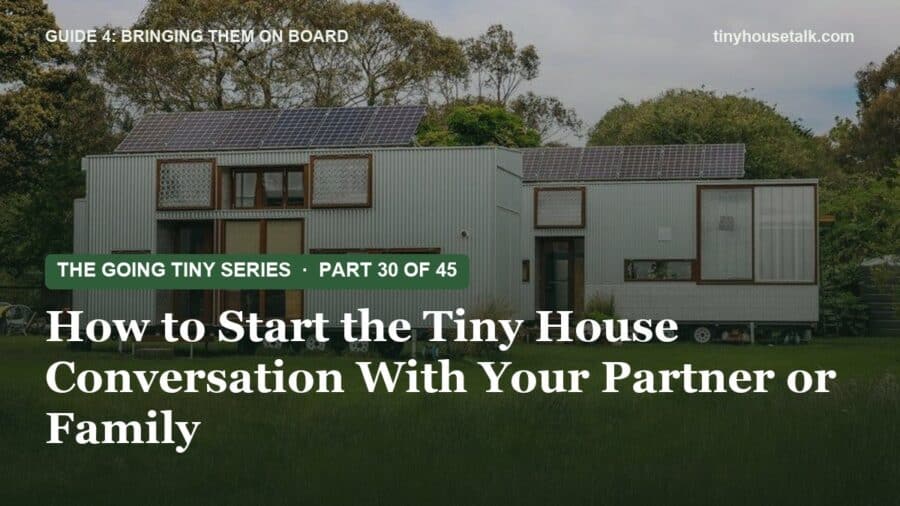
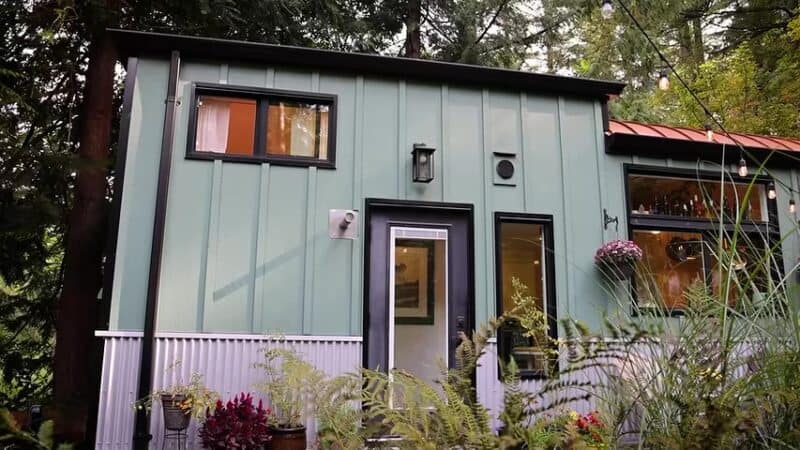
Top photo: Two tiny houses: one for the parents, one for the teens. Photo via Living Big in a Tiny House/YouTube. See their story.
Your turn
Is someone in your life on the fence about living smaller? Share what's worked (or hasn't) in the comments.
Prefer the clean, printable version?
This series is free to read here, and it always will be. If you’d rather have it as five clean, printable PDFs, that’s the Going Tiny Toolkit:
- Bringing Them On Board (the guide this chapter comes from): conversation starters, low-risk trial ideas, and worksheets for couples and families
- The Tiny House Money Plan
- Where Can I Put It?
- Tiny Without the Ladder
- Your First Tiny Steps
Every guide adds printable worksheets and a 30-day action plan, and Tiny Without the Ladder comes with the bonus One-Level Floor Plan Idea Book (18 to-scale floor plans). All five are $47, with a 30-day refund.
← Previous: Part 29: What's Really Underneath the No to Going Tiny
Next (tomorrow): Part 31: Try Tiny Living Before Anyone Decides
Not sure which part matters most for you? The free 10-minute What’s Really Holding You Back? quiz tells you where to start. And to get a new part (and a new home) in your inbox each day, join the free Tiny House Newsletter.
Disclosure: This post may contain affiliate links. If you purchase through one of our links, we may earn a commission at no additional cost to you.


Alex
Latest posts by Alex (see all)
- How to Start the Tiny House Conversation With Your Partner or Family - November 17, 2026
- A Never-Used 10×16 Backyard Office With a Bathroom and Kitchenette in Winlock, Washington - November 16, 2026
- A New Orleans-Inspired 34-Foot Family Tiny House with Bunk Rooms on BC’s West Coast - November 16, 2026




Join the Conversation
No comments yet. Be the first to join the conversation.