Disclosure: This post may contain affiliate links. If you purchase through one of our links, we may earn a commission at no additional cost to you.
The Going Tiny Series, Part 9 of 45 · Guide 2 of 5: Where Can I Put It?
A free chapter goes up every day. See every part. Rather have it all at once, with printable worksheets? Get the Going Tiny Toolkit.
When I asked Tiny House Talk readers what was holding them back from going tiny, going small, or simplifying, about a third of everyone who answered said some version of the same thing: I don’t know where I could legally put it.
That question deserves a straight answer, so here it is. For most people, finding a legal, livable place for a tiny or small home is the hardest part of the whole journey. It’s harder than the design. Often it’s harder than the money. Rules vary from one county to the next, sometimes from one side of a road to the other, and the people who know the rules work in offices that can feel intimidating to call.
But “hard” is not “hopeless.” The rules are written down. They can be read. The people in those offices answer questions like yours every week. And the landscape has been changing in your favor: many states and cities have loosened rules on backyard cottages, and in July 2026 a major federal housing law opened new doors for factory-built homes. This guide shows you how to find out, calmly and step by step, what’s actually allowed where you want to live.
“I guess what I want the most is a step by step guide… ‘Go talk to the county about permits’ doesn’t help me much, because I don’t even know what county office to go to.”
— Tanya, Tiny House Talk reader
Tanya, this one’s for you. So is everyone who wrote some version of these:
“Where I live, nothing is allowed sub-600 square feet.”
— J, Tiny House Talk reader
“Due to POA/HOA restrictions we have not found anything that will allow homes under 1,200–1,300 square feet minimum… We need a home around 800 square feet or less.”
— Cynthia, Tiny House Talk reader
“To find out anything often requires a phone call or a visit in person. Being deaf and needing highly technical information makes it difficult for us to really plan ahead.”
— Jeffery, Tiny House Talk reader
You do not have to go tiny
Let me say this clearly, right up front: you do not have to go tiny. If the rules where you want to live say 600 or 800 square feet minimum, a 650-square-foot cottage is still a huge, wonderful step down from a 2,000-square-foot house. A backyard cottage behind your daughter’s house counts. A park model in a friendly community counts. A small manufactured home on a quiet lot counts. Simplifying right where you are counts.
Throughout this guide, when the answer to “Can I put a 200-square-foot house on wheels here?” is no, I’ll show you the next question to ask, which is usually: “What’s the smallest home I can live in here, legally and comfortably?” That question has a yes answer far more often.
Want to do this on paper?
The printable PDF of Where Can I Put It? has fill-in worksheets for this step, including:
- Jurisdiction Finder
- Zoning Code Search Log
They come with all five guides in the Going Tiny Toolkit.
Who this guide is for
- You’re dreaming of a tiny house on wheels, a small cabin, a cottage, an ADU, or a park model, and you have no idea where it could go.
- You own land (or a family member does) and want to know what’s possible on it.
- You’re shopping for land and don’t want to buy a lot you can’t live on.
- You hate phone calls, can’t easily make them, or just want everything in writing.
- You live in the U.S., or you live in the U.K., Canada, or Australia and want the general approach (see Part 18).
How to use this guide in one evening
- Read Parts 10 and 11 (about 30 minutes). They explain the vocabulary officials will use. This is the part that makes everything else click.
- Skim the chapter that fits your situation. Family land? Part 12. Shopping for land? Part 16. Looking for a spot to park? Part 15.
- Print the worksheets at the back and fill in Worksheet 1, the Jurisdiction Finder, for one place you’d like to live. That alone moves you forward tonight.
- Pick one afternoon this week for Part 13’s zoning research session. Bring Worksheet 2.
A quick word on accuracy
I’ve checked the facts in this guide as of October 2026, but codes and laws change, and they vary enormously from place to place. Treat this guide as a map for asking the right questions, not as the final answer for your address. The final answer always comes from your local planning and building offices, ideally in writing. Nothing here is legal advice, and for anything with real money or real risk attached, a local land-use attorney or experienced local builder is worth the consultation fee.
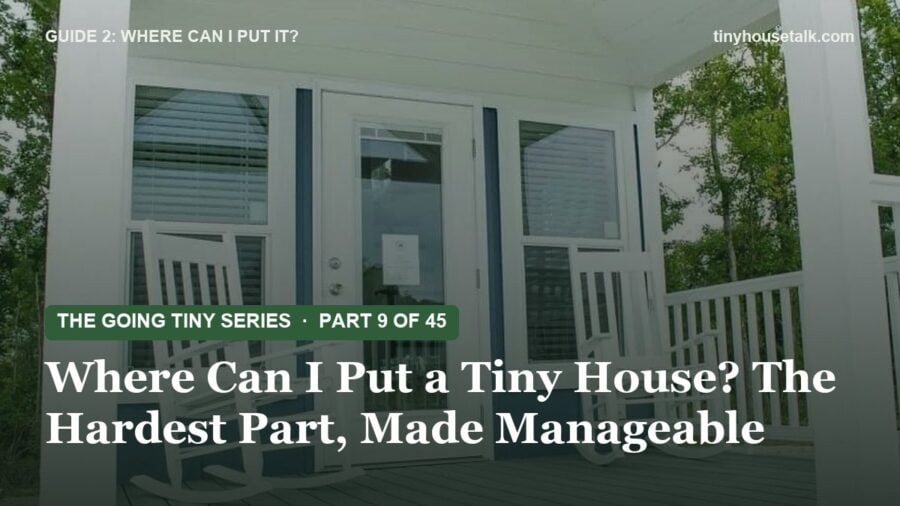
Top photo: A Park Model Cottage at a North Carolina Lake Resort. Photo courtesy of Carolina Park Models. See their story.
Your turn
Where are you hoping to put your tiny or small home? Share your state or country in the comments.
Prefer the clean, printable version?
This series is free to read here, and it always will be. If you’d rather have it as five clean, printable PDFs, that’s the Going Tiny Toolkit:
- Where Can I Put It? (the guide this chapter comes from): zoning research in an afternoon, call scripts and email templates, and a land checklist
- The Tiny House Money Plan
- Tiny Without the Ladder
- Bringing Them On Board
- Your First Tiny Steps
Every guide adds printable worksheets and a 30-day action plan, and Tiny Without the Ladder comes with the bonus One-Level Floor Plan Idea Book (18 to-scale floor plans). All five are $47, with a 30-day refund.
← Previous: Part 8: Tiny House Insurance, Scams, and Protecting Your Money
Next (tomorrow): Part 10: Is Your Tiny House an RV or a House? Why It Decides Everything
Not sure which part matters most for you? The free 10-minute What’s Really Holding You Back? quiz tells you where to start. And to get a new part (and a new home) in your inbox each day, join the free Tiny House Newsletter.
Disclosure: This post may contain affiliate links. If you purchase through one of our links, we may earn a commission at no additional cost to you.


Alex
Latest posts by Alex (see all)
- Where Can I Put a Tiny House? The Hardest Part, Made Manageable - October 27, 2026
- This Curved Off-Grid Tiny House in New South Wales Is Almost All Kitchen - October 26, 2026
- California Tiny House Element 20: A Modular 8×18 Shell You Build Up From - October 26, 2026