Disclosure: This post may contain affiliate links. If you purchase through one of our links, we may earn a commission at no additional cost to you.
The Going Tiny Series, Part 14 of 45 · Guide 2 of 5: Where Can I Put It?
A free chapter goes up every day. See every part. Rather have it all at once, with printable worksheets? Get the Going Tiny Toolkit.
Many readers told me some version of: “I don’t know how to talk to the government.” Here’s a secret that will make this easier. The planner who answers the phone, or the email, usually likes this part of the job. They spend a lot of their week dealing with disputes. A polite, curious person asking a clear question is a welcome change.
The four rules of asking
- Use their words. Instead of “Can I live in my tiny house?”, say “Is a 380-square-foot single-family dwelling on a permanent foundation allowed in the RR-5 district?” or “Can a recreational vehicle be used as a permanent residence on a privately owned lot in the A-1 district?”
- Cite the section. “I’m reading Section 4.12 on accessory dwellings and want to make sure I understand it correctly.”
- Ask hypothetically first. You don’t have to give an address or your name to ask a general question about how the code works. “I’m researching the county before buying land” is completely normal.
- Get it in writing. A phone answer is a starting point, not a promise. Email lets you keep a record. Before you buy land or spend real money, ask for a written answer, and in many places you can request a formal zoning verification letter or zoning determination for a specific parcel (sometimes for a fee).
Why hypothetical questions come first
If you’re simply researching, there’s no reason to share a specific address until you’re ready. And if you’re already living somewhere and unsure whether it’s compliant, it’s wise to understand the rules, and possibly talk with a land-use attorney, before identifying yourself. This isn’t about evading anything. It’s about understanding your options clearly before you take a step you can’t undo.
If phone calls are hard, or impossible
Email is not second best. For this kind of research, it’s often better, because you get a written record. Most planning departments list a general email address or an online “contact us” or “ask a planner” form. Many also offer:
- Online permit portals where you can submit questions or pre-application requests.
- Pre-application meetings, sometimes by video call. If you’re deaf or hard of hearing, you can request captions, a sign language interpreter, or written communication as an accommodation. Ask in your first email.
- Telecommunications relay services. In the U.S., dialing 711 connects to relay services so you can communicate by text with offices that only answer the phone.
If you write and don’t hear back within a week or two, a polite follow-up is fine. If you still get nothing, try the department’s main address, the planning director, or your county commissioner’s or city council member’s office. They can often nudge a question to the right desk.
Want to do this on paper?
The printable PDF of Where Can I Put It? has fill-in worksheets for this step, including:
- Call and Email Script Builder
They come with all five guides in the Going Tiny Toolkit.
Phone script: the first general question
“Hi, my name is [first name]. I’m researching whether I could live in a small home in [city/county] and I’m hoping you can point me in the right direction. I’m not asking about a specific property yet.”
“I’m interested in a home that’s about [size] square feet. It would be [on a permanent foundation / a tiny house on wheels that’s certified as an RV / a park model RV / a manufactured home].”
“Is there a minimum dwelling size in the [district] zone, or in residential zones generally?”
“Does the county [or city] allow [accessory dwelling units / recreational vehicles as permanent residences / tiny houses on wheels] anywhere, and if so, in which zones?”
“Is there a section of the code I should read? And is there an email address where I could send follow-up questions?”
“Thank you so much. May I have your name, so I can mention it if I follow up?”
Take notes during the call on Worksheet 3 (Call and Email Script Builder): the date, the person’s name, and exactly what they said. Then send a short follow-up email summarizing what you understood (“Just to confirm what we discussed today…”) and ask them to correct anything you got wrong. Now you have a written record.
Email template 1: General research question
Subject: Question about minimum dwelling size and small homes in [district/area]
Hello,
I’m researching [city/county] as a possible place to live and would appreciate your help understanding the zoning code. I’m not asking about a specific property at this time.
I’m interested in living full-time in a small home of about [size] square feet, which would be [describe category].
- Is there a minimum dwelling size in the [district name] zone? I’ve read Section [#] and want to make sure I understand it correctly.
- In which zoning districts, if any, would this type of home be allowed as a permanent residence?
- Has [city/county] adopted the tiny house appendix to the residential building code (Appendix Q, AQ, or BB depending on edition)?
I’m hard of hearing [or: I communicate best in writing], so an email reply would be very helpful. Thank you for your time.
[Your first and last name]
[Email]
Email template 2: Specific parcel, before buying
Subject: Zoning question for parcel [parcel number]
Hello,
I’m considering purchasing the parcel at [address], parcel number [#], which your map shows as zoned [district]. Before I make an offer, I want to confirm the following:
- Could a single-family dwelling of approximately [size] square feet on a permanent foundation be permitted on this parcel?
- Is the parcel a legal, buildable lot under current zoning (for example, does it meet minimum lot size and road frontage requirements)?
- Are there any overlay districts, floodplain designations, or other restrictions I should know about?
- Would I be permitted to live in a recreational vehicle on the parcel temporarily while building, and if so, for how long and with what permit?
If your department issues a zoning verification letter for a specific parcel, could you tell me how to request one and the fee?
Thank you,
[Name, email]
Email template 3: ADU on a family member’s property
Subject: Accessory dwelling unit question, [address or general area]
Hello,
My [mother/son/friend], who owns the home at [address or “a home in the R-1 zone”], is interested in adding a small detached accessory dwelling unit of about [size] square feet so that I can live nearby.
- Are detached ADUs allowed in this zone, and what are the size, height, and setback limits?
- Is owner occupancy required?
- Is a [factory-built cottage / manufactured home / tiny house on wheels] allowed as an ADU?
- What permits are needed, and is there a pre-application meeting we could schedule (video or in person)?
Thank you!
[Name]
What to do with the answers
- File every email in a folder named for that town or county.
- Note who said it and when. Staff change, and interpretations can drift.
- If two people give you different answers, politely ask for a written interpretation from the zoning administrator. That’s the person whose reading of the code usually counts.
- Remember that a friendly answer isn’t a permit. The permit is the permit.
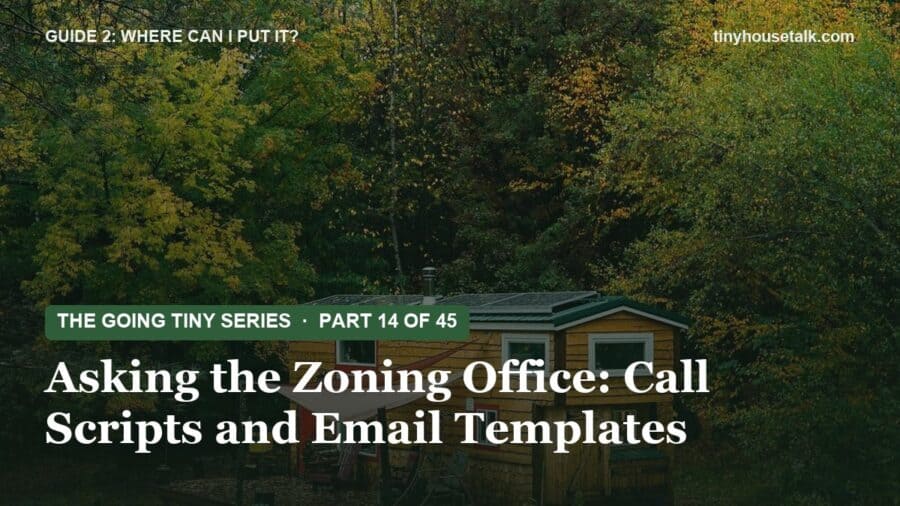
Top photo: From Van Life to Their Own 14 Acres in Vermont. Photo via @anamericanroadstory/Instagram. See their story.
Your turn
Where are you hoping to put your tiny or small home? Share your state or country in the comments.
Like to print things out and write on them?
This series is free to read here, and it always will be. If you’d rather have it as five clean, printable PDFs, that’s the Going Tiny Toolkit:
- Where Can I Put It? (the guide this chapter comes from): zoning research in an afternoon, call scripts and email templates, and a land checklist
- The Tiny House Money Plan
- Tiny Without the Ladder
- Bringing Them On Board
- Your First Tiny Steps
Every guide adds printable worksheets and a 30-day action plan, and Tiny Without the Ladder comes with the bonus One-Level Floor Plan Idea Book (18 to-scale floor plans). All five are $47, with a 30-day refund.
← Previous: Part 13: How to Research Tiny House Zoning in One Afternoon
Next (tomorrow): Part 15: Where to Park or Build a Tiny House: Your Options, Ranked
Not sure which part matters most for you? The free 10-minute What’s Really Holding You Back? quiz tells you where to start. And to get a new part (and a new home) in your inbox each day, join the free Tiny House Newsletter.
Disclosure: This post may contain affiliate links. If you purchase through one of our links, we may earn a commission at no additional cost to you.


Alex
Latest posts by Alex (see all)
- Knitwear Designer Lives and Works in a 280 Sq Ft Oakland Garage ADU - November 1, 2026
- How Do I Get Land for a Tiny House or Camper? 5 Paths That Work - November 1, 2026
- Birches Creek Village: A Quiet RV and Tiny Home Community in the East Texas Woods - November 1, 2026