
Disclosure: This post may contain affiliate links. If you purchase through one of our links, we may earn a commission at no additional cost to you.
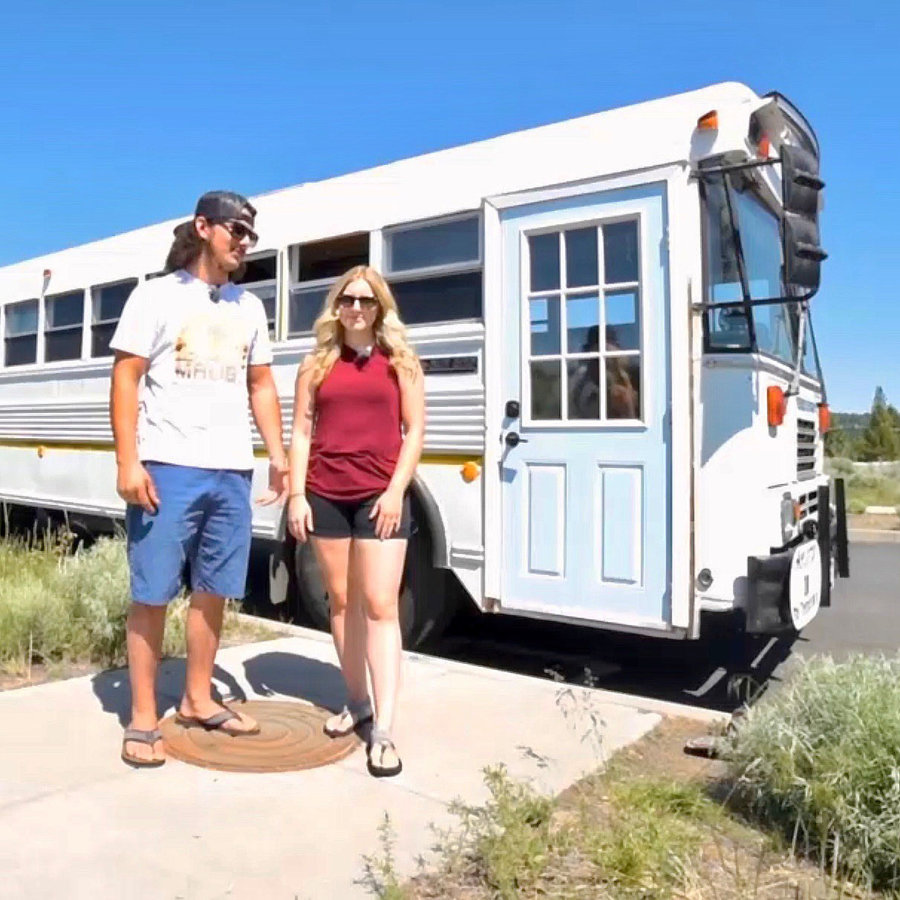
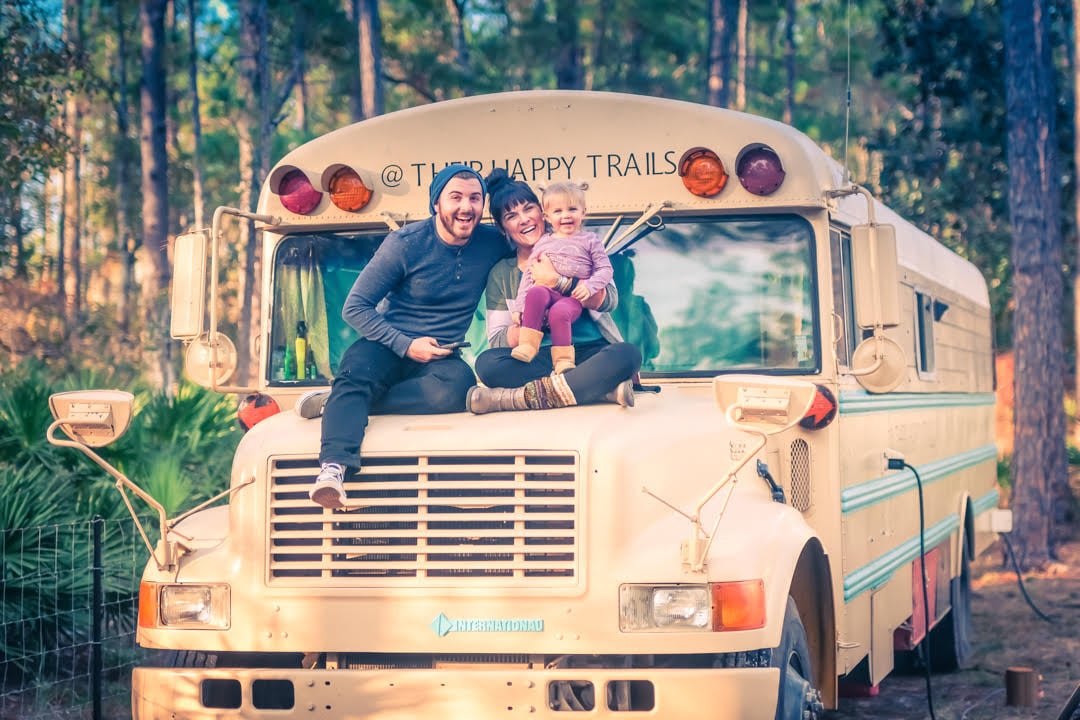
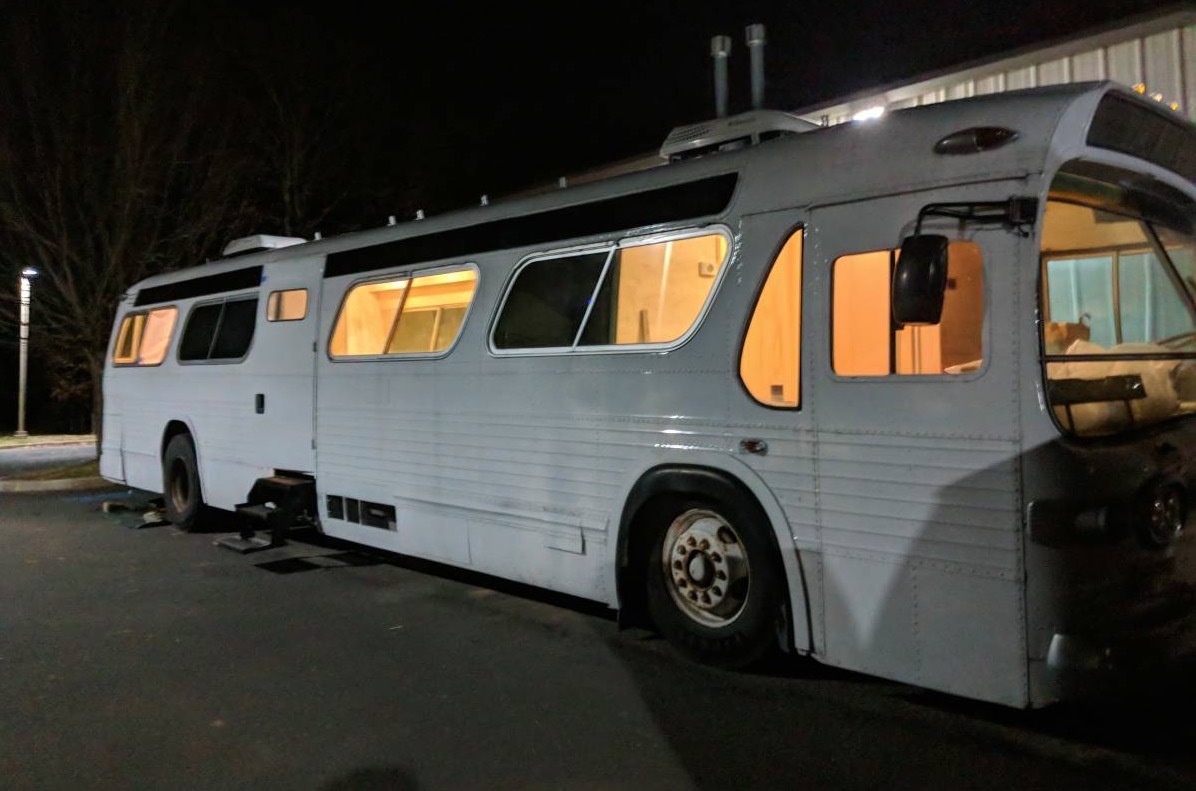
When Ethan and Cassidy set out to build their full-time home, they chose a platform that most people overlook entirely: a retired fire bus. Where others see an aging emergency vehicle, they saw a sturdy, purpose-built chassis ready for a second life on the open road. The result is a surprisingly spacious, thoughtfully designed conversion that proves fire buses deserve far more attention from the tiny home community than they typically receive.
Fire buses differ from the school buses and transit coaches that dominate the skoolie conversion scene. Built to handle emergency response conditions — heavy loads, rough terrain, relentless use — they come with reinforced frames and robust mechanical systems that translate well to full-time living. For Ethan and Cassidy, that foundation gave them the confidence to invest in a proper build rather than working around a vehicle’s limitations. In just four months of DIY work, they transformed the former emergency vehicle into a home equipped with a full kitchen, a dedicated bedroom with custom lighting, a custom living area with built-in bar, and a bathroom designed around real daily use.
The couple doesn’t travel light. Two dogs make every trip a family adventure, and a dual-sport motorcycle stowed aboard gives them the range to explore beyond wherever the bus can park. Follow along with their story on Instagram at @twopupsandus.
From Fire Truck to Full-Time Home in Four Months
Four months is a remarkable timeline for a full bus conversion — especially one done entirely by a couple working DIY. Most skoolie builds stretch six months to a year or longer, particularly when builders are learning on the fly. Ethan and Cassidy’s pace speaks to the planning they put in before the first cut was made. Fire buses offer some structural advantages that help speed things along: the floor plan tends to be simpler than a transit coach, the chassis sits high enough to work underneath comfortably, and the interior shell is already stripped and clean from emergency service use. Starting with a well-maintained vehicle meant less time wrestling with rust, rot, or mechanical surprises, and more time focused on the build itself.
A Complete Kitchen Built for Life on the Road
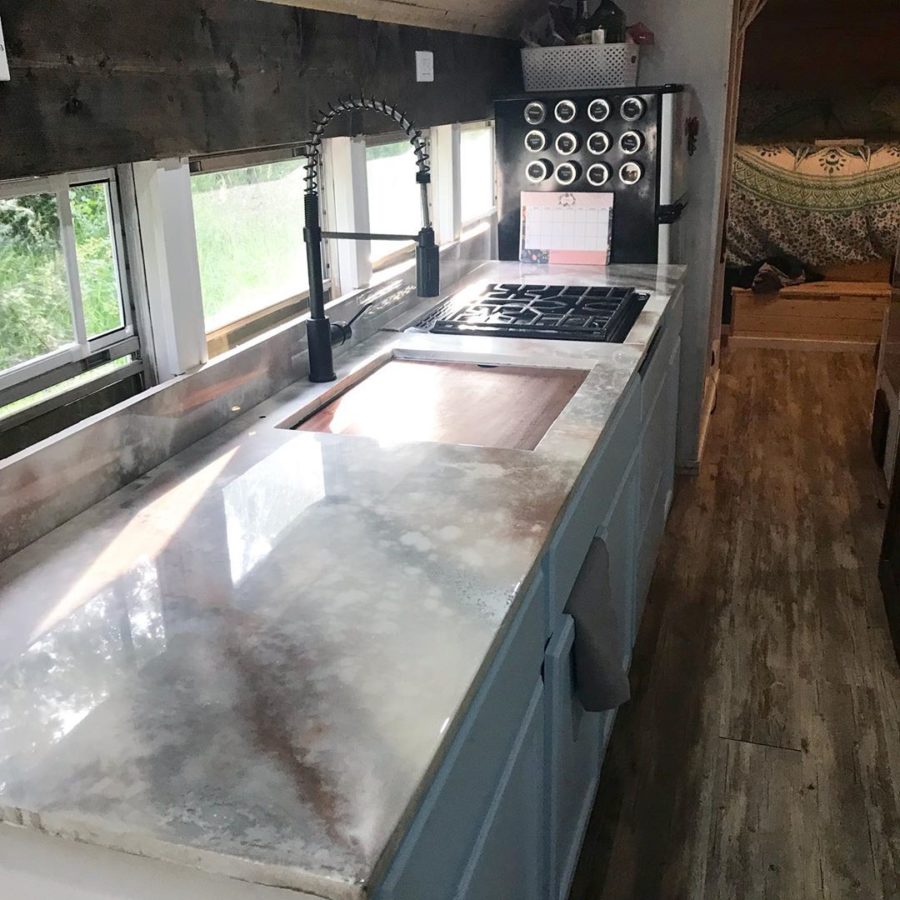
A fully functional kitchen is one of the most impactful investments you can make in a bus conversion. The ability to cook your own meals — breakfast, lunch, and dinner — transforms bus life from an extended camping trip into genuine home living. It reduces the daily cost of travel significantly, eliminates the stress of finding restaurants in unfamiliar areas, and creates a sense of routine that keeps full-time living sustainable long-term. Ethan and Cassidy’s kitchen makes good use of the available counter space, with storage built around the realities of cooking on the road: spices, pantry goods, and cookware all within reach. A kitchen that works well in a bus requires more thought than one in a house — every drawer must stay closed over bumps, every appliance must be secured, and the workflow must function in a narrow galley format. Getting that right is one of the hallmarks of a well-designed conversion.
Images via twopupsandabus/instagram
A Cozy Bedroom with Custom Built-In Ceiling Lighting
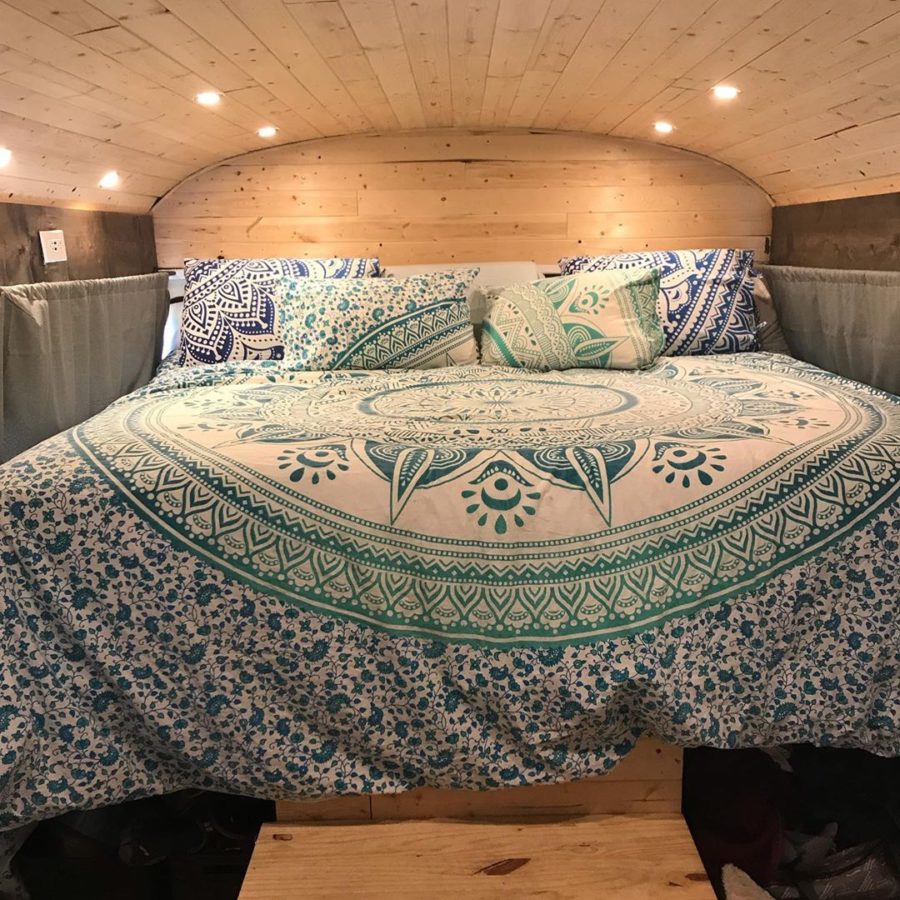
Lighting defines a space more than almost any other design element, and nowhere is that truer than in a bus conversion bedroom. When you work with a fixed footprint and no opportunity for tall floor lamps or elaborate sconce installations, ceiling-mounted lighting becomes the primary tool for creating atmosphere. Ethan and Cassidy opted for custom built-in ceiling fixtures — a choice that serves multiple purposes at once. The lights don’t project into the living space, they don’t create tripping hazards, and they free every inch of wall space for other uses. More importantly, they create distinct zones within the bus: when the bedroom lighting is on and the rest of the bus is dimmed, you have a genuine bedtime environment rather than a curtained-off section of a lit hallway. For full-time bus dwellers, that psychological separation between sleeping and living space matters enormously for sleep quality and mental health over the long haul.
Images via twopupsandabus/instagram
Custom L-Shaped Couch and Bar for Relaxing and Entertaining
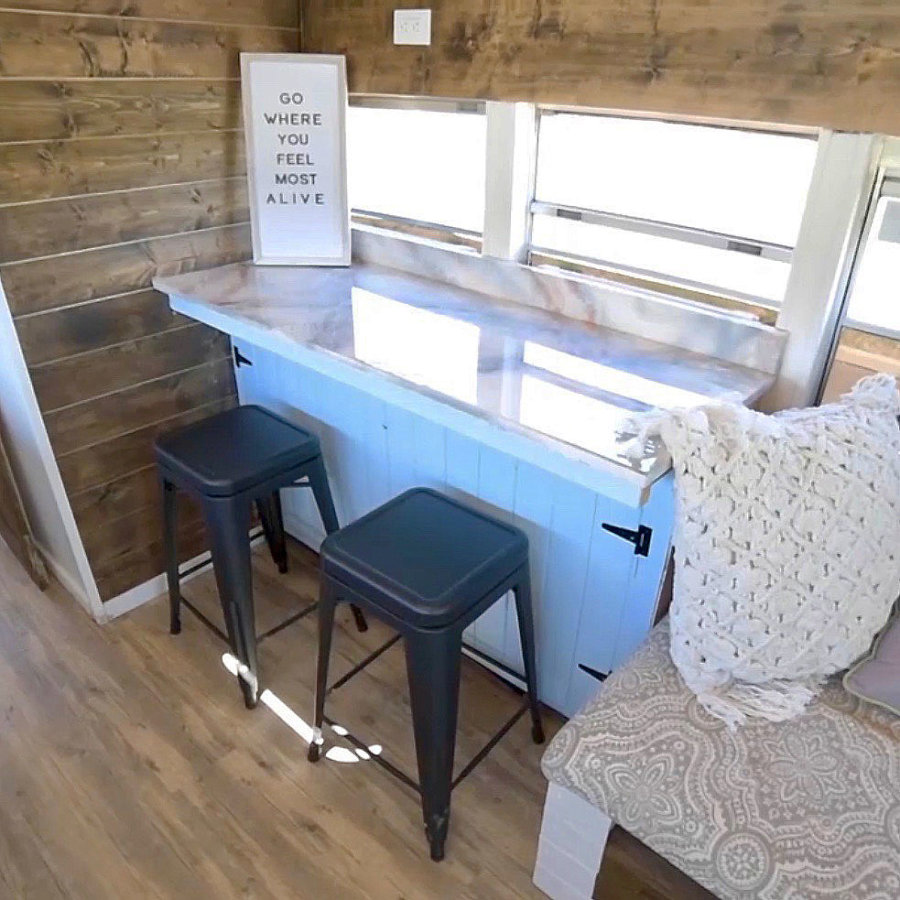
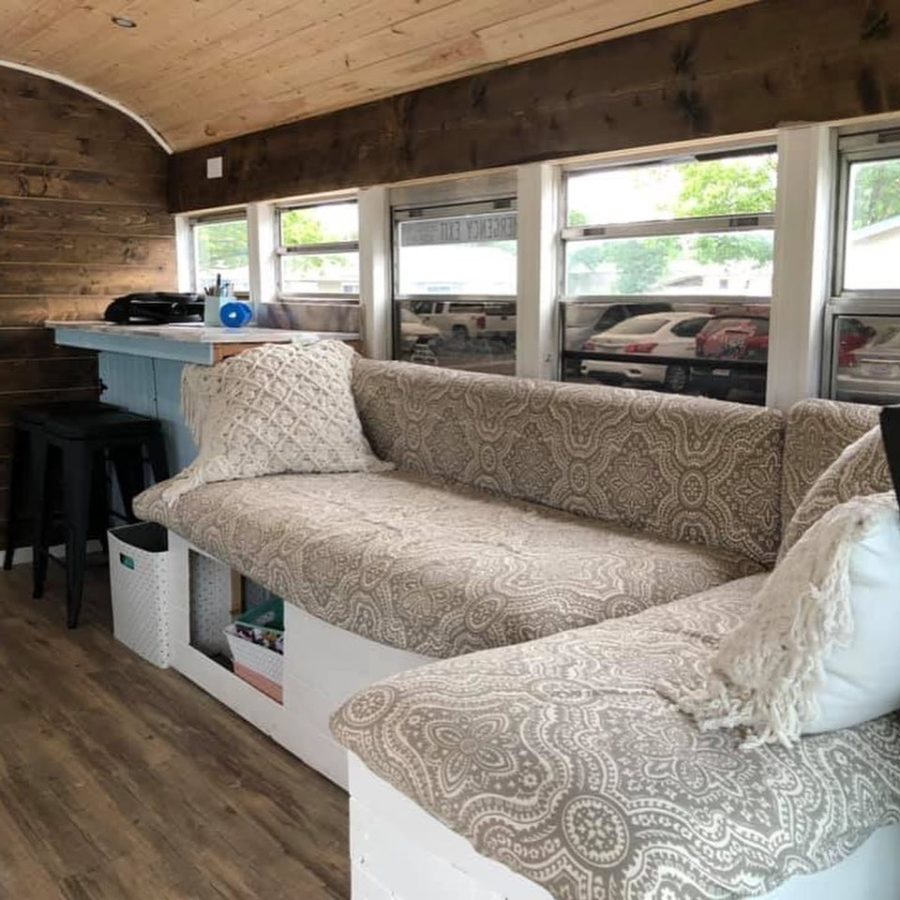
The L-shaped couch is one of the smartest furniture solutions available for a bus conversion living area, and Ethan and Cassidy took the concept a step further by adding a built-in bar alongside it. In a narrow floor plan where a standard sofa might seat two people facing a single direction, an L-configuration wraps the seating around a corner, dramatically increasing capacity while creating a natural gathering spot. It also forms a visual anchor for the living area — a clearly defined social space rather than an ambiguous middle section of the bus. The bar addition is more than a fun touch. It transforms the living area into a place where friends and guests feel genuinely welcomed, which matters when your home is a vehicle and hospitality requires intentional design. Paired with the kitchen behind it, this area functions as a proper great room: a space for cooking, socializing, and relaxing that happens to be mobile.
Images via twopupsandabus/instagram
A Sliding Barn Door Bathroom with Clever Space Planning
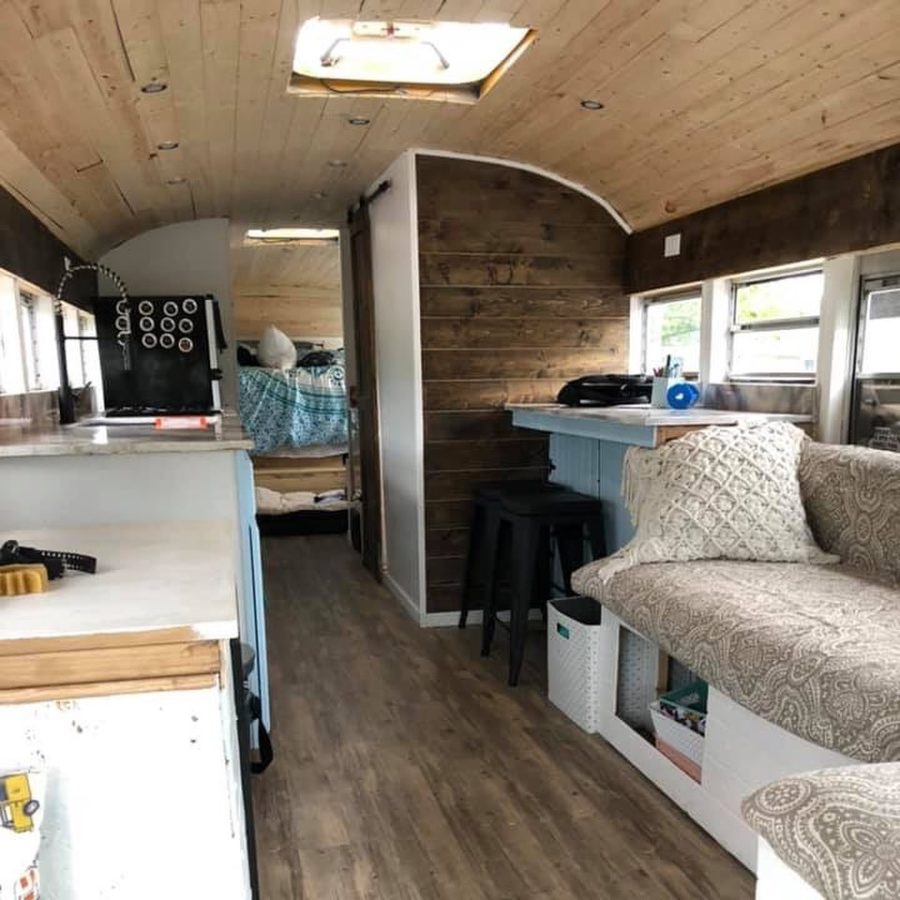
The bathroom is one of the most technically demanding spaces in any bus conversion, and the door choice alone reveals a lot about a builder’s experience level. Swing-out doors — the default in houses — are a poor fit for a narrow bus aisle: they collide with furniture, require a clear floor arc, and constantly feel in the way. A sliding barn door solves all of these problems in one move. It requires no floor clearance, slides parallel to the wall, and actually makes the bathroom feel more intentional rather than squeezed in. Ethan and Cassidy’s bathroom enclosure uses this approach effectively, giving the space a clean, defined entry that doesn’t compromise the living area in front of it. Inside, every square inch has to work harder than it would in a home bathroom — wet bath or dry bath, storage must be vertical, and the fixtures must be selected with weight and water management in mind. The fact that they have an enclosed bathroom at all (rather than an exposed wet bath) speaks to how much living comfort they prioritized in the build.
Images via twopupsandabus/instagram
Two Pups Along for Every Adventure
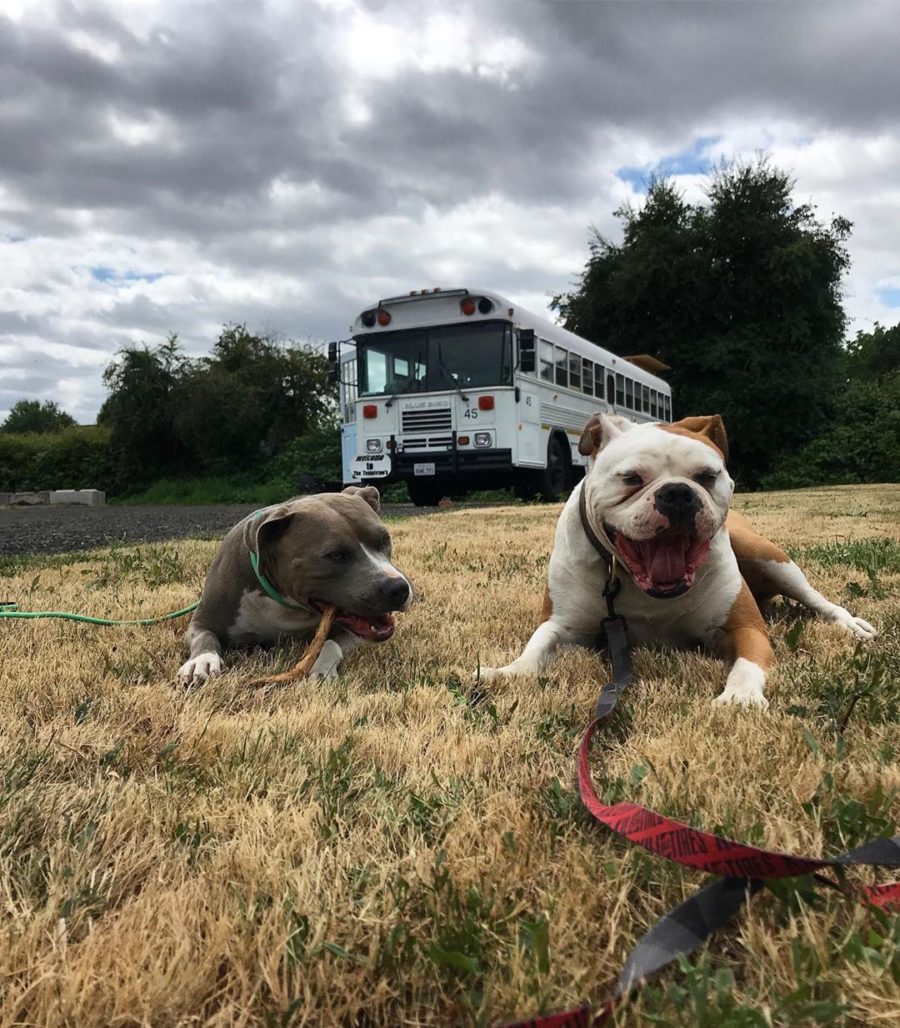
Designing a bus conversion around dogs requires forethought that many first-time builders underestimate. Dogs need room to move, surfaces that are easy to clean, secure resting spots during travel, and access to fresh air and exercise at every stop. Ethan and Cassidy’s open floor plan handles the first requirement naturally — without walls subdividing the central living area, their two dogs have room to settle wherever they’re most comfortable. The durable, easy-clean materials typical of bus conversion interiors also hold up far better to pet life than carpet or delicate finishes would. For many full-time travelers, the dogs aren’t passengers — they’re the reason the lifestyle works at all, providing companionship and routine that make life on the road feel grounded. The fact that this bus was designed with them in mind from the start, rather than adapted awkwardly after the fact, shows in how comfortably everyone coexists in the space.
Images via twopupsandabus/instagram
A Dual-Sport Motorcycle for Off-Bus Exploration
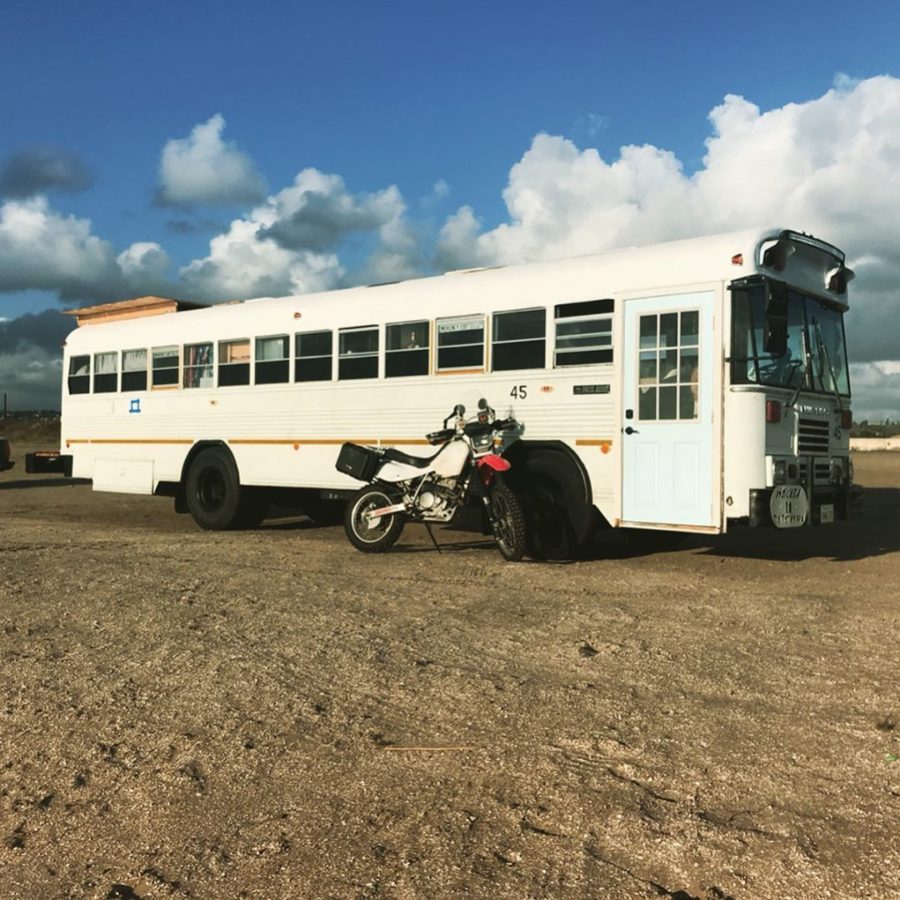
One of the practical constraints of bus life is that the bus itself can’t go everywhere. Parking in a city center is an ordeal. Narrow mountain roads, campsite loops, and small-town main streets are often inaccessible to a full-size vehicle. Carrying a secondary form of transportation — in this case a dual-sport motorcycle — solves that problem elegantly. A dual-sport bike is particularly well-suited to this role: it handles paved roads and dirt tracks equally well, which means Ethan and Cassidy can explore hiking trailheads, forest service roads, and urban neighborhoods that would be impossible to reach in the bus. The bike also travels light and parks anywhere, making it a practical daily driver once the bus is settled at a campsite. For couples doing long-term travel, having that independence — the ability to split up for different errands or explore independently — reduces the pressure that can build when two people are always occupying the same 200 square feet.
Images via twopupsandabus/instagram
Design Details
- Vehicle: Retired fire bus (converted to full-time tiny home)
- Conversion time: 4 months (DIY build by Ethan and Cassidy)
- Kitchen: Full kitchen with counter space and storage
- Living area: Custom L-shaped couch with built-in bar
- Bedroom: Dedicated sleeping area with custom built-in ceiling lighting
- Bathroom: Enclosed bathroom accessible via sliding barn door
- Lighting: Custom built-in ceiling fixtures throughout
- Pets: Designed to accommodate two dogs
- Transportation: Dual-sport motorcycle carried for off-bus exploration
- Builders: Ethan and Cassidy (@twopupsandus on Instagram)
Lessons from This Fire Bus Conversion
- Fire buses offer a sturdier starting platform than standard school buses, with heavy-duty chassis built for emergency response — that durability translates directly into a more reliable foundation for full-time living
- A four-month conversion timeline is ambitious but achievable with dedication — having a clear plan before you start makes all the difference between a focused build and an endless project
- Sliding barn doors are one of the smartest bathroom solutions in bus conversions — they save valuable floor space compared to traditional swing doors and give the bathroom a clean, intentional feel
- Built-in ceiling lighting transforms the feel of a bus interior, creating distinct zones and genuine ambiance without taking up wall or floor space that would otherwise serve multiple purposes
- Multi-functional furniture like an L-shaped couch with a bar maximizes both seating capacity and the social quality of a narrow floor plan — the bus becomes a place people actually want to gather
- Carrying a secondary vehicle like a dual-sport motorcycle dramatically extends your exploration range at each stop, solving one of the most common frustrations of full-size bus travel
- Designing for pets from the start — open floor plans and durable materials — makes full-time bus life work for the whole family, not just the human members of it
Learn More
- Watch the full video tour: Detailed Tour of a DIY Skoolie Build on YouTube
- Follow Ethan and Cassidy on Instagram: @twopupsandus
- More from Tiny Home Tours on YouTube: Tiny Home Tours Channel
Video Tour
Highlights
- Retired fire bus converted into a full-time tiny home by couple Ethan and Cassidy
- Completed the entire DIY conversion in just four months
- Features a full kitchen, custom L-shaped couch, and built-in bar
- Cozy bedroom with custom built-in ceiling lighting creating distinct zones
- Bathroom accessed through a space-saving sliding barn door
- Home to two dogs who travel everywhere with the couple
- Dual-sport motorcycle carried along for off-bus adventures and exploration
- A standout example of how creativity and determination can turn a retired emergency vehicle into a comfortable, stylish home on wheels
Explore more School Bus Conversions | Browse Bus Conversions | Watch more Video Tours | See all Skoolies
Disclosure: This post may contain affiliate links. If you purchase through one of our links, we may earn a commission at no additional cost to you.


Alex
Latest posts by Alex (see all)
- The Cheapest Legal Way to Live Smaller, Based on Your Situation - October 21, 2026
- A 14-Foot Cargo Trailer Tiny Home with a Lift Bed, Real Shower, and Ramp Patio - October 20, 2026
- NOAH-Certified Tiny House with a Main-Floor Queen Bed and Slide-Out Near Asheville - October 20, 2026








Looks like a non-insulated nightmare 🙁
They mentioned doing spray foam insulation during the video tour… But it is a vehicle…
I would say without xray vision it would be difficult to tell but they did say it was spray foamed. Having used spray before I assure you it is solid, holds heat and cool air quite well and dies not need to be 4 inches thick which would be illogical. A newer camper sometimes has the same thing and they are quite easy to heat and cool. Nightmare? For some perhaps. I would call it my small luxury.
$50k seems a bit steep for this conversion. Especially since they mention a couple of flaws and things they’d do different in their video!
Could be that the mileage is low – the type of engine etc, could play into price but its buying a house not just a vehicle.