
Disclosure: This post may contain affiliate links. If you purchase through one of our links, we may earn a commission at no additional cost to you.
Innovative building methods always catch my attention, and this unique tiny home in New Zealand is a perfect example of how creativity and sustainability can come together.
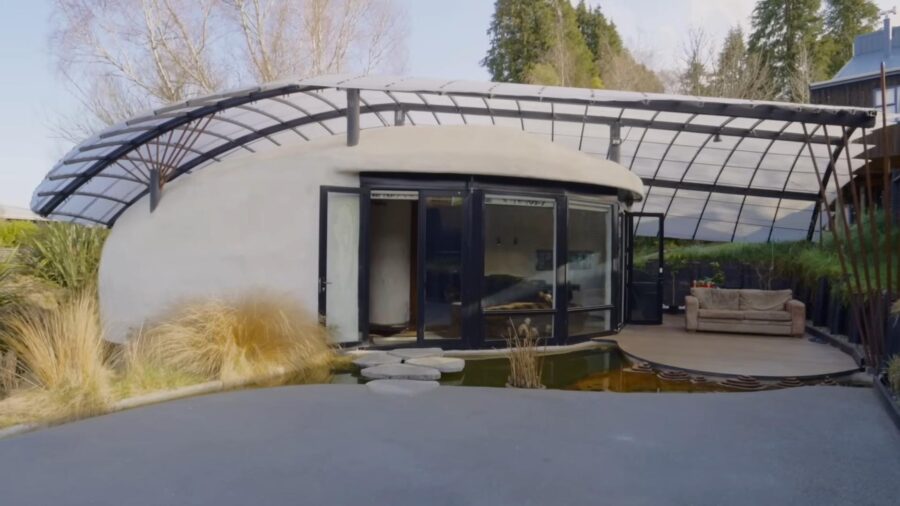
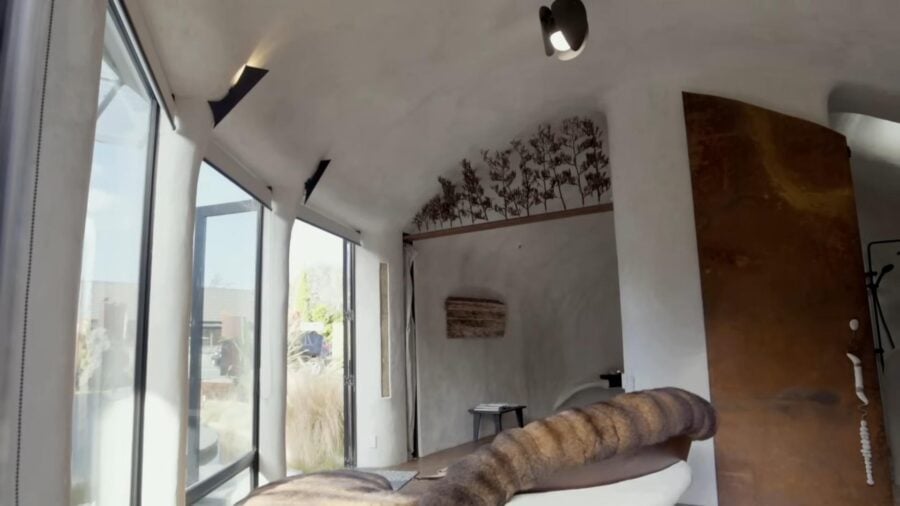
Known as the Pumice House, this sculptural straw bale tiny home was built using around 200 bales of barley straw—a recycled agricultural byproduct—and finished with a lime-based plaster that gives it a soft, organic look. Inside, you’ll find a thoughtfully designed layout that includes a first-floor bedroom, a roll-away TV, and a beautifully sculpted bathroom and shower.
It’s an inspiring reminder that tiny homes don’t have to follow the same formula—sometimes the most interesting designs come from rethinking materials entirely. Take a look and let me know what you think.
Don’t miss other amazing stories like this – join our FREE Tiny House Newsletter for more!
Eco-Built Strawbale Tiny Home with Pumice and Lime Plaster
Images via Tiny Home Tours
Built with Straw, Pumice, and Lime Plaster
Images via Tiny Home Tours
Every Surface Was Shaped by Hand

Images via Tiny Home Tours
Organic Design with Natural Forms

Images via Tiny Home Tours
Video Tour: Straw Bale and Plaster Tiny Home
Design Details
- Name: The Pumice House
- Location: New Zealand
- Construction: Straw bale with lime-based plaster
- Materials: 200 bales of barley straw (recycled agricultural byproduct)
- Bedroom: First-floor bedroom (no loft climbing)
- Bathroom: Sculpted shower stall
- Kitchen: Custom sculpted countertop
- Entertainment: Roll-away TV
- Exterior: Lime-based plaster finish with organic curves
- Style: Sculptural, hand-shaped surfaces throughout
- Availability: Available for booking on Airbnb
Lessons from This Build
- Agricultural Waste Becomes Building Material: 200 bales of barley straw—a waste product from farming—form the core of this home, showing how “waste” can become valuable building material
- Lime Plaster Creates Organic Forms: Unlike rigid conventional materials, lime plaster can be sculpted by hand to create flowing, organic shapes that feel alive
- Pumice Replaces Concrete: Using pumice instead of concrete reduces environmental impact while still providing structural integrity
- Hand-Shaping Adds Character: Every surface shaped by hand gives the home a unique, artisanal quality that mass-produced buildings can’t replicate
- Alternative Materials Can Be Beautiful: This build proves that sustainable materials don’t mean sacrificing aesthetics—the sculptural forms are stunning
Learn More
- Book a Stay in the Pumice House on Airbnb
- Follow the Pumice House on Instagram
- Subscribe to Tiny Home Tours on YouTube
Related Stories
- 927-sq.-ft. Strawbale Home w/ 3 Bedrooms, 2 Baths, and a Mudroom!
- Jordana’s Straw bale and Cob Cabins in Oregon!
- Julia & John’s Solar-Powered Straw Bale Home in Central New York
You can share this using the e-mail and social media re-share buttons below. Thanks!
If you enjoyed this you’ll LOVE our Free Daily Tiny House Newsletter with even more!
You can also join our Small House Newsletter!
Also, try our Tiny Houses For Sale Newsletter! Thank you!
More Like This: Tiny Houses | Airbnb | Tiny House Vacation | Cob Homes
See The Latest: Go Back Home to See Our Latest Tiny Houses
Disclosure: This post may contain affiliate links. If you purchase through one of our links, we may earn a commission at no additional cost to you.


Alex
Latest posts by Alex (see all)
- A Hotel Designer’s 484 Sq Ft Milan Apartment with a Rotating Room Divider - October 9, 2026
- Hermosa Orchards Village: A Durango Tiny Home Community with Its Own Fruit Orchard - October 9, 2026
- The Sanctuary Minnesota: A Tiny House Village on 80 Acres of Woods - October 9, 2026
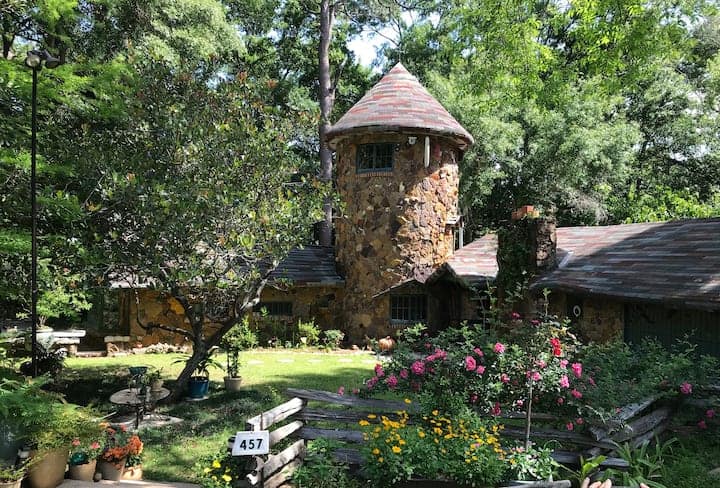


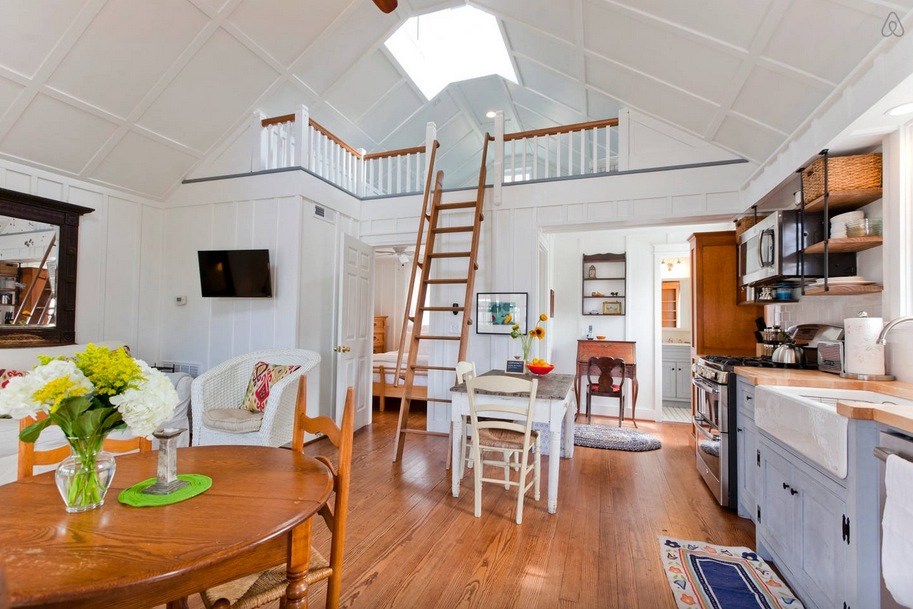

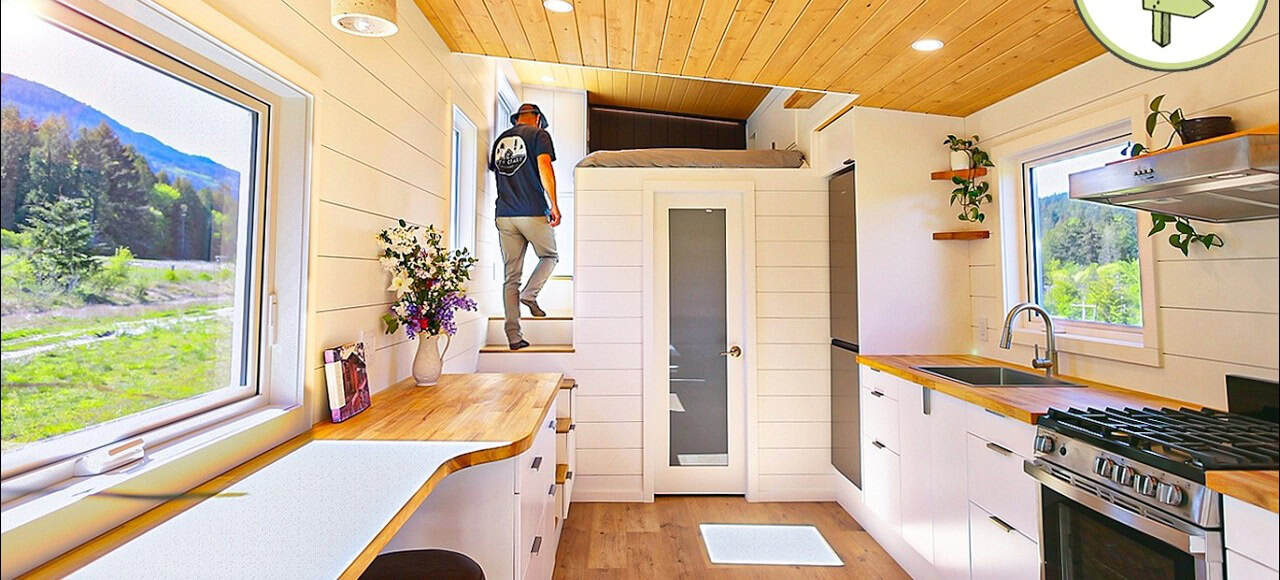

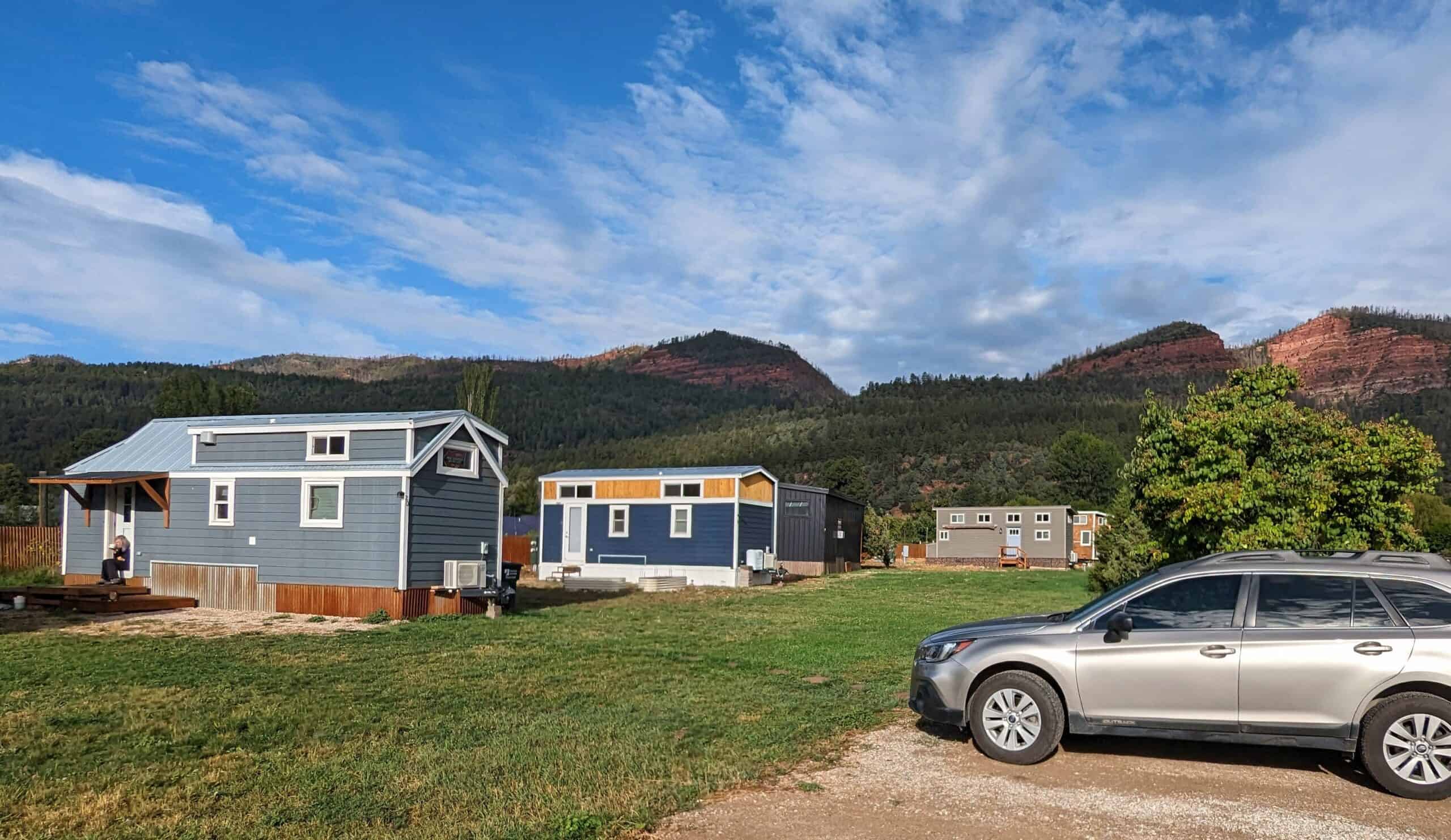



It’s lovely. It’s unique. . .but it ain’t tiny.
Well, it may not seem so but note that it’s still built on a trailer and can be moved. So, it’s not actually that big, is more akin to a weird shaped Park Model, being more like a circular dome than the normal rectangle box, with more empty/unfilled space to just make it look larger.
While it is also docked/blended into where it’s parked to make it look like the exterior space is part of it. Enhancing the sense of it being larger than it actually is…
It also still utilizes many design elements of tiny homes, like the compact kitchen/dining area, fold out cutting board, compact storage spaces, etc.
Besides, it still falls under alternative housing and that’s part of the movement too, as it’s all about looking at alternatives to traditional housing to re-evaluate what works best, and it is a type of alternative that is scalable and thus can always be done smaller…
All true, but do you know the actual square footage?
60 Sqm (~645 Sq Ft)… Average size home in NZ is just over 2000 Sq Ft, for how that compares there…
Long ago, when I first began to follow tiny houses, anything under 400 square feet was considered tiny, but most tiny homes were 8′ x 12′ or 16′, then grew to 8 1/2′ x 20′ and 24′. Then they kept getting wider and longer until they are truly no longer tiny homes, but stick built mobile homes, large, traditionally designed, yet most are still under 400 square feet which is still huge. So to me, 675 square feet is in no way a tiny home. Small for the area, but not tiny.
Fair enough, I can understand that point of view…
However, people thinking 400 Sq Ft is the threshold is a pretty recent trend from just the last 8 years as that all evolved from how efforts to legalize tiny homes resulted in establishing an arbitrary standard to patch the laws, which previously had a threshold restriction based on making a clear distinction between legal residential homes from RV’s and other non-residential structures.
When the movement started, there was no preconceived notions or consensus, but rather a wide range of opinions ranging from extreme minimalists who even considered micro-homes to those who considered even 2000 Sq Ft too small for even one person and would refuse to consider anything smaller.
Consequently, much of the early criticism, which evolved into NIMBY’ism, focused on the idea that Tiny houses weren’t real houses and were just glorified RV’s.
So it just worked out that way to get around the restrictions, as it was the quickest and easiest solution to just patch the law instead of re-writing it and focusing on the size range of the restriction, but that still means it is arbitrary and not universal, especially, all over the world.
For example, while the US limits Park Models to be under 400 Sq Ft, Canada allows Park Models to be up to 538 Sq Ft. While the UK treats their Park Homes more like Manufactured Houses and allow sizes up to 136 sqm (~1464 Sq Ft), but have more strict size and weight constrictions on their Caravans/Trailer RVs/THOWs. So THOWs in the UK can’t be as large as they can be in the US…
Really, we can look at one of the first Tiny House TV shows, Tiny House Nation, and note that the show’s intro states tiny as being 500 Sq Ft and less, not 400!
Additionally, THN included episodes where they dealt with larger homes. Up to and including examples like ADU’s that exceeded 700 Sq Ft. Showing how the concept of Tiny didn’t start out strict at all…
For example, what’s tiny for one person would not work the same for a family, even for just a couple that would still make this home equivalent to a single person living in a 322.5 Sq Ft home as that space would have to be shared, among other examples where people would adjust their interpretation of tiny to work with their actual needs.
Just like how achieving minimalism would vary with different people, what’s ‘Appropriate’ effects what the size of the home should actually be and that was what people were originally seeking when the tiny house movement started…
So, it’s fine if you still disagree, I’m just pointing out that it shouldn’t be treated as an absolute and always true, as it won’t be for everyone and in all situations…
Besides, the average size house in the US is still over 3 times larger than this home and there’s still terms like Micro-House for homes that can go even smaller than tiny houses. Showing how much leeway there is to debate the size. Especially, as some people will use tiny and small, interchangeably, but also doesn’t mean there is no overlap where even more people can confuse the terms…
I concede : )