
Disclosure: This post may contain affiliate links. If you purchase through one of our links, we may earn a commission at no additional cost to you.
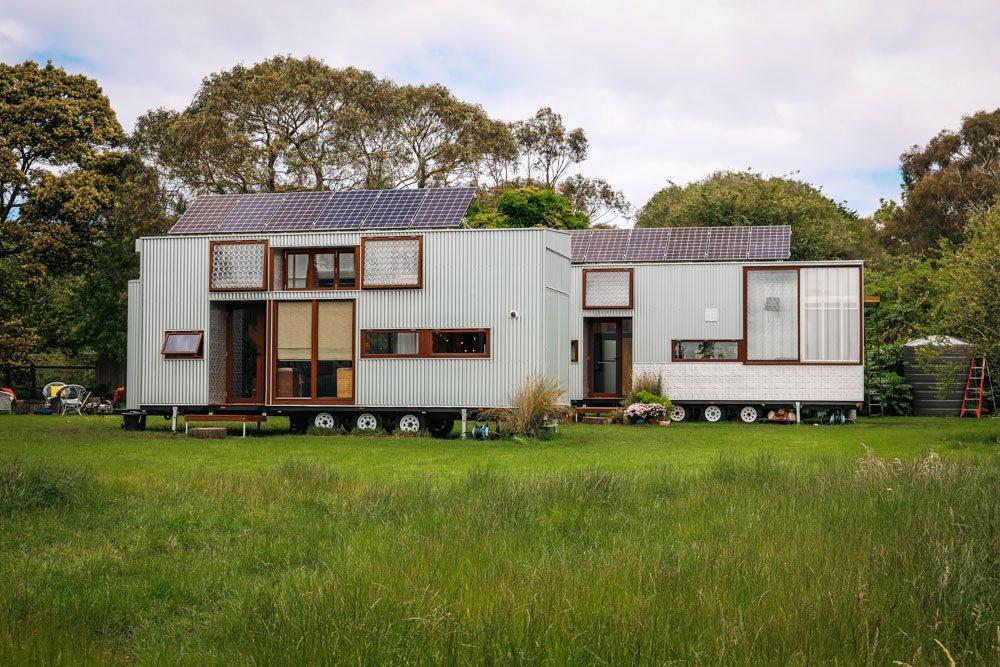
Why settle for just one tiny house when you can create a connected, multi-functional space with two? This stunning double tiny house design from Australia showcases a creative way to expand your tiny home lifestyle while keeping the dwellings mobile.
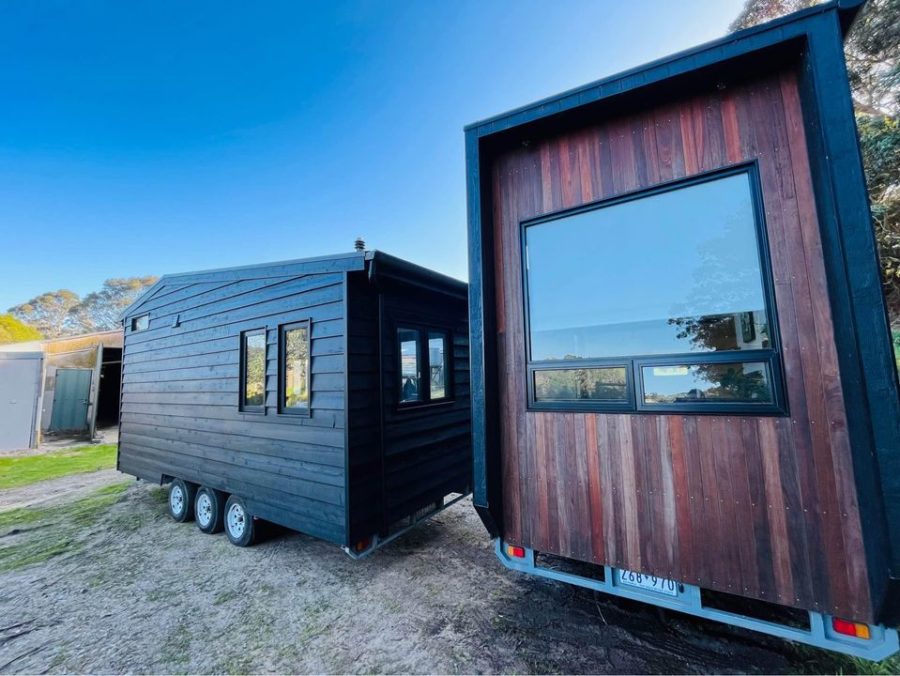
Professionally built and beautifully styled, these two separate tiny homes are designed to be connected by a deck, forming a seamless indoor-outdoor living space. One home serves as a dedicated kitchen and dining area, while the other houses the living space, loft bedroom, and bathroom.
It’s a brilliant concept that maximizes livable square footage without sacrificing the flexibility of a home on wheels.
Don’t miss other interesting tiny homes like this, join our Free Tiny Houses For Sale Newsletter for more!
Two Tiny Homes, One Beautiful Living Space

Let’s take a closer look at each of the two homes and how they work together to create a cohesive tiny living experience:
Tiny Home 1 – Kitchen, Dining, and Fireplace
Dimensions: 6 L x 2.5 W x 3.5 H
Frame: Structural insulated panels (SIPs) on a triple axle trailer
Interior Use: Kitchen, dining, fireplace area
Features include:
- Recycled western red cedar cladding
- Reclaimed hardwood timber floors
- Custom-built cabinetry and reclaimed timber benchtops
- Glem Gas oven and cooktop, stainless steel appliances
- Velux opening skylight and double French doors
- Cozy Wagener Sparky Fireplace from New Zealand
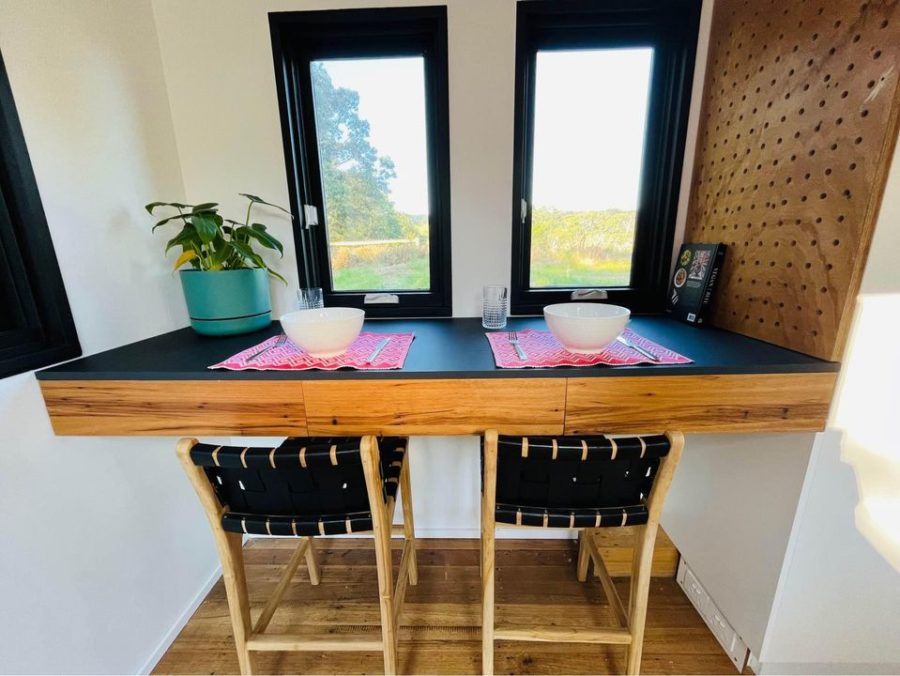
- Multipurpose breakfast bar (perfect for dining or work)
- Space for a full-size fridge
- Plenty of storage and clever layout
Tiny Home 2 – Living, Bathroom & Loft Bedroom
Dimensions: 6 L x 2.5 W x 4.2 H
Frame: BlueScope steel with R3 insulation
Interior Use: Living room, bathroom, loft sleeping space
Features include:
- Weathertex and recycled timber cladding
- Aluminum Rylock windows
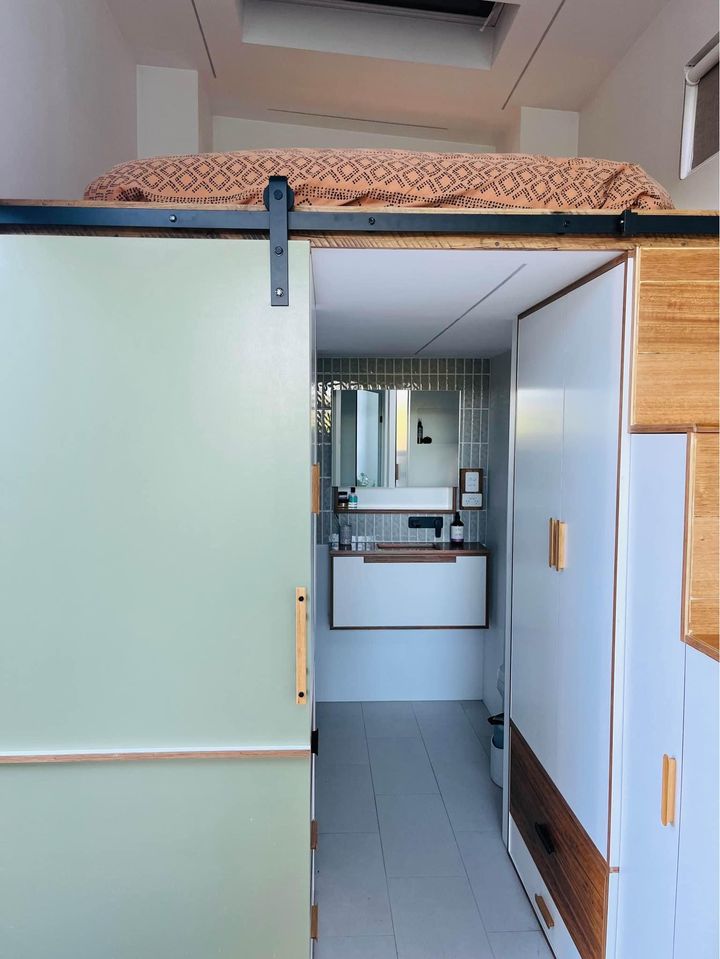
- Large tiled bathroom with a 1200 x 900 shower
- Optional composting toilet (Nature’s Head)
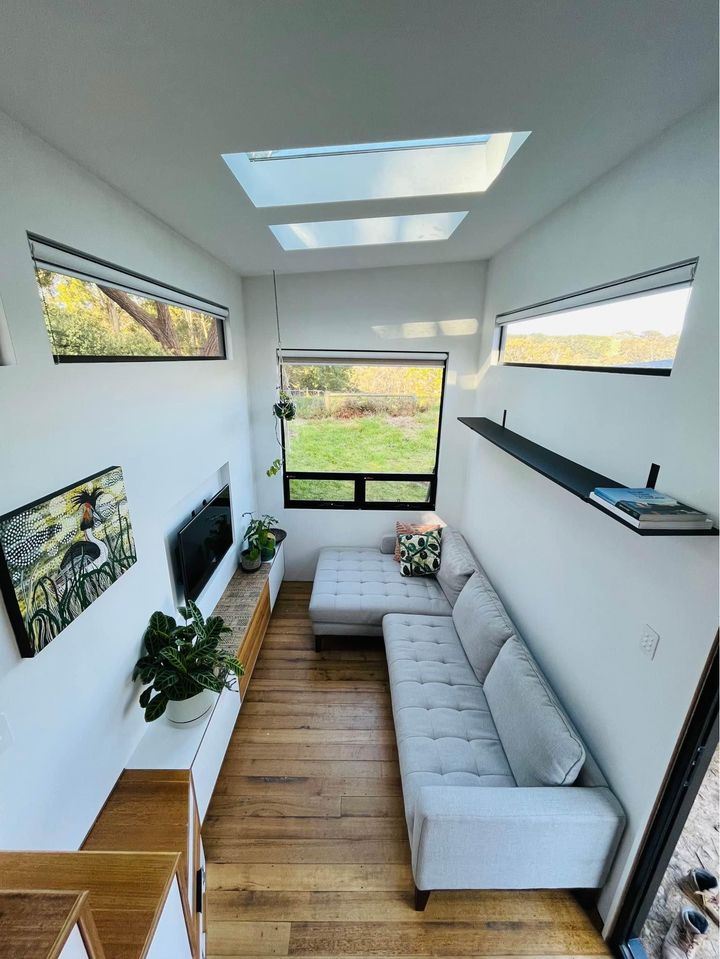
- Four Velux skylights (two solar-operated)
- Spacious loft fits a queen mattress with sitting headroom
- Built-in custom cabinetry and ample storage throughout
Tiny House One: Living Room, Private Bedroom & Full Bathroom

Natural Light Flows In Through Dual Skylights
Modern Bathroom with Built-In Sink & Mirrored Cabinet

Cozy Loft Space Enhanced by an Additional Skylight
Tiny House Two: Seamless Indoor-Outdoor Living with Openable Windows

Charming Breakfast Bar with Scenic Window Views
Stylish Green Backsplash Adds a Pop of Color

Stay Toasty with the Built-In Fireplace

Adding a Deck Can Offer a Unified Outdoor Living Space
Highlights and Extras
- Both homes are designed to connect with an alfresco deck
- Efficient design with low-voltage lighting and appliances
- Rinnai instant gas hot water unit serves both homes
- Can operate off-grid or with a 10 amp extension lead
- Road-legal and trailer-registered
- Optional extras that were once included:
- Modular fabric sofa
- Samsung TV
- LG 420L stainless fridge (4.5-star energy rating)
- Composting toilet
Smart, Stylish, and Ready for Inspiration
While this particular home was once available for purchase, it now serves as an inspiring example of how flexible and functional tiny house living can be. Whether you’re dreaming of off-grid freedom, a vacation retreat, or a full-time dwelling, this design shows what’s possible with a little creativity.
? What do you think of the dual-home concept? Would you build something similar?
Source
https://www.facebook.com/groups/291524694656306/permalink/1464635887345175/?sale_post_id=1464635887345175
Related Stories:
- Double Tinies by Tiny Mountain Houses
- Two 24ft Tiny Houses Connected by Sunroom
- Two Tiny Homes in One with this Duplex Cabin
You can share this using the e-mail and social media re-share buttons below. Thanks!
If you enjoyed this you’ll LOVE our Free Daily Tiny House Newsletter with even more!
You can also join our Small House Newsletter!
Also, try our Tiny Houses For Sale Newsletter! Thank you!
More Like This: Tiny Houses | Builders | THOWs | Tiny Houses For Sale
See The Latest: Go Back Home to See Our Latest Tiny Houses
Disclosure: This post may contain affiliate links. If you purchase through one of our links, we may earn a commission at no additional cost to you.


Natalie C. McKee
Latest posts by Natalie C. McKee (see all)
- Two Bed Two Bath 10×40 Tiny House - June 16, 2024
- Southern Heights Small House Village - June 16, 2024
- Little Italy Tiny House Community: Corcoran, CA - June 16, 2024


Like the concept as what I plan to do but multiple things here drive up costs.
They need to learn how to make much lighter THs by using things like SIP, much lighter materials glued together to lower impact, cost.
Next the trailers are a waste as will be wasted. If you have to have them, build it so the TH sits on it so it can be used instead of rusting away. Or better, never buy a trailer and rent one or have a flat bed tow truck move it. If built lighter the trailer can be a lot cheaper and use a smaller tow vehicle.
If made longer instead of higher, it’ll use a lot less gas to move it plus climbing stairs, ladders gets old fast to lofts.
The 2 don’t seem to mate in any way to make a living area. Mine are set up so if face to face you can extend the roofs to make a near free center room between them, expandable as needs grow. Or can be end to end, or L which is what I expected here.
They did use SIPs but SIPs isn’t necessarily low cost…
They are a lot cheaper as use less materials which are rather pricey today. And one would make their own. Weight costs to buy, tow, use, so to lower cost you lower weight.
SIP having superior sealing, insulation gives more savings in summer, winter and likely last longer, especialy those driven a lot.
SIPs are a great option but everything has it’s pros and cons, including SIPs.
SIPs can still be expensive to get, even in the present economy, companies like Incredible Tiny Homes get around this by getting cut offs at a discount that they can then just stitch together to make up the difference in the size of the panels. There was a cost advantage when wood prices skyrocketed but they’re coming back down now and there often has to be other reasons to choose between them…
For SIPs, you often need to engineer/pre-plan the layout or you’re going to have to add time and labor to make all the conduits, channels, cut outs, and sizing to actually build the home and make it functional, which you need specialty tools like a foam cutter, etc. Among the hidden costs of using SIPs.
Though, using surface mounted channels can help get around much of that, it’s not going to work for all builds and conflict with a number of finishing options. While, unlike wood, you typically can’t just leave SIPs bare and have to apply a finishing option. Even, though, some manufacturers can provide the panels with a finishing layer already applied and like the panels just have the seams to deal with to finish but that’s still an additional cost.
The cost of transport, assembly, labor, etc. can still be a greater cost advantage, it is SIPs strongest advantages, but the difference won’t necessarily be as much in total when all costs are considered and doesn’t mean it won’t cost some more if they have to deal with more overheads, higher cost panels, etc.
SIPs are generally manufactured with extreme precision and accuracy. Otherwise, they wouldn’t be as airtight as they are. So, if the crew handles the SIPs without care, it may sustain damage and reduce its performance considerably, which means you need a certain skill level to properly use them but there is a learning curve to deal with that will take time for those new to SIP construction to adapt to and thus why it often takes time for SIPs to be adapted by companies.
Incredible Tiny Homes is an example of this as their original ESP homes failed because of the difficulty of their workers in learning how to build with them, making the builds take far too long, and they had to re-work it to their present assembly line and move away from custom building with their model homes and the Incred-I-Box series. Lowering the skill requirement and simplifying the construction to the point it’s practical for them to then focus on the advantages of using the panels.
While those made of OSB or Plywood you still have to worry about insects, termites, and rodents that can likely cause damage to the panels. So they can still have to be protected up till the home is complete. Among the variables that can effect different uses of SIPs…
Again, you can save time on assembly and the final home will usually be extremely light but those aren’t the only considerations for everyone. Like SIPs are harder to modify and it would be more of a project to near impossible to do any changes later in the build, which can be an issue if the plans aren’t set in stone and perfect from the start and thus aren’t a great option for custom builders who may have to make numerous changes throughout the build.
Industry wide not all SIPs are equal and they can have issues like a drop in insulation value over time, manufacturing defects, etc. DIY SIPs would be even more prone to defects, would cost more to make as no one can compete with the mass production of a factory, etc. While some people may just care more about sustainability and the environment, which can conflict with the foam, glues, and resins used in SIP manufacturing and what can happen whenever a structure needs to be torn down and replaced. Among other considerations people may have with dealing with SIPs.
So there are of course advantages, very significant advantages as you have already highlighted, but it doesn’t automatically mean it’ll be the best choice for everyone as it can cost some people more than they are willing to invest in it, both financially and in other ways…
That said, composites, SIPs, and other types of panel construction are great options and more and more companies are offering them now. Just like any other options, there’s a place for them and they may become the dominant option but everything has its compromises and trade offs to consider.
One reason to build a tiny house on a trailer, and keep it on the trailer, is that it can be registered with the DMV as a trailer. This allows you to bypass rules that restrict building on a lot, but do allow you to park a vehicle. We’ve done this with a rural vacation tiny home. We avoided having to get permits, a septic system, etc. Legally we can only “camp” on the property 30 nights a year, but no one is around to monitor that. It probably wouldn’t work for full time living, but for a secret hideaway, it was our most affordable option (beyond a tent, which we used to use).