
Disclosure: This post may contain affiliate links. If you purchase through one of our links, we may earn a commission at no additional cost to you.
George Dunnett, a 28-year-old video editor from Scotland, spent 11 months transforming an abandoned 1700s stone cottage in his village into a modern 400-square-foot home. The building had been used to store religious books centuries ago and had deteriorated into a crumbling storage unit with no plumbing, electricity, or insulation. George purchased it and documented the entire renovation on YouTube — total project cost including purchase price came to approximately £157,844, with renovations alone costing £102,458.

Images by George Dunnett/YouTube
What George Found Inside: The “Before”
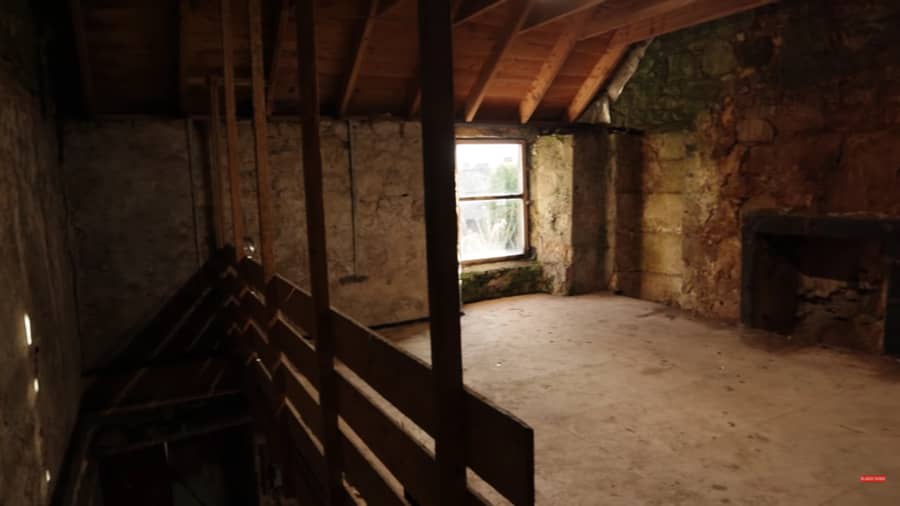
When George first stepped inside the upper floor of the cottage, he found exactly what you’d expect from a building that had been abandoned for years: bare stone walls, exposed beams sagging under their own weight, debris scattered across uneven floors, and absolutely no insulation. This was a building that had been used for storage, not habitation. For anyone considering a similar renovation, this is the sobering reality of what “buying a fixer-upper” actually looks like in practice. Historical stone buildings have charm, but they also come with centuries of deferred maintenance. The romance of owning a piece of history quickly gives way to the practical question: can these walls even support modern living systems?
Images by George Dunnett/YouTube
The Ground Floor Before Renovation
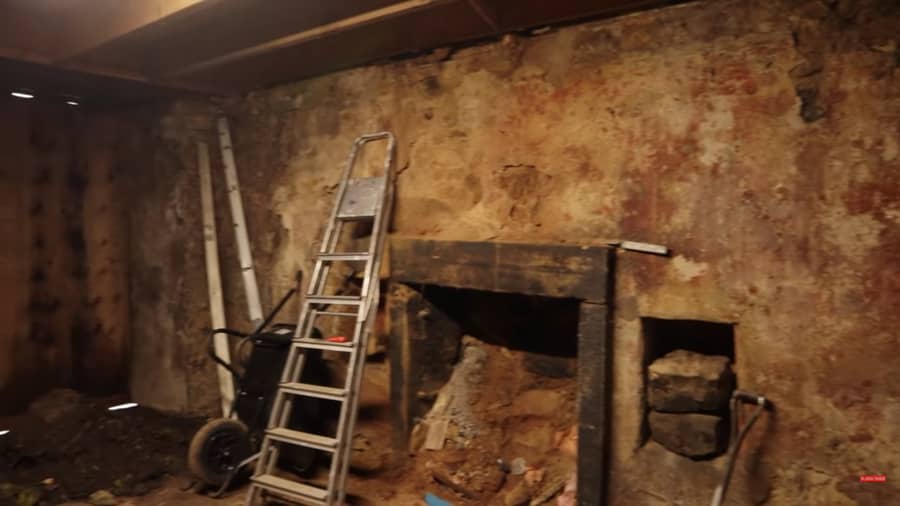
The downstairs condition was equally raw — just stone walls and a dirt or bare floor. No plumbing, no wiring, no insulation. No evidence that this space had ever been designed for human comfort. Starting from this baseline meant George wasn’t just renovating; he was essentially building a home from scratch inside an existing stone shell. The advantage of working within existing walls is that the structure (and planning permission) already exists. In Scotland, historic buildings like this often have protections that make demolition difficult or impossible, but renovations that preserve the exterior character are encouraged. The challenge is making centuries-old construction work with modern building standards — bringing 1700s stone masonry into compliance with 2021 energy codes, for instance.
Images by George Dunnett/YouTube
Structural Reinforcement: Making Old Bones Strong Again
Before any cosmetic work could begin, George needed to address the fundamentals: the roof, walls, insulation, and foundation all required significant upgrades. Working with 1700s stone construction means respecting the original building techniques while bringing everything up to modern standards. New mortar was pointed between the stones — a painstaking process of removing deteriorated mortar and carefully replacing it to match the original style. The roof was rebuilt entirely, as the old one was past saving. Modern insulation was added to make the building energy-efficient — a critical consideration in the Scottish climate where winters are damp and cold. This is where the bulk of the £102,458 renovation budget went. Structural work doesn’t photograph as dramatically as finished interiors, but it’s the difference between a renovation that lasts decades and one that needs constant repairs.

Images by George Dunnett/YouTube
The Exterior Transformation: New Mortar, New Windows, New Life
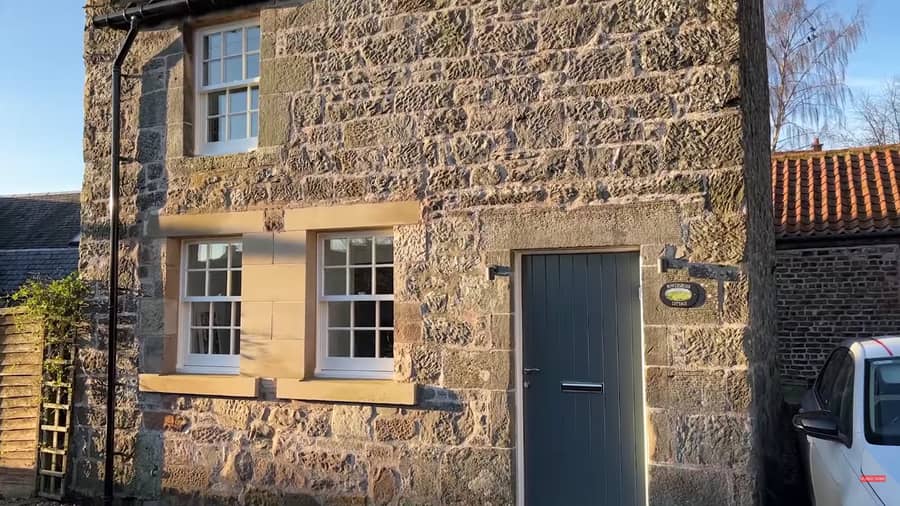
With fresh mortar between the stones and new windows installed, the cottage’s exterior was transformed from a crumbling ruin into a charming stone home that honors its 1700s origins. The stone walls that once looked like they might collapse now look solid and intentional. The new windows are sympathetic to the building’s age — they don’t try to pretend to be 300 years old, but they’re proportioned and styled to complement the stonework rather than fight it. This is one of the great rewards of renovating a historic building: the materials are already beautiful. You don’t need to add character with faux finishes or decorative elements — you just need to reveal what’s already there. The texture of hand-laid stone, the irregular shapes of the blocks, the way light plays across the uneven surface — these are design features that modern construction can’t easily replicate.
Images by George Dunnett/YouTube
The Upstairs Reinvented: L-Shaped Kitchen, Living Space, and Office
The upstairs is where the “modern” in this modern-meets-historic renovation really shines. George created an open-plan space that serves triple duty: an L-shaped kitchen with contemporary finishes, a comfortable living area, and an office corner for his video editing work. The open layout maximizes the sense of space in a 400-sq.-ft. footprint, and the upstairs placement of the kitchen and living areas means George gets the best natural light where he spends most of his waking hours. The kitchen features clean white cabinetry, wood countertops, and modern appliances — a deliberate contrast to the rustic stone walls visible elsewhere. Rather than trying to make everything match the cottage’s age, George embraced the juxtaposition. The result feels intentional rather than confused: this is clearly a 21st-century living space that happens to exist within 18th-century walls.

Images by George Dunnett/YouTube
A Private Ground-Floor Bedroom with Built-In Storage
Downstairs, George dedicated the ground floor to the private spaces: a bedroom with a built-in wardrobe, a bathroom, and a clever under-the-stairs cubby for additional storage. This layout decision is smart for several reasons — the bedroom stays cooler in summer (heat rises), the stone walls provide excellent sound insulation from any activity happening upstairs, and separating sleeping quarters from living spaces on different floors creates a psychological sense of having distinct rooms in what is objectively a very small home. The bedroom is simple but comfortable, with white walls that brighten the space and a large window that brings in natural light. The built-in wardrobe makes efficient use of otherwise awkward wall space. In a 400-sq.-ft. home, every square foot counts, and custom storage solutions like this are the difference between a space that feels cramped and one that feels carefully considered.

Images by George Dunnett/YouTube
Design Details
- Size: Approximately 400 sq ft across two floors
- Type: Renovated 1700s stone cottage
- Location: Kinnesswood, Scotland
- Construction: Original stone walls with modern insulation, new roof, repointed mortar, new windows
- Layout — Downstairs: Bedroom with built-in wardrobe, bathroom, under-stairs storage cubby
- Layout — Upstairs: Open plan with L-shaped kitchen, living area, office corner
- Total project cost: Approximately £157,844 (including purchase price)
- Renovation cost: £102,458
- Timeline: 11 months (January–November 2021)
- Builder/Renovator: George Dunnett (video editor, self-funded through savings and YouTube income)
- History: Originally used to store religious books in the 1700s; later became a storage unit
What Makes This Renovation Special
- Preservation meets modernization: Rather than demolishing and rebuilding, George worked within the existing 300-year-old stone structure, proving that historic buildings can be adapted for modern living without losing their character
- Inverted floor plan works beautifully: Placing the bedroom downstairs and the kitchen/living upstairs is unconventional but smart — it puts the most-used spaces where natural light is best and keeps the bedroom cool and quiet
- Transparent budgeting builds trust: George’s follow-up cost breakdown video (£102,458 in renovations) gives aspiring renovators honest numbers to work with, something the renovation community rarely gets
- The “walk past it every day” story resonates: George transformed a building he’d walked by for years in his own village, proving that sometimes the best opportunities are the ones hiding in plain sight
- Self-funded through creative work: George financed the project through his video editing career and YouTube channels — a modern path to homeownership that doesn’t rely on traditional employment
Learn More
George Dunnett’s YouTube Channel
Video Tour: The Full Renovation
Watch George’s original renovation video documenting the entire 11-month transformation:
George also published a detailed cost breakdown answering viewers’ questions about exactly how much the project cost:
Explore More
Subscribe to our Newsletters:
Join the Tiny House Newsletter
=> tinyhousetalk.com/tinyhousenewsletter
Join The Small House Newsletter
=> tinyhousetalk.com/small-house-newsletter
Join Our Tiny Houses For Sale Newsletter
=> tinyhousetalk.com/tiny-houses-for-sale-newsletter
Disclosure: This post may contain affiliate links. If you purchase through one of our links, we may earn a commission at no additional cost to you.


Alex
Latest posts by Alex (see all)
- The Atlas by Zook Cabins: A 233 Sq. Ft. Park Model With a Bed That Rolls Onto the Deck - October 22, 2026
- Red Oak Fire Lookout: An 80-Foot Steel Tower With a 14×14 Cab - October 22, 2026
- White Oak Treehouse: Built Into a 210-Year-Old Oak - October 22, 2026






Upstairs in the living room there appears to be a door (plant in front of it)- where does this go?
Great transformation to a beautiful home!
Corina
Corina, I thought the same, but I think it is a mirror showing reflection of bed on opposite wall.
What a great job on the renovation. Beautiful.
I think is is a cupboard/storage nook. It looks like there is a recess in the stone wall in that spot, when you look at the “before” pictures.
Looks like it was likely recessed wood storage. Probably made into a closet.
I believe the living room is on the 2nd floor and if you look closely, it appears the door may hide some mechanical item, e.g., furnace, water heater or something, as the doorway does not appear to go to the floor. That room may be on the back or the left side of the house as there is no window on the right side of the house (see front door to the right side of the building which shows no windows). gorgeous little home
Perfect! After watching many episodes of Escape to the Country and wanting to see a tiny home in Scotland or England, I am thrilled to see this little house. Brilliant rescue, beautiful use of the space, absolute perfection. My only tiny suggestion, Mr. Dunnett, is to change the coffee table out for a smaller one, perhaps with a wood top and black hair pin legs. (Different strokes, as you say.) The rug works beautifully. Thank you for sharing your home.
Great job! An overhead fan would be nice and is there only 1 entrance/exit? The light be walls make it be seem larger
Yes
Interesting. In NZ there must be by law, and yes I looked it up, 2 entrances/exits. Even for existing buildings. And they must be, as near as possible, on opposite sides of the building.
But that aside… bloody awesome job. Top notch.
Interesting, can you quote the clause reference number for that requirement?
I can’t… but I can assure you the builders in this country wouldn’t put them in if they didn’t have to. Builders are the same world wide, if it ain’t mandated they’ll leave it out. People’s lives don’t matter unless its their own, or family/friends. It’s a sad state of affairs when you think about it.
Uh, no, I believe you’re overly generalizing and stereotyping builders, especially the world over as there would be a very limited number of house designs and of all questionable quality if builders only did what they were mandated to do. The building codes are generally the minimum requirements and largely don’t dictate design choices as long as there isn’t a safety consideration.
Builders are just like everyone else, some do better work than others and some are better at it than others.
What usually limits them is budget and time or one of those mandates telling them they can’t do something or only can do it in a specific way. While the builders aren’t the only ones involved typically, which means problems aren’t always because of the builder, and often the builder can only do what they’ve been contracted to do, regardless of what they may prefer to do and how the government dictates they operate under their rules and regulations…
Never mind there would be no high end or custom builds if there wasn’t anything beyond mandates for builders… But if a builder isn’t doing anything beyond what is mandated, they’re either a bad builder or there’s a deeper issue involved…
Anyway, I wanted to look up that clause because I’m pretty sure it only applies to commercial buildings as residential should only dictate egress and not entrances. While egress point would also be what’s common in most countries code requirements but the secondary egress point doesn’t have to be a door and can be any means of egress, like a window that can facilitate that function.
While there’s usually a provision to account for size and capacity of the structure. So requirements have to meet certain thresholds and thus may not necessarily apply equally or to all structures.
Though, I could have missed something when reading the NZ building codes but overall they don’t appear that much different from most countries that use IBC, etc.
Beautifully done! I love stone houses but they are rare here in California. Regarding entrances/exits, a small house…or RV…can have just one entrance/exit door but it is required that there must be a way to get out of the structure in rooms away from that door. Windows that are large enough for an adult to fit through and easily open are key to those small homes. Even basements that are habitable must have large enough windows for someone to escape through throughout the U.S….as seen on many reno programs. Good luck, though, finding homes in California that have basements. 😉 I guess earthquakes make that less feasible or practical. Someone asked about pricing and I thought the video was supposed to cover that. In a way, it is irrelevant because pricing fluctuates wildly from country to country, state to state and neighborhood to neighborhood. It is also dependent on what kind of structural problems you have to deal with. It would be nice to get an idea, of course, but research is going to be necessary in any case. Fabulous post!
Well done! Beautiful! What was the cost of the home and renovation?
Didn’t say but he’s planning on doing another follow up video answering that and other questions…
He did mention that it was expensive haha. But there was a LOT of work and structural work that had to be done, and he didn’t DIY it (which is totally fine!). That said, I’m glad he had the finances to restore that building rather than it rotting away.
Beautiful! Perfect! I wouldn’t change a thing….
This is a delightful transformation and beautifully spare space. I really like that instead of a completely new build he went with a building that already existed. I think if he likes the table he should keep the table. I personally would probably have fingerprints all over it which would bother me.
You were lucky to find workman who did a outstanding job, good luck.
What a lovely job you’ve done with this building! I’m envious – I’d love to have such a sweet little place! I live on a ranch in Oklahoma but love the UK and Ireland and this would be a perfect ‘holiday home’ to stay in while I was there. 😉 Well done, and I wish you many years of enjoyment in your beautiful ‘tiny house’! PS I like the rug in front of the couch but not so sure about the pink in the table. JMO
I’m surprised that they allowed him to make the changes that he did ….. this looks like an historical site and would allow little more than a restoration.
. I know that is what i’d do — i’d honor the original design and construction and history of the house. Something like that should NEVER be lost.
True, but at least he kept the building. As it was, it wasn’t much more than a delapitaded shed and was only getting worse-off. And prior-to, it was just two large rooms upstairs and downstairs, so he had to edit the layout of the place to really make it liveable. I’m not one for modern designs in general, but I don’t think he could have kept much of the internal “character” and still have a habitable home.
delapitaded, rotflmao, that should be dilapidated.
Not everything old is part of a historical site. Like protected land, it’s something that has to be officially designated but not everything is and thus there’s a lot of really old buildings just sitting around. Some areas there’s even entire villages that were abandoned in the last century when people moved to the cities that will just be lost to time unless someone does something with them and there’s also the issue that not all old buildings were homes and could lack any modern use unless converted…
Note, he did mention the area has some abandoned buildings, including the one he purchased, and only one was historical and kept original to honor a poet that had lived there in the 17th century. Typically, buildings without a link to a historical person are not preserved like a museum piece and may actually have gone through many changes over the years since it was first built, which could mean not all of it is original anymore.
For most historical sites, they function mainly like a HOA preserving the historic appearance of the buildings but allowing the interiors to be modernized and changed over time. Otherwise, people wouldn’t be able to have any modern conveniences like electricity and indoor plumbing, which weren’t around when those buildings were originally built. There’s just usually a council responsible for approving anything done to the buildings and it can depend on the specific building and its location for what is and isn’t allowed…
In this case, it was just an old abandoned building, no one had lived there in over 50 years and it was basically just a storage building before he purchased it with no one taking care of the building. So he saved it from being completely lost to time and turned it into an actual home instead of basically just a warehouse, as can be seen in the before photos for what state it was in when he purchased it…
Others may have just torn it down and put something modern or taken it apart and sold the materials, like how century old barns are being reclaimed for their wood and used to make furniture or add character to new buildings.
James, you and I don’t always agree, but I have to say here-yes! yes! yes. You are so, so very correct. He saved what most would have torn down and then made the building look like it had been there for hundreds of years. He did it well. He did it right. It’s easy enough to change interior finishes to give it “character charm.” By his saving the building, he provides many opportunities for others in years to come. I fully support your assessment and give a standing O to this young man.
Oh yes, the table must go, it destroys the whole project, hahaha. You have done such a tremendous job. So wonderfully planned and executed. The table seems to be bothering you, so change it.
Love it! Other than adding some potted plants out front wouldn’t change a thing. Great job!
Great idea!
Apparently, the grammar/spelling police have arrived.
No. It’s the Spell Chuck ploice.
Tiny home perfection! There are many old stone cottages in Switzerland that look essentially look the same on the outside as they have looked for 400 years, but are totally modern inside. Love them!
I love what you have done with this quaint, beautiful old place.
I don’t know if you are in ENGLAND, SCOTLAND, NZ or IRELAND. I love painting these old cottages that are over that part of the world. I may attempt to paint your place if it is okay with you.
dm
You did a wonderful job, don’t change a thing, even the coffee table
I love this house. Just perfect!
You are certainly blessed to find this beautiful wreck and turn it into such a wonderful home. Thank you for showing us your hard work. If I may say, your furniture concerns are an easy fix or not. My love and I found an old (old US, not UK old) brick home, which we rebuilt. It took twenty years as we found the money for the various projects, floors, roof, new rooms, bathrooms, kitchen, and back yard renovation with a fence. and the many rugs and furniture changed over time 🙂
What a great adventure, I hope your home is the same thrill for you.
Larry
I would have loved to see a rustic rebuild.
Totally love what was done here. Colors are perfect for a man imo.
Great utilization of spaces. Love the desk built in and the wardrobe build ins. I think the coffee table is nice just a bit large for the space. The skylights are a necessity bringing in the light. Hope he enjoys living in this gorgeous piece of art!