Today I published a collection of tiny house books, plans, and workshops all in one place.
It’s the Tiny House Talk Store. You’ll see I added a link to it in the menu, too.
I did this so it’s easy for you to see what’s out there all in one place.
By the end of this week I’ll also be adding more to it, so please let me know if you have any suggestions on what would be helpful.
I’m planning on adding links to other products that are helpful for people who live in small spaces.
Things like compact appliances, alternatives, and other useful gadgets.
Click on the screenshot below to go and check it out and then let me know if you have any helpful ideas.

Click on the picture above to go check out our store then leave your helpful suggestions/ideas below in the comments. Thanks!
{ }
Today I’m going to introduce you to Mandala Custom Homes. Specifically, their round tiny home, which is 21′ in diameter.
It’s 322 square feet inside and has just the right mix of yurt and cabin, don’t you think? The video is going to take you through a two-minute time-lapse of the construction process. From the subfloor set up to the roof sheathing, you’ll get to see it all in fast forward. It took a small group of people to go from floor to sheathed roof in approximately 8 hours.
Please don’t miss other exciting tiny homes – join our FREE Tiny House Newsletter!
Round Tiny House/Cabin
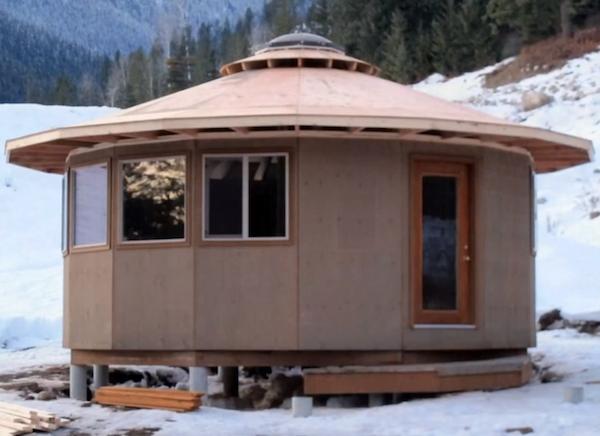
Spaces like these are great for a lot of different purposes. Below are some ideas on what a structure like this might be used as. [continue reading…]
{ }
Recently I found out about a new tiny house builder. I ran into their video tour on YouTube. You’ll get the complete tour of the house below.
Andrew Gilcheck is the man behind Itty Bitty House Company. The tiny home you’ll see here has a relatively large porch and is completely non-toxic. On the outside, it’s all solid cedar siding, trim, and decking. The roof is metal and the windows are all full crank-out casement while the others are crank out awning style windows.
Please don’t miss other exciting tiny homes – join our FREE Tiny House Newsletter!
Tiny House on Wheels by Itty Bitty House Company
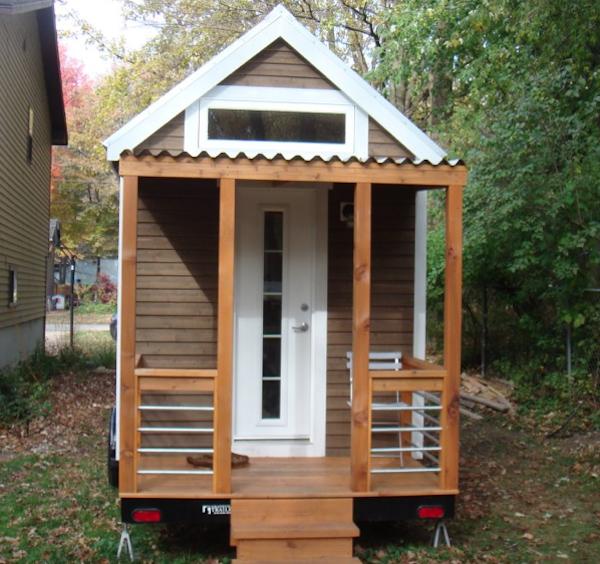
Photo Courtesy of Itty Bitty House Company
The front door is fully insulated wood with a double pane fully insulated glass window. [continue reading…]
{ }
Hello fellow tiny house enthusiasts! I’m looking for your questions/concerns/experiences on trailers for tiny homes.
Would you be willing to share your thoughts real quick?
Are trailers something that you even need help with? If so, let me know how I can help. You might find the ideas listed at the bottom of this post helpful. I will be using your feedback for future posts, ebooks, videos, and interview questions. Thank you so much in advance for your suggestions. I truly appreciate it because it helps me serve you better later on.
Please don’t miss other exciting tiny homes – join our FREE Tiny House Newsletter!
What are your questions about tiny house trailers?

Photo Courtesy of Aldo Lavaggi
This might help you get your brain going… [continue reading…]
{ }
I ran into Erick’s tiny house over on YouTube.
His video takes you through the entire construction process.
It’s in a slideshow format and starts with the trailer floor foundation.
Erick’s design includes a…
- hot water heater,
- refrigerator,
- and other common appliances.
Be sure to notice the corner shelving in the kitchenette area for storage too.
Erick built an inexpensive composting toilet in the back across from the shower that you’ll also see.
Please don’t miss other exciting tiny homes – join our FREE Tiny House Newsletter!

Photo Courtesy of Erick / YouTube
Here’s what Erick had to say in the YouTube comments regarding the toilet… [continue reading…]
{ }
Who better to have a tiny house question and answer session with than Jay Shafer? He has built dozens of tiny homes on wheels and has been living in them since 1997. A few weeks ago I told you about the Tumbleweed Tiny XS House that’s being featured at the Toledo Museum of Art.
Right now they’ve got it up for auction on eBay so you have a chance at bidding on this 65-square-foot portable home. Toledo Museum of Art featured Jay Shafer as a guest speaker. In case you don’t know, the XS House is one of his designs. One of his smallest, too. Sit back and relax. Grab a hot tea or coffee, and enjoy.
Please don’t miss other exciting tiny homes – join our FREE Tiny House Newsletter!
Tiny House Q&A With Jay Shafer of Tumbleweed Houses at Toledo Museum
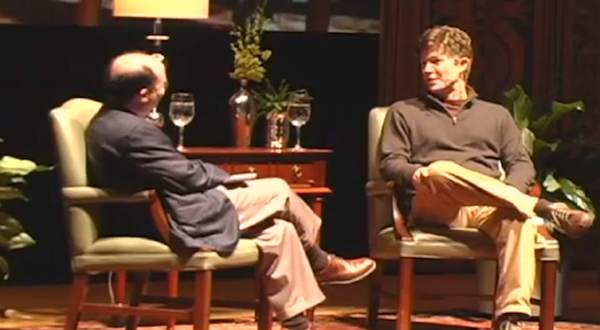
Tiny House Question and Answer Interview with Jay Shafer
Length: 1:09:37
[continue reading…]
{ }
Most of the time when you think of tiny houses, if you’re like me, you’re thinking of a “micro” home of around 65 to 200 square feet. This house is going to be a little bit different because I think it suits a small family perfectly.
Designed by Jessica Helgerson, photographed by Lincoln Barbour, and recently featured in Martha Stewart Living, the home won’t fail to impress you. As you’re walking up to the home, you’ll immediately notice the green, living roof. This small house is surrounded by beautiful trees and other greenery. If you’re like me, you’ll love the attention to detail everywhere in this house. Like the tree which comes out of the front porch flooring. I love that.
Please don’t miss other exciting tiny homes – join our FREE Tiny House Newsletter!
Classic Little Family Cottage

Notice the swing which is hanging from the tree, too. Wouldn’t you have loved to grow up in a house like this? [continue reading…]
{ }
This is the UEV 480 Conqueror. It’s Australia’s versatile, off-road-ready, micro camping trailer. Since it’s ready for just about any terrain, it’s a wonderful addition to your 4×4 adventure vehicle. It’s the perfect vehicle add-on to conquer the terrain around you. It’s a breed between an off-road teardrop trailer and a pop-up camper. And it’s loaded with features like:
- Flat-screen television
- Dining table that converts to bed
- Pop up the roof so you can stand
- An extra bed that folds out the front
Please don’t miss other exciting tiny homes – join our FREE Tiny House Newsletter!
Australia’s UEV 490 Conqueror Off-Road Camper

In addition to all of that, it features much, much more…
[continue reading…]
{ }
The Bauhaus is an electric-powered houseboat. It measures 50′ by 13.5′ so it’s approximately 675 square feet. Not tiny, but certainly small, and very interesting. It weighs about 20 tons and has enough solar panels to run everything all year long. There is no gas, diesel, or petrol required. You even cook and heat with the electricity that the PhotoVoltaic panels generate.
There is a giant 1.2-ton battery bank/storage to keep it all. The solar-powered Bauhaus barge/houseboat was built in 2010. Inside you would find two cabins, a bathroom, a large lounge area with kitchen, skylights, fully glazed door, and windows. So let’s take a look, shall we?
Please don’t miss other exciting tiny homes – join our FREE Tiny House Newsletter!
Electric-Powered Houseboat
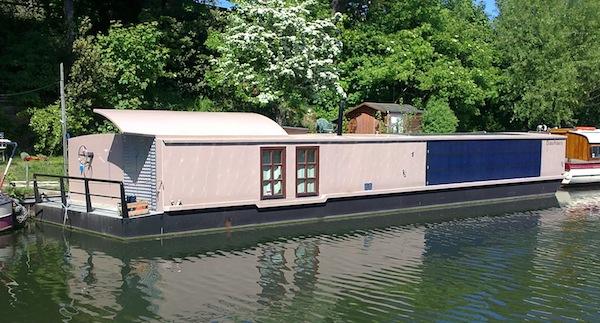
Photo Credits Bauhaus Barge
[continue reading…]
{ }

