
Disclosure: This post may contain affiliate links. If you purchase through one of our links, we may earn a commission at no additional cost to you.
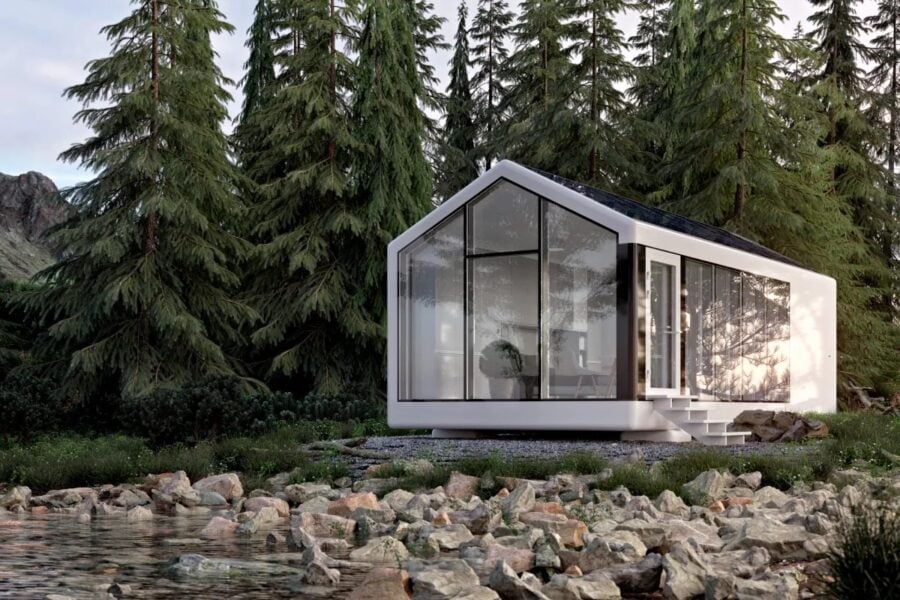
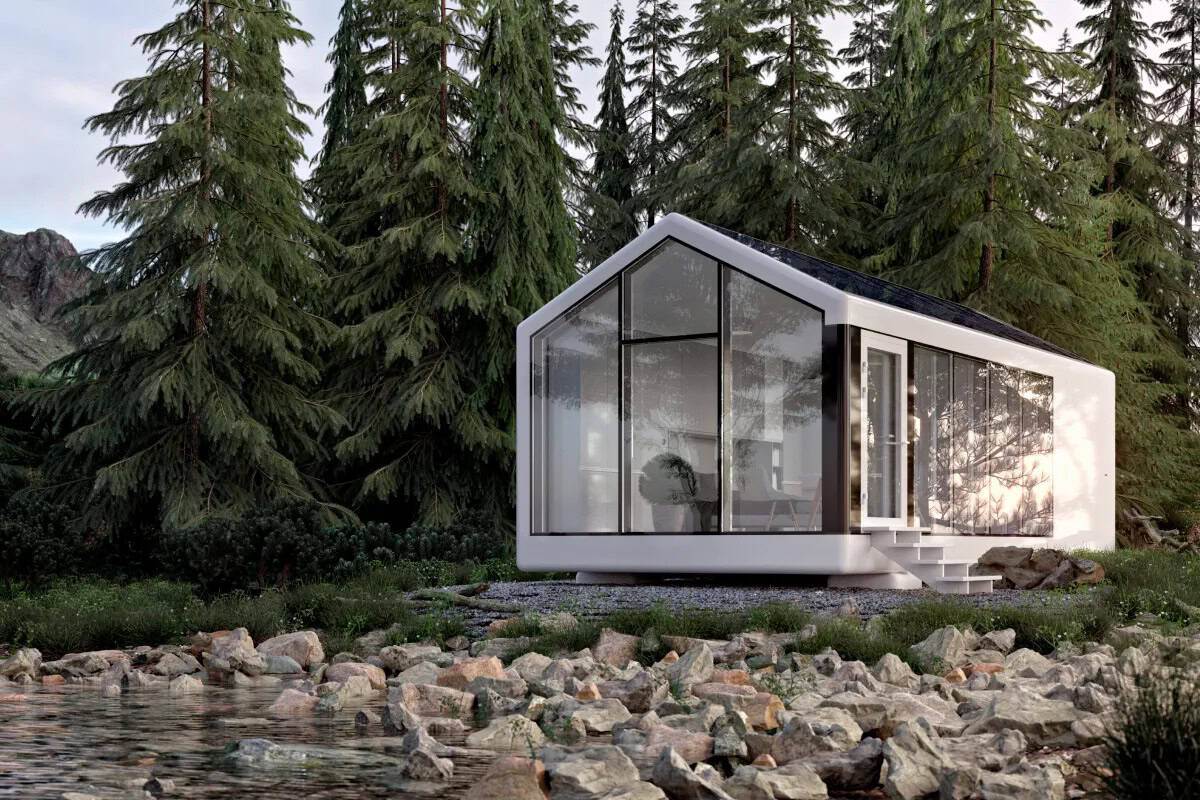
Most prefab homes still arrive as a kit that needs weeks of on-site assembly, utility hookups, and inspections before anyone can move in. The Haus.me mOne takes a fundamentally different approach: it ships as a fully finished, fully autonomous 400-square-foot home that can be placed on a foundation and lived in the same day it arrives. No external water hookup, no grid connection, no septic system required. Founded in 2017 by Ukrainian immigrant Max Gerbut and based in Southern California, Haus.me builds its homes using 3D-printed composite polymer walls — a construction method that makes the units resistant to earthquakes, hurricanes, and fire. The mOne is their flagship model, and it caught the attention of YouTuber Kerry Tarnow, who spent time staying in one and documenting the experience for his 163,000 subscribers. His verdict? The technology is genuinely impressive, even if the price tag gives pause.
Images courtesy of Haus.me
What makes the mOne worth examining isn’t just its off-grid capability — it’s how comprehensively the company has rethought what a home needs to function independently, from generating its own water out of thin air to running entirely on solar power.
A Fully Autonomous Home That Generates Its Own Water
The mOne’s headline feature is its autonomy. This isn’t off-grid in the “we installed some solar panels” sense — it’s designed to operate with zero external infrastructure from day one. The unit generates its own water through an atmospheric water condensation system that pulls moisture from the air, filters it, and stores it for domestic use. A built-in wastewater recycling system handles the discharge side, so apparently no septic hookup is required.
Power is generated by a rooftop solar array paired with battery storage, providing enough energy to run the home’s HVAC, appliances, and smart systems. A HEPA air filtration system continuously cleans indoor air — a feature that feels less like a luxury and more like a necessity in an era of wildfire smoke and air quality concerns. The entire system is managed through a smart home interface that monitors energy production, water levels, and air quality in real time.
Images courtesy of Haus.me
Floor-to-Ceiling Glass and a Surprisingly Open Layout
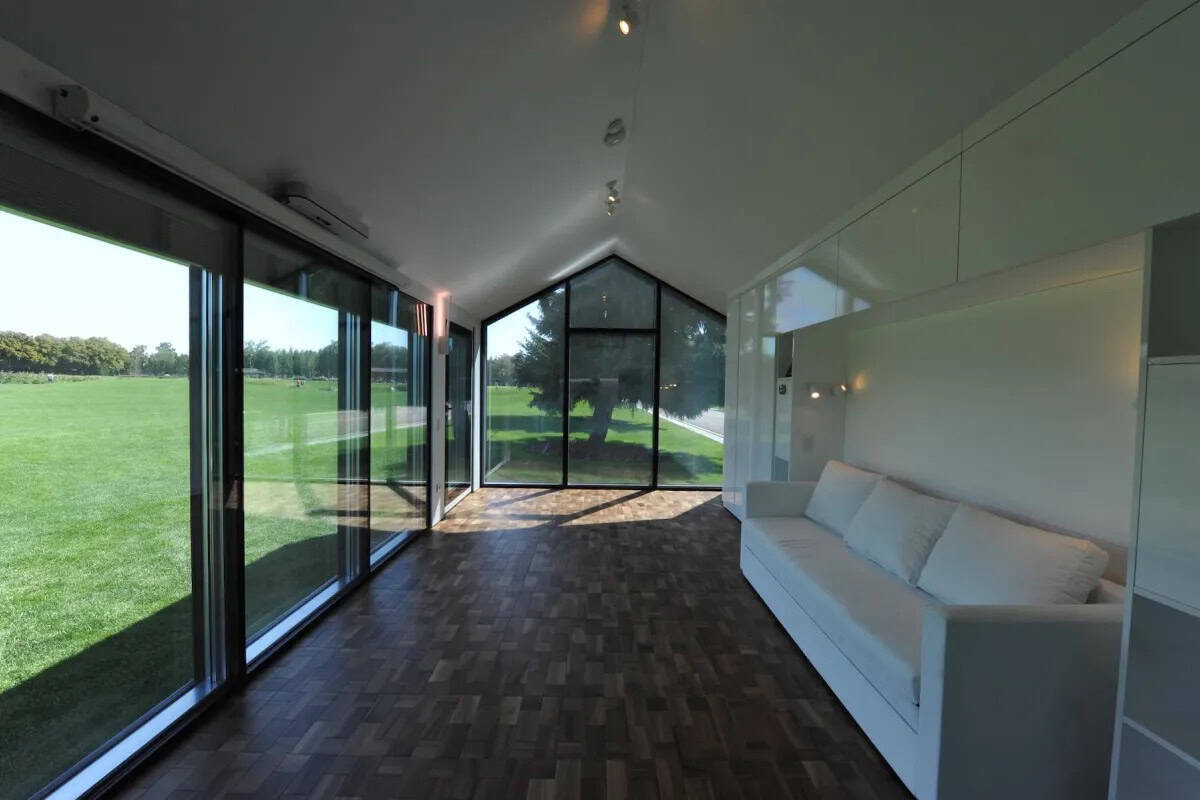
For a 400-square-foot home, the mOne feels remarkably open. The secret is floor-to-ceiling panoramic glass walls that dissolve the boundary between inside and out. When placed in a natural setting — lakeside, in the woods, or on open land — the effect is dramatic. The living area becomes an extension of the landscape rather than a box sitting on top of it.
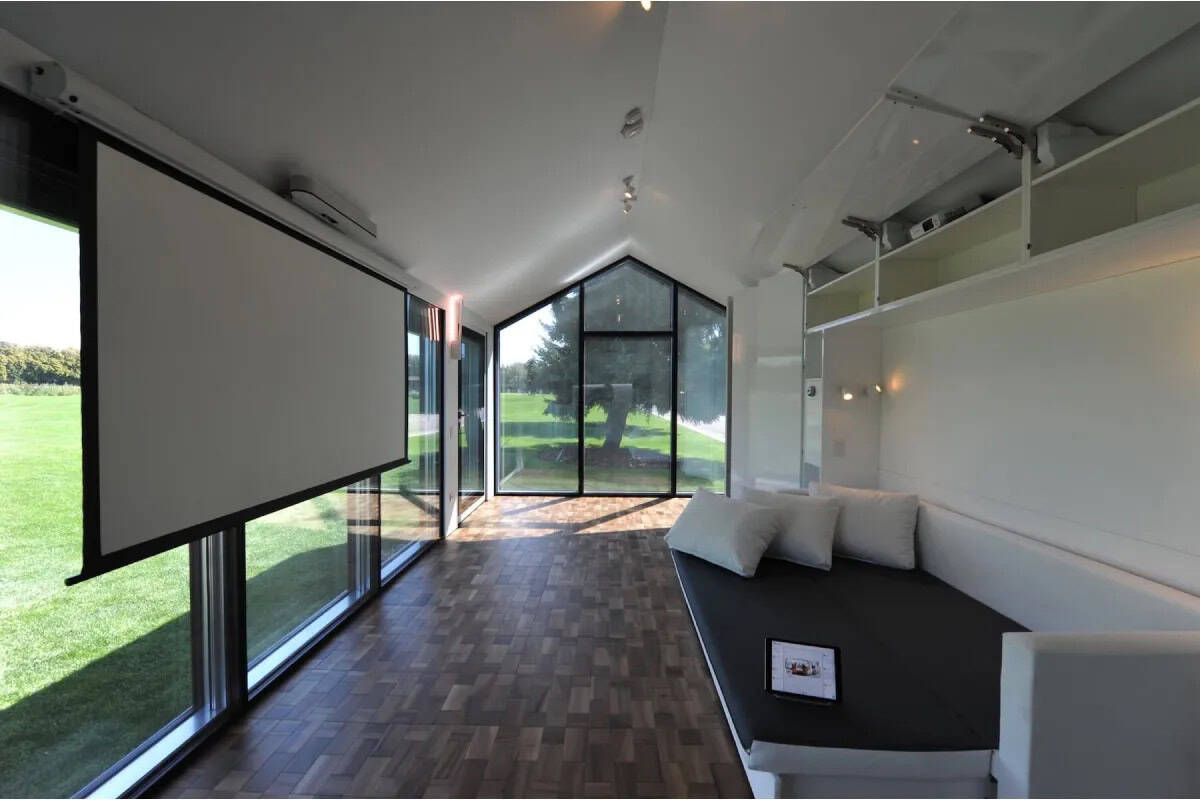
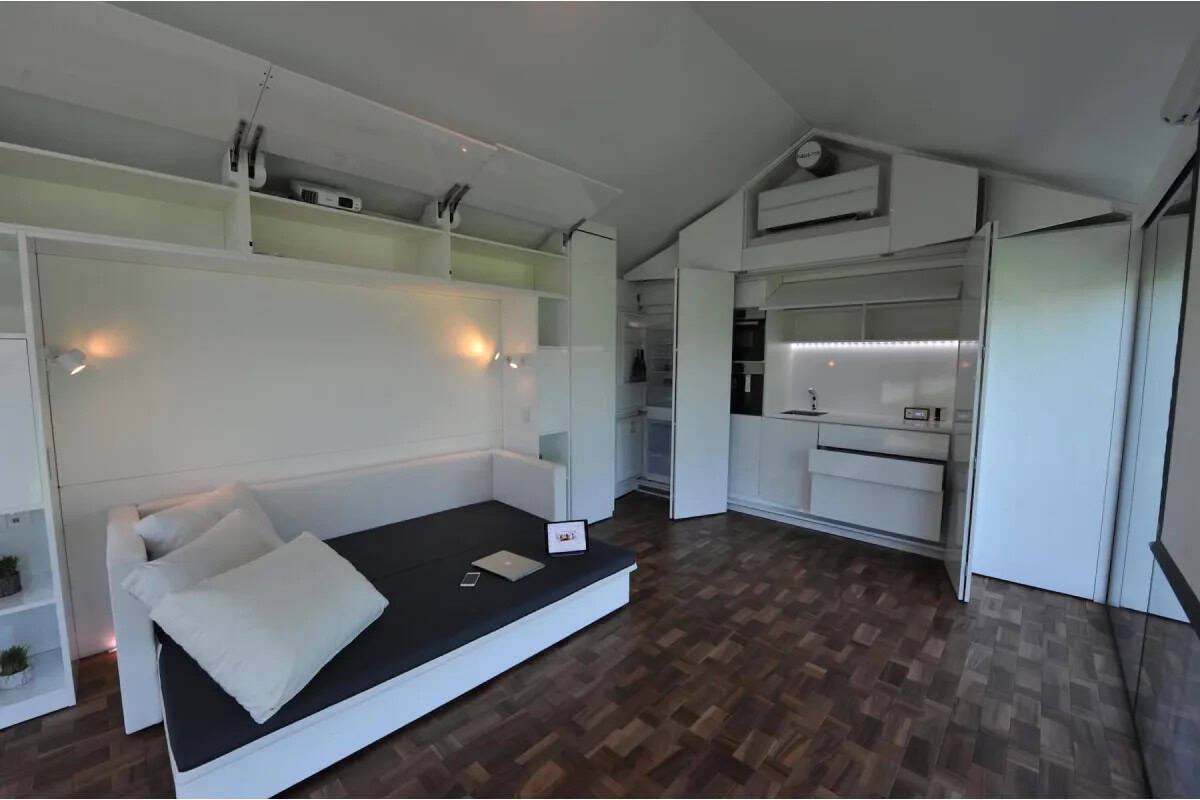
The interior features a clean, minimalist aesthetic with white walls, light wood accents, and built-in furniture, keeping the floor plan uncluttered. A large sofa anchors the living space, and a built-in projector system replaces a traditional TV — saving wall space while creating a cinema-sized viewing experience when the lights go down.
Images courtesy of Haus.me
A Murphy Bed That Transforms the Space
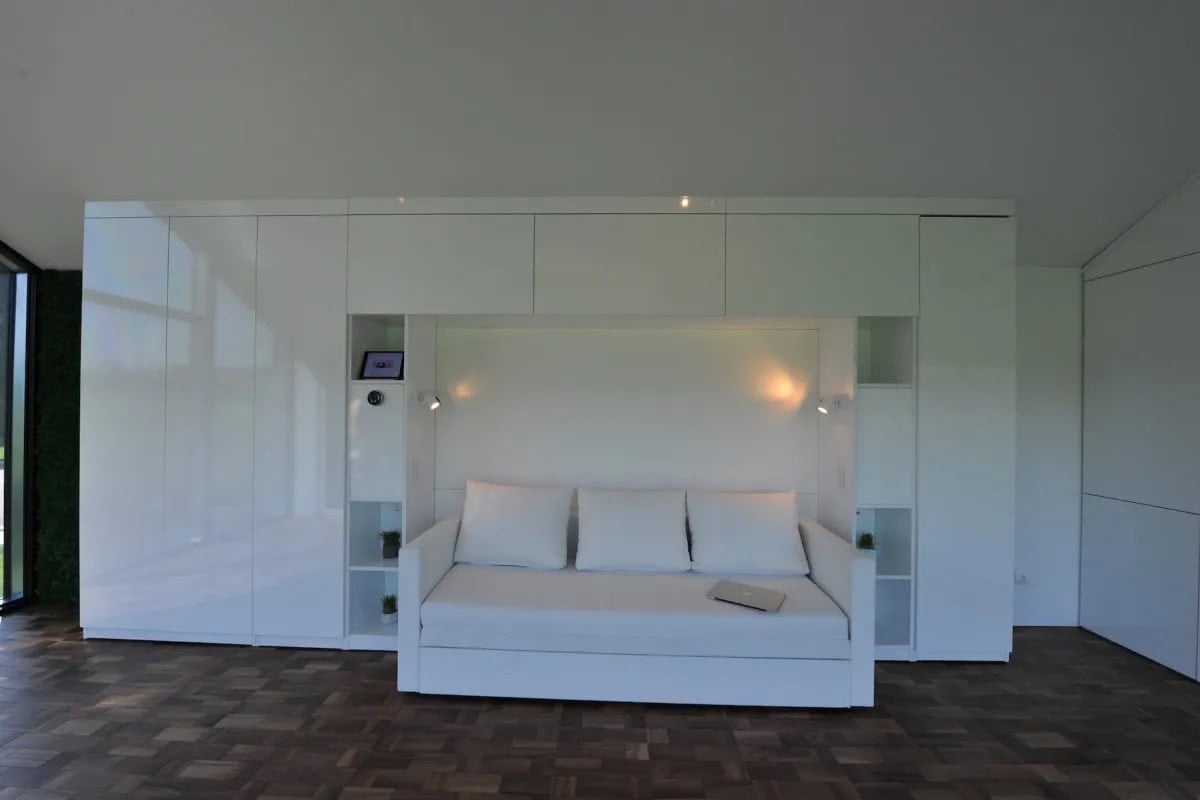
The bedroom solution is a wall-mounted Murphy bed that folds up when not in use, converting the sleeping area into additional living space during the day. Built-in shelving and reading lights on either side mean the bed area doesn’t sacrifice functionality when deployed — it genuinely feels like a bedroom, not a pullout.
This is a design choice that makes or breaks small homes. A permanent bed in a 400-square-foot space would consume a quarter of the floor area around the clock. The Murphy bed allows the mOne to function as a spacious studio during the day and a proper bedroom at night. It’s the same approach used in high-end micro-apartments in cities like New York and Tokyo, and it works just as well here.
Images courtesy of Haus.me
A Hidden Kitchen That Punches Above Its Weight
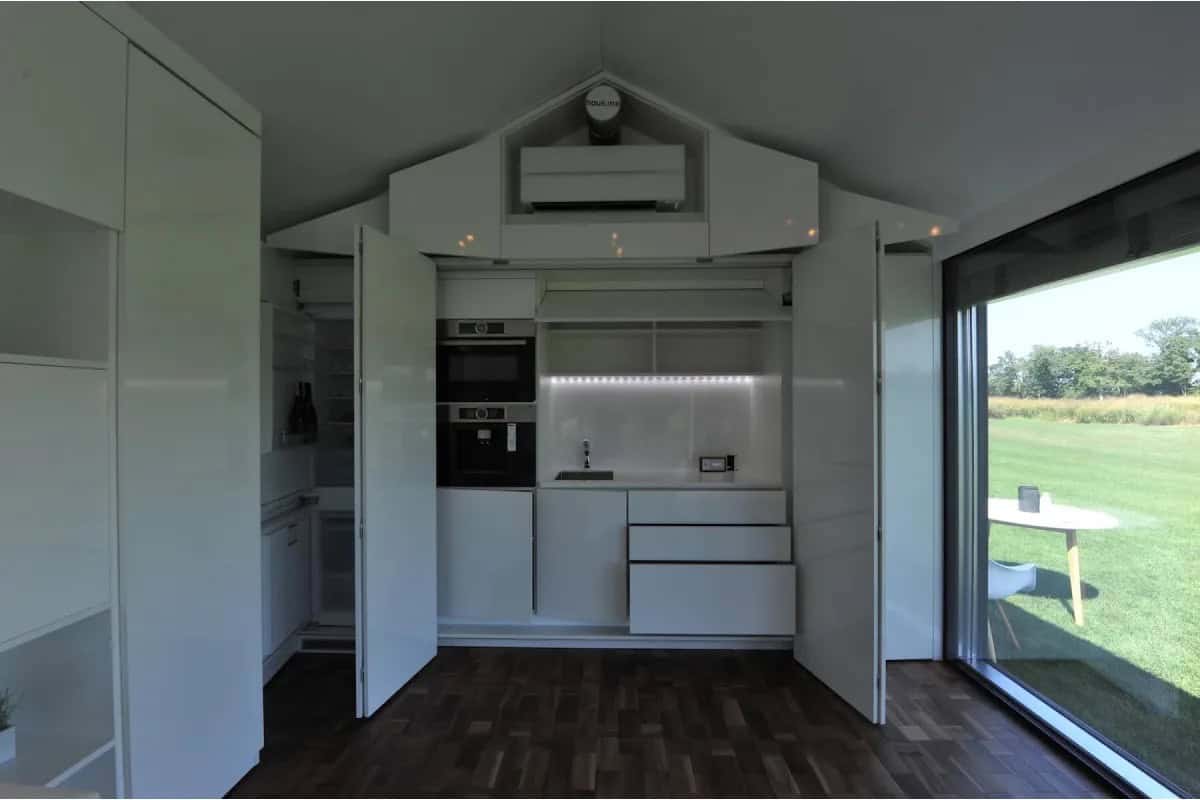
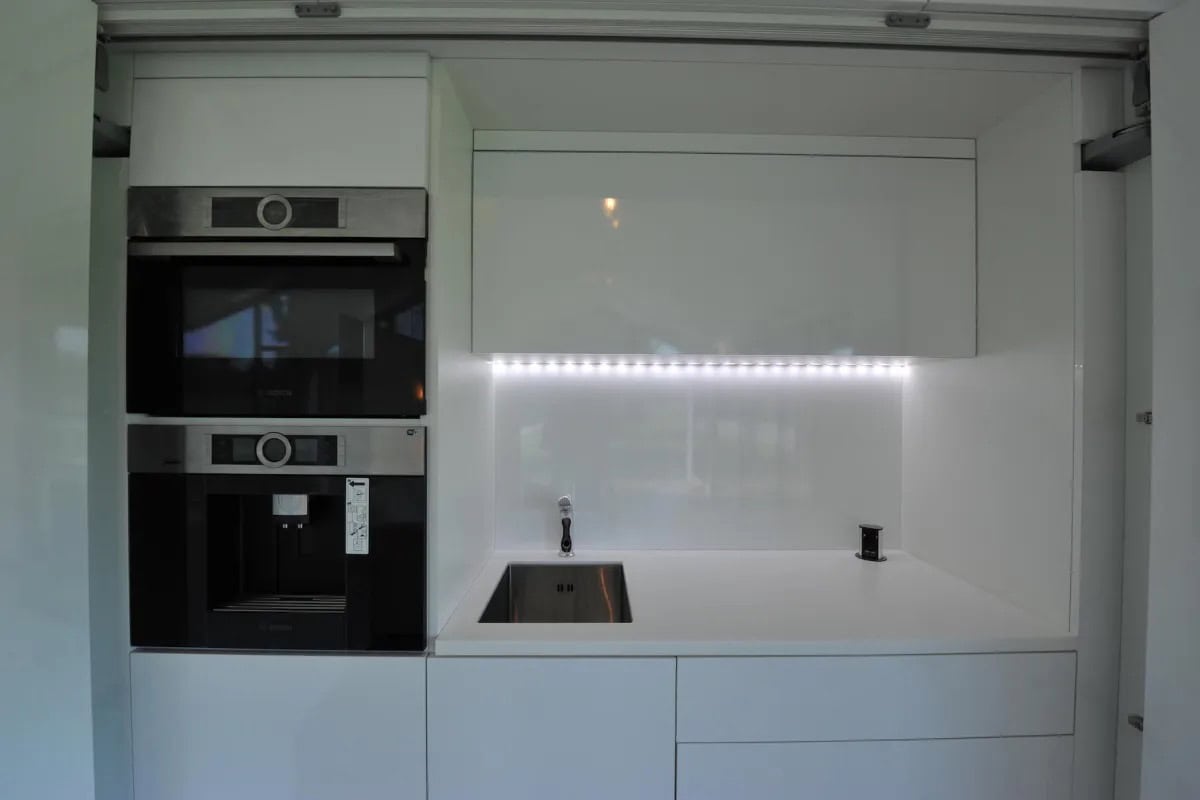
The kitchen is concealed behind fold-out doors that, when closed, blend seamlessly into the wall. Open them up and you’ll find a Bosch oven, microwave, coffee maker, refrigerator, and a stainless steel sink — all tucked into a compact galley layout with LED under-cabinet lighting.
It’s a full kitchen by any reasonable standard, which is more than many prefab units at this price point can claim. The fold-away design means the kitchen disappears when you’re not cooking, keeping the main living area clean and open. The LED lighting underneath the upper cabinets provides ample task lighting and adds a warm glow to the space that photographs exceptionally well — though more importantly, it makes food prep comfortable in a compact workspace.
Images courtesy of Haus.me
Images courtesy of Haus.me
A Modern Bathroom with Real Fixtures
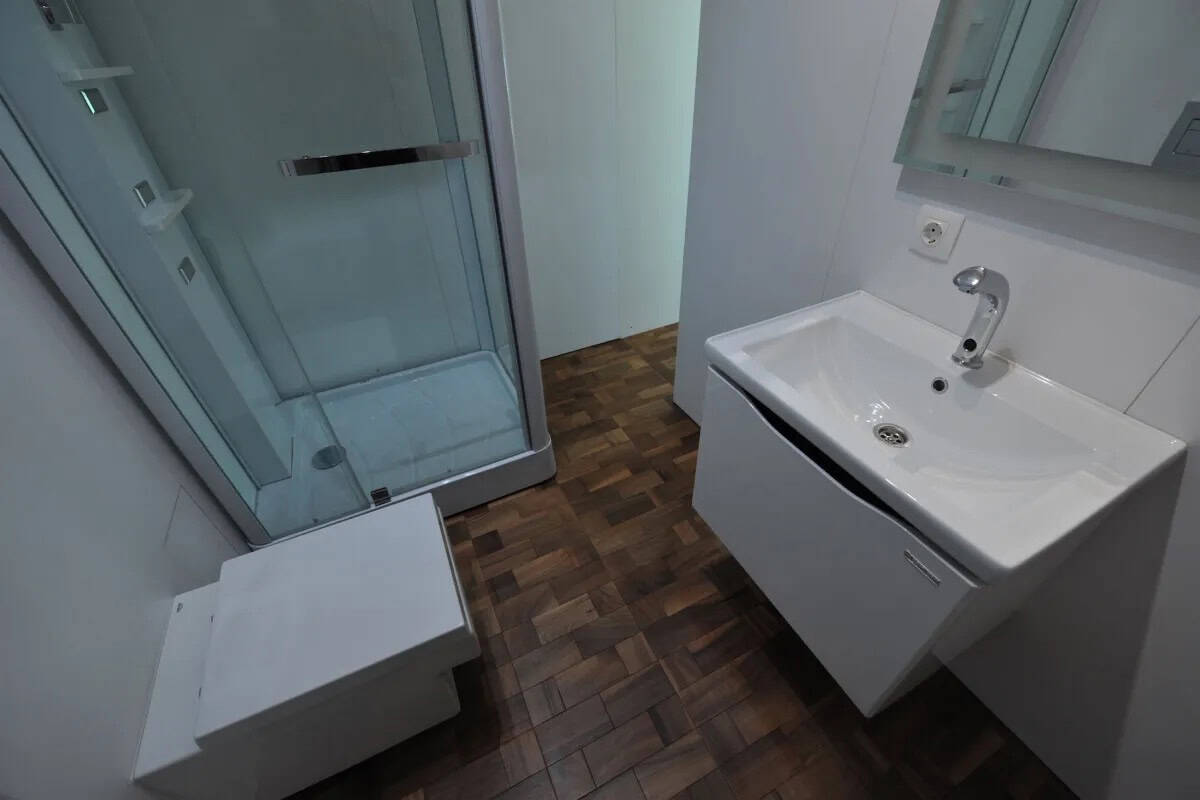
The bathroom doesn’t cut corners. A full glass-enclosed shower, a modern square-profile toilet, and a floating white vanity with under-mount sink are all finished in the same clean, contemporary style as the rest of the home. Wood-look flooring adds warmth to what could otherwise feel clinical.
In many tiny and prefab homes, the bathroom is the first place compromises show up — undersized showers, composting toilets, or shower-over-toilet combos that require creative engineering. The mOne’s bathroom feels like it belongs in a boutique hotel, not a 400-square-foot prefab. It’s a small detail that speaks to the overall design philosophy: this is meant to feel like a real home, not a compromise.
Images courtesy of Haus.me
The Full Studio Layout
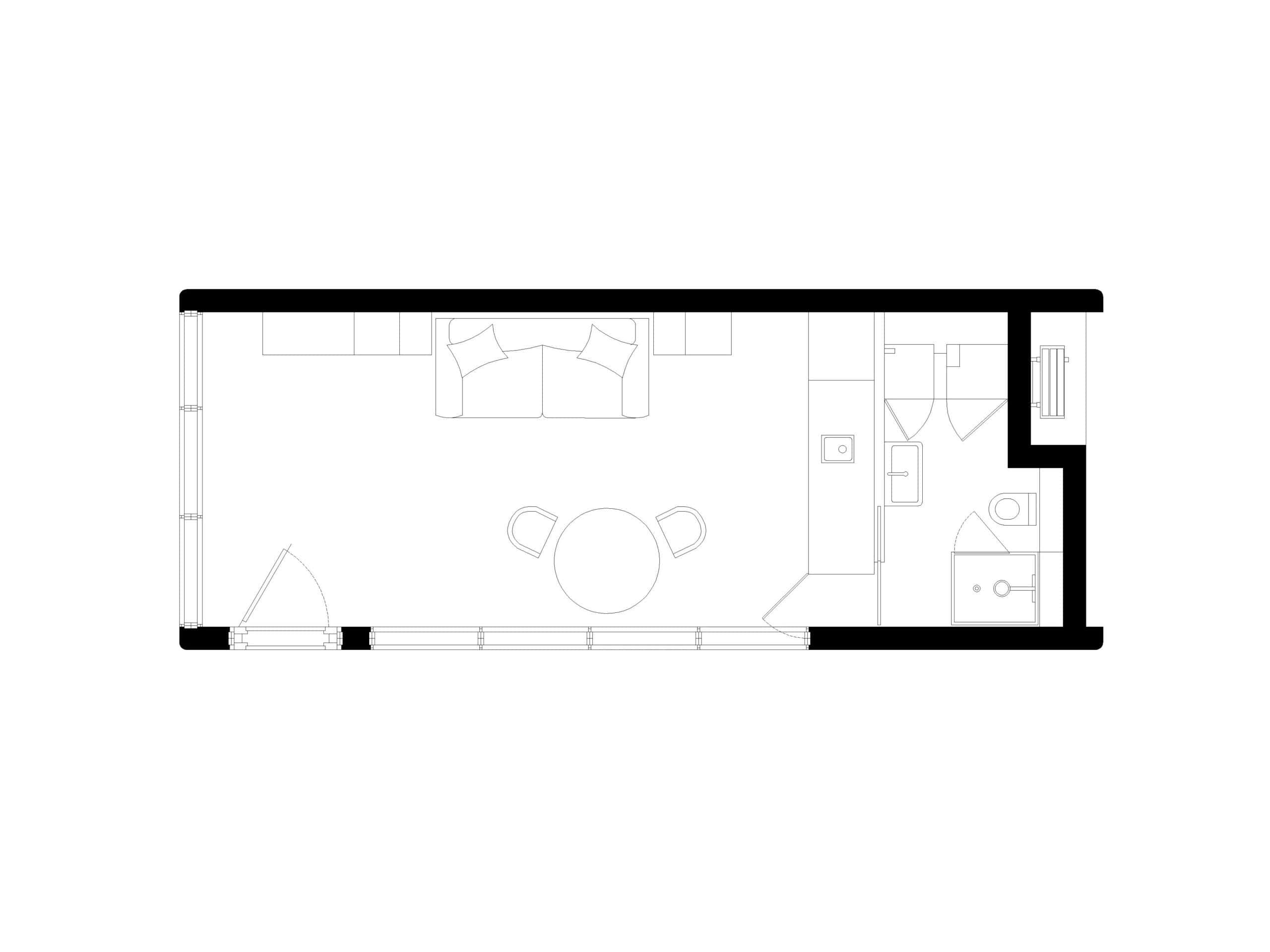
When every element is deployed — bed down, kitchen open, living space arranged — the mOne reveals how thoughtfully the 12-by-34-foot footprint has been utilized. The open floor plan flows logically from the entrance through the living area to the sleeping space, with the kitchen and bathroom tucked along one wall.
Images courtesy of Haus.me
Floor Plan
The floor plan shows how Haus.me organized 400 square feet into distinct zones without interior walls. The bathroom is the only fully enclosed room, while the rest of the space uses furniture placement and the Murphy bed mechanism to define areas. It’s a layout that rewards careful study if you’re planning any small-space build.
Images courtesy of Haus.me
Design Details
- Model: Haus.me mOne
- Size: 400 sq ft (12′ x 34′)
- Bedrooms: 1 (Murphy bed)
- Bathrooms: 1 (full bathroom with glass shower)
- Sleeps: 2-5 people
- Construction: 3D-printed composite polymer walls
- Power: 100% solar with battery storage
- Water: Atmospheric water condensation system (generates water from air)
- Air: HEPA filtration system
- Waste: Built-in wastewater recycling (no septic needed)
- Resilience: Earthquake, hurricane, and fire resistant
- Smart Home: Integrated monitoring for energy, water, and air quality
- Installation: Same-day placement (arrives fully finished)
- Price: Starting at approximately $199,999 (configurations up to $449,000)
- Availability: Arizona, California, Nevada, Oregon, Washington
- Company: Haus.me, Southern California (founded 2017 by Max Gerbut)
What Makes This Prefab Different
- True autonomy: Unlike most “off-grid” homes that still need a well and septic, the mOne generates water from air and recycles wastewater internally — it literally needs nothing but a flat surface to function
- 3D-printed construction: The composite polymer walls are manufactured, not framed, which eliminates many traditional construction variables and provides natural disaster resistance
- Same-day livability: Most prefab homes still require weeks of on-site finishing; the mOne arrives complete with appliances, fixtures, and systems already installed and tested
- Smart monitoring: Real-time tracking of energy production, water levels, and air quality gives occupants unprecedented visibility into how their home is performing
- Scalable model range: Haus.me offers sizes from 120 sq ft (microHaus at $89,990) to 1,600 sq ft (mFour at $1M+), meaning the technology scales for different needs
- The price question: At $199K-$449K for 400 square feet, the mOne costs significantly more per square foot than traditional construction — but the price includes solar, water generation, wastewater recycling, smart home systems, and appliances that would be separate line items in a conventional build
Learn More and Experience It
- Haus.me website: haus.me — explore the full model lineup including the microHaus (120 sq ft), mOne (400 sq ft), mTwo (800 sq ft), and mFour (1,600 sq ft)
- Stay in one: Book a Haus.me on Airbnb — experience the mOne firsthand before buying
- Kerry Tarnow’s review: @kerrytarnow on Instagram — follow for more tiny home and alternative living content
- Our previous coverage: 3D-Printed Smart Tiny House by Haus.me — our earlier feature on the company
Video Tour
YouTuber Kerry Tarnow spent time living in the Haus.me mOne and documented his experience in this detailed 16-minute review. He walks through every feature, tests the autonomous systems, and gives his honest take on whether the technology justifies the price tag.
Highlights
- 400 sq ft fully autonomous prefab home — no external water, power, or sewer connections needed
- 3D-printed composite polymer construction resistant to earthquakes, hurricanes, and fire
- Atmospheric water generation system pulls drinking water from the air
- 100% solar-powered with battery storage
- Full kitchen with Bosch appliances behind fold-away doors
- Modern bathroom with glass shower and floating vanity
- Murphy bed transforms bedroom to living space
- Floor-to-ceiling panoramic glass walls
- Smart home monitoring for energy, water, and air quality
- Same-day installation — arrives fully finished and livable
- Available in AZ, CA, NV, OR, WA starting at approximately $199,999
Explore More
Disclosure: This post may contain affiliate links. If you purchase through one of our links, we may earn a commission at no additional cost to you.


Alex
Latest posts by Alex (see all)
- A Hotel Designer’s 484 Sq Ft Milan Apartment with a Rotating Room Divider - October 9, 2026
- Hermosa Orchards Village: A Durango Tiny Home Community with Its Own Fruit Orchard - October 9, 2026
- The Sanctuary Minnesota: A Tiny House Village on 80 Acres of Woods - October 9, 2026




I only see one entry/exit. THat would not be to code in my area.