
Disclosure: This post may contain affiliate links. If you purchase through one of our links, we may earn a commission at no additional cost to you.
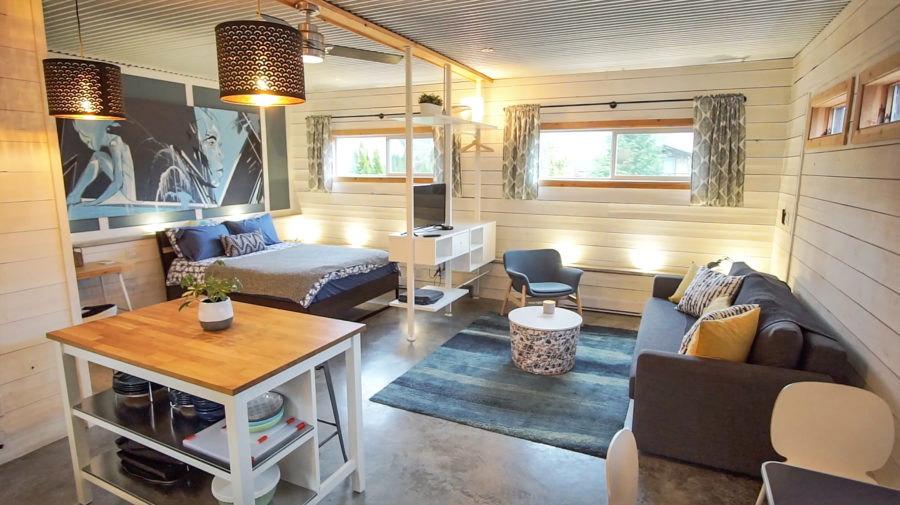
This 470-square-foot garage on the Sunshine Coast in Gibsons, BC was converted into a stunning modern open-concept living space and listed on Airbnb as a form of house hacking to help the owners pay their mortgage. Exposed concrete floors, a corrugated metal ceiling, and high windows give it the feel of a designer micro cabin — except it is in a backyard, close to stores and services.

Open-Concept Studio with Rustic-Modern Design
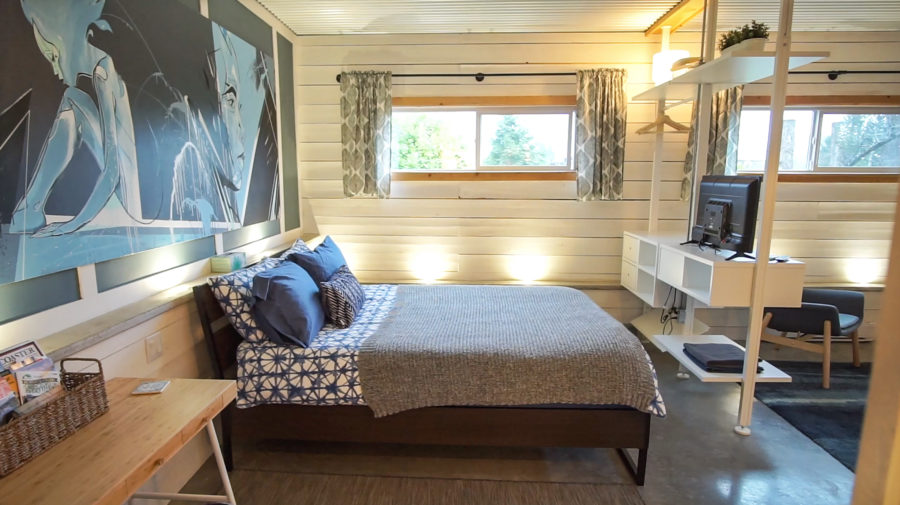
The interior is an open-concept studio with exposed concrete floors and a corrugated metal ceiling that preserve the garage’s industrial character. High windows bring in natural light while providing privacy from the main house nearby. The designers used smart techniques to define each zone without walls — a kitchen island acts as a natural barrier, a large area rug outlines the living room, and a large painting with an open-air closet delineates the sleeping area.


Garage Conversions and the Housing Conversation
Converting a garage, adding an accessory dwelling unit, or building a laneway house is becoming increasingly common in cities. It densifies urban areas, creates new rental spaces, and can help prevent sprawl. The trade-off is that these secondary units usually cannot be purchased separately from the main house, so they do not create new homeownership opportunities. It is not a perfect solution to the housing crisis, but it does add housing stock — and it can help make cities more sustainable.
Video Tour
Watch the full tour from Exploring Alternatives to see how this garage was transformed into a modern living space:
Learn More
- Watch the full tour on Exploring Alternatives
- Book on Airbnb
- Built by Blenheim Construction Ltd., finishing by John Lieffers
- Bedroom painting by Ben Tour
Explore More
Subscribe to our Newsletters:
Join the Tiny House Newsletter
=> tinyhousetalk.com/tinyhousenewsletter
Join The Small House Newsletter
=> tinyhousetalk.com/small-house-newsletter
Join Our Tiny Houses For Sale Newsletter
=> tinyhousetalk.com/tiny-houses-for-sale-newsletter
Disclosure: This post may contain affiliate links. If you purchase through one of our links, we may earn a commission at no additional cost to you.


Latest posts by Exploring Alternatives (see all)
- 3 Years Living in the Smallest Tiny House on an Epic Off-Grid Homestead (Full Tour) - December 22, 2025
- VIDEO: Woman Living Off-Grid in an ULTRA Tiny Yurt Home - June 19, 2025
- Why Are Tiny Houses So Expensive? Builder Shares Actual Costs and Important Considerations - September 8, 2023








This is absolutely fantastic for disabled persons in wheel/powerchairs. I am disabled and I would LOVE to have a place like this!
Nice, but i’d immediately need to put a real door on the bathroom. Stop it with barn doors on bathrooms already.
Oh man I want a barn door on my bathroom so badly haha.
Barn doors on my closets are perfect. They don’t have to take up space to swing open, so tiny spaces and passageways function really well. Pocket doors work well on the bathroom and bedroom for the same reason, but they are not as trouble-free as the barn doors. The only swinging door inside my tiny is the 15″ one on the linen closet in the hallway. Even the double French doors at the entry swing out onto the porch.
I know, right?!
Such a cool feature! =D
Barn doors are perfect for tiny houses because they don’t take up what limited space you have. You can always put a eye hook on it to secure it if your that worried about someone walking in.
I have been considering doing this and was wondering how much work was involved to tie in the bathroom to the main sewer / water lines from the house? costs?
Not much because all your doing is tying into them. it will cost a lil to cut the concrete but if your putting a kitchen in to an existing concrete flor your doing that anyway and few more feet isn’t going to cost but a couple more bucks.
The owners of this garage did a great job of converting their garage. However, left out was the potential costs of such a project. Mainly running water, gas, plumbing, and permit costs. You also have the cost of construction that is not allowed unless done by professionals such as electric wiring and plumbers. For people in cities that allow for such a conversion, this project can take years to pay for itself. And can mean a tax increase. A mortgage means additional monthly expenses. It would be great if someone would find and list cities and states that are more lenient towards homeowners who wish to provide additional housing and income.
Thanks JB — I wish we had a huge staff that could start researching that. It’s so tricky because even within a town, you can have different rules based on where you are zoned. It would take a massive effort, and I feel that by the time you went through every town in the US the laws may have/would have changed. As a general rule, however, the more rural the area, the better chance you have to build without as much interference.
In a lot of cities… if you want to do something like this and have a rental property on the same lot where you live, to bring in extra monthly income… the city will change your property tax and utility rate from residential to commercial which means you will then be paying triple the cost in property tax and utilities. You do all the work… pay for all materials and the city reaps the financial benefits… not you.
That’s true, it’s also something to watch out for if you or your tenant is running their own home business on the property or you can also run afoul of an HOA or other regulatory body that may prohibit commercial use of the property.
Government gets into pretty much all forms of business transactions… But the extent this happens varies and should be something to check before doing something, especially, as failure to do so can get you hit with fines and other penalties by not following the requirements or not filling out the proper forms.
2 points here, 1. That’s why you just tell them. Most people who do this in town build them for relatives, generally children in college or the ole mother in law, What the city doesn’t know won’t hurt them and 2. That’s why you do out of city limits, there are FAR fewer state/county codes out of town then there are city codes in town, in fact many state and county codes doesn’t even cover structures under 600 or 800 square feet.
Which would explain exactly **why** the garage door was left on. What the authorities don’t know the authorities don’t tax.
Yes sir! And if they do ask the answer is “I’m just putting bathroom and 2nd second kitchen in my garage so people don’t go in my house when I throw parties and BBQ’s.”. As long as it’s intended to be a house extension and not a “residence” they can’t tax it as such. a bathroom/kitchen in the garage isn;t going to raise your property tax either.
Good points. There are definitely a lot of issues to overcome but lots of cities are making it easier. I’ll just speak to my area, we’re not bleeding edge on this but we’re pretty far along. California passed legislation making it much easier to add an ADU or JADU and cities were forced (I think it’s a good thing, others may disagree) to address the new codes. Some cities have gone further than the State code. Several years ago my city dropped a lot of the building/permit fees and has done a lot more since then including adding a list of pre-approved plans and pre-fabs. It now even allows tiny houses. There are several agencies that provide financing and there are incentives to rent at an “affordable” rate (which still isn’t very affordable I’ll grant). Property taxes are increased on the value of the addition (maybe not with tiny houses?) but that’s always been the case for improvements. Here at least that is more than offset by the rental income, obviously that will be different by location. There are still restrictions but as someone who lives in a city with a large population I do want safety and density to be considered. We’ve been waffling on the issue for years and it’s easier than ever, in our case it’s fears of being landlords that are stopping us.
This link might get you closer to what you’re looking for: https://www.tinysociety.co/articles/tiny-house-laws-united-states/
Where is the designated space for clothing and what about a refrigerator? Also, the bedroom area needs to be less visible.
@Virginia Jones – Coat closet by entrance and another hanging space next to the TV, with shelves and drawers…
Wow! This is so pretty! I like the divider between the bedroom space and the living space. I love the kitchen and bath area. It’s all so lovely and roomy, but still warm and cozy. Nicely done!
Cool home!
I like how they decorated it, but I would definitely put some walls around that bedroom area.
I like it to be dark, while I’m asleep. Personal preference.
Otherwise, perfect.
Cudo’s to the home owners for such a great design.
Kudo’s not Cudo’s. Just saying.
Yeppers. Thanx,
As long as it wasn’t Cujo…
Aaaaaaaaahhhhh! Not Cujo! OMG! Not Cujo… he’s such a sweet, sweet thang. I think.
It is just another version of a pocket door….without the pocket. =)
I wouldn’t mind a sliding barn door for a bathroom door, but I would get rid of the big barn doors on the outside wall.
By leaving the big doors it doesn’t be a “residence” and doesn’t jack your property tax up by becoming a “commercial property” because it’s still a working garage.
Absolutely LOVE it but I’d have to put a wall up between the living room and the bedroom. I like a little privacy. It could stay open to the rest of the house but I’d have to wall that up, you can build a Lazy Susan to put the tv on so you can rotate the t.v. and watch it from the living room or the bedroom.