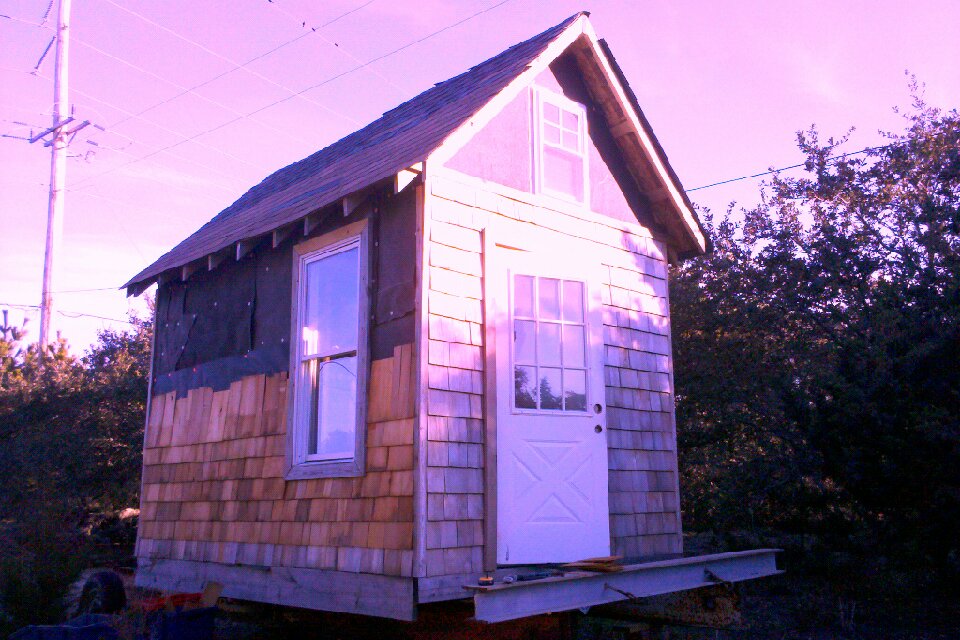
Most of the time I like to show you tiny houses on wheels but I also have a passion for other small spaces, like this 252-square-foot tiny victorian cottage built on a foundation by Tiny Texas Houses.
I think a home like this is a great option if you’re interested in living tiny but know that something slightly bigger would work better for you.
Maybe it’s because you want to share the house with somebody, you want to keep some more of your goodies, or you just enjoy a little more spaciousness.
Photo Credits Texas Tiny Houses
Did you know that Brad Kittel builds his tiny homes of nearly 100% recycled & reclaimed materials that he repurposes, gathers and restores himself? Pretty amazing if you ask me.
I like how the interior is a lot like most little houses on wheels. It’s got the kitchen with an upstairs sleeping loft. Only here you get to enjoy the feeling of more space thanks to a bigger house and the open/vaulted ceilings.
I encourage to tour the rest of this awesome little house below:
[continue reading…]
{ }
Another question I get asked about our tiny house is how we handle storage for things big and small. Clearly when your home is the size of a parking space this sort of thing needs special consideration. I thought I might take you on a short tour of our tiny house storage.
Before talking about where we put things in the tiny house I thought I might mention something about our downsizing process. When we decided that we wanted to build a 120 square foot home we were living in a 2700 square foot house in suburban Atlanta. It was a really nice house and we did like it when we bought it but we quickly realized that having a large house was not something that we needed or wanted any more. When we started to explore alternative housing and decided on the tiny house we began to downsize our lives.

Our house in Atlanta. Photo by Laura M. LaVoie
I learned an exercise from the book Little House on a Small Planet by Shay Salomon. Take a post-it note and place it at the doorway to every room in the house. Every time you go into the room write down why you’re there. After a week compare the notes and determine if there are any activities that can be consolidated into other spaces or if there are rooms you’re not using at all. We found that we were using our bedroom, our kitchen, and our entertainment space the most. We almost never sat in the living room and there were two whole bedrooms that were completely unused.
Click below to read more about our storage solutions.
[continue reading…]
{ }
I wanted to show you this 165 square foot tiny house on a trailer that was built using slightly modified Tumbleweed Fencl plans. It has that rustic look to it that I personally love and the pictures below speak for themselves.
The interior is beautiful and features high quality home style cabinetry with a spacious kitchen/bathroom for such a tiny home. A design like this is perfect for those of you who prefer that your tiny house feels like a home over the futuristic overly-modern style like this.
Don’t miss other tiny homes like this – join our FREE Tiny House Newsletter for more!
165-sq.-ft. Tiny House on Wheels

I think you’ll get a better idea of what I mean once you go inside below:
[continue reading…]
{ }
This is the small house that feels big… It’s an 800-square-foot custom designed and built home on a foundation and I think you’re going to like it.
I just can’t get enough of small houses that are well designed like the one you’re about to see here. It’s a timber frame build by Nir Pearlson in Oregon. His firm specializes in green designs.
In this case, the client wanted an energy-efficient small home made out of sustainable materials. The clients are an aging couple who are nearing retirement so they wanted a single-story design that they’d love. Here is the result.
Do you like small homes like this? If so, join our Small House Newsletter for more just like it!
The Little Cottage That Feels Big (And Where to Get the Plans to Build It)
[continue reading…]
{ }
It’s assuring to know that one of TIME’s top 100 most influential people in the world has planted his prints in the tiny house community.
This man is an Italian prize winning architect by the name of Renzo Piano who has created his own high tech self sufficient tiny house prototype.
He is known for creating some of the most magnificent structures around the world including the tallest skyscraper in Europe, named The Shard.
Now when you hear his credentials I’m sure you assume that his tiny house probably wouldn’t be so tiny. 300 square feet maybe? Definitely not less than 200, right?
Guess again. Piano’s tiny house project, dubbed ”Diogone” is a wooden saddle-roofed house that has a surface area of 2.4 x 2.4 meters and a ridge height of 2.3 meters. Correct me if I’m wrong but that’s just around 62 square feet!
I’m sure you’re wondering, “How did the same man who built something as large as The Shard (Europe’s tallest skyscraper) turn around and decide to build a tiny house that sounds like it might even be too small for people like you and me, who are tiny houses enthusiasts?
Well, this is not no regular tiny house because ”Diogone” was designed to function in various climate conditions as a self sufficient system that collects its own water and even supplies its own power.
Photo Credit: Vitra Magazine
Come inside for more information and photos of this inspiring design. (Yes, we have a photo of the interior to show you below)
[continue reading…]
{ }
I’ve been wanting to remind you about this for the last few weeks because it’s a great way to help a fellow tiny house person who could really use it.
And the great part is you can get a “perk” as a thanks for helping. Now there’s a cool way to encourage giving, right? Although we should all be humbled by those who give anonymously just because they want to.
Anyway, many of you have heard of Kim Langston who has been having to rebuild her tiny house because her first one was burned down in a mysterious barn fire last summer.
So what I’d like to do (with your help) is continue to help Kim go back from this:
To this:
It’s totally optional to contribute. But if you can spare anything and feel like doing it, then do go for it! Otherwise, no problem and no worries! Just enjoy the video below and don’t worry because those of us who are able to pitch in will. 🙂
Watch the Video Below:
[continue reading…]
{ }
I still can’t get over the incredible time I had with all of the amazing people I got to meet in Vermont this weekend.
I’ll be sharing more photos and videos soon but I wanted to talk about this article and the video you can watch below that was featured on the New England Cable News.
It features the tiny house built by Yale student Elizabeth Turnbull Henry that I had the pleasure of touring on my visit to the Tiny House Fair at Yestermorrow where I got to speak this weekend.
Kate Stevenson, the executive director of Yestermorrow, explains in the video below how more and more people are interested in living mortgage-free.
Then below that video, I actually had the chance to get Kate to tell us more about the house while giving you a tour of the house in its most recent condition.
Photos by Alex Pino
Come inside to see the video below:
[continue reading…]
{ }
So I thought I might continue on our little tour of our tiny house, our construction choices, and the outcome.
Since I am currently enjoying some beautiful summer days I thought I might talk a little about our outdoor living space.
The first outdoor space we built was our front porch and since we used plans to build our post and pier foundation based on deck plans, no front porch was in the original design. We always planned to build one but we needed to have the house built first.

Photo by Laura M. LaVoie
Our front porch may be the smallest deck ever constructed. It is essentially a free-standing structure using just four deck blocks for stability. It is attached to the house by the porch overhang. It provides a small covered spot to take off our muddy shoes before going inside.
I encourage you to read more and see our photos of the process below.
[continue reading…]
{ }
I thought these Gypsy Caravans created by Kees Hoekstra of Roulottes were pretty neat and would like to share them with you today. Kees has been building gypsy caravans since 1992 and was a graphic designer/illustrator in Amsterdam.
With his knowledge in graphic design, Kees borrowed some tools from a friend and set off to France for 20 weeks restoring his caravan. After he was finished people starting asking if it was for sale/rent and that inspired him to create his own business. Since there weren’t many original caravans left, he decided he needed to build them from scratch. He then moved to Czech Republic where he set up a workshop and hired carpenters.
Please don’t miss other exciting tiny homes – join our FREE Tiny House Newsletter!
Graphic Designer Borrows Tools And Restores This Gypsy Caravan Tiny House To Perfection!?
Today he sells his creations which are used for campsites, hotels, backyard workshops and more…
[continue reading…]
{ }