
Disclosure: This post may contain affiliate links. If you purchase through one of our links, we may earn a commission at no additional cost to you.
If you could point to a single structure that ignited the modern tiny house movement, this would be a strong contender. Jay Shafer’s original Tumbleweed tiny house — built between 1997 and 1999 — was a radical experiment: could a person live comfortably and with dignity in just 89 square feet?
The answer, as Shafer proved by living in the house himself, was yes. That proof of concept didn’t just change his life. It launched a company (Tumbleweed Tiny House Company), inspired a generation of builders, and helped create the cultural framework we now call the tiny house movement.
In this video tour, Derek “Deek” Diedricksen — author of Humble Homes, Simple Shacks, host of HGTV’s Tiny Yellow House, and one of the tiny house community’s most recognizable voices — walks through the original Tumbleweed and gives us an inside look at where it all began.

The House That Started a Movement
Before Jay Shafer built this house, he had been living in a 14-foot Airstream trailer for two years. That experience taught him something important: he didn’t need much space, but he needed far better insulation and a more intentional design than a mass-produced trailer could offer. So he set out to build exactly the home he needed — nothing more, nothing less.
The result was this 89-square-foot structure, built on a trailer frame for mobility. Shafer named it “Tumbleweed,” and the name stuck. When he began designing homes for others, the Tumbleweed Tiny House Company was born. The house’s exterior evokes a miniature country chapel, with weathered wood siding and a steeply pitched roof that gives the interior a sense of vertical space that belies its tiny footprint.
What made this house revolutionary wasn’t its size — people had lived in small spaces before. It was the intentionality. Every element served a purpose. The design proved that small could be beautiful, functional, and chosen rather than imposed by circumstance.
Inside the Original Tumbleweed
Despite its compact 89 square feet, the original Tumbleweed packed in the essentials for daily living. The main floor houses a micro kitchen with a two-burner range stove and a tiny sink, a living area with built-in cabinets and drawers, and a wood burning stove for heating. Built-in hooks and storage compartments throughout the walls make every vertical surface work double duty.
One charming detail: a car stereo system provided entertainment in what might be the most efficiently sized living room ever built. It’s a reminder that Shafer wasn’t designing a survivalist shelter — he was designing a home, complete with the small comforts that make a space feel livable.
The Sleeping Loft with a Gothic Window
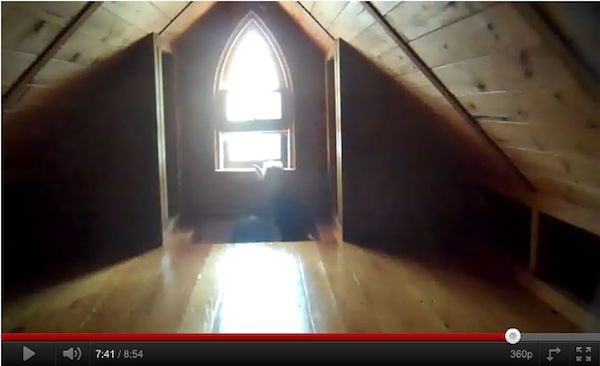
Upstairs, the sleeping loft demonstrates one of the most effective design strategies in tiny house architecture: using the vertical space created by a pitched roof. The loft provides a dedicated sleeping area that keeps the main floor open for living, cooking, and socializing.
The standout feature is a beautiful Gothic-style arched window that gives the loft its own character. Rather than feeling like an afterthought tucked under the rafters, the loft feels like a deliberate, designed space. Built-in storage surrounds the sleeping area, keeping personal items within arm’s reach without cluttering the main level below.
Video Tour with Deek Diedricksen
Derek “Deek” Diedricksen’s 9-minute walkthrough of the original Tumbleweed captures the house in detail. Deek brings an experienced builder’s eye to the tour, pointing out construction details and design choices that casual observers might miss. As someone who has built dozens of micro-shelters himself and authored multiple books on small-space construction, his perspective adds real depth to what could otherwise be a simple walkthrough.
Design Details
- Type: Tiny house on wheels (THOW)
- Size: 89 square feet
- Designer/Builder: Jay Shafer
- Year Built: 1997–1999
- Exterior: Weathered wood siding with steeply pitched roof
- Heating: Wood burning stove
- Kitchen: Two-burner range stove, small sink
- Sleeping: Upstairs loft with Gothic-style arched window
- Storage: Built-in cabinets, drawers, and wall hooks throughout
- Significance: The original prototype that launched Tumbleweed Tiny House Company (est. 1999)
What Makes This Build Special
- This is where the modern tiny house movement began: Jay Shafer’s decision to build and live in this 89-square-foot house wasn’t a publicity stunt — it was a genuine lifestyle experiment. When he shared his experience online and in print, it resonated with thousands of people who were questioning why American homes kept getting bigger while satisfaction didn’t follow. The Tumbleweed became the proof that a different path was possible.
- The design prioritized dignity over deprivation: Shafer didn’t build a shed to sleep in. He built a tiny home with architectural details like a Gothic window, a steeply pitched roofline, and thoughtful wood siding. The message was clear: choosing to live small isn’t about doing without — it’s about doing with intention.
- Built-in storage everywhere proves that 89 square feet can function: The wall-mounted hooks, under-loft cabinets, and built-in drawers demonstrate that the difference between a cramped space and a functional one often comes down to storage design. Every surface in this house has a secondary purpose.
- The sleeping loft template became an industry standard: The loft-over-living-space arrangement that Shafer used here became the default layout for thousands of tiny houses that followed. It’s now so common that it’s easy to forget someone had to pioneer it for the residential context.
- Two legends of the tiny house world in one video: Having Deek Diedricksen — himself a pioneer in micro-shelter design and education — tour Jay Shafer’s original creation makes this video a unique piece of tiny house history.
Learn More
- Jay Shafer’s current work: jayshafertinyhouses.com
- Tumbleweed Tiny House Company: tumbleweedhouses.com (Jay left the company in 2012 to found Four Lights Tiny House Company, later renamed Jay Shafer Tiny Houses)
- Derek Diedricksen’s YouTube: Tiny Yellow House on YouTube
- Deek’s book: Humble Homes, Simple Shacks — available on Amazon
Highlights
- Jay Shafer’s original Tumbleweed tiny house — the structure that launched the modern tiny house movement
- Just 89 square feet, built between 1997 and 1999 on a trailer frame
- Features a micro kitchen with two-burner stove, wood burning stove for heat, and built-in storage throughout
- Upstairs sleeping loft with a distinctive Gothic-style arched window
- Toured by Derek “Deek” Diedricksen, author of Humble Homes, Simple Shacks and host of HGTV’s Tiny Yellow House
- The design that became the template for thousands of tiny houses on wheels that followed
- Led to the founding of Tumbleweed Tiny House Company in 1999
- 9-minute video tour captures the house in detail with expert commentary
It’s remarkable to see where the tiny house movement started — in an 89-square-foot house built by one person with a clear vision. Does seeing the original Tumbleweed change how you think about what’s “enough” in a home? Share your thoughts in the comments below.
You might also enjoy exploring:
Disclosure: This post may contain affiliate links. If you purchase through one of our links, we may earn a commission at no additional cost to you.


Alex
Latest posts by Alex (see all)
- BridgeWay Village: 18 Tiny Homes Helping Women and Families in Spartanburg Leave Homelessness - October 19, 2026
- Two Bedrooms, Sleeps Eight: An Off-Grid Log Cabin in Oregon’s White River Canyon - October 19, 2026
- Modern Tiny Living Catalina: A Retro Saltbox Tiny House with a First-Floor Master Bedroom - October 19, 2026




I forgot to mention… If you like this house, and want to build your own version of it Jay still sells the plans he created for it. They’re normally $859 but they’re on sale until November 30th, 2011… They’re 40% off right now so it’s a good time to order them if you see this house in your future. 🙂
Here’s the link: https://tinyhousetalk.com/go/epu (it’ll take you to Tumbleweed’s site)
Hey, thanks for sharing the video Alex! -Deek
My pleasure, Deek, glad you came by!
Cool house, it has held up well over the years. I like the woodburner but I think I would remove it and put in a smaller wall hung stove to add a little more room to the space. Thanks for sharing!
Glad you enjoyed it, Danielle! See ya!