
Disclosure: This post may contain affiliate links. If you purchase through one of our links, we may earn a commission at no additional cost to you.
Tiny houses push the boundaries of the smallest amount of space needed to comfortably live in. You want to “make the most” of this space, but how? In this article, I talk about the pitfalls of adding too much stuff to a tiny house, and propose 7 design tips for making a small space feel more spacious.
If you’re trying to fit your whole life into a tiny house, your first instinct is probably to find space for all the furniture, appliances, devices, and belongings you’ve always needed to be comfortable. And obviously you’ll need to partition out a living room, kitchen, bedroom, reading nook, and office… right?
But before you add too much, consider this: Your house design is tiny already. Why do anything to make it feel more cramped or enclosed? Here are 7 design tips that will help you design an interior that feels spacious, and avoid making your tiny space feel claustrophobic.
7 Spacious Tiny House Design Tips
- Avoid unnecessary partitions. For example, instead of creating separate “living” and “sleeping” rooms, consider ways that one larger space could function as a living area by day and a sleeping area by night. A folding or hideaway bed could help.
- Keep the space uncluttered above waist height. Anything above waist height that projects into the living space will make the space feel that much smaller. That means kitchen base cabinets are not a problem, but upper cabinets might be. Limit cabinets, shelves, or anything else that intrudes into this space.
- Take advantage of vertical space. Whether you choose a gable roof, shed roof, or any other style, make the ceiling as high as you can. High windows can allow additional light into the space, and they’re preferable to skylights for passive solar purposes. (More on roof design, and passive solar techniques, in later posts).
- Use light colors to create a spacious feeling. Light colors make a space seem bigger, while dark colors make a space seem smaller. Choose white or light-colored finishes for the ceiling and walls. (The floor color is less important for this purpose).
- Add a mirror in a strategic spot. Hang a large mirror, and you’ve instantly doubled the visual size of your space. Use your creativity. Make a whole wall a mirror. But don’t place the mirror directly facing the front door, it’s bad feng shui.
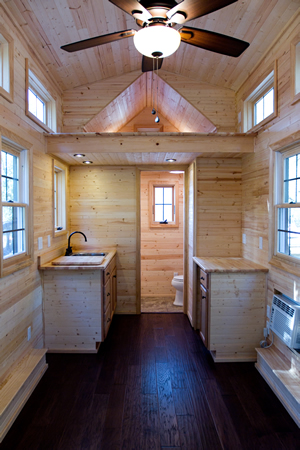 Photo credit: Tiny Home Builders
 - Carefully place windows to provide daylight and views. Light the space from multiple sides if possible. Extra-large windows may look awkward on a tiny house, but choose windows that are big enough to provide a view of the outdoors. Devices like venetian blinds can help diffuse light up into the room while providing a measure of privacy.
- Open up to the outdoors. In addition to windows, think of creative ways that doors or even whole sliding walls could allow you to open your house up. (Check out the Virginia Tech LumenHaus for one elegant example). With a porch, deck, and a whole landscape outside, your tiny space won’t feel at all claustrophobic.
The ‘Tiny Living‘ plan from Tiny Home Builders (at right) is a good example of design that creates a spacious feeling. The walls are not white, but are relatively light in color. A high ceiling and high windows bring in light. Only the small bathroom is partitioned off. And no cabinets or other elements intrude into the space above waist height.
There’s no doubt about it—downsizing and simplifying your life to fit in a tiny home is a very difficult thing to do. And you certainly will want some storage space, partitions, and so on. But beware of the “big house mentality” in which a room can be packed with cabinets, bookshelves, and furniture and still feel spacious. In a tiny house, it can’t. Restraint, and a little bit of good design, will go a long way towards making your small space feel plenty comfortable.
Have more ideas on how to make a tiny space comfortable? Share them in the comments below! In my next post, I’ll talk in more detail about lighting strategies for tiny homes.
Disclosure: This post may contain affiliate links. If you purchase through one of our links, we may earn a commission at no additional cost to you.


Vincent Baudoin
Latest posts by Vincent Baudoin (see all)
- Small and Affordable: The 20K House Project - April 1, 2013
- Solar-Powered Tiny House Prototype: the LumenHaus - March 16, 2013
- Types of Tiny House Communities: Urban, Suburban, and Rural - March 7, 2013






Most of my research to prepare for Tiny House living has involved watching tons of videos, and reading massive amounts of articles on multi-use furniture, and cabinets. There is a lot of information on this available on YouTube. Resource Furniture has tons of amazing ideas, however they are terribly expensive. I happen to be quite creative, and capable, so I am using the ideas I have obtained through these hours of research and discovery to design and create the furniture/cabinets that will suit us to the best of possibilities for our family. If you haven’t already, try searching YouTube for Resource Furniture, Lego Apartment, Multi-use furniture, Space Saving Furniture, Hidden Beds, etc… What you will find is really a lot of fabulous ideas. This is a great posting Alex, Thank you for thinking of it. I am looking forward to reading all the ideas I am sure people will post on this thread.
Good tip!
I think another mistake people make is in expecting that some life activity that requires more space to fit in a tiny gem of a home.
I always come back to my personal library. It is an element of my life that is important and constantly used. I have discovered that, like the Tiny movement, there are entire rooms in a regular home that are pointless for me.
So my ideal tiny home, includes the necessary space to house my library, yet, I am content with the rows of bookcases set up relatively close together. I don’t need the 4+ feet between units that a public library might use. Suddenly, I can find room for the entire library in one good-sized room that includes my office, a couple of reading spots, and even my sewing tables set under windows. My entire life can fit into one room. I am amazed by this. Years ago I would have said it could only be done in a huge house, but by evaluating, downsizing, parting with things I don’t use, and being absolutely honest about who I am and why certain things are important to me, I am able to plan for a small house.
Living fully tiny does require a lot. It is a beautiful ideal, especially for persons who find they actually don’t have anything they have to have that requires square feet to house. If you don’t need it, why not go tiny and enjoy those miniscule heating and cooling bills?
RE-use, re-purpose, downsize, simplify– such freeing concepts and good for the spirit!
Thanks for this great perspective. If downsizing were about getting rid of everything indiscriminately, imagine how dull the end result would be. Instead, you get it exactly right: it’s about getting rid of the unimportant and focusing on the important. All of the tiny house designs I draw for myself have generous space for books as well. (But for someone else, it might be photographs, or knitting supplies, or an art collection).
And bookshelves can add be beautiful and sometimes very unique element of an interior. For example, I’ve seen some great pictures of bookcases built into stairs or ladders.
Yup been to that web page. Love their ideas, but most don’t handle my two needs: 1. huge amounts of shelf space and 2. accessible without a ladder.
I must admit, I always wanted a book case that hid the door to a room. It just seems like it would be a hoot. Better yet, rather than make the entry to the room inconvenient, perhaps a bookcase door that hid the exit onto a tiny balcony?
I will likely not do anything so fancy and just line up my bookcases like good little soldiers, tie them together for stability, hang simple lighting to shine down each aisle, and keep my desk near whatever windows there are for natural light where I work.
Ann,
Have you ever thought of putting hinged bookcases about 3 or 4 inches apart, attached to the same wall? Width of the bookcases would be determined by the amount of free space toward the opposite wall. They would be double sided, and as high as is possible to reach books. To access books, you open up a pair of bookcases just like opening up a book. The closer they could swing to be almost parallel to the wall they are hinged to, the more accessable they would be when open, and the less space out from the wall they would take up. There was a used bookstore here with a similar but less extreme version of this.
John C
That is a great picture from the Chicago Sun-Times for this article.
Welcome Vincent! I enjoyed your article and look forward to more.
Great article!! We need more like this.
I’ve found the house width has a lot to do with how big it feels and what you can do with a given sq’. 8′ causes many compromises vs 10-12′ wide gives a much better feeling of room. So if you don’t need to travel, get a wider TH. They can still be moved as wide load permits are very cheap. Or a flat bed tow truck already has one, just hire it or a trailer to move. Just like they deliver sheds that size.
While I like leaving the middle level free of things, I do like storage above seating sighting level since you rarely are standing, it’s the sitting sightlines to worry about.
I built my 12×12′ with the kitchen, bath, desk, closet on 2 walls adjacent to each other and the rest, 10’x10′ open plus a 6×3′ picture window gives lots of room, light, storage for 1-2. I use 2 chairbeds, some shelving is everything I need for comfortable living.
Plus 2 12’x2′ storage lofts above 6’6” the floor gives added storage even while standing.
And as foam insulated, cheap to cool, heat.
And only cost $1500 in materials and 200 hrs of labor.
TH’s don’t have to be expensive. Just build your own, it’s not that hard. If no experience join Habitat for humanity, they even have just girl crews, to learn, get experience advice and maybe helpers. Then find a plan you like and build it!!
Alex, I’ve really enjoyed your guest writers… great move!
Vincent, thank you for such a succinct article and I’m looking forward to your next contribution on lighting.
I’ve subscribed to PilotHouse Design and will be happy to see your plans & designs in Feb.!
Vincent, nice article. I’m looking forward to the next one on passive solar lighting/heating. Also thanks for the links to Bookshelf Porn, PilotHouse Design, & Virginia Tech Lumen Haus.
Question you might or might not be able to answer in an article–Re: tiny house communities, how far apart should houses be spaced in order to gain the maximum sun exposure on all 4 sides? I’ve looked at a couple pocket tiny communities and the sides look too close to each other to get maximum daily sunlight all day long for everybody.
Carolyn, thanks for your comment. I would love to do a post about passive solar design. In fact, I will probably do several because it’s an important subject!
Your question regarding house spacing is a good one. It depends on a lot of different factors, including orientation, latitude, and the flatness of the site. On a flat site, at 38°N, about the latitude of Washington, D.C., you would want to keep 17-20 feet between tiny houses if they are placed directly south of one another. But of course most real-life situations will be more complex than that. If this is something that interests you, I can certainly address it more in one of my future posts.
Definitely interested in this. I may not understand it all but I’ll try to wade through any explanations. Thanks!
I want to chime in with my interest in Passive Solar and all things sustainable. I will await more articles with interest!
I am building my own Tiny with only one window on the North wall and several windows on the South wall. The West facing wall is pretty much all window, as I’m using a french door on that end…the East wall will have 2 windows, one upstairs in the loft and one downstairs in the door on that end.
Thanks for the interesting info! 🙂
Parker
Fantastic tips! This came at just the right time for me as I am considering our house design again. I’m looking forward to your post about strategic lighting.
After a few years part-timing in a 13′ Boler trailer I’ve come to a lot of the same conclusions about tiny house design. Having a lot of area with a high ceiling is up there on my list, as well as maximising the windows on the view/light side. I also like having a window on each side that gives you a view of what’s going on outside without actually going out there (midnight critter panics, approaching relatives, etc). Life in the Boler would have been a lot less pleasant without the partially covered outdoor deck and having an outdoor kitchen is great for the summer. Also good when you want to cook strong smelling food but not be reminded of it for days. I’d also recommend getting the quietest,most powerful exhaust fan you can find for your kitchen. My biggest design challenge is the fabric and craft supplies and equipment, including a treadle sewing machine and spinning wheel but it’s amazing how much stuff you can store if you organize it properly. Those vacuum pack storage bags are great for squashables.
Alice, those are all great points. It’s amazing how the details you might not think of (like strong food odors) can make such a big difference.
My first sight of the interior of a tiny house was Jay Schafer’s “Epu” and I loved the way he handled storage, for books, clothes, the desk, etc. As much as nothing above counter space makes sense for making the perception of the space seem larger, there is no storage in this design. I actually liked the way the space was divided into living/working/storage, kitchen, bathroom. I suppose my love of boat interiors over the years has made me appreciate how we can make space work for our needs. Absolutely, everyone will have different needs. For me, the sleeping loft on the Epu was too low – I like to sit up in bed, to read, amongst other things. I would also want a way to get a real mattress up there and not a foam one. And you have to work out if you are building you home on a trailer to get around building codes, or if you want to move occasionally. Outdoor decks, etc, also add to what you might need to move, so the idea of the porch is a good one too. I am so enjoying what I am reading on all these blogs, and the things I am discovering. I am probably going to have to design my own home as I live in a metric country (Australia), but am just now learning to use SketchUp so that might help me along the way. Thanks everyone.
I didn’t mean to imply that nothing should come into the space above waist height — just that you have to be very aware of how it affects the perception of space. Certainly, some vertical storage can be very helpful and I agree that some of the Tumbleweed designs do this well. But I’ve also seen some pictures of spaces that look like the inside of a work truck, with shelves and cabinets on both side and a small, claustrophobic aisle in the middle.
My impression of metric countries is that wood and other building products are available in sizes that are fairly similar to our imperial sizes. I suspect you could convert a plan with only some minor changes, if you wanted.
Hi Vincent – well I am a long way from building my own tiny house, so as I’m assimilating so many people’s wonderful ways of doing their own places, I suspect that I will end up with a lot different house than is currently floating around in my mind. Love your design, BTW. I suppose I had my thinking on the 8ft wide model of doing it, easily movable if need be, but actually not intended for touring. I’m loving this discovery I’m on. Thanks for being part of it.
Ian, I’m going to build dormers in my roof to give me more loft height, light, & cross-ventilation up there. Also, Instead of using valuable space on my trailer I’ve seen some really cool fold-up decks that close up when you travel. I’d rather use my trailer length for inside space.
Hi Teri – I am also looking at the dormers to add extra space in the loft area and also push up the side walls a bit. I have also seen some of those extendable decks but I must admit I like the idea of a permanent deck at this early stage. I suppose one of the “mantras” that runs through my head at the moment is the one about, if you live in a small space, if you want storage, you have to go up the walls and use the space. I love seeing the inventive way people are doing their places. Even some of those ones that look a bit ungainly, they are doing the “form follows function” thing. and that becomes a delicate balance. I’m sure your tiny place will be wonderful. All brave people.
Hi back again Ian! If you like Pinterest you can find lots of good Tiny House ideas on it. I’ve got tons of storage solutions on my Pinterest board http://pinterest.com/terijanefoster/teri-s-tiny-house/ Feel free to check it out… 🙂
Teri, your Pinterest board is great. I say you use all of those ideas (of course, you will need a bigger tiny house!) 🙂
Thanks, Vincent! What really feels good is that I’m starting to narrow down my preferences as I get closer to building (have to sell my regular house first). What I love is that the TH people are so willing to share ideas, experiences & wisdom. We don’t have to reinvent the wheel and we’re not alone!
Two things that always make a place claustrophobic for me are, first, a hallway look to the place, with cabinets and things lined up on either side taking up 2/3 of the width. It gives the place a temporary look, as if it were just the entrance to some other space. And then it ends, leaving you feeling unsettled, thwarted.
It helps if some spaces are opened up, breaking the line. A wider section, perhaps housing a pull-out table or a comfortable chair would do the trick.
A hallway is even worse if it ends in a closed wall, either another door or shelves, or even a bare wall. A fair-sized window at the end would help. So would the front door being placed on the long side of the house.
And the other thing, much worse even without the hallway line-up, is a bathroom at the very end, so that from the front door, you’re seeing the tip of the toilet. So you get the feel of a tiny closed space, even if there’s the whole rest of the house in between. Or the bathroom door is always closed (hard to manage sometimes), making a dead end.
Leave the entrance to the toilet off-centre, at least. Or open it at right angles to the front door. And include a window, even if it’s tiny.
Another way to open up the space is to position the work areas, like the kitchen sink and the deskm right in front of a window. Put storage to the side, above, and below, but lose the cubbyhole feel.
It’s nice to have lots of storage space, so under-the-sofa storage is handy, but at least some of the furniture should have open space underneath; it makes the floor area seem larger.
One thing I always do, whether I’m arranging a humongous space or a tiny one, is stand at the open front door and look in. What is the first thing you see? Is it inviting from this spot? (This is why the toilet at the end is such a no-no.)
Imagine yourself a visitor; do you see a place you could sit down and make yourself at home in? Is it alive?
Even more important, imagine yourself coming home tired from a long day’s work or play, opening your door, and seeing … what? More work to be done? Or a place to unwind, put your feet up, breathe?
Your first impressions, every day, will have a big effect on how you feel your space all the time.
I have wondered at so many TH designs where there is either an “inset” porch or and end one—it seems like you lose SO much room! I have wondered why these are not built with what is used on an RV Toy Hauler—a flip down porch attached to the actual house. This could even protect the windows if the TH was towed to the site. And if you were using it in transit you could just leave it for the night still raised as long as it doesn’t block the door.
Something to think about.
I like this idea!
Something I have always done, anyplace I lived, is to take advantage of space above a doorway. In the Tiny Home Builder example above,there is a loft above the doorway. I can’t tell but hopefully they also took advantage inside the bathroom to put a storage shelf above the door. Tops of windows can be used this way also…small shelves to hold books, for example. The plane of the room is already broken by the top of the door or window…
I also do like versatile furniture, and furniture with storage. However, remover that furniture you can see under also makes a room look more spacious.
Great idea Ginger. I did this in our apartment. We had an awkward tiny hallway between the bedroom and the bathroom (two doors in there) so I created lots of extra storage by installing wire shelving directly above the doors and that’s where we store our toilet paper, printing paper, and things like that.
Tip #8: Instead of using full-size fixtures and appliances in your tiny home, downsize to RV-sized fixtures and appliances. Your house isn’t full-size, so why try to cram full-size appliances into it? Using smaller sinks, toilets, showers, fridges, stoves, furniture, doors, and cabinets can really increase the available space and make the home feel much more livable.
One of the biggest reasons that many of these tiny homes seem so cramped and claustrophobic is because the builders install fixtures and appliances that we are used to seeing in full-size homes. In a tiny home setting, these items appear larger, intruding on and dwarfing the living space. The RV industry learned a long time ago that having all the amenities in a tiny space requires downsizing everything within the space.
Before you build your tiny home, go to an RV dealer or RV show and spend some time walking through campers, trailers, and motorhomes. Notice how everything is smaller than standard size (except perhaps the TV!) but you scarcely notice because everything is “right-sized” for the available space.
I’ve spent soooo many happy years aboard boats that I think that if you’re really wanting the TH perspective go look at some boats or look online at some to really see how small spaces can be egficiently used.
I need help for a very small space/1 story/washer/dryer,fridge/bed,table.etc
closets.