Disclosure: This post may contain affiliate links. If you purchase through one of our links, we may earn a commission at no additional cost to you.
A startup south of Austin is revolutionizing the construction industry by using robots to build homes out of clay pulled directly from the ground. This innovative approach, led by Terran Robotics in Luling, Texas, aims to lower costs and drastically reduce the carbon footprint of new home construction.

How the Terry Robot Builds a Home
Terran Robotics uses AI-powered cable-driven robots to build homes out of adobe, a mixture of clay, soil, water, and straw sourced directly from the building site. No concrete trucks. No structural steel. No lumber framing. Just dirt from the ground, shaped by a robot that works around the clock.
The company completed its first home at Proto-Town, an experimental development community near Lockhart, Texas, in April 2026 — and plans to build 20 or more similar units over the next year. In a housing market where material costs have risen 34% since 2020 and the construction labor shortage sits at 92%, Terran’s approach offers something genuinely different: homes that are fireproof, mold-free, energy-efficient, and built with 80% less embodied carbon than conventional construction.
Terran’s robot system, called “Terry,” is a cable-driven machine suspended from a four-pillar gantry anchored by earth screws. Two people can set up the entire system in a single day using a truck and trailer — and once running, it can cover a workspace as large as a football field.
What makes Terry different from the industrial robots you see on factory floors is its intelligence. Most construction robots follow pre-programmed paths. Terry uses real-time depth cameras and AI spatial awareness to constantly monitor what is happening around it. It reads topographical heat maps of the walls to identify voids, then adapts its behavior on the fly. As CEO Zach explains: “Our robot is constantly using cameras to understand the world around it and react to what’s happening.”
The build process has two phases. First, Terry picks up roughly 10-pound increments of adobe mix with a specialized claw, carries them to the wall, and deposits them precisely. Then it switches to a hammering attachment that pounds and sculpts each layer smooth. The system runs autonomously 24/7, using reinforcement learning and computer vision to optimize every placement — and it gets better at it every day.

Image courtesy of Terran Robotics

Image courtesy of Terran Robotics
Why Adobe? A 1,000-Year-Old Material Meets Modern Code
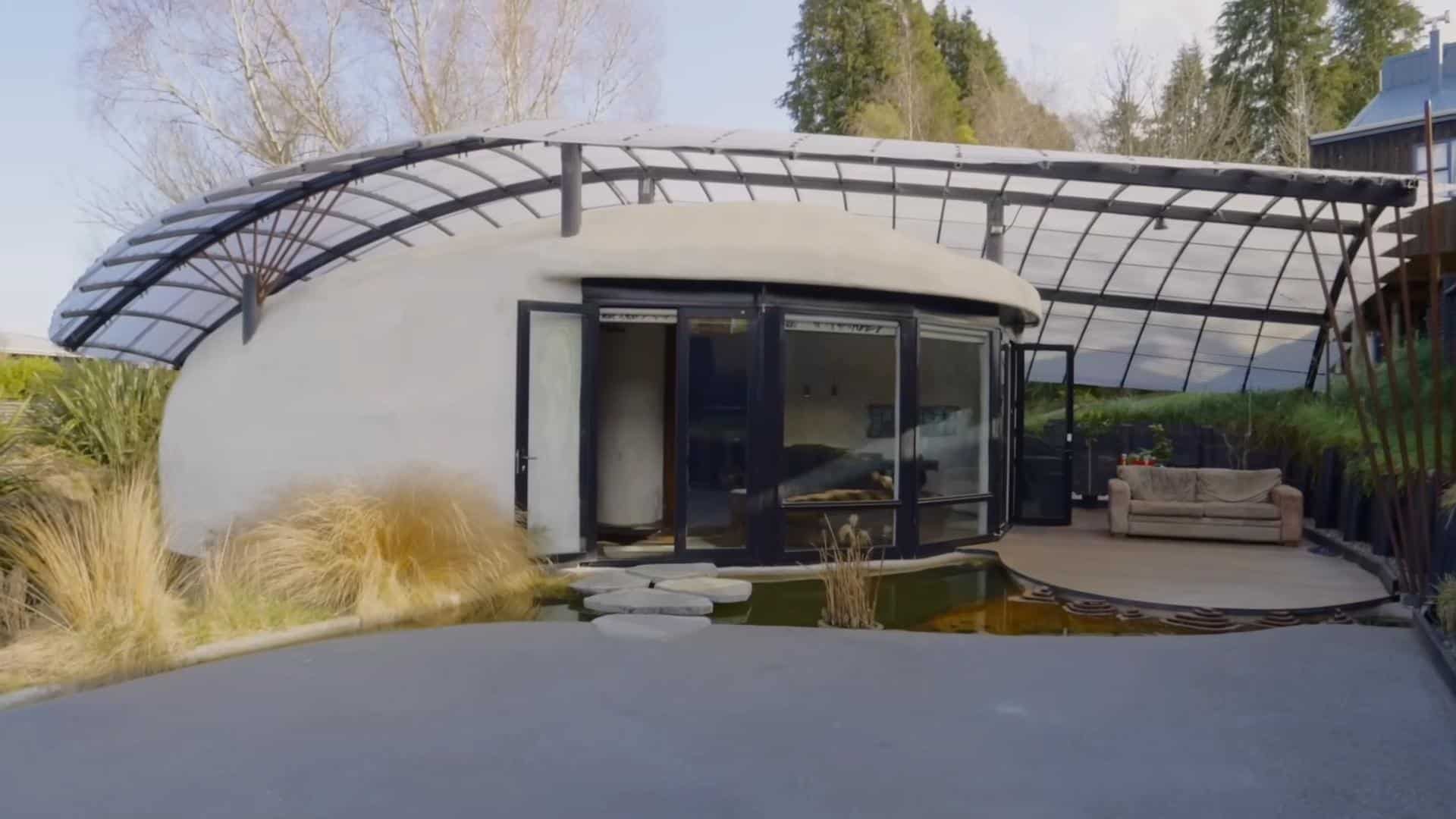
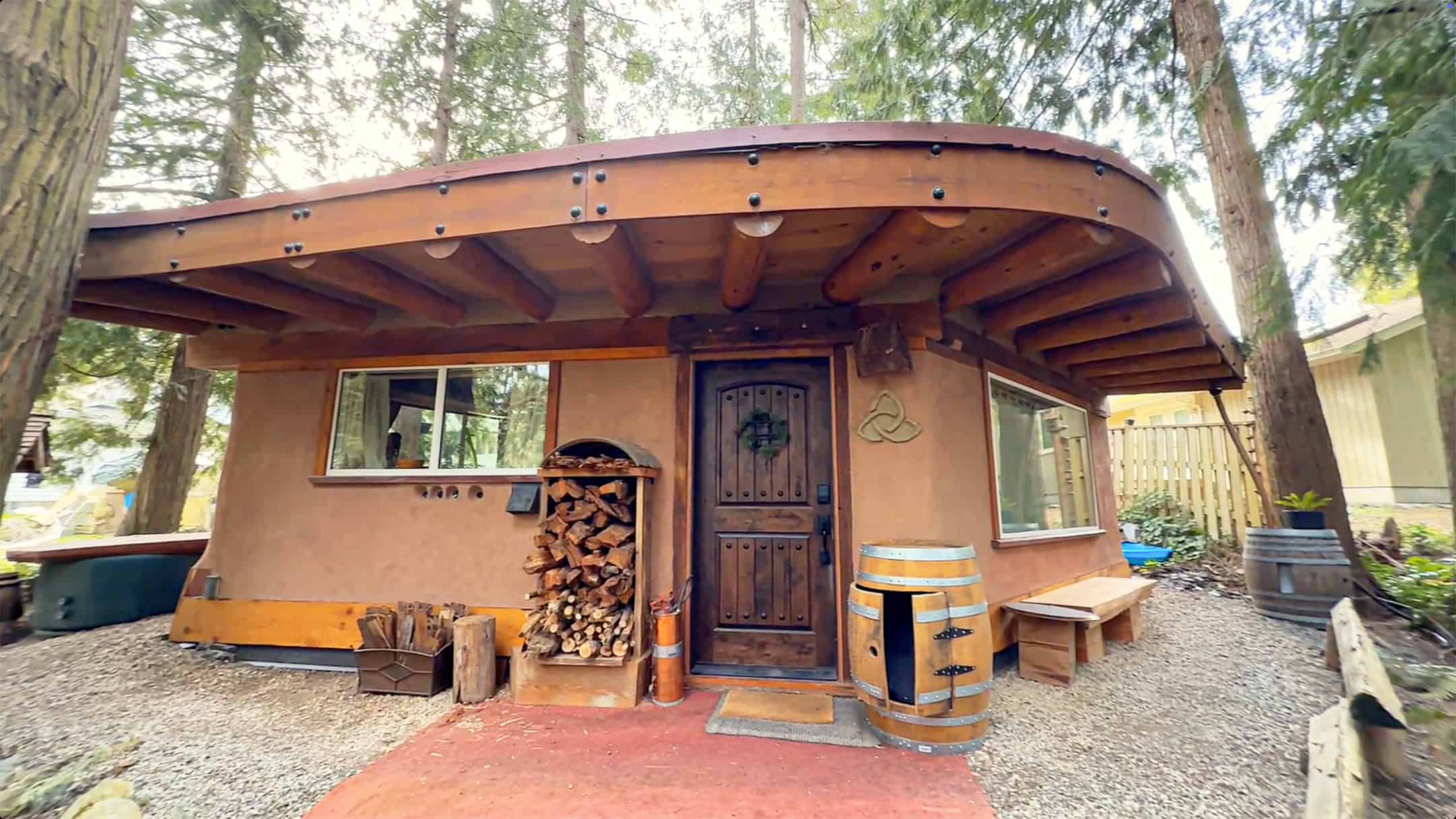
Adobe construction is nothing new — some of the oldest standing structures on Earth are built from it. What Terran has done is take this ancient, proven material and pair it with modern robotics to make it scalable. The raw earth is sifted, mixed with straw as a binder, and placed immediately on site. The resulting walls are monolithic, meaning they are single continuous masses rather than assembled from individual blocks or bricks.
These walls are built to IRC Appendix U — Cob Construction (Monolithic Adobe), making them fully code-compliant. They replace framing, insulation, siding, and drywall all in one system. The thermal mass of thick adobe walls keeps interiors cool in summer heat and warm in winter without relying heavily on HVAC. The homes are also naturally soundproof, fireproof, and mold-resistant — qualities that are difficult and expensive to achieve with conventional stick-frame construction.

Image courtesy of Terran Robotics
Zero-Mile Materials and 80% Less Carbon
One of the most compelling aspects of Terran’s approach is what they call “zero-mile” sourcing. The clay and soil come directly from the building site itself — often from the same excavation that creates the foundation. There are no delivery trucks hauling concrete or lumber from hundreds of miles away. The primary ingredient is, quite literally, free.
This translates to a dramatic reduction in embodied carbon. According to Terran, their homes produce 80% less embodied carbon than conventional construction. For anyone interested in sustainable building, this is a significant number. And because the walls are zero-VOC (volatile organic compounds), indoor air quality is naturally healthier than in homes built with synthetic insulation and chemically treated lumber.

Image courtesy of Inside Indiana Business
From Proto-Town to Pocket Neighborhoods
Terran’s first completed home stands at Proto-Town, located at 2600 Mineral Springs Road in Luling, Texas. But the company is already thinking much bigger. In Bloomington, Indiana, where the company is headquartered, they are building accessory dwelling units (ADUs) on existing residential properties. In Columbus, Indiana, they are partnering with Chestnut Development to create “pocket neighborhoods” — clusters of multiple homes on plots that traditionally hold a single-family house.
The company’s founding designer, Jacob Bower-Bir, sees density as central to solving the housing crisis: “If we’re gonna solve this housing crisis, density is a big, big key.” The long-term vision is multifamily residential developments built entirely from local earth, produced at a speed and cost that traditional construction simply cannot match.

Image courtesy of Terran Robotics

Image courtesy of Inside Indiana Business
The Finished Product
Once the robot finishes the walls, conventional tradespeople handle electrical, plumbing, and HVAC installation using familiar top-plate systems. The result is a home that looks and functions like any modern residence on the inside, but with walls that are quieter, more energy-efficient, and built from materials that will outlast most conventional homes by centuries.
Terran has received grant funding from the National Science Foundation, Elevate Ventures, and the Flywheel Fund, and has partnered with Autodesk and ARUP (the engineering firm behind the Sydney Opera House) to refine their technology further.

Image courtesy of Terran Robotics
Watch the KXAN Report
KXAN visited the Proto-Town site in Texas to see the robot in action. The full video report shows the Terry system picking, placing, and hammering adobe into walls in real time.
Design Details
- Builder: Terran Robotics (HQ: Bloomington, IN; Build site: Luling/Lockhart, TX)
- Construction method: AI-powered cable-driven robot (“Terry”) with autonomous pick-place-hammer system
- Materials: Monolithic adobe — approximately 20% clay, soil, water, and straw, sourced on-site
- Code compliance: IRC Appendix U — Cob Construction (Monolithic Adobe)
- Structural steel: Zero required
- Embodied carbon: 80% less than conventional construction
- Wall properties: Fireproof, mold-free, soundproof, zero-VOC, high thermal mass
- Setup: Two people, one day, with a truck and trailer
- Robot operation: Autonomous 24/7 with reinforcement learning and computer vision
- First completed home: April 27, 2026, at Proto-Town near Lockhart, TX
- Planned production: 20+ units over the next year
What Makes This Approach Special
- Zero-mile materials — clay and soil come from the building site itself, eliminating transportation costs and emissions
- AI that learns — unlike pre-programmed robots, Terry adapts in real time using cameras and machine learning, improving with every build
- Ancient material, modern code — adobe has been proven over millennia, and Terran’s walls meet current IRC building codes
- Walls replace four systems — a single monolithic adobe wall replaces framing, insulation, siding, and drywall
- Fireproof and mold-free by nature — no chemical treatments or fire-resistant coatings needed
- Scalable density — the same technology works for ADUs, pocket neighborhoods, and multi-story residential developments
- Backed by serious partners — NSF grants, Autodesk, and ARUP engineering support validate the technology
Learn More
- Website: terranrobotics.ai
- How it works: Terraforming process page
- KXAN report: Robots are building clay homes in Central Texas
- Inside Indiana Business: How Terran Robotics plans to use AI and clay to fight the housing crisis
- LinkedIn: Terran Robotics on LinkedIn
Highlights
- AI-powered cable robot builds adobe homes autonomously using clay pulled directly from the building site
- First home completed April 2026 at Proto-Town near Lockhart, Texas, with 20+ more planned
- 80% less embodied carbon than conventional construction; zero structural steel required
- Walls are fireproof, mold-free, soundproof, and code-compliant under IRC Appendix U
- Robot runs 24/7, learns and improves with every placement through reinforcement learning
- Two-person setup in one day — can cover a space as large as a football field
- Backed by NSF, Autodesk, and ARUP; expanding to ADUs and pocket neighborhoods in Indiana
Explore More
Subscribe to our Newsletters:
Join the Tiny House Newsletter
=> tinyhousetalk.com/tinyhousenewsletter
Join The Small House Newsletter
=> tinyhousetalk.com/small-house-newsletter
Join Our Tiny Houses For Sale Newsletter
=> tinyhousetalk.com/tiny-houses-for-sale-newsletter
Disclosure: This post may contain affiliate links. If you purchase through one of our links, we may earn a commission at no additional cost to you.


Alex
Latest posts by Alex (see all)
- The Atlas by Zook Cabins: A 233 Sq. Ft. Park Model With a Bed That Rolls Onto the Deck - October 22, 2026
- Red Oak Fire Lookout: An 80-Foot Steel Tower With a 14×14 Cab - October 22, 2026
- White Oak Treehouse: Built Into a 210-Year-Old Oak - October 22, 2026