
Disclosure: This post may contain affiliate links. If you purchase through one of our links, we may earn a commission at no additional cost to you.
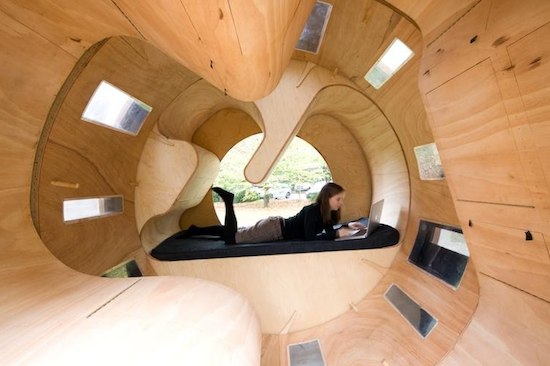
The Roll It house challenges conventional thinking about tiny home design. Created as an experimental dwelling concept, this cylindrical structure transforms its interior simply by rotating—turning a workspace into a bedroom or a kitchen into a bathroom with a gentle push.
How the Rotating Design Works
Unlike traditional tiny houses where furniture folds or slides, Roll It takes a fundamentally different approach. The entire cylindrical interior rotates 180 degrees, revealing completely different functional zones on opposite sides of the drum.
The transformation mechanism includes:
- Desk to bed conversion: Rotate the cylinder and a work surface becomes a sleeping area
- Velcro-secured mattress: Bedding stays in place during rotation
- Hidden storage: Pillows, blankets, clothing, and linens stored underneath the sleeping surface
- Kitchen to bathroom: The utility zone rotates between cooking and bathing functions

Practical Design Solutions
The designers addressed the obvious concern: the toilet cannot rotate upside down. Fixed plumbing elements remain stationary while the living surfaces rotate around them.
The interior includes:
- Kitchenette with stove
- Bathroom with sink and toilet
- Work desk area
- Sleeping quarters


Origins and Design Philosophy
Roll It emerged from the University of Karlsruhe in Germany (now Karlsruhe Institute of Technology). Students Christian Zwick and Konstantin Jerabek developed the concept while exploring efficient and mobile dwelling solutions.
Their design philosophy centered on a key question: What if the space itself could change, rather than the furniture within it?
Lessons for Tiny House Design
While Roll It remains a concept prototype rather than a production dwelling, it offers valuable insights for anyone designing compact living spaces:
- Rethink transformation: Moving the entire space can be simpler than complex folding furniture
- Single rooms, multiple functions: The same square footage serves different purposes at different times
- Fixed vs. rotating elements: Some systems (plumbing) stay put while others transform
- Storage integration: Hidden compartments make transformation seamless
- User-powered systems: No motors or electronics needed—just push
Roll It demonstrates that innovative tiny house design isn’t limited to traditional rectangular forms. What unconventional shapes or mechanisms might work for your ideal small space?
Photo Credits: University of Karlsruhe
Disclosure: This post may contain affiliate links. If you purchase through one of our links, we may earn a commission at no additional cost to you.


Alex
Latest posts by Alex (see all)
- Studio Home Laurel: A One-Bedroom Backyard ADU in Four Architectural Styles - October 10, 2026
- A 6’5″ Man’s DIY Tiny House on Wheels, Permitted in Calgary - October 10, 2026
- A Long House: A Designer’s 603 Sq Ft Seoul Apartment Opened Up Around Morning Rituals - October 10, 2026









SEND ME MORE INFO
Fun but I’ll bet people couldn’t wait to move out of it.
I know! Lets call it the HAMSTER WHEEL HOUSE!