
I recently asked my own Facebook community for some inspiration about topics for the various blogs I write.
One question that intrigued me was this one:
“I’d be curious to know where folks think “tiny” ends and “small” begins. I dream of downsizing to a smaller space, but I don’t think I could live in a tiny house for an extended period.”
This is an interesting question so I thought I might look into it a little more.
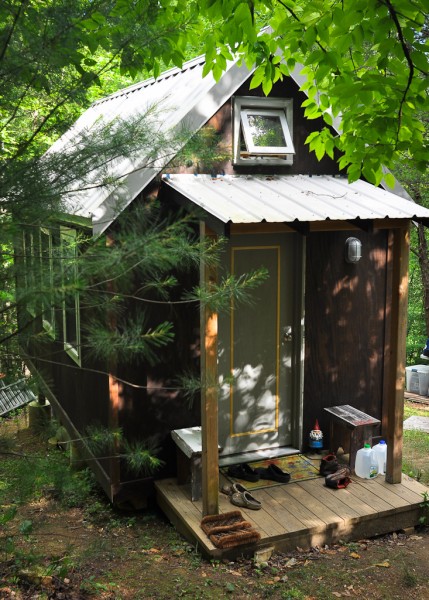
Photo by J. Andrew Flenniken
Read below for more thoughts on small versus tiny.
“Tiny” and “Small” are pretty arbitrary concepts. What one person considers tiny others might think is small. For instance, Matt and I live in a house that is 120 square feet which we find delightful but other tiny house couples prefer a house that is over 200 square feet which strikes me as being on the big side, even though I know better. Here is an additional bit of trivia for you – Matt and I have not been staying at our tiny house for the winter. We’ve found ourselves in a 1940s bungalow on the north edge of Asheville proper. The small house is 700 square feet. I know several people who find that way too small to be livable but for us as a conventional house goes it is just about perfect. As a small aside, there were many factors that went into the decision to live in the city for the winter, but I am aching to get back to the tiny house.
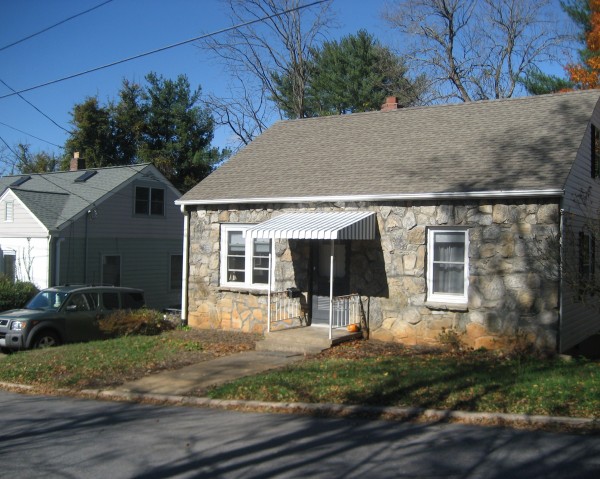
Photo by Laura M. LaVoie
So what is Tiny and what is Small?
At its inception the Tumbleweed Tiny House Company, with Jay Shafer still at the helm, offered two “types” of tiny house plans. On the website today they are listed as “House to Go”™ and Cottages. The largest “house to go” is 172 square feet. The smallest of the cottages is 261 and they up as large as 884.
When we were looking for a place to live in the city for the winter we were pretty flexible. We looked at one small basement apartment that was about 250 square feet. We looked at a 1000 square foot apartment which seemed expansive to us but had everything we needed and then some. Finally we found this little house that was absolutely perfect for our lifestyle. At 700 square feet I consider it firmly in the small house category.
As I mentioned, the assignment of these categories are somewhat arbitrary and I think there are several factors in place. Most people think of the 100+ square foot houses on trailers when they think “tiny house.” While this is the case the majority of the time it is not always true, especially considering our own 120 square foot house is on a foundation. However, a “small house” can be typically between 300 and 900 square feet and are probably not movable. A small home in that range can be anything from a cabin in the woods to a turn of the century bungalow or apartment in the city. They don’t have to be DIY like many tiny houses.

Photo by Laura M. LaVoie
If you are thinking about downsizing your life but can’t quite imagine living in something less than 200 square feet I think there are still plenty of options for smaller living. You can build a small house, like one of the Tumbleweed cabin designs, or find a gem of a home in your local real-estate market. Remember, if you’re looking for small you might be able to get a great deal because many conventional home buyers are passing up small houses for something with more space.
What do you think about the differences between Tiny and Small houses? How small could you go?
This post may contain affiliate links and/or sponsored content.


Laura LaVoie
Latest posts by Laura LaVoie (see all)
- Top 5 Things to do on a Rainy Day in Your Tiny House - October 20, 2013
- Top 5 Reasons I Love My Tiny House in the Fall - September 24, 2013
- 3 Tips You Should Know Before Building From a Tiny House Builder - September 18, 2013

I think in terms of my family. We are a family of three so I think anything below 400 sq ft is tiny and below 800 sq ft is small. I came about these measures by way of vacations. We stayed in a 430 sq ft hotel room and we managed ok but I was sure if it had been smaller we would have not fared well. we live in a 700 sq ft apartment and it seems spacious for us.
I do believe the definitions for a tiny and small house are very personal. Some people learn to live in smaller places than others. Some people are unwilling to live with less. You have to know and work with those involved to get to the mid-ground.
So I’ve been thinking about your comment since it was posted. And while I do believe that tiny and small are arbitrary definitions I came to the conclusion for myself that the number of people in the house doesn’t change the category. Just because four people are in a 400 square foot house doesn’t mean it is a tiny house.
I respectfully disagree but am fine with your own assessment.
My opinion is just that; my opinion. Before I had my own family and home I thought that anything less than 1000 sq ft was small. I moved out after college into an apartment that was 150 sq ft and I thought it was fine because the whole space was mine. When I started tending to my own home and had a family my ideals changed considerably. This is why I said my comment was based on my family of three.
Our experiences change how we see things and we all have different points of view.
Are you looking for a firm “legal” definition of “tiny” and “small”? Everyone is going to think differently.
What you personally call tiny depends on how many people live in it. For my family (5 kids) 1000 square feet was tiny. LOL Seems like tiny is easily moved, and small is not. If you have it on a foundation, you can still call it tiny. It’s all good. 🙂
I have spent the last 6 1/2 years living in a wonderful 12′ X 16′ cabin with a half loft in the Yukon Territory of Canada. This past September I moved into town (Whitehorse), sharing a condo with a friend. I discovered that I really missed the personal space of my little cabin on a lake, and that I had created a place for everything in my little 288 sq. ft. domain. And I had such a pride place, that almost every weekend, that little cabin had dinner guests, or was the location for great parties, whether it was +70 F in summer, or -30 F in winter.
6 weeks ago, my partner and I were presented with the opportunity to buy a 2/3s finished 1200 sq. ft. house that was built on the same property, and to also own the little cabin, so we’ll be back on the lake by June 1. It will be interesting to see how big or small 1200 sq. ft. feels for two, compared to the 288 sq. ft. cabin for one. I guess, by the above article’s definition, our new house will be bigger than “small”, but I think it may be perfect and luxurious… big enough to feel very spacious after the 288 sq. ft. cabin, but small enough that we can afford to make it a little jewel in terms of building details. I can’t wait to get back to the lake! Cheers!
I think people will forever want to specifically sort and classify the square footage of homes into the various categories of “tininess”, but I don’t think its really possible, seeing as there are so many variables, and I’m not so certain there’s a true need to do so either. Its always an interesting debate though, and I think its just human nature to assign labels to things….and this is the No. 1 question journalists seem to ask….I’ll be curious to see what people have to say. ‘Hope you’re well Laura!
-Deek
My 13′ Boler trailer is too tiny, even with a partly covered deck. Partly it’s the tiny amount of open space left after the built-ins, partly the low ceiling, partly the amount of stuff you have to move or reconfigure for everyday living, partly the lack of space to pursue various hobbies. My 300 sq ft apartment in my son’s basement is luxuriously spacious, with 9 ft ceilings and well thought out storage. The only drawback is not having enough windows. Eventually I’ll move into a yet to be built 8×20 tiny house on wheels that will replace the Boler and that should be just about right for a single grandmother of 2 with a craft habit. The Boler will make a great guest house/art project.
I have considered anything above 400 sf to be small rather than tiny. But having lived in less than 800 sf all but 6 years of my life, I tend to consider houses under 600 sf small for one person and 800 for a small family. For me it’s very much a matter of perspective… and location. In my area, there are many houses for sale between 700-900 sf, so I consider them normal.
For me tiny vs small vs large is a variable concept and depends mainly on how many people and pets are occupying the space. And also on the layout of the house. Bad layout can make a big home feel tiny and awkward and good design can have the opposite effect.
Good article, Laura L. I like cutting tiny off at 400 sq ft & labeling small up to 1,000 sq ft. I prefer small, single story, & on-grid because of my disability.
I’ve lived in a duplex of 866 (livable) sq ft for 20+ yrs. With a properly designed floor plan, I could decrease to 576-600 sq ft. My dream master bedroom is 12′ x 12′, not counting the closet area.
To me, it depends on weather or not it could be on a trailer. So, if it’s no more than 8 feet wide, it’s tiny. If it’s no more than 400 Sq ft, I consider it small. A micro woukd be 64 Sq ft or less.
The 400 / 1000 concept fits my thoughts as well. A tiny house on wheel can be up to 12 wide by 32 feet long on a readily available trailer. You would have to be permitted to move it and it would not be a RV substitute but it would be an easily moveable home. So at 384 sq ft this is the upper end of a non foundation tiny homes. Looking at the 400 sq ft house 20 x 20 you would have a 10 x 10 kit a 10 x 10 bedroom a 10 x 12 living room a 6×8 bathroom and a 3×4 pantry/mechanical closet and a 3×4 clothes closet. Any additional bedroom needs for additional family members would require another 100 sq ft bedroom each. These additional bedroom needs would move you almost immediatly into the small house catagory. This next move would be in the 400+ to 1000 sq ft relm.
Definitions for house size are arbitrary and cultural. If you go to other countries they would think any house over a few hundred square feet is massively huge.
Americans used to have modest standards and a huose under 2000 sqft was consudered normal and around 1200-1500 was very common.
Then we hit the McMansion era and house sizes zoomed up as peoples income went u and everybody had to have one.
Now people are downsizing and choosing comfort and liveability over size and staying out of debt has become fashionable again.
IMO any house under 1200 sqft is considered small, under 400 sqft is a cabin or bungallow and under 200 sqft is tiny.
5 years ago my wife, twin 4 year old boys and I moved out of a 2000 sq.ft house I had built. We had been camping in Baja for 4 month and on our return moved into a 500 sq.ft cob house. The camping made the transition easier. After 2 years in the small cob, we moved up to a 800 sq.ft cob house with 2 bedrooms in the upstairs. The bath house was separate with shower, composting toilet and outdoor tub and was on its own grey water system. They key to successful living in a small space is storage. When I am designing a small space for a client, I take a trip to Ikea to get fresh ideas on storage. I am planning a new house for my family and 800 sq.ft. would be the maximum. The boy will be teenagers soon and will need more space. Friends ask about this and I tell them that they will be able to build their own tiny home by them.
Patrick
Lucky you… we don’t have IKEA in New Zealand, and recently received notification that they would NOT be opening a store in New Zealand. Which is a shame coz they have some pretty awesome stuff… |sigh|
I currently live in an under 900 square foot home with my family of four, with four dogs. I LOVE it. We have lived in it for 16 years. Since my kids are getting older, my husband and I are talking of selling in a few years and moving to where my parents are. We are still debating about a tiny house, or small cabin, but either way, I would like to downsize even farther. In my mind, there is no reason to build another house of 900 square feet when we will have fewer people in the house. I am yearning to create a house with better storage, and that is more intimate and has better flow (and will be easier to clean). In our current house, I never set foot in my son’s room. I am only in the bedroom, except to sleep. I want to capitalize on using the living space!
Definition of tiny is “very small”, so whatever you base small on, tiny is the lower subset of that. I believe the majority of media stories about tiny houses have been based on those built on trailers. That leads many to associate “tiny house” with trailer built models no more than 8.5′ wide and 13.5′ tall. It’s not an accurate way to separate the terms, but it’s what appears to be becoming the accepted slang.
The only reason I can think of to care about the difference if any, is for building, ownership, or maintenance purposes, ie: tiny houses on trailers do not have to comply with most codes. This may also support the idea of trailer built tiny houses having their own term, or being associated with the term “tiny house”, with small house referring to the rest.
I just think of things in terms of “small” in general. 🙂
We like living in under 500 sq ft. I don’t care whether it’s “tiny” or “small” to someone else, but we really love it.
We are a family of 3, but I feel confident that we could go up to 4 or 5. We’d just have to create loft/bunks for the kiddos in the bedroom (they’d have to share). And keep up with minimalism. 😉 Perhaps it’s more like functionalism. 🙂 Anyway. . . labels. . . fun game.
What about self-sufficiency and off-grid systems in Tiny homes, and the new challenges posed by the lack of storage and square footage/surface area? I bet that most tiny house people are at least interested in self-sufficiency or living off-the-grid, and I know that in my own tiny house project I’ve met with the limitations that 100 square feet can impose in terms of being energy/fuel independent. Rainwater collection, photovoltaic systems, etc. require surface area. Water, Off-grid battery banks and food preservation/storage takes up storage space not necessarily available in a “tiny” 100 sq. ft. house, but certainly available in a smart house that is 200 or 300 (or even 400) sq. ft….there’s no need to be “tinier than thou”, and maybe in the long run it’s smart to think about the needs of the future, when we are all producing (collecting and storing!) our own food, energy, fuel, and other resources. Just something to think about!
I live very happily in my tiny home of 100 square feet, but sometimes I wish I would collect more rainwater off of it and store more preserved food in it….
I had to smile at the comment “no need to be “tinier-than-thou”,” because I sometimes think that’s where I tend to head. I own nothing but my computer (a desktop, not a laptop), some very few clothes, and a canvas bag full of wonderful literature. I truly can live in something very tiny; right now, until I know where I’m going to be living long-term, I’m staying in a motel. The room is far too large for me at something around 300 s.f.; I’d really love to try living in a tiny (under 200 s.f.) house or apartment if the opportunity ever presents itself.
Holy cow Joyce! I think opportunity is knocking right now!!! That must be expensive living in a hotel. You could build your own little dream house with all the amazing resources available in the tiny house community right now. And it sounds like you would be content at the tinier end of tiny… which could be fairly inexpensive. Sounds like you’re in a great spot!
Uhm, motel… not hotel… ; )
Rather different in terms of accommodation and costs.
I’ve had some experience being a member of a non-hegemonic group, a class of people who fall outside of what is considered “normal.” I think we can all agree that those of us who love, live in, or aspire to the lifestyle of tiny homes can agree that we are oddballs, way outside of the mainstream….even if current trends might reveal a few more people being interested in living smaller.
There’s a lot of power to oddballs finding one another. We learn about ourselves, are relieved to find out that we are not alone, and form a strong collective sense of identity. We have more conviction and more pride, and become more articulate (even evangelical) about our beliefs.
That’s all great but then we start trying to define whatever it is that binds us together….and the categorizations starts. In this case, what I think of as tiny might be considered diabolically huge to another. Or my zeal might be labeled as reckless or judgmental by another. Factions begin, then before long splinter groups and subgroups of the splinters and on down the line. That process, whether it happens in groups of racial, sexual, ethnic, or other minorities, is what keeps the hegemony strong and in control.
While I like to ponder for myself where that line exists for my family between tiny and small, I’m not so sure having the conversation publicly helps. It just starts a process of codification and infighting.
Having said all of this, I find myself really grateful that the discourse among tiny house folks has been pretty civil (including right here on this thread) and at the same time nervous that at some point the finger pointing and “tinier than thou” attitudes will do us in. I sooooooooo hope that doesn’t happen.
I have seen some ‘tiny homes’ that have less square feet than other home,yet these smaller homes have a much ‘bigger’ look and feel to them because they make better use of the available space. One great example is at the Ikea Store in our city where they have taken 592sq ft. and created a VERY spacious 2 bedroom home. It looks and feels at least 200 ft bigger because they made great use of the space available. Ikea is the first place I got a ‘taste’ of how big a small space can really be and I have also seen that time and time again throughout this site. Just like beauty is in the eye of the beholder, so is size :o)
I like this definition. I also like Sarah Susanka’s description of “The Not So Big House”. It really clicks with me and her concept of the well laid out and well thought out space (of whatever size) is a touchstone and guiding principle for me.
In a more primitive economy in the USA 1790 Massachusetts,the most common sizes were 1000 sq ft and 600 sq ft.
The 1000 sq ft size was true in the US until the 1960/s.
I frankly think houses at 200 sq ft are not practical.Except for a few people.Maybe for a summer cabin?
Lofts are useless to older people.
As soon as you admit that,you can get on to something less bizarre and more rational.You have a point.Smaller size is a good goal.Not that small.
Thanks Walt. I agree, ~200 sq. ft. not for many but definitely many of us that would enjoy it.
Truly agree Walt! Even most middle agers prefer steps up to the bedroom and preferably to stand up in said bedroom. I have done both, living the last 28 years of the small life. Small, tiny, or micro is not the issue. To each their own but the fussing and puffery about size amazes me within our oddball (agree with Denis!) tiny living community ;(
Can’t we all just get along???? Who cares about defining the words we use to describe specific sizes?
What is tiny, small, medium, big or huge seems to be a matter of perception. What I live in is “small” compared to the rest of this country, but would be huge to many posting here. Obviously, size is partly a matter of usability of the space and sight lines, etc. and not just square footage. Everyone has to be honest about needs for “psychological” space, especially if living with someone else. My husband and I have needed (and that is need, not want) separate spaces, so essentially have 2 “small” homes in one. Which then makes it “whatever” size. If we had been in 1 space, there would only be one person left standing. And then 4 big dogs and 4 cats….. Another very important point, tho, as some have mentioned, is that life and “needs” change over time. For some, having kids means more space. And the one area that will always make a “tiny” home an impossibility for some, is having certain kinds of disability. And to go one step further, what happens if there is a serious illness, with need for equipment or others helping in the home. Has anyone been “in hospice” in a tiny home? Or a small home? Currently, our “not so big house” is way too small since my husband got ALS and needs tons of equipment to maintain a modicum of quality and also has hospice/home health involved. There are a lot of other people here and all the “stuff”, takes up a ridiculous amount of room. This kind of situation can happen to anybody, at any age. And altho I love the idea of tiny and really small spaces (if I were living by myself) and figuring out how to get the most out of less, there was always the concern of what if…… How do others here feel or think about what would happen to you if….. Or does anyone make contingency plans, at least in their head? Or what about finances if a change had to happen? I really am curious to know how this very real possibility of “disability”, temporary or permanent/severe illness issue is approached.
Very valid and great points Susan. I agree with you and wish you and your husband the best. Thanks, Alex
Many uniform building codes require a minimum square footage of 1,000 and have for decades. So, I will accept that as the arbitrary lower boundary of a “normal” house. I also agree with what many others have said here and based on the various examples of tiny homes on this blog that 400 square feet seems about the upper limit for a tiny house. Obviously, these delimiters can never be absolute, but then neither are the boundaries between architectural styles (is it a ranch, a cape cod, or a bungalow?).
In any case, as much as I love the do-it-yourself, low-cost, code-free, live-anywhere zeal of the tiny house movement, I think there is far more potential demand (and need) at present for well-designed, energy efficient small houses. A proliferation of the latter could really help reduce our carbon/land footprint as a country.
I live alone, and at 66, would love to downsize to a smaller space. Living in Boston, there is no such thing as a tiny house, and I guess that’s because of zoning laws. Being a senior citizen, I would love to see small or tiny house communities for people over 55 near or in an urban setting. It would be great foe someone to create such communities where you could choose to own or rent. Just a thought.
If it was just me…. One room would be fine, or a loft with a stairway. Indoor bath, minimal kitchen. I’ve seen several that I’ve oohed and aaahed over. I like the idea of easily movable, however… I don’t climb ladders any more. I think I could make do with a single room with maybe a Murphy bed or a daybed. Or, like you, living in a Regular House part of the time. If I couldn’t be outside, I think it would have to be bigger. Still thinking. Meantime, I am simplifying my current situation. https://tinyhousetalk.com/power-of-simple-living/ says a lot. 🙂
I moved from 2800 square feet to a 20’x30′ house. It was a garage many yrs. ago. Each of my spaces are 10×10′. I find I collect more things then I need so next Spring I plan to start my 8’x24′ project except I will use a hideway bed under the sofa area. I also agree with a small garage attached would help for the wood and snow shovels. Also with setting up the garden supplies .
I currently live in. 2200 sq. ft. house where we raised 3 of our own children and fostered 27 children (not all at the same time, of course). Our youngest biological son is turning 18 soon and our last foster child moved out last week. Our season of change is coming and I am very excited about it. I don’t need this huge house anymore to raise 4-6 children! That season of my life, while very fulfilling, is now coming to and end.
Our dream has been to downsize to a small home. We are currently debating what does “small” mean to each of us. To my husband, 1000 sq. ft. is small enough. I think we could live in 500-600 sq. ft. My husband also insists on a garage, so we are thinking of building a 2 car garage and living over it. Thank you for this blog! Even if we do not go truly tiny, I am documenting all the space saving ideas to be used in our small house.
Wonderful! 🙂 Thanks Celeste
How about “teeny tiny”? Or “little”? Scroll down to bottom at this page for definitions. 😉
http://www.apartmenttherapy.com/contest-info-faq-the-10th-annual-small-cool-contest-2014-203533
My husband and I have been married for 44 years and have generally had homes 1500 sf or above. Our last home was 1800 sf. Upon retiring from his current job we decided to downsize. So we went from 1800 sf to 1300 sf and are now looking to build a 732 sf home. Over time we have been getting rid of things we have hung on to but haven’t been using, a great sigh of relief. Also we went from a 3/2/2/ situation to hopefully building a 1/1/2 soon. I think for us tiny or small is relative. We had actually considered a tiny home on wheels but due to some health issues with my husband we need to be on a foundation that is big enough to meet some specific health needs plus we need 2 cars and living in a tornado/hail storm belt we also needed a 2 car garage. The great thing is that those terms “tiny” and “small” can be seen in many different situations depending on what the individual needs are. We do not feel the 732 sf is small and has all we need plus room for our 3.5# female chihuahua, LOL. Some have questioned this future build since we are becoming great grandparents the first of 2015 and feel we might regret not having room for everyone when they visit. We feel that the space we will have can accommodate a family at a time. That is what sleeper sofas are for! This house is small compared to homes in our past and not tiny as we see it. The other homes we have had are over kill for us and we are choosing to simplify our lives. We wish we had done this decades ago but life happens and you just go on with it. So for me I guess it boils down to the lifestyle you choose or the lifestyle that chooses you as far as tiny and small go. I would love to give a definite size for tiny and one for small but that is just not something I can do. Because this world is made up of individuals then these terms are only for the individuals interpretation on how they need to be used. Thanks for all the insight as this helps me and my husband continue to nail down our decision to go “small”
What I have noticed while houses are small, most include wide open spaces outside. Privacy is a factor but so is “mental” space. People are social by nature but they also require time away from others, even ones relatives. (sometimes especially ones relatives including children and spouses.) Disability is another factor. I live in a small one bedroom that would be spacious under normal circumstances. Trying to navigate it in a wheelchair is difficult at best. Trying to cook or use the bathroom is next to impossible. At one time three adults lived here now it is difficult for one. There is no one-size-fits-all. You have to figure out what you need and make room for flexibility and tomorrow.
I first saw my 675 sq ft house while driving in an area I hadn’t been before. I literally slammed on the brakes and knew it was the house for me. I’ve always enjoyed a touch of whimsy in my life, and here was a perfect little 1920’s shotgun house. I felt it in my bones. Two years later, I am firmly settled into this beautiful work in progress. Owned by the same family since 1941, it has beautiful old hardwood floors, a still functioning 1957 30 gallon water heater, and some very real touches of whimsy… A picture of the house from 1941 reveals the same mail box and house numbers attached to the house. I have added some tile and carpet in the front room, but there is so much more to do. Every single time I arrive home, I have to smile at my little house. It is still a work in progress, but I am so excited about keeping the history of the 1920’s house and the 1940/50’s added kitchen going.
Some houses are small in size, but have HUGE personalities! I wouldn’t want to be anywhere else. 🙂
That’s awesome! Thanks for sharing Nancy 🙂
Why don’t you winter in the house? I’m just curious. I think “Tiny” is a concept, or state of mind, living in your means, not being excessive? My house is 1082 sqft, but to me it’s tiny at times. I long for just one more room to hide in, especially on dreary wet days. We are a family of 3 and for us, this is as small as we want to get. But we chose to go this small when we could have gone bigger in suburbia. We chose to go small and have more land to homestead. So we did live deliberate in this case. Even Thoreau said he doesn’t want people to live as he does, but to find their own way in life, not the way some one else has chosen for them. I do love these tiny homes, and hope to build my own one day. But in a way I’m recycling, rehabbing and greening up this 1940’s farm house. I feel free out here, free from the cares and hang ups of “modern” civilization.
I think tiny should be 400sq feet or under while over that is a small house.