
Disclosure: This post may contain affiliate links. If you purchase through one of our links, we may earn a commission at no additional cost to you.
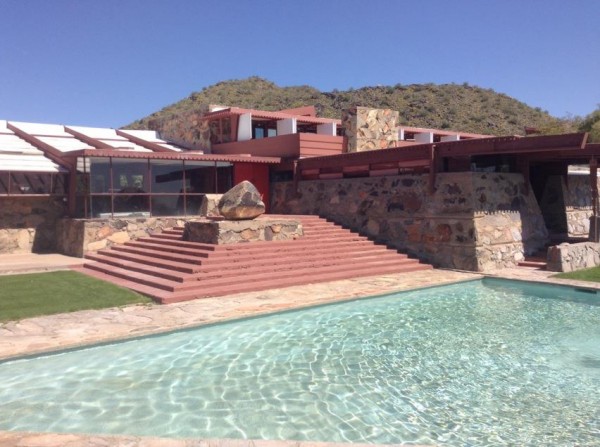
I just got home from a week long South Western vacation. The entire week was topped off by a visit to Frank Lloyd Wright’s winter home, Taliesin West.
I started studying Frank Lloyd Wright in college. It was something that Matt and I had in common before we started dating a billion years ago. While we were still both at school we would often travel to Frank Lloyd Wright buildings local to Kalamazoo, Michigan (there are quite a few, surprisingly). We’ve been all over the country to see his buildings: Wisconsin, Illinois, New York, Pennsylvania. Now I can add Arizona to my list.
Related: Students Design Build Unique Tiny Dorm Cabins at Frank Lloyd Wright Arch School
His buildings had a greater impact on me than I had even realized. Click below to read more.
It has been a while, though. The southeast, where I live, is sadly lacking in Wright creations and after we moved down here it was harder find them. The last one we went to see was the Guggenheim Museum in New York City on weekend in August 2005.
Returning to a Frank Lloyd Wright designed home last week reminded me what I fell in love with his work to begin with. FLW himself was a deeply flawed man and his hubris was well known. He referred to himself as the greatest architect in history; but was he wrong?
Sure, his two personal estates are expansive and palatial but there was more to him than that. In fact, when you tour Taliesin West it comes across as a series of smaller structures built together into the brow of the hill rather than one giant mansion.
Many of FLW’s ideas have permeated tiny house culture. The Usonia Homes, for instance, were imagined to be affordable and practical homes for the American middle class of the 20s and 30s. These small houses were only one story where the kitchen and living area were open to one another and the floor featured radiant heating. These are ideas that tiny house builders use frequently in their designs for sustainable small homes. However, what Wright considered “affordable” and what the general public were willing to spend on homes was a vastly different number. Not many of these homes were built.
How Frank Lloyd Wright Impacted Our Tiny House Design
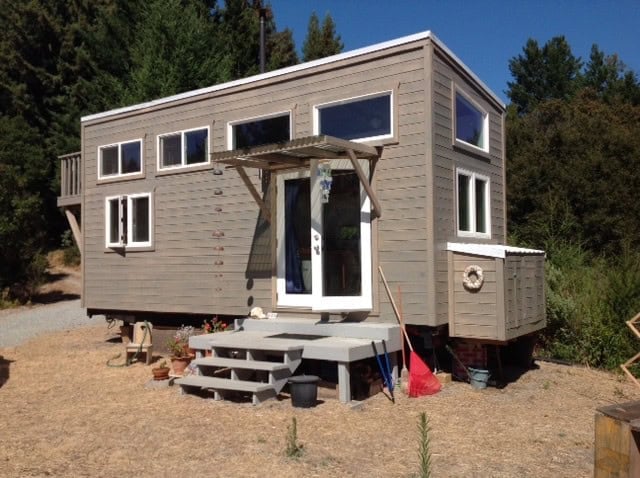
I didn’t realized how much the philosophy of Frank Lloyd Wright had become part of my own subconscious until we went to Taliesin West. Taliesin means “shining brow” in Welsh and Wright specifically built his two Taliesin estates into what he referred to as the brow of the hill. He blended them into the landscape rather than perching them on top of the hill. Without even thinking about it this is precisely what we did with our tiny house. We didn’t build it at the top of our ridge or at the road but rather placed perfectly in a clearing about halfway up. We choose a color palate that fit the Appalachian landscape. We angled the house to mimic the angle of the mountain range.

There are many great architects throughout history but I would argue that few made as much of an impact, both positive and negative, as Frank Lloyd Wright. His principles and ideas are still in practice today even when we don’t realize they were his designs. He was certainly an inspiration for my own project. Who was or is your tiny house inspiration?
Disclosure: This post may contain affiliate links. If you purchase through one of our links, we may earn a commission at no additional cost to you.


Laura LaVoie
Latest posts by Laura LaVoie (see all)
- Top 5 Things to do on a Rainy Day in Your Tiny House - October 20, 2013
- Top 5 Reasons I Love My Tiny House in the Fall - September 24, 2013
- 3 Tips You Should Know Before Building From a Tiny House Builder - September 18, 2013












Join the Conversation
8 comments