
Disclosure: This post may contain affiliate links. If you purchase through one of our links, we may earn a commission at no additional cost to you.
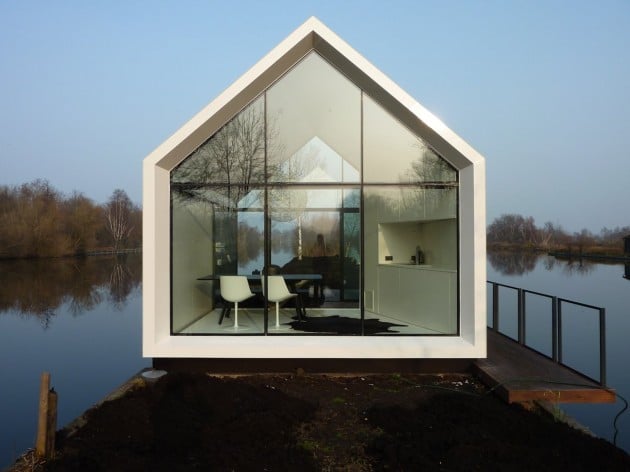
What happens when you place a house on an island barely wider than the building itself? You get one of the most striking examples of architecture that dissolves the boundary between indoors and out. Designed by 2by4-architects, this 215 sq ft glass cabin sits on a narrow island in Loosdrechtse Plas, a lake district southeast of Amsterdam in the Netherlands. It is a home that transforms from an enclosed shelter into an open-air pavilion with one bold gesture.
Images courtesy of 2by4-architects
The Setting: An Island Just 16 Feet Wide
The island measures roughly 5 meters (16 feet) wide by 100 meters (328 feet) long, a slender strip of land in the middle of a Dutch lake. The cabin is oriented along the east-west axis, which means the glass end walls frame both sunrise and sunset over the water. There is almost no separation between the house and its surroundings. Step off the wooden deck and you are at the water’s edge.
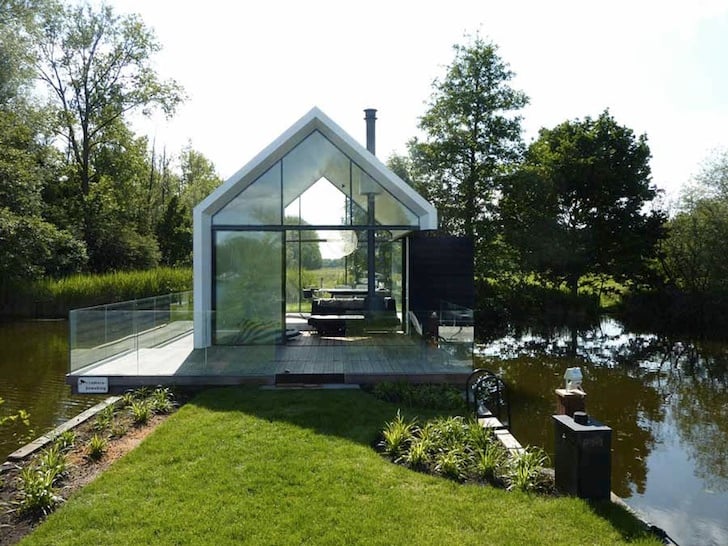
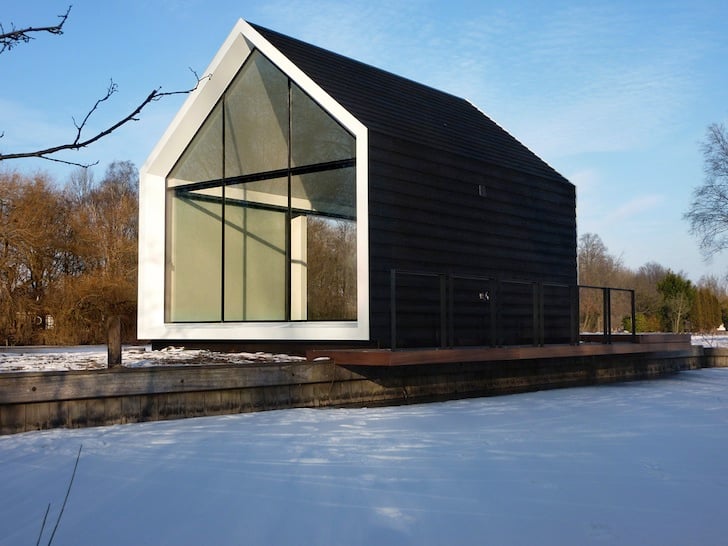
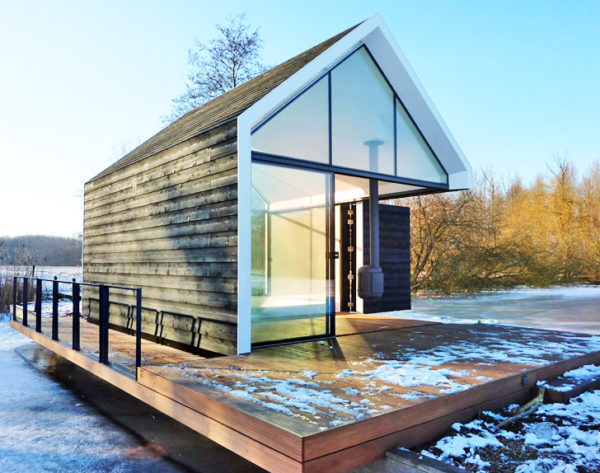
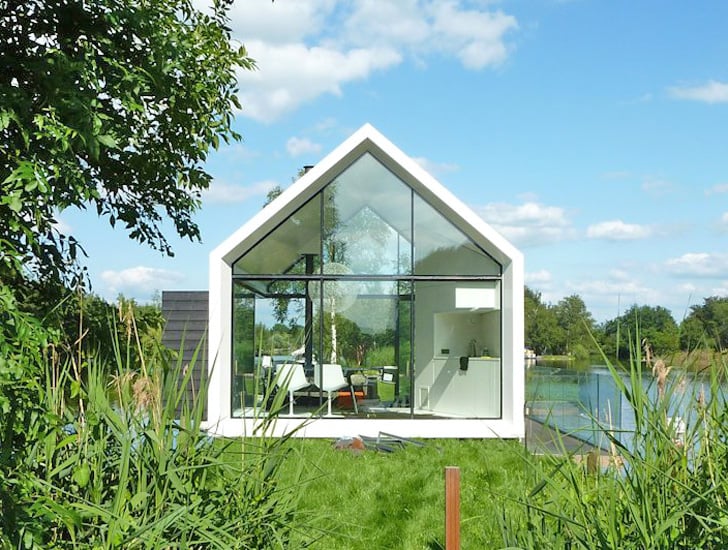
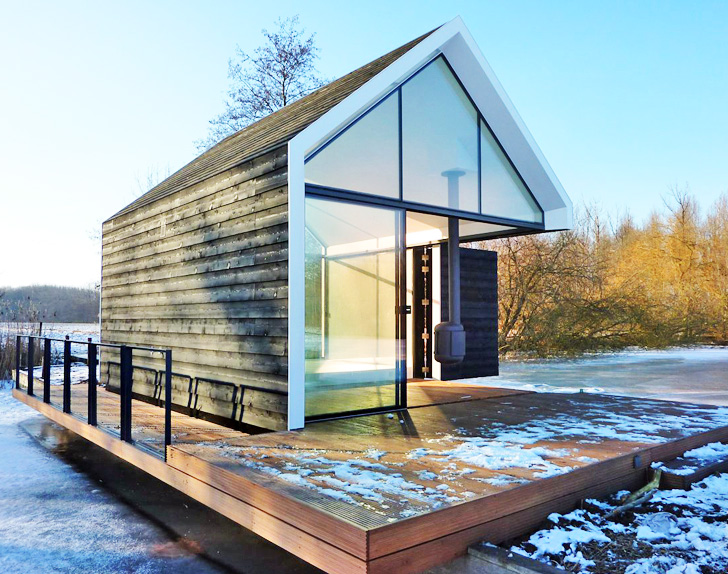
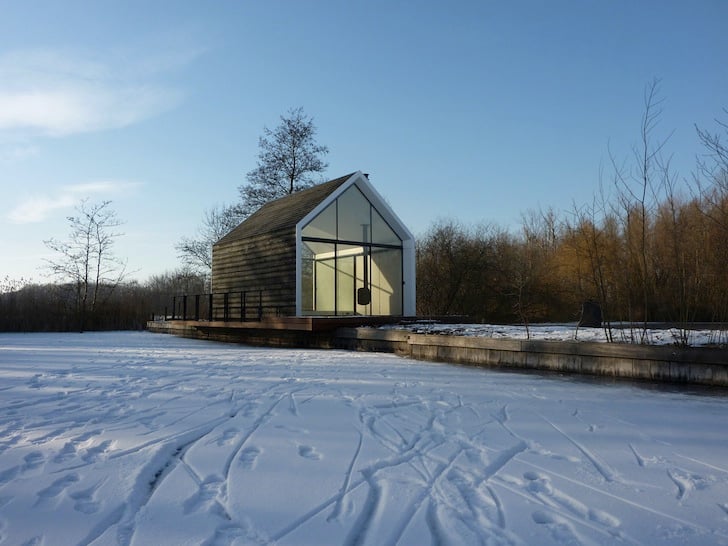
The cabin looks dramatically different depending on the season. In summer, the lush greenery nearly swallows it. In winter, it stands as a dark silhouette against snow and ice, its glass walls glowing with warmth from within.
Design and Features
The exterior is clad in blackened timber, giving the cabin a bold, monolithic presence from the sides. But from either end, it is almost entirely glass, floor to ceiling, creating a transparent tunnel through which you can see the lake on both sides.
The Folding Wall
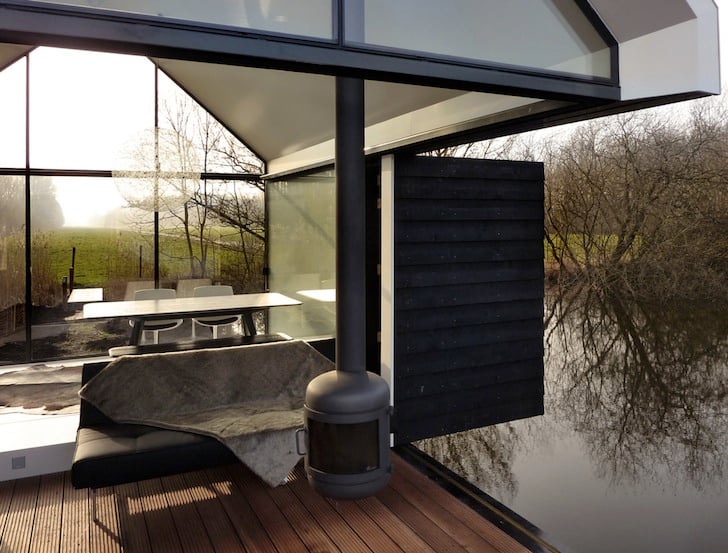
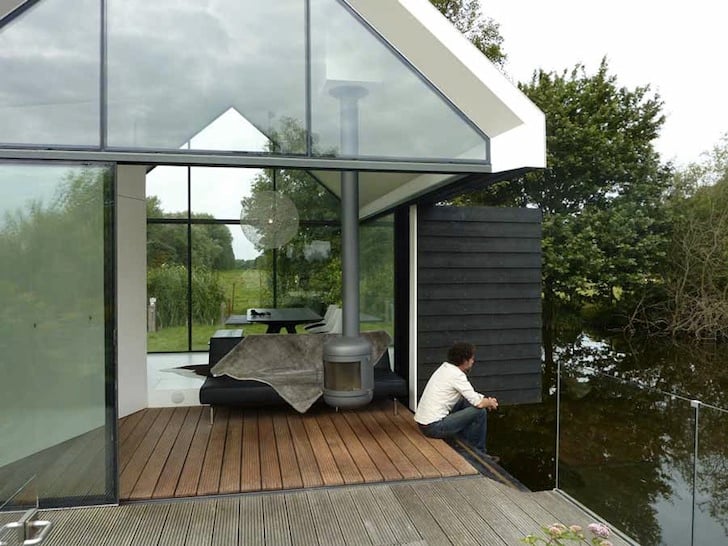
The signature feature is a large section of the dark wooden facade that folds outward, transforming one side of the cabin into a completely open-air pavilion. When the wall is down, the living space extends directly onto the terrace and the lake beyond. It is one of the most dramatic indoor-outdoor transitions you will find in any small home.
The Double Wall
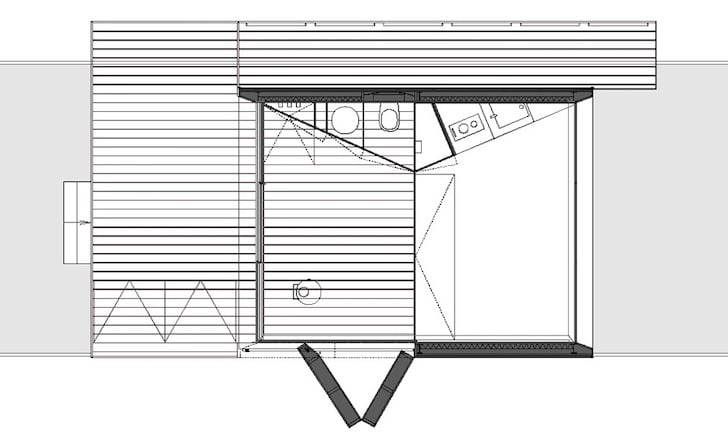
The architects solved the storage problem with a clever double wall that runs along one side of the interior. This thick wall integrates the kitchen, bathroom (shower and toilet), and all storage into a single compact element. Everything that is not living space is tucked away inside this wall, leaving the main room open and uncluttered.
Living in 215 Square Feet
Inside, the cabin is organized around a floor-level change. The main living area with a daybed sits at one level, while a raised wooden platform creates a dining area with views straight through the glass gable to the lake. A rotatable wood-burning stove serves as the visual anchor of the room, providing heat that can be directed toward the living area or the dining space.
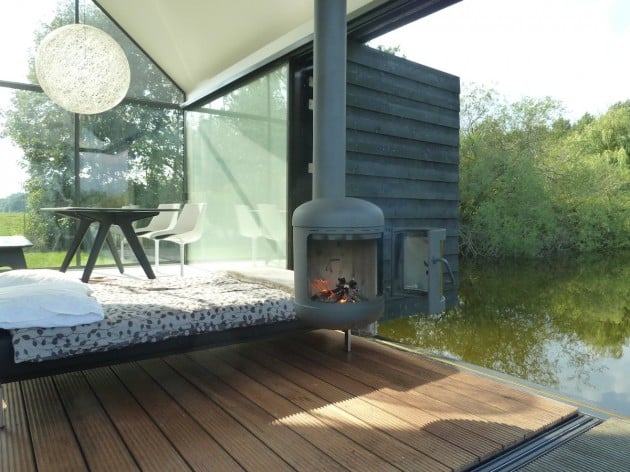
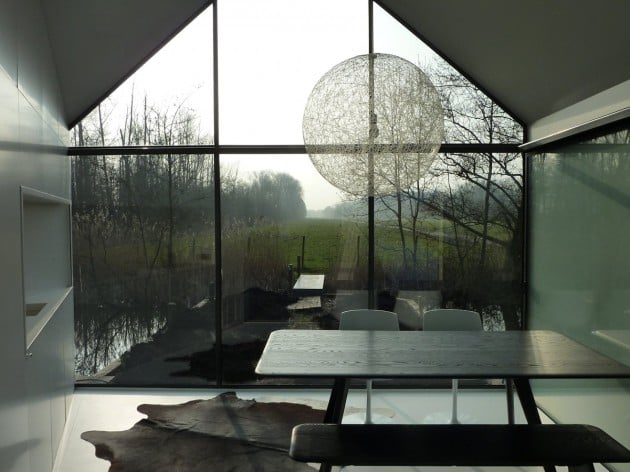
The raised dining platform also conceals hinged storage beneath its floor. The shower was designed so it can be used with the bathroom door open, visually borrowing space from the main room. Every square foot earns its place.
Prefab Versions
Following the success of this island cabin, 2by4-architects developed three prefab models based on the same design principles:
- Aida (226 sq ft) – The most compact option, closest in size to the original
- Tosca (419 sq ft) – A mid-size version with more room to spread out
- Nabucco (516 sq ft) – The largest model for those who want extra space
Note that the prefab versions do not include the signature folding wall from the original. That feature remains unique to this island cabin.

Highlights
- Size: 215 sq ft (20 sq m)
- Architect: 2by4-architects
- Location: Island in Loosdrechtse Plas, Netherlands
- Island dimensions: Approximately 16 ft wide by 328 ft long
- Exterior: Blackened timber cladding with floor-to-ceiling glass end walls
- Key feature: Folding facade wall that opens the cabin into an outdoor pavilion
- Interior: Double wall integrating kitchen, bathroom, and storage
- Heating: Rotatable wood-burning stove
- Layout: Split-level with raised dining platform and under-floor storage
- Prefab versions: Aida (226 sq ft), Tosca (419 sq ft), Nabucco (516 sq ft)
Would you live in a glass cabin on an island barely wider than your house? What feature stands out most to you – the folding wall, the glass end walls, or the clever double wall? Share your thoughts in the comments below.
Disclosure: This post may contain affiliate links. If you purchase through one of our links, we may earn a commission at no additional cost to you.


Alex
Latest posts by Alex (see all)
- Studio Home Laurel: A One-Bedroom Backyard ADU in Four Architectural Styles - October 10, 2026
- A 6’5″ Man’s DIY Tiny House on Wheels, Permitted in Calgary - October 10, 2026
- A Long House: A Designer’s 603 Sq Ft Seoul Apartment Opened Up Around Morning Rituals - October 10, 2026



This is the Design of those who have much to say in terms of Ideas
and genius. Praise to Merit Creative. I Like It
Maybe they’ll have much to say also on how freaking cold it is with all that glass and no coverings (aka curtains). Even that hanging fireplace isn’t going to compensate for “all” the heat loss.
Also, very sterile looking as well. Not for me, if I want that sterile look I’ll wait until they put me on a slab. Oh, but then I won’t know will I?
Less is so much more❗️?
This home is gorgeous! If built in the middle of nowhere it would offer the ultimate in serenity. For privacy I would make flowing linen drapes that could be pulled together.
What matters is the form in architecture combined with the technical executive you can not split the two things ( Art and Functionality).
Then on the way they resolve the various problems that arise….
But what is appreciated is always the visual impact
Perhaps in this ” space age”, you accept a flying fireplace.
Stunning!
He who lives in a glass house should never throw stones…! But it is a very interesting glass house…!
Well…it’s a lovely design [possibly practical for a potting shed on a large lot with home. Conveniently located over that stagnant water–
you would be eaten alive by hoards of insects [and frequently visited
by rats & snakes].
This is a lovely design especially for the view, but where is the bedroom?
I need way more privacy than this affords.